Metropolis Blu-ray Movie
HomeMetropolis Blu-ray Movie 
Giorgio Moroder Presents MetropolisKino Lorber | 1984 | 82 min | Not rated | Nov 15, 2011
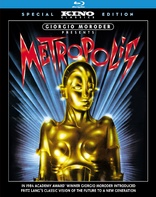
Price
List price:Listed on Amazon marketplace

Movie rating
7.5 | / 10 |
Blu-ray rating
| Users |  | 3.0 |
| Reviewer |  | 3.5 |
| Overall | | 3.5 |
Overview
Metropolis (1984)
Starring: Gustav Fröhlich, Brigitte Helm, Alfred Abel, Rudolf Klein-Rogge, Fritz RaspDirector: Fritz Lang
| Drama | Uncertain |
| Music | Uncertain |
| Sci-Fi | Uncertain |
Specifications
Video
Video codec: MPEG-4 AVC
Video resolution: 1080p
Aspect ratio: 1.34:1
Original aspect ratio: 1.33:1
Audio
Music: DTS-HD Master Audio 5.1
Music: LPCM 2.0
silent film
Subtitles
None
Discs
50GB Blu-ray Disc
Single disc (1 BD)
Playback
Region A (locked)
Review
Rating summary
| Movie | | 3.5 |
| Video |  | 4.0 |
| Audio |  | 4.5 |
| Extras |  | 2.0 |
| Overall | | 3.5 |
Metropolis Blu-ray Movie Review
Revisionist silent sci-fi, 1980s-style.
Reviewed by Casey Broadwater November 18, 2011From nearly the moment Metropolis was finished, Fritz Lang’s 1926 silent science fiction masterpiece was trimmed and rearranged—
butchered, essentially—first by the German film industry for export purposes and later by playwright Channing Pollack, who cut the length down
from
fourteen reels to seven, removing potentially controversial elements for movie’s U.S. debut. This had the effect of making the story almost entirely
incomprehensible. What was left was visually magnificent—the largest budgeted movie of its time and the first grand-scale dystopian sci-fi epic—but
dramatically crippled. Few audiences ever got to experience the film as Lang intended it to be seen, and footage from the original cut quickly
disappeared, lost in vaults or outright destroyed.
For decades, a quarter of the film was presumed irretrievably lost, but in 2008 archivists at the Museo Del Cine in Buenos Aires made a miraculous
discovery: a 16mm safety reduction negative of the uncut version, which provided film preservationists in Germany and Argentina with the
blueprints
and materials necessary to carry out a truly remarkable restoration, released last year by Kino as The Complete Metropolis. But this wasn’t the
first time the film had been restored. Much of the credit for renewed public and scholarly interest in Metropolis should go to Italian composer
Giorgio Moroder, who—hoping to bring the film to a new audience—produced a radical revision of the film in 1984. Moroder’s version was primed
specifically for the MTV generation, tinted, sped up, and set to a soundtrack of 1980s pop hits from the likes of Pat Benatar, Adam Ant, and Freddie
Mercury.
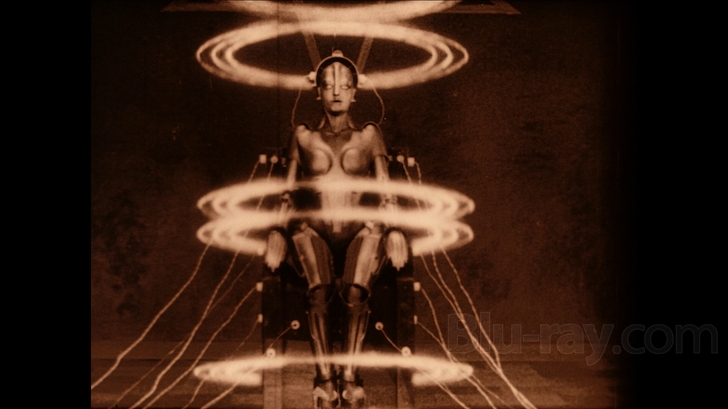
Needless to say, this was somewhat controversial in the film community. Some of Moroder’s additions seemed—and still seem—crassly commercial. In a bid to attract a younger audience, he swapped intertitles for faster-moving subtitles, overlaid key scenes with new rotoscoping effects, color- toned the footage, and gave the story a pulsing, synthesizer-driven backbeat. At the same time, his intentions appeared pure; he simply wanted more people to appreciate Lang’s way-ahead-of-its-time sci-fi magnum opus. Most importantly, he wanted to preserve the movie before its nitrous film stock completely self-destructed. In a lengthy 3-year research, acquisition, and restoration process, Moroder reconstructed the film with the best materials then available, even managing to reinstate several previously missing scenes and subplots. Although still incomplete and only running 82 minutes—thanks to the subtitles and a 24 frame-per-second projection speed—this was the first time since its Berlin premiere that Metropolis’ narrative began to make sense. Cinema purists in the ‘80s had to take the bad—or, at the very least, the unnecessary— with the good.
For the uninitiated, a quick summary: Metropolis is an Art Deco utopia, a skyscraping bourgeoisie dream where the elite live in luxury, spending their days competing in athletic games, frolicking at the Eternal Gardens, and living it up at Yoshiwara, a swanky party palace. Looming above the angular cityscape is the New Tower of Babel, from which Joh Fredersen (Alfred Abel), the founder and fascist ruler of Metropolis, keeps watch over his creation. Joh has literally built his empire on the backs of the working class, dull-eyed drones who slave away in subterranean factories beneath the city.
His son, Freder (Gustav Frölich), becomes obsessed with these have-nots and sneaks into the dystopian underworld, where he witnesses an enormous industrial machine explode, killing a score of workers in the process. Freder is struck by a vision of the machine as Moloch—the Old Testament's all-devouring god of sacrifice—and, forsaking his wealth, trades places with one of the plebes to experience firsthand how the other half live. The workers are this close to violent revolt, but their anger is temporarily assuaged when Maria (Brigitte Helm), a wide-eyed prophetess, foretells the coming of a "mediator" who will bring peace and balance by bridging the class divide. This peace is called into question when the mad scientist Rotwang (Rudolph Klein-Rogge) kidnaps Maria and makes a Man-Machine in her likeness, a sexpot robot who foments utter chaos.
I’ve you’ve never seen the film before, there’s no question you should start with The Complete Metropolis, an inclusive, true-to-directorial- intent restoration that presents the movie as it was meant to be seen, including composer Gottfried Huppert’s original Strauss and Wagner-inspired score. In comparison, the Moroder version—though instrumental in saving the film from being lost for good—now feels like a strange, no-longer- necessary relic of the 1980s. A curiosity. A piece of ephemera rescued from the trash heap of history. I can see how it might have strong nostalgia factor for those it introduced to Metropolis, but it’s hardly the preferable way to watch the film.
Why? It’s simple, really. There’s a jarring disconnect between the timelessness of Fritz Lang’s iconic imagery—which directly inspired Streamline Moderne architecture, humanoid robotics, and just about every sci-fi blockbuster, from Star Wars to The Matrix—and the extremely dated musical selections. Moroder’s own instrumental cues are okay, but most of the pop songs are much, much too obvious. Do we really need Freddie Mercury singing “Love Kills” when the evil robot-twin of the film’s heroine does a lascivious, riot-inducing strip tease, or Loverboy’s “Destruction” blaring as the subterranean portion of the city is, yes, destroyed? Pat Benatar’s “Here’s My Heart” and Bonnie Tyler’s “Here She Comes” don’t fare much better. It doesn’t help that the songs are somewhat poorly arranged. For how blatant the music often is— lyrically—the synthesizer-dominated tunes rarely sync well with the action, and there are even long pauses where the soundtrack recedes entirely. A great silent film score complements or enhances what we see on screen; this one mostly distracts. Anyone with a good feel for the film and a reasonable iTunes library could construct a better, more fitting playlist in a couple of hours.
Metropolis Blu-ray Movie, Video Quality
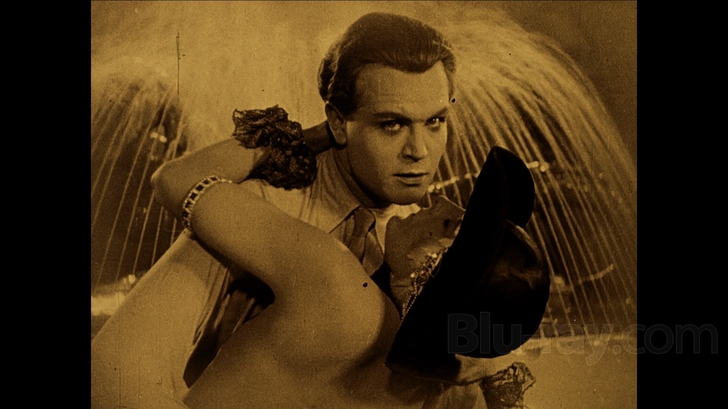
Sourced from one of the few remaining prints of Giorgio Moroder's version of the film, this 1080p/AVC-encoded transfer isn't nearly as pristine as the immaculately restored Complete Metropolis that Kino released last year. That said, I don't think anyone expected otherwise, and besides—taken on its own merits, this edition looks fairly good for an 85-year-old silent movie patched together from numerous different prints. Damage and debris are somewhat heightened here—there are near-constant scratches and flecks—but your eyes quickly adjust and you stop noticing the age-related wear and tear after awhile. The Moroder version skipped the DVD generation because of rights issues, so if your last memory of it is on VHS or LaserDisc, you're in for an enormous leap in picture quality. Clarity pales next to The Complete Metropolis, of course, but there's no doubt that this is a high definition transfer. The tinted color looks good as well, and although there are times when shadow detail is all but wiped out in certain darker scenes, contrast is pleasing and never overblown. Film grain remains natural, and there are no signs of edge enhancement or excessive compression problems.
Metropolis Blu-ray Movie, Audio Quality
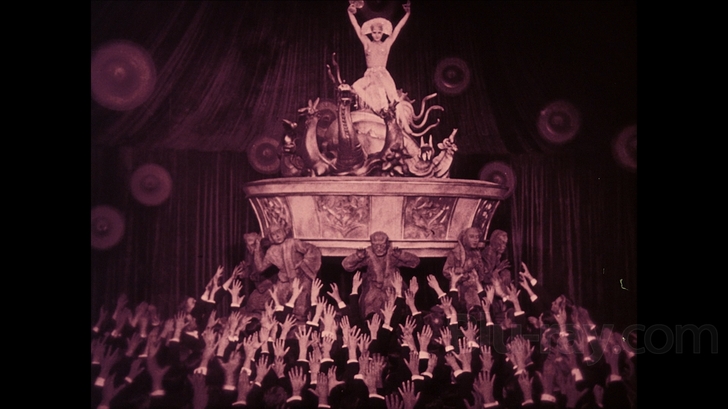
This version of Metropolis is all about the music, so if that's what you've come for, you'll have no complaints with the DTS-HD Master Audio 5.1 surround track included here. Moroder was a pioneer of synthesizer music and digital recording, and his contributions to the score sound great, with plenty of vibrancy, depth, and presence. The various pop songs have heft and clarity too, with deep, clean bass, searing synth lines, and crisp highs. The music is spread throughout the soundfield, taking up space in all channels, and the individual instruments are clearly defined in the mix. There are occasional sound effects, but nothing particularly striking or even necessary. The disc also includes an uncompressed LPCM 2.0 stereo mix, which sounds a bit thinner overall but is still perfectly acceptable.
Metropolis Blu-ray Movie, Special Features and Extras
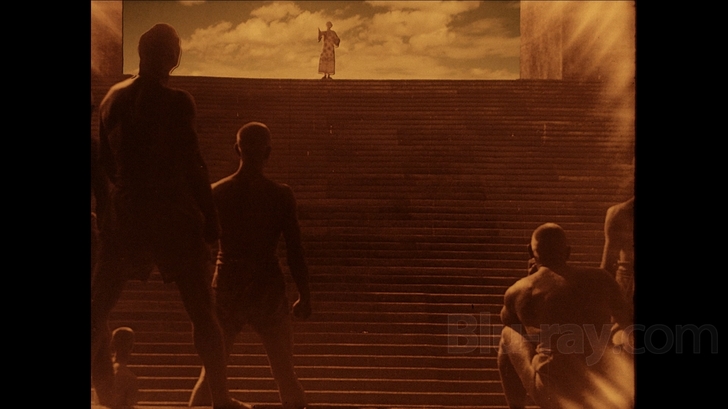
- The Fading Image (1080i, 17:50): A 1984 documentary that takes us behind the scenes of Moroder's restoration and scoring of Metropolis.
- Trailers (1080p): Includes trailers for The Complete Metropolis and Moroder's Metropolis.
- Gallery: A small gallery with posters and soundtrack artwork.
Metropolis Blu-ray Movie, Overall Score and Recommendation
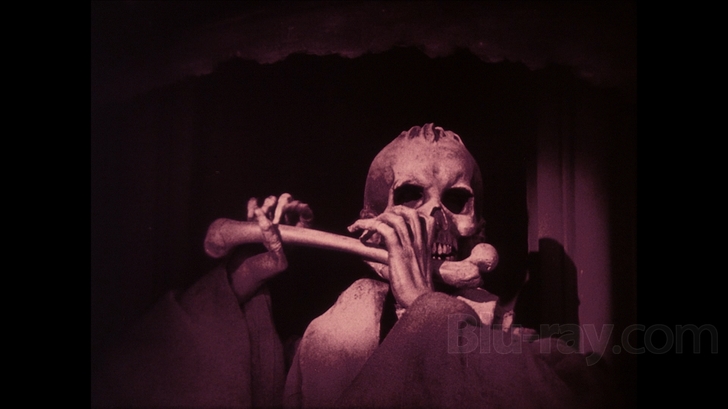
While it's wonderful that Kino has finally made Giorgio Moroder's version of the film available again on home video—due to music rights issues, it never appeared on DVD—The Complete Metropolis eclipses it in every way. Still, this tinted, synthesizer-slathered edition is certainly a cinematic oddity, and for that alone some film collectors may want to consider this release. The transfer is nowhere near as clear and pristine as The Complete Metropolis, but the audio is presented strongly and the disc includes "The Fading Image," a rare documentary about the importance of film restoration. Recommend for the curious and/or those extremely nostalgic for the 1980s.
Similar titles
Similar titles you might also like

Metropolis
The Complete Metropolis
1927

Smithereens
1982

Wild Style 4K
Limited Edition
1983

'Round Midnight
1986

A Face in the Crowd
1957

The Music Room
জলসাঘর / Jalsaghar
1958

Fatherland
Limited Edition to 3000
1986

Autumn Sonata
Höstsonaten
1978

Her Smell
2018

Things to Come
1936

The Man Who Fell to Earth
Limited Collector's Edition
1976

Baxter, Vera Baxter
1977

Ema
2019

1984
1984

Stalker
Сталкер
1979

The Wild Blue Yonder
2005

Mo' Better Blues
1990

Sound of Metal 4K
2019

The Connection
Project Shirley, Volume 1
1962

Hard to Be a God
Трудно быть Богом
2013