Mascagni / Leoncavallo: Cavalleria Rusticana / Pagliacci Blu-ray Movie
HomeMascagni / Leoncavallo: Cavalleria Rusticana / Pagliacci Blu-ray Movie 
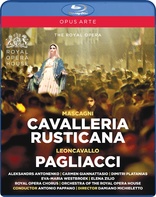
Royal Opera House, Antonio PappanoOpus Arte | 2015 | 153 min | Rated Exempt | Nov 18, 2016

Movie rating
6.5 | / 10 |
Blu-ray rating
| Users |  | 0.0 |
| Reviewer |  | 3.5 |
| Overall | | 3.5 |
Overview
Mascagni / Leoncavallo: Cavalleria Rusticana / Pagliacci (2015)
Starring: Aleksandrs Antonenko, Eva-Maria Westbroek| Music | 100% |
Specifications
Video
Video codec: MPEG-4 AVC
Video resolution: 1080i
Aspect ratio: 1.78:1
Original aspect ratio: 1.78:1
Audio
Italian: Dolby Atmos
Italian: Dolby TrueHD 7.1
Italian: DTS-HD Master Audio 5.1
Italian: LPCM 2.0
Subtitles
English, French, German, Japanese, Korean
Discs
Blu-ray Disc
Two-disc set (2 BDs)
Playback
Region A (B, C untested)
Review
Rating summary
| Movie | | 3.5 |
| Video |  | 4.0 |
| Audio |  | 4.5 |
| Extras |  | 1.5 |
| Overall | | 3.5 |
Mascagni / Leoncavallo: Cavalleria Rusticana / Pagliacci Blu-ray Movie Review
Reviewed by Jeffrey Kauffman October 6, 2016It might be a sign of the “mainstreaming” of Dolby Atmos that we now have what I believe to be the first opera release with this audio option (it’s at least the first opera release with this audio option that I’ve personally reviewed). That said, opera aficionados who are also tech heads may be wondering, “Why Cav/Pag in Dolby Atmos?” For those uninitiated in this frequently paired duo, I refer you to my long ago Mascagni / Leoncavallo: Cavalleria Rusticana / Pagliacci - Zurich Opera Blu-ray review for information on the genesis of each piece (and indeed I’ll be purloining parts of that review for plot summaries, below). What might not register in terms of these operas’ histories is that neither would be termed a “barn burner” in terms of sonic content, and in fact both might be considered chamber operas in a way, smaller scale works that tend to emphasize intimate interpersonal dealings rather than huge aural fireworks with an overwrought orchestra and huge ensemble chiming in. That’s not to say that both operas don’t have at least passing moments with those elements at play, but Cav/Pag strikes me as a kind of odd choice for the first use of Dolby Atmos on an opera release. I probably would have gone with a Wagner piece, or one of Richard Strauss’ more hyperbolic offerings, but that said, this new two disc offering features some stunning music, even if some of the staging decisions are on the odd side.
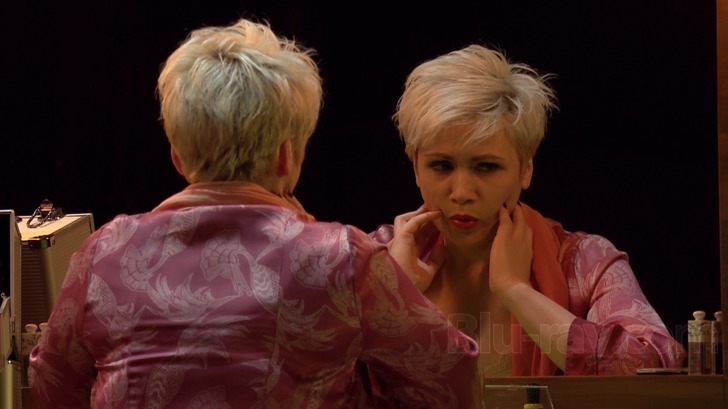
While both of these relatively brief pieces (they each clock in at about an hour and fifteen minutes) deal with jealously, love and murder, their tones really couldn’t be more different. Cavalleria Rusticana is an unironic portrait of a tragic ménage-a-trois of sorts. Turiddu (Aleksandrs Antonenko) had once loved Lola (Martina Belli) before his military service got in the way. Lola ended up marrying Alfio (Dimitri Platanias), and Turiddu ended up with Santuzza (Eva-Maria Westbroek). Cavalleria Rusticana plays out in real time in and around Easter as these two mismatched couples find their lives intertwined, leading to a predictably tragic conclusion, which in this version is actually offered up front as a sort of foreshadowing prelude or bookending device (something that I found odd and not especially helpful).
This is “kitchen sink” opera (something that attains a somewhat different meaning here, since a lot of the action plays out in a bakery), rather prescient in fact of dramatic sensibilities that wouldn’t take hold of traditional, non-sung theater, for another half century or so. Cavalleria is also a fascinating study in Verdian accompaniment. Note, for example, how little actual singing there is in the opening scene, which in this version includes the ending (so to speak). This is a brisk and violent journey through some frankly twisted emotions, and it’s rather remarkable that a little known composer, one who would try but fail to recapture his early success with Cavalleria, was able to so aptly capture the furious energy of these characters.
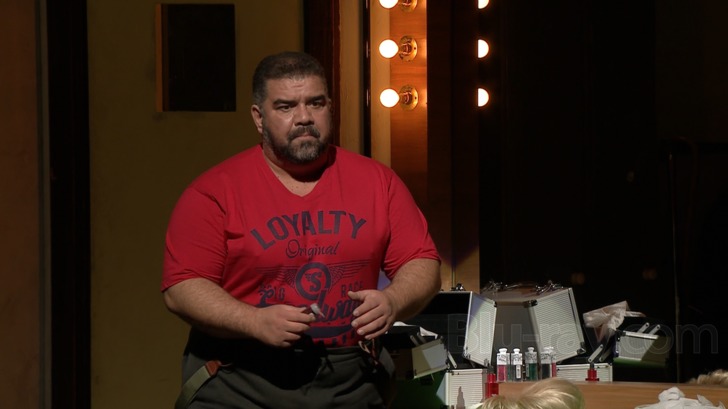
Pagliacci, on the other hand, is all about artifice. This one-act famously opens with an intentionally ironic prologue which both serves as a credo for verismo while simultaneously warning the audience not to take anything too seriously, since everyone know they’re onstage and are playacting. It’s one of the most fascinatingly self-reflective and oppositional moments in all of opera, and it is testament to Leoncavallo (who wrote his own libretto) that the genius of these two completely disparate ideas are presented so naturally and artfully. Pagliacci of course utilizes characters from Commedia dell’Arte in a very non-comedic way, as Canio (Aleksandrs Antonenko), an itinerant actor, becomes enflamed with jealous rage at the thought of losing his wife, Nedda (Carmen Giannattasio). Canio is almost the Stanley Kowalski of verismo, a big, brooding character who is violent one moment and then surprisingly vulnerable and heart wrenching the next.
Director Damiano Michieletto found out that even the typically reserved British can go more or less ballistic if someone toys with their beloved operas too much, as Michieletto did in a now infamous production of Rossini's Guillaume Tell at the Royal Opera House (Michieletto's debut production with the troupe). He's considerably more reserved in his staging here, though (as evidenced by that bookending artifice mentioned above) he does tweak things. He attempts to knit the two properties together more than they typically are simply by being produced with each other by suggesting everything is playing out in the same village, and he further links the two by having characters from the "other" opera show up in its sibling. Therefore, Dionysios Sourbis and Carmen Giannattasio appear in Cavalleria Rusticana in non-singing roles as (apparently) Nedda and Silvio, and likewise Eva Maria-Westbroek's Santuzza wafts through Pagliacci. A poster for Pagliacci also adorns the outer wall of the bakery that's a focal setting for Cavalleria Rusticana. Whether this adds anything salient to the dramatic purposes of the pair is questionable, but it's kind of interesting. Michieletto is also obviously referencing Italian cinema in his staging of the pieces, with a huge rotating set that keeps the action fluid even as locations change. While the singing is at least decent (Westbroek sounds a little tired to my ears), some of the "acting" is completely over the top, including an almost unintentionally comic hysteria emanating from Elena Zilia as Mamma Lucia in Cavalleria Rusticana.
Mascagni / Leoncavallo: Cavalleria Rusticana / Pagliacci Blu-ray Movie, Video Quality
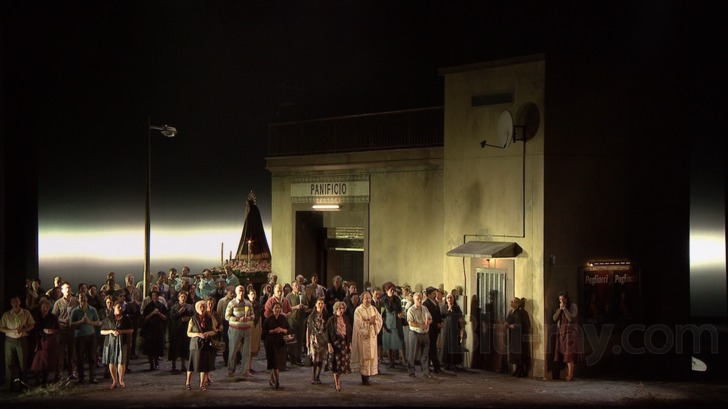
Cavalleria Rusticana and Pagliacci are presented on Blu-ray courtesy of Opus Arte and The Royal Opera House with AVC encoded 1080i transfers in 1.78:1 (on separate discs). These are solid looking "live" performance transfers that are occasionally hobbled by director Damiano Michieletto's preference for rather dimly lit stages. In certain scenes in both operas, vast areas of the stage are subsumed by shadow, and therefore detail levels are understandably not as clearly resolved (or at least apparent). In brightly lit moments, the palette looks natural (if not especially vivid—by design) and detail levels are generally quite good (note the nicely swirly texture of the supposed stucco on the outside of the bakery for one nice example). Some introductory and/or interstitial views of Pappano and the orchestra are murkier than the bulk of the presentation (and is Pappano actually chewing gum while he conducts? — the horror!).
Mascagni / Leoncavallo: Cavalleria Rusticana / Pagliacci Blu-ray Movie, Audio Quality
Both operas feature Dolby Atmos tracks (with Dolby TrueHD 7.1 cores), along with DTS-HD Master Audio 5.1 and LPCM 2.0 options (all in the original Italian, with optional subtitles in various languages). The sonics here are generally superb, though I was personally put off by Michieletto's decision to have things like the already minimal singing in the opening of Cavalleria Rusticana take place offstage, where balance issues favor the orchestra and some of the vocals can barely be heard. Once the actual "action" kicks in in Cav, things are considerably more visceral. Pagliacci encounters no similar issues in terms of offstage singing, but I again found balance between the orchestra and soloists just slightly weighted toward the instrumental forces at times. Despite these occasional issues, fidelity is excellent, though I'm frankly not all that sure what the Atmos track offers that the other surround tracks don't. There's simply not a whale of a lot of opportunity for "object" oriented placement in an opera, at least not in the same way the FX laden spectaculars do in terms of discrete placement of sound effects. The orchestra has an impeccably burnished sound, with the brass sounding especially resplendent, and despite some evident raggedness in some of the singers, the vocals are similarly well rounded and intense.
Mascagni / Leoncavallo: Cavalleria Rusticana / Pagliacci Blu-ray Movie, Special Features and Extras
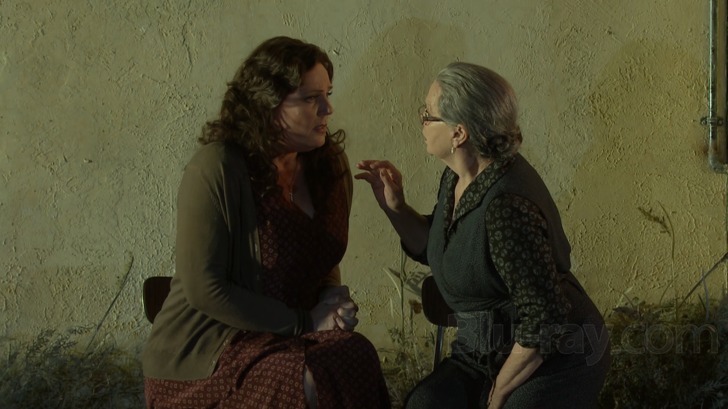
Cavalleria Rusticana
- Introduction to Cavelleria Rusticana (1080i; 4:44) is a brief overview with interviews.
- Antonio Pappano on the Music (1080i; 5:19) features the conductor offering some thoughts on the score.
- Cast Gallery (1080i; 00:41)
- Introduction to Pagliacci (1080i; 5:08) is a brief overview with interviews.
- Antonio Pappano on the Music (1080i; 5:19) features the conductor offering some thoughts on the score.
- Cast Gallery (1080i; 00:41)
Mascagni / Leoncavallo: Cavalleria Rusticana / Pagliacci Blu-ray Movie, Overall Score and Recommendation
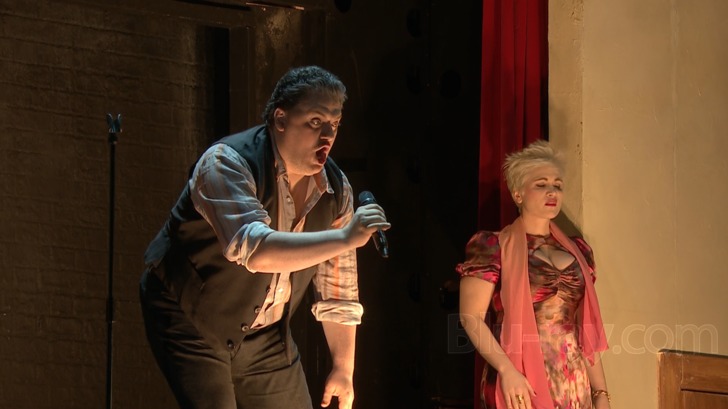
Cav/Pag has (have?) become an inviolable pair through the years, and this production knits the two together in some interesting ways. The physical production is quite interesting, if needlessly dark (in terms of actual lighting) a lot of the time. Pappano extracts some luscious playing from the orchestra, but I found the balance between the orchestra and the singers occasionally problematic. Still, those with a dual interest in opera and the latest shiny (audio) object (i.e., Dolby Atmos) may find this a worthwhile release. Recommended.