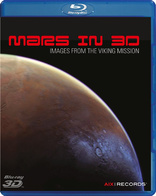
Mars in 3D: Images from The Viking Mission Blu-ray Movie
HomeMars in 3D: Images from The Viking Mission Blu-ray Movie 
Blu-ray 3DAIX Records | 1979 | 33 min | Not rated | Jun 26, 2012
Price
List price:Listed on Amazon marketplace

Movie rating
6.8 | / 10 |
Blu-ray rating
| Users |  | 0.0 |
| Reviewer |  | 2.5 |
| Overall | | 2.5 |
Overview
Mars in 3D: Images from The Viking Mission (1979)
A historical production by Stanford University and the History Office of the NASA Ames Research Center presented in Blu-ray 3D Video and features footage from the 1980's NASA Viking 1 & 2 Missions to Mars. The soundtrack was created at the Center for Computer Research in Music and Acoustics (CCRMA) at Stanford under the direction of John Chowning. This disc contains bonus features including a 15 minute interview with John Chowning, William Schottstaedt and Michael McNabb.
Starring: Elliott C. LevinthalNarrator: Elliott C. Levinthal
Director: Kenneth L. Jones
| Documentary | Uncertain |
| Music | Uncertain |
Specifications
Video
Video codec: MPEG-4 AVC
Video resolution: 1080p
Aspect ratio: 1.33:1
Original aspect ratio: 1.33:1
Audio
English: Dolby TrueHD 5.1
English: LPCM 2.0
Subtitles
None
Discs
25GB Blu-ray Disc
Single disc (1 BD)
Blu-ray 3D
Playback
Region free
Review
Rating summary
| Movie |  | 2.0 |
| Video |  | 3.0 |
| Audio |  | 3.5 |
| Extras | | 2.0 |
| Overall | | 2.5 |
Mars in 3D: Images from The Viking Mission Blu-ray Movie Review
3... 2... 1... Headache!
Reviewed by Kenneth Brown July 9, 2012Even after sitting through both the 2D and 3D versions of Mars in 3D: Images from the Viking Mission and poring through the disc's special features, I'm not sure why the 32-minute 1979 documentary is being released on Blu-ray. For one, the 3D presentation is excruciating. Not excruciatingly bad, mind you, but literally excruciating; as in I ripped the 3D glasses off my face within minutes of pressing play because the disorienting, migraine-inducing crosstalk inherent to the experience was so severe that a sharp pain erupted behind my eyes. Crosstalk (also referred to as ghosting) is typically the product of the 3D display and/or glasses, but, in this case, it's actually a product of the film's original 3D photography and source. (See my video review for more details and impressions.) Take away that 3D presentation, though, problematic and painful as it is, and all that remains is a dull, dutifully scientific affair as dated as it is dry. The stereoscopic Viking Program photographs Mars in 3D features are certainly valuable insofar as history is concerned, but the thirty-three-year old film itself? An odd relic of a bygone era, more notable for its deliciously cheesy, delightfully sinister '70s synth score than anything else.
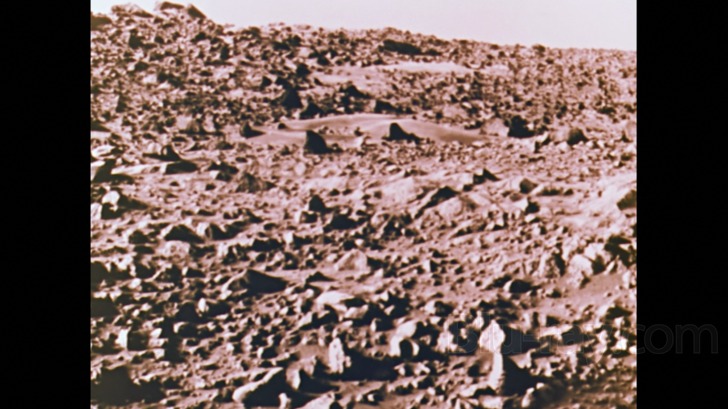
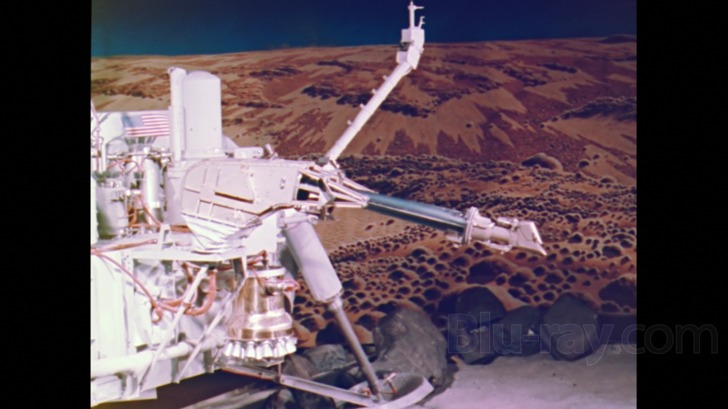
The first Viking Program spacecraft, Viking 1, was launched in August of 1975, followed in September of that same year by a second craft, the aptly named Viking 2. The destination: Mars. The mission: establish an orbit, photograph and study the Red Planet's atmosphere and surface, and deploy landers to survey and explore the planet itself. The cost: approximately $1 billion. Critics of NASA's ambitious Viking Program labeled the mission a waste of money and a fruitless endeavor. But without it, the Mars Pathfinder, Globaly Surveyor, Odyssey, Express, and Rover may have never come to fruition, and Mars might be cloaked in even more mystery than it is. Seven years after the first spacecraft was launched, in the winter of 1982, the mission concluded; the last Viking lander had gone offline. The Viking Program was declared a success and NASA scientists, who had already been analyzing the incoming orbiter and lander images and data, have continued to study the probes' findings to this day.
The particulars of the Viking Program, its seven-year mission and the information and knowledge gleaned from it are fascinating stuff, and the building blocks of the Mars programs of the late 20th and early 21st centuries. As presented in Mars in 3D in 1979, though -- three years before the mission concluded -- the film is incomplete to say the least. It asks broad questions and poses even broader answers, but rarely offers up anything today's armchair scientists, weened on an endless supply of more advanced, enlightening and thought-provoking documentaries, might consider "current," other than raw observational facts. Better to ignore the at-times speculative, oft-times comatose narration altogether and focus on the only things that matter: the imagery and the music. The imagery is, of course, positively quaint in 2012, making it a bust. Stunning new photographs and footage are a mere mouse click away thanks to our friend the internet and, as I mentioned, the 3D presentation doesn't enhance the Viking-captured images whatsoever; it undermines and disrupts it in almost every way. Which leaves us with William Schottstaedt and Michael McNabb's score, the only real treat to be had. Created using John Chowning's breakthrough FM synthesis, the music is as old and wrinkly as everything else, but it at least engages some of the senses and doesn't bring on a headache, things I can't say for other aspects of the film.
Mars in 3D: Images from The Viking Mission Blu-ray Movie, Video Quality
To gain a perception of depth in the stereo movie you are about to see, you need to wear the stereo glasses. They can be worn over the glasses you normally wear. Sit back and relax your eyes. If you are fusing the two images into a single image, this text should look like a staircase with steps descending towards you.
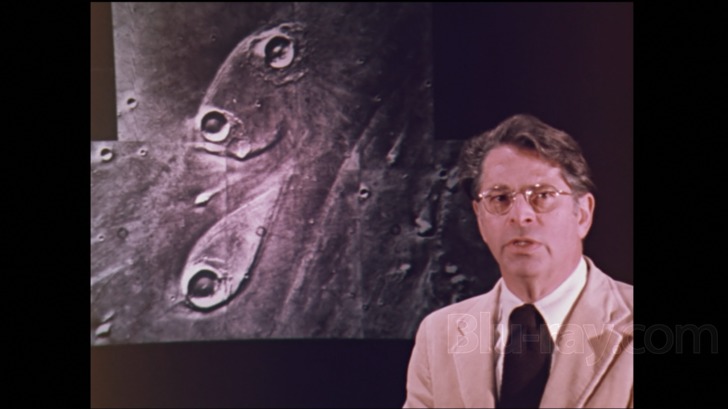
First things first. The quality of AIX's 1080p/MVC-encoded video transfer is sound. Artifacting, banding and other compression anomalies are in short supply in both the 2D and 3D presentation of the film (aliasing being the only distracting issue of note), and most every other blip and blemish is rooted in the original photography and stereoscopic source. Very few resources have been invested into remastering or restoring footage of host and producer Elliott C. Levinthal, and it doesn't appear as if the remaining film has undergone any major color, contrast or clarity enhancements. That isn't necessarily a bad thing; the film looks like a scientific documentary issued in 1979 (as it should), so the end result only contributes to whatever aesthetic charm the release has going for it. Just adjust your expectations. Detail is decent at best, definition is merely adequate, black levels are muddy, colors are weak and virtually nothing about the 2D presentation is anything other than passable. Grain removal has occurred (as outlined in the special features) but it's unclear how much, if any, texture was removed with it.
The 3D experience, on the other hand, is nauseating. To be clear: the MVC-encoded transfer is not to blame. The brutal crosstalk and convergence point irregularities that render much of the 3D imagery poorly resolved at best -- and unwatchable at its worst -- is a product of the source. (God help you if your 3D display is prone to ghosting. I can't imagine how my head would have felt had the problem been exacerbated any further.) The long explanation as to why crosstalk plagues the presentation is... a very long explanation. The short explanation is that each chunk of orbital 3D imagery was created using two separate passes over the planet; one dedicated to each "half" of the 3D image. In the hours between those two passes, the shadows shifted, which in turn produced two substantially different images; images that, even when aligned, produce a near-disastrous effect, no matter how proficient the subsequent 3D encode might be. Ground-level images have their own issues to contend with. Because of the large .8 meter separation between the lander cameras, the images have an emphasized stereoscopic effect that make the horizon easier to view than the foreground. With some practice, moving your eyes slowly down the screen allows your brain to better merge the 3D image. But if you already have a headache from viewing the orbital shots, beware. It isn't a pleasant exercise.
Ultimately, I had such difficulty with the crosstalk and convergence difficulties that, try as I did, I just couldn't stomach watching the full 32-minute film in 3D in one stretch. As a result, my 3D score is based on my subjective experience alone. My base video quality score is based on the technical merits of the encode and the fact that, even if given a more thorough overhaul, the 3D presentation couldn't really be improved.
Mars in 3D: Images from The Viking Mission Blu-ray Movie, Audio Quality
Two 48KHz/16-bit audio mixes are included: a lossless Dolby TrueHD 5.1 surround track and an uncompressed LPCM 2.0 stereo track. But it's the Dolby TrueHD mix that reigns supreme here, allowing William Schottstaedt and Michael McNabb's score to boldly go where it's never gone before. Full, robust and more alien than ever, the tone and timbre of the synth pieces fill the soundfield and create an eerie, otherworldly experience (one almost at odds with the otherwise dry, matter-of-fact documentary). LFE output and rear speaker activity is still on the light side, but I can't imagine the music sounding any better than it does here. Levinthal's narration is clean and clear, even though a slight, almost negligible buzz seems to haunt his voice when the score surges. Nothing beyond the extraterrestrial synth hymns, though, screams lossless audio. Orient your expectations accordingly.
Mars in 3D: Images from The Viking Mission Blu-ray Movie, Special Features and Extras

- Interview with John Chowning and Michael McNabb (SD, 41 minutes): Chowning, Schottstaedt, McNabb and editor Uri Geva discuss their involvement with the project, their work on the Blu-ray release, the difficulties in converting the stereoscopic imagery to Blu-ray 3D, and other hot topics in this recently produced extra.
- About the Project (HD, 2 minutes): A quick overview of the Viking Program and the creation of Mars in 3D.
- Mars Suite and Mars Music (Dolby TrueHD 5.1): Isolated selections of the score.
Mars in 3D: Images from The Viking Mission Blu-ray Movie, Overall Score and Recommendation
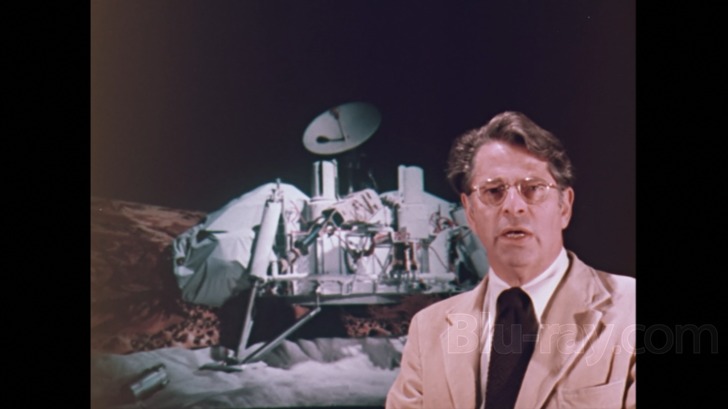
Mars in 3D should have remained a tool for scientific study. With its startling, at-first-glance defective 3D presentation, I can't imagine uninformed consumers being pleased in any way with AIX's Blu-ray release. (At the time of this review, Amazon has pulled the title from stock, suggesting a high volume of complaints and returns were received.) Its video encode is fairly proficient, the 3D oddities are inherent to the stereoscopic source materials, and its Dolby TrueHD 5.1 surround track is quite good, but there's too much about this release that will have viewers up in arms. I even knew what I was getting myself into and I still came away with a throbbing headache. If this one becomes available again, approach with extreme caution.
Similar titles
Similar titles you might also like
(Still not reliable for this title)

Big Star: Nothing Can Hurt Me
2012

Beats, Rhymes, & Life: The Travels of a Tribe Called Quest
2011

20 Feet from Stardom
2013

Dig!
2004

Country Music
Ken Burns
2019

The Police: Everyone Stares — The Police Inside Out
2006

Bad Reputation
Joan Jett
2018

Pavarotti
2019

Oasis: Supersonic
2016

The Decline of Western Civilization Part II: The Metal Years
1988

One More Time with Feeling
2016

I Am Trying to Break Your Heart: A Film About Wilco
2002

The Decline of Western Civilization Part III
1998

The Decline of Western Civilization
1981

The Prodigy: World's on Fire, Live
2010

Michael Jackson's This is It
Two-Disc Limited Edition
2009

The Devil and Daniel Johnston
Choice Collection
2005

Sigur Rós: Inni
2011

The Promise: The Making of Darkness on the Edge of Town
Bruce Springsteen
1977-2009

Kurt Cobain: About a Son
2006