Mahler: Symphony No. 9 Lucerne Festival Orchestra Blu-ray Movie
HomeMahler: Symphony No. 9 Lucerne Festival Orchestra Blu-ray Movie 
Accentus | 2010 | 95 min | Not rated | Jan 25, 2010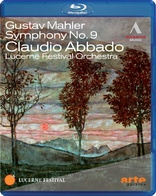
Price
List price:Listed on Amazon marketplace

Movie rating
7.4 | / 10 |
Blu-ray rating
| Users |  | 4.5 |
| Reviewer | | 4.5 |
| Overall | | 4.5 |
Overview
Mahler: Symphony No. 9 Lucerne Festival Orchestra (2010)
Claudio Abbado and his hand picked Lucerne Festival Orchestratake their acclaimed Mahler cycle to a new level with this performance of the most complex and compelling of Mahler's symphonies.
| Music | 100% |
Specifications
Video
Video codec: MPEG-4 AVC
Video resolution: 1080i
Aspect ratio: 1.78:1
Original aspect ratio: 1.78:1
Audio
Music: DTS-HD Master Audio 5.1
Music: LPCM 2.0
Subtitles
None
Discs
25GB Blu-ray Disc
Single disc (1 BD)
Playback
Region A, B (C untested)
Review
Rating summary
| Movie | | 4.5 |
| Video | | 4.5 |
| Audio |  | 5.0 |
| Extras |  | 1.0 |
| Overall | | 4.5 |
Mahler: Symphony No. 9 Lucerne Festival Orchestra Blu-ray Movie Review
Reviewed by Jeffrey Kauffman April 15, 2011Back in the days when Mozart and Haydn were tossing off symphonies with virtually every breath they took (well, maybe not exactly like that, but you get the idea), there was no special connotation about anyone’s ninth symphony, any more than there would be about anyone’s fifteenth, thirtieth, or, in the case of Haydn, the 108th. It wasn’t until Beethoven of course that anyone paid any special attention to that magic number of nine, but once Beethoven’s ninth did come along, it quickly became the touchstone and apotheosis of all things symphonic. Suddenly even if you created four undisputed masterpieces as did Johannes Brahms (his First Symphony often being nicknamed “Beethoven’s Tenth”), you might be seen in some circles as lacking a certain compositional fortitude in not being able to get to that vaunted number. Of course there may have been good reason for composers to not exactly rush toward completing their ninth symphony, as there is supposedly a folk tale circulating in the higher echelons of classical music that nothing brings about one’s demise quicker than writing that final double bar at the end of a ninth symphony. This silly superstition may have started, if in fact it ever really existed at all, with the death of Beethoven after he finished his iconic Ninth Symphony, but according to none other than Arnold Schoenberg, it was still going strong by the time Gustav Mahler approached writing his Ninth Symphony. Mahler, according to Schoenberg at least, thought he had beaten the so-called “curse of the Ninth” by having completed what he viewed as a quasi-symphonic song cycle, Das Lied von der Erde. That would have made Mahler’s Ninth his actual Tenth by that kind of reckoning. Evidently Divine counting doesn’t allow for such bending of symphonic rules, for Mahler, like Beethoven before him, died after having completed his Ninth Symphony, though Mahler at least managed to get started on his “actual” Tenth Symphony before shuffling off of this mortal coil.
Mahler’s Ninth couldn’t be more different than Beethoven’s, in form or content. If Beethoven is rightly seen as radically reinventing the symphonic medium with his Ninth, including the celebrated choral finale, Mahler essentially deconstructs the entire notion of a symphony with this mammoth piece, and builds it up from scratch again. Here we have two incredibly introspective, almost lethargic movements bookending more vigorous, almost manic, inner movements. Commentators have long posited that Mahler was in a sense only too aware of his own mortality when he wrote the Ninth, and there is a longing melancholy which hangs over virtually every note of this piece, even more so than in a lot of Mahler’s other pieces, which of course are more often than not tinged with sadness and a taste of the bizarre.
Leonard Bernstein, who was so instrumental (no pun intended) in helping to popularize Mahler’s music, is on record (to repeated catcalls) that the Ninth’s “. . .opening bars of. . .are an imitation of the arrhythmia of his failing heartbeat.” Whether or not this is actually the case is really irrelevant, as the entire symphony is suffused with an awareness of impending death and dissolution. This is elegiac composition of the highest order, with not so much the kitsch of nostalgia as the perhaps futile reach toward the unreachable. Mahler was obviously one of the most deeply introspective composers of all time, one prone to intense questioning not to mention outright rage at the indignities of fate, and the Ninth Symphony is testament to the fact that Mahler himself may have felt he had reached the end of the line without obtaining any really meaningful answers.
And yet that false feeling in and of itself provides Mahler with the most commanding answer of all: the impeccable majesty of this Symphony, certainly one of the most towering in all of symphonic literature. I well remember the very first recording of this symphony I ever had, a boxed set conducted by Bruno Walter that included the Ninth along with that “other” ninth, Das Lied von der Erde. I had frankly never heard any Mahler before, still being quite young at the time, and took the advice of a friend of my sister’s who foisted the set off on me and told me to find some “quiet time” alone to listen. Though I was probably more immediately struck by Das Lied, with its flash and delirium, than with the more slow moving Ninth, in the long run it was the Symphony which had the more profound affect on my subconscious, and I suspect that will be the case with most listeners. This is music which seeps into the very emotional fabric of the listener and reveals inner worlds that very listener may have been heretofore unaware even existed.
Claudio Abbado has been releasing some of the most stupendously gorgeous Mahler interpretations of the high definition era, and this new Blu-ray featuring his hand picked Lucerne Festival Orchestra is certainly no exception. A piece as daunting as Mahler’s Ninth, a piece which even if played briskly runs for well over an hour, requires a conductor of unusual stamina and perspicacity, and Abbado has certainly earned his place as one of the most effortlessly commanding Mahler conductors of our time. While he may not always present the refined eloquence that Walter did, or the tempestuous musical manic-depression that Bernstein often culled from his orchestras, Abbado has a keen eye for the overall architecture of the Ninth, and his steady, unfussy approach reaps enormous dividends here.
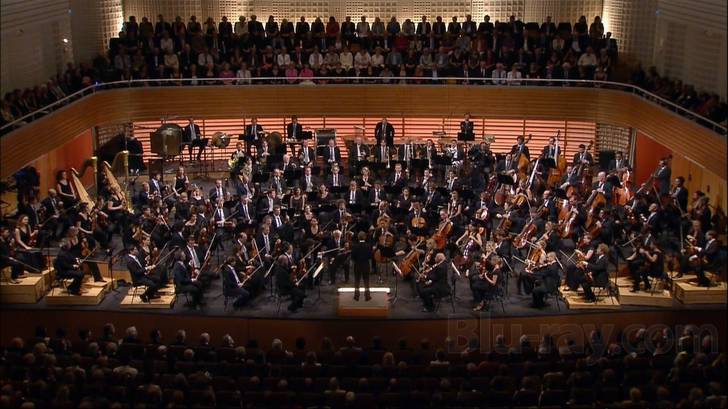
It’s amazing to see the gargantuan forces Mahler wrote for play this piece, forces which are here represented by the front rank of European musicians, many of whom play full time for the leading continental orchestras and join Abbado for the summer festival in Lucerne every year. Each of these players is a virtuoso in their own right, and to hear them together is an unusually moving and musically profound experience. Abbado and the Lucerne Festival Orchestra do especially brilliant work in the first and last movements, movements which are so meditative that they can lose momentum if not approached with a very real care. That care is completely evident here, and the entire performance rings with an authenticity and depth of feeling that will hopefully dispel any lingering thoughts of any kind of curse being associated with music of this order.
Mahler: Symphony No. 9 Lucerne Festival Orchestra Blu-ray Movie, Video Quality
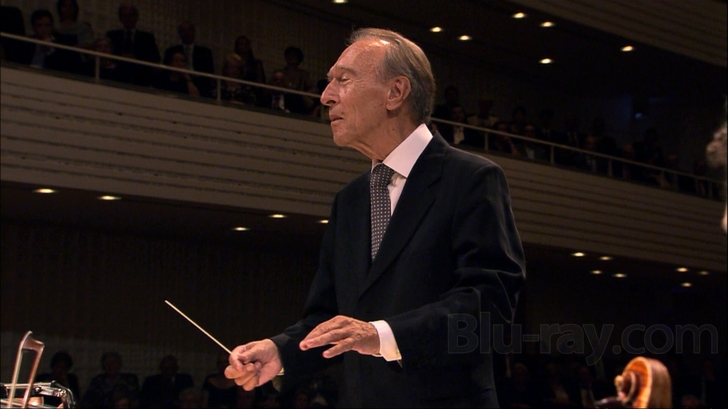
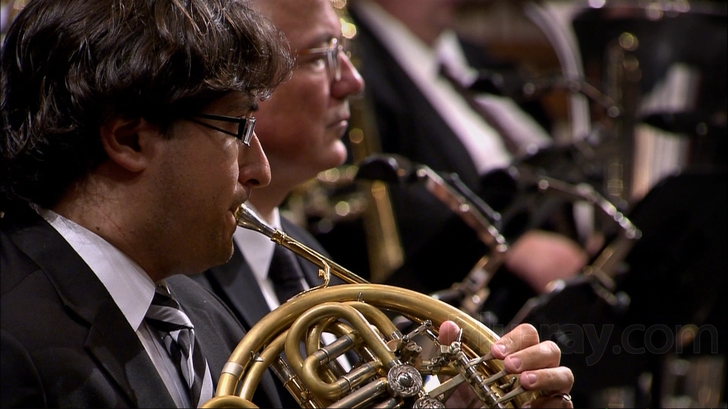
Gustav Mahler Symphony No. 9 arrives on Blu-ray courtesy of Accentus Music, with an AVC encoded 1080i transfer in 1.78:1. This is one of the nicer looking Blu-rays we've had of this particular Mahler cycle, with robust, very natural looking color and some excellent fine detail in the close-ups. Abbado's fly away hair is caught in all its glory, and various up close and personal looks at various orchestra members shows everything from crow's feet to the occasional wisp of perspiration. Camera coverage is exceptional throughout this piece, and we get a huge variety of perspectives on this equally huge orchestra. Contrast is very strong and there is little to no artifacting on this release, something that has occasionally plagued some of the other releases in this series.
Mahler: Symphony No. 9 Lucerne Festival Orchestra Blu-ray Movie, Audio Quality
Gustav Mahler Symphony No. 9 features a reference quality lossless DTS-HD Master Audio 5.1 track, as well as a superb lossless LPCM 2.0 stereo fold down. What amazing music this is, and how brilliantly the DTS-HD Master Audio 5.1 track captures it all. Dynamic range here is nothing short of astounding. This symphony starts out with a musical whisper, as it were, but by the time we reached the "full force" trombones, a stack of discs I had on my sub-woofer went flying across the room due to the vibration. Who says only summer action blockbusters can provide earth shaking LFE? Seriously, though, this is one of the most crystalline and appealing DTS-HD Master Audio tracks that we've yet had on a classical music release, all the more amazing in that Mahler's orchestra here is so incredibly massive. And yet there is ample breathing room in the hall ambience afforded by the surround track, so that even the tiniest nuances aren't swallowed up by the overwhelming amount of sound. Strings are simply luscious, and when the brass enters it's often like the force of planets colliding. The final movement is achingly rendered, with unbelievably evocative ambience as the music trails off into eternity.
Mahler: Symphony No. 9 Lucerne Festival Orchestra Blu-ray Movie, Special Features and Extras
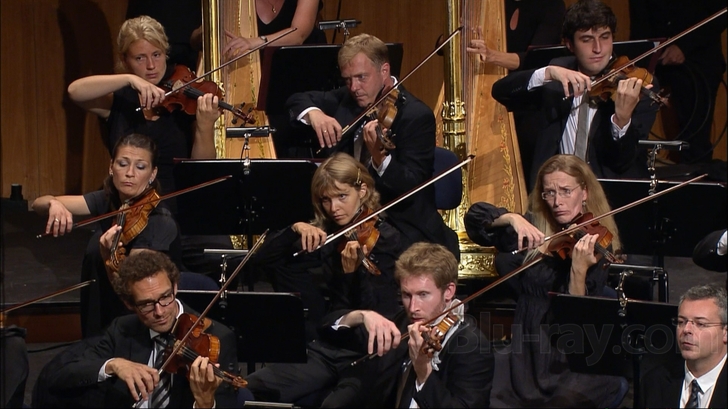
A Conductor Cam is suposedly available on the first movement using your remote's angle feature, but I'm not at all certain it was working for me. Toggling between two featured angles didn't always seem to change things, and they reverted at regular intervals anyway. What seems to be the intent, anyway, is for one of the angles to be centered solely on Abbado, but what happened for me was that it would feature Abbado for a moment and then revert back to views of the orchestra.
Mahler: Symphony No. 9 Lucerne Festival Orchestra Blu-ray Movie, Overall Score and Recommendation
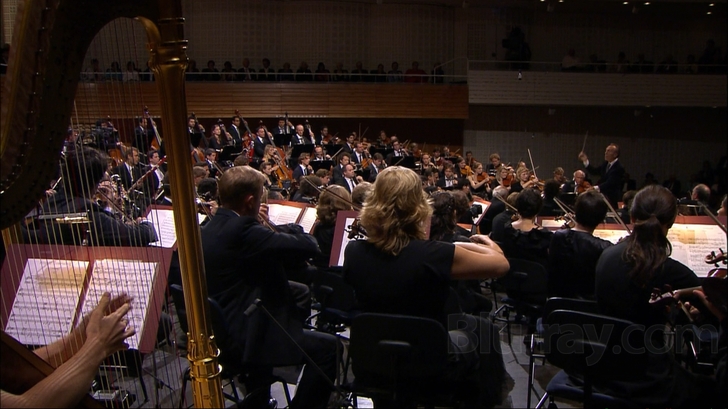
Mahler's Ninth Symphony is such a completely overwhelming experience that it can be difficult to talk about rationally. This is music which seems to enter the very conciousness, indeed the soul, of the listener at a vibrational level, working its magic slowly but surely at the most inner level of the self. Unusual in form and technique, but bearing all the hallmarks of classic Mahler, the Ninth is long but never laborious. Claudio Abbado once again offers a sumptuous interpretation of one of the great masterpieces of symphonic literature. Abbado's hand picked Lucerne Festival Orchestra offers a lustrous and intensely moving account of this incredible piece of music. Very highly recommended.
Similar titles
Similar titles you might also like
(Still not reliable for this title)

Pink Floyd: Wish You Were Here
Blu-ray Audio | 50th Anniversary Edition
1975

David Gilmour - Live at the Circus Maximus
2024

Prince and the Revolution: Purple Rain
Blu-ray Audio
1984

Fleetwood Mac: Rumours
Atmos Blu-ray Audio
1977

The Beatles: Let It Be
Super Deluxe Edition | Blu-ray Audio
1970

David Bowie: The Rise and Fall of Ziggy Stardust and the Spiders from Mars
Dolby Atmos Blu-ray Audio
1972
Depeche Mode: Strange Too
1990
Depeche Mode: Strange
1988

Pink Floyd: The Dark Side of the Moon
50th Anniversary Atmos Remix / Blu-ray Audio
1973

Roy Orbison: Black & White Night 30
1987-2017

Prince and the Revolution: Live
1985

John Williams: The Berlin Concert
Limited Deluxe Edition
2021

Pink Floyd: Pulse
1995

Pink Floyd: Animals
Atmos Remix / Blu-ray Audio
1977

Eric Clapton: The Lady in the Balcony - Lockdown Sessions 4K
2021

The World of Hans Zimmer: Live at Hollywood in Vienna
2018

Madonna: The Girlie Show - Live Down Under
1993

S&M2: Metallica and San Francisco Symphony
2019

John Williams - Live in Vienna
2020

Roger Waters: Us + Them
2019