Mahler: Symphony N° 8 Blu-ray Movie
HomeMahler: Symphony N° 8 Blu-ray Movie 
Accentus | 2011 | 92 min | Not rated | Sep 27, 2011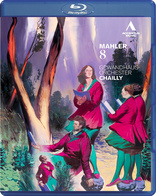

Movie rating
7.3 | / 10 |
Blu-ray rating
| Users |  | 0.0 |
| Reviewer |  | 4.5 |
| Overall | | 4.5 |
Overview
Mahler: Symphony N° 8 (2011)
Riccardo Chailly conducts Mahler's Eighth Symphony from the 2011 International Mahler Festival in Leipzig.
Starring: Riccardo Chailly| Music | 100% |
Specifications
Video
Video codec: MPEG-4 AVC
Video resolution: 1080i
Aspect ratio: 1.78:1
Original aspect ratio: 1.78:1
Audio
German: DTS-HD Master Audio 5.1
German: LPCM 2.0
Subtitles
English, French, German
Discs
25GB Blu-ray Disc
Single disc (1 BD)
Playback
Region A (B, C untested)
Review
Rating summary
| Movie | | 4.5 |
| Video | | 4.5 |
| Audio |  | 5.0 |
| Extras | | 0.0 |
| Overall | | 4.5 |
Mahler: Symphony N° 8 Blu-ray Movie Review
Odes to joy.
Reviewed by Jeffrey Kauffman October 9, 2011Gustav Mahler’s Eighth Symphony bears the soubriquet “Symphony of a Thousand,” due to the immense forces which are required to be marshaled to perform the gargantuan piece. If Riccardo Chailly gathered together what appears to be every available musician in Leipzig and only came up with around 500 souls, well, who are we to haggle about truth in advertising? Chailly has become one of the more respected Mahlerians of recent times, with a series of well received recordings featuring at least a couple of major orchestras, and he has been Music Director and Chief Conductor of the Leipzig Gewandhaus Orchestra, the oldest civic symphonic troupe in the world. Once fallen on hardscrabble times and a less than lustrous reputation, the Gewandhaus has seen its fortunes rather dramatically reverse under Chailly’s leadership, and for the most part, the qualities that have led to its renaissance are firmly on display in this frequently impressive reading of the “magnumest” of Mahler’s almost always magnum opus output. German Symphonic Choral Heresy Alert: most people would probably immediately choose Beethoven’s Ninth Symphony as the reigning champion of this subgenre of symphonic output, but for me personally the apotheosis of choral symphonies has always been Mahler’s Eighth. From those first commanding organ tones through the blistering “Veni, Creator Spiritus” to the more ruminative reflections culled from Goethe’s Faust, this piece may be, as Leonard Bernstein once opined, something akin to all the choirs of Christendom gone mad, but in this case, the madness is divinely inspired. For a composer who is so often thought of as being morose and depressive, Mahler is more or less (well, you can’t have everything) triumphant throughout the Eighth, which doesn’t mean he’s stopped questioning or has ceased to place the listener akimbo with asymmetrical structures and interwoven choral and instrumental lines that can resemble a sonic cat’s cradle at times.
If indeed Beethoven’s Ninth can be seen (not to mention heard) as the prime example of the 19th century’s headlong rush toward “equality, liberty and fraternity,” Mahler’s Eighth can similarly be understood as the statement of the first decade of the 20th century, when hopes were still high for Mankind, but the seeds of discord which would soon erupt and scar most of the rest of the century had already been sown and were lying just beneath the surface, like corrupt weeds about to invade a perhaps imagined Garden of Eden. Mahler’s music is always characterized by ambivalence and doubt. One moment it’s exclamatory, literally crashing the gates of heaven with massed sound and fantastic orchestral effects, and the next moment it’s halting, tentative, never quite sure where to go or what’s going to happen next. If the former trait is much more in evidence throughout the Eighth, it can’t be denied that the second characteristic is also firmly on display, though much more in the gargantuan symphony’s second section than its anthemic first movement.
Chailly inaugurated an international Mahler festival in 2011, and this performance of the Eighth was one of two Chailly-Gewandhaus performances of the premiere season (the other performance was of the almost equally massive Second Symphony). Last year’s Blu-ray release of an almost complete Mahler cycle conducted by Claudio Abbado and his handpicked Lucerne Festival Orchestra perhaps helped to whet high definition aficionados’ appetites for the humongous sound world of Mahler, and Chailly and his group for the most part do not disappoint. Personally I would have loved a more floorboard rattling organ opening than what we’re presented with here, but the majesty of the choral entrance helps to make up for that somewhat. Chailly and his immense forces seem just a tad tentative in the opening bars of the “Veni,” but within just a minute or so, Chailly has created an aura of excitement and energy that rarely lets up for the rest of the movement. In fact by the triumphant ending of the piece, the floorboards are indeed rattling and the sudden silence—hushed, awestruck— of the audience after the piece comes to its cataclysmic, quasi-orgiastic climactic close is amazing to hear (or not hear, as the case may be).
The liner notes for this release talk about Mahler’s connection to Leipzig, and of course the composer-conductor got his early career start in the city, but in a perhaps fanciful extension of that connection, the liner notes aver that this supposed “Leipzig Connection” includes the Eighth, making it the perfect choice for a performance in the city. That may be little more than wishful civic pride thinking, but the fact is that Chailly managed to recruit forces almost exclusively culled from the ranks of Leipzig’s musicians, something probably not that easy given the city’s relatively small size and resultant population of artists able to handle the tricky mechanics of Mahler. Aiding these “home town talents” are an international array of brilliant soloists, including Erika Sunnegardh, Ricarda Merbeth, Christiane Oelze, Lioba Braun, Gerhild Romberger, Stephen Gould, Dietrich Henschel and Georg Zeppenfeld. The overlapping, intertwining lines of the “Veni” probably best show off the singers’ abilities both as individuals and within the blending confines of their small group ensemble singing.
Many critics and exegetes through the ensuing years have questioned the connection between the “Veni” and the excerpts from Goethe’s Faust, but both are filled with the redemptive power of grace and love. If the first movement is an anthem opening the portals of heaven so that the Holy Spirit swoops down and captures the listener whole scale (no pun intended), the second movement is a more interior exploration of the same ideas, but linked now to nature and man rather than an ichoate Divine. Here again Chailly shines, less athletically than in the first movement, but nonetheless drawing together the innately filigreed reeds and winds that Mahler uses so evocatively in most of his symphonies, but probably never more so than in the Eighth.
Mahler: Symphony N° 8 Blu-ray Movie, Video Quality
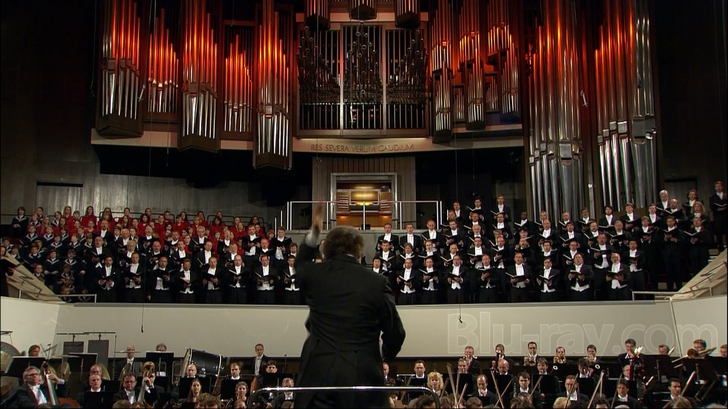
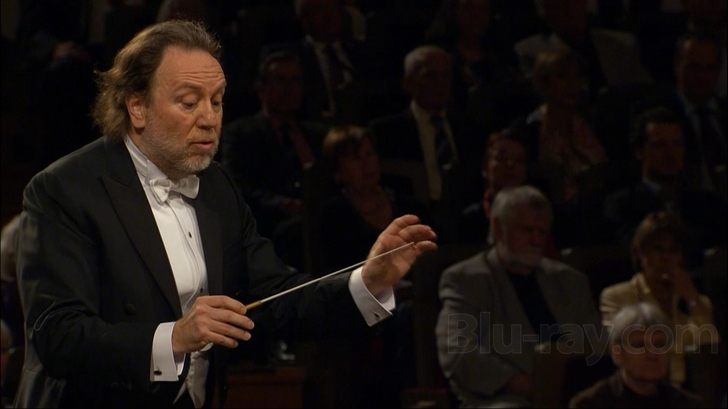
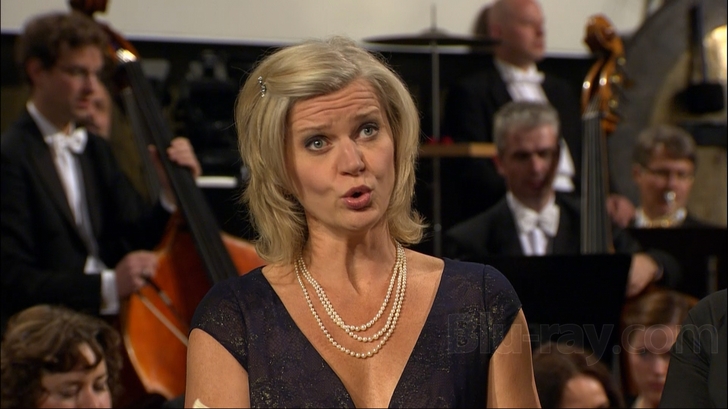
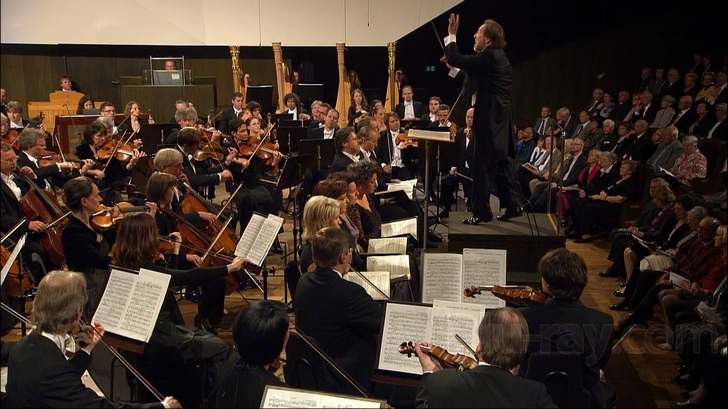
Mahler 8 is presented on Blu-ray courtesy of Accentus with an AVC encoded 1080i transfer in 1.78:1. The immense hall where the Gewandhaus-Orchester performs, replete with its massive pipe organ, looks fantastic in this high definition outing, with crisp lines, excellent color and abundant fine detail. Close-ups of both Chailly and the soloists, as well as various individuals in the regular and children's choirs, and the orchestra itself, pop with vitality and precision. There are few if any interlacing artifacts to report, and in fact about the only compression artifact of any note (no pun intended) is some very minor and non-intrusive crush when the massed black outfits of the singers are seen in wide shots. Camera coverage is largely superb, but a couple of times in the "Veni" the director focuses on the wrong "soloist," who may indeed be singing but who doesn't have the focal line at that particular point. Otherwise, this is a really sharp and well defined looking Blu-ray that is a pleasure to watch.
Mahler: Symphony N° 8 Blu-ray Movie, Audio Quality
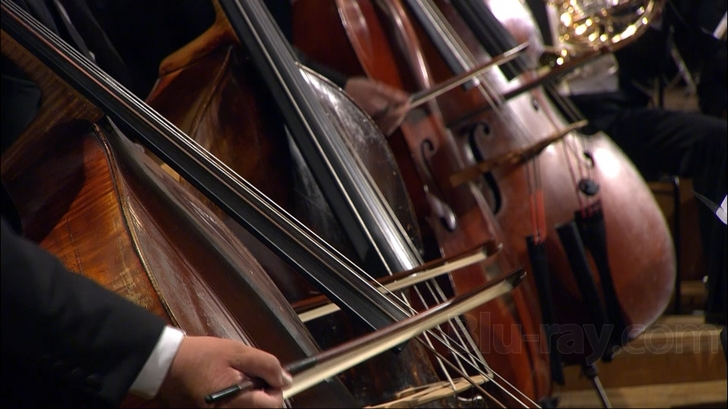
There's not another symphony quite like Mahler's Eighth, one which taxes the abilities of even the best sound systems and recording techniques, but the good news is that both lossless audio options on this Blu-ray come through with flying colors. Both the DTS-HD Master Audio 5.1 surround mix and its sibling LPCM 2.0 stereo fold down sound magnificent. The 5.1 mix beautifully recreates hall ambience and the intersecting lines of the "Veni" are transparently clean and brilliantly fulsome. There are some very minor balance issues with individual soloists and the massive orchestra Mahler calls for in this piece, but frankly that's more than usually the case with the Eighth, and in this particular instance, the issues are transitory and not very troubling in the long run. There are a couple of minor intonation issues with various orchestra members, notably a briefly squeaky clarinet, but otherwise the playing is of the highest order. Fidelity is incredibly rich and clear and dynamic range is nothing less than astounding throughout the recording.
Mahler: Symphony N° 8 Blu-ray Movie, Special Features and Extras
There are no supplements per se on the Blu-ray. This new Chailly disc is housed in a trifold case which bears original art by Leipzig painter Neo Rauch.
Mahler: Symphony N° 8 Blu-ray Movie, Overall Score and Recommendation
If Abbado's Mahler of the past few years has been measured, learned and always aware of the overall architecture, this Chailly reading of the Eighth is considerably more spontaneous feeling, as if the music is being created in front of our very eyes. While the "Veni" gets off to a perhaps less than thunderous start, it soon makes up for it, and the rafters are certainly shaking by the close of the movement. The Faust movement is lovely and lyrical, and both movements offer superb singing and brilliant playing for the most part. It would be fantastic if Accentus and Chailly ended up releasing their own Mahler cycle to compare with the Abbado, but for the time being, this Eighth makes an exuberant companion piece to the Abbado box which ended with the Seventh. Highly recommended.