Mahler: Symphony No. 6 Blu-ray Movie
HomeMahler: Symphony No. 6 Blu-ray Movie 
EUROARTS | 2006 | 89 min | Not rated | Sep 28, 2010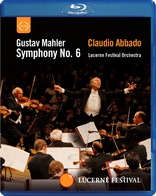
Price
List price:Listed on Amazon marketplace

Movie rating
7.7 | / 10 |
Blu-ray rating
| Users |  | 4.5 |
| Reviewer | | 4.5 |
| Overall | | 4.5 |
Overview
Mahler: Symphony No. 6 (2006)
The imposing experience of Mahler's No. 6 is captured live in a performance of awesome silences and towering climaxes with the Lucerne Festival Orchestra and Claudio Abbado. Claudio Abbado has realised a dream with his new Lucerne Festival Orchestra. The orchestra, an exclusive ensemble of handpicked orchestral musicians, opens up new dimensions in the interpretation of symphonic music with exceptional soloists such as violinist Kolja Blacher, cellist Natalia Gutman and clarinettist Sabine Meyer filling the first desks.
Starring: Eteri Gvazava, Lucerne Festival Orchestra, Orfeón Donostiarra, Anna Larsson| Music | 100% |
Specifications
Video
Video codec: MPEG-2
Video resolution: 1080i
Aspect ratio: 1.78:1
Original aspect ratio: 1.78:1
Audio
Music: DTS-HD Master Audio 5.1
Music: LPCM 2.0
Subtitles
None
Discs
25GB Blu-ray Disc
Single disc (1 BD)
Playback
Region A (B, C untested)
Review
Rating summary
| Movie | | 4.5 |
| Video |  | 4.0 |
| Audio | | 4.5 |
| Extras |  | 0.0 |
| Overall | | 4.5 |
Mahler: Symphony No. 6 Blu-ray Movie Review
Order and disorder color Mahler's epic Sixth Symphony.
Reviewed by Jeffrey Kauffman October 1, 2010Classical music is usually seen by outsiders as the refuge of the intelligentsia, the patrician class which always knows best (or at least thinks they do) and is unequivocally correct in its artistic pursuits and decisions. I wonder what outsiders would make of the somewhat humorous more or less century long dispute about how to order the inner movements of Mahler’s Sixth Symphony. The symphony itself is rife with contradictions. It gained the soubriquet “Tragic,” rightly or wrongly, even though it was written during one of the few times of out and out happiness for Mahler. That said, its finale is “catastrophic,” to paraphrase the liner notes included on this Blu-ray release, completely at odds with most of Mahler’s other tempestuous symphonies, which tend to end either with triumphant shouts of orchestral acclamation or a sort of blissfully quiet resignation. The sixth also is one of Mahler’s most traditionally structured large scale works, with actual precise sonata-allegro forms filling the aural landscape in several movements, which makes the brouhaha about how to place the Andante and Scherzo all the more amusing, at least to those with a perhaps jaded sense of humor.
One of the unusual things about the Sixth, at least in its original conception, was Mahler’s placement of the Scherzo as the second movement. A scherzo or dance movement is of course traditionally reserved for the “number three” spot in a Symphony, but Mahler twisted convention, placing his Adagio third. However, Mahler had second thoughts, and conducting his own premieres of the Sixth over the course of several months, he put the Adagio back in its traditional second movement place, and the Scherzo in its traditional third movement location. Though the piece had been published with the Scherzo second and the Andante third, Mahler requested that “Errata” slips be inserted in scores which had already come off the printing presses, perhaps because “I changed my mind” didn’t sound quite as plausible. The Symphony continued with this form for the rest of Mahler’s lifetime, but after his death, things got considerably crazier. His widow Alma evidently indicated that Mahler had had “second second thoughts” and wanted the symphony performed in its original published form, with the Scherzo second. Debate continued over the ensuing decades, with some conductors choosing one version and others liking the other. However, when German musicologist Erwin Ratz published his Critical Edition of the Sixth in 1962, he decided that the original published order was correct, and for some reason the bulk of the classical music field fell into lockstep behind him, with the bulk of performances following his edict. Of course, critics and their Critical Editions were born to be questioned, and over time, Ratz’s decision came to be seen as more or less arbitrary, and the pendulum has swung back to at least the middle position—i.e., some conductors doing the Sixth Scherzo-Andante, and others vice versa—if not totally to the Andante-Scherzo side of the equation.
So of course the burning question remains: what is Claudio Abbado’s decision on this stellar performance with his hand picked Lucerne Festival Orchestra, an assembly of first chair musicians from the finest ensembles around Europe? It’s Andante-Scherzo, ladies and gentlemen, the way Mahler wanted it, insisted it should be done, and had his publisher change the score to reflect. What those who insist on doing this piece Scherzo-Andante seem not to realize (or perhaps to willfully ignore) is the similarity between the First Movement of the Sixth and the Scherzo. With the Scherzo coming directly after the First Movement, it almost seems like a joking sort of long-form coda, not that that would be counter to Mahler’s often subversive artistic proclivities. But with the langorous Andante interpolated between the two movements, we have a chance to experience the differences between the First and Third movements, rather than their somewhat pointed similarities.
The Sixth, as stated above, may indeed be the most formally traditional of all of Mahler’s symphonic output (if one puts aside the ridiculous browbeating over how to order the movements). That said, it is typically Mahlerian in virtually every way, with both mordant humor and incredibly lyrical expressionism cohabitating side by side in an emotionally tempestuous manner. Much has been made of Mahler’s “fate” motif, which colors the bookending First and Fourth movements, and it is hard not to think of this Symphony as somehow a 20th century “answer” to Beethoven’s Fifth. The martial strains of the First Movement, however, have just as often made me think of the similarly militaristic strains of some of Prokofiev and Shostakovich’s work, some of which came a half century after Mahler, proving his musical prescience.
In fact that prophetic quality of Mahler has long been used as an excuse, more or less, to subtitle the Symphony “Tragic,” though Mahler never himself called the piece by that name. Though the Sixth was written in a time of near euphoria for the composer, a state he all too rarely experienced, within weeks of its premiere, one of his daughters had died, the composer himself had been diagnosed with a terminal illness, and he was forced to resign from the most prestigious musical job on the continent, Music Director of the Vienna State Opera. Perhaps more importantly, if less personally, the Sixth seems to presage a world about to drop precipitously into the abyss of world war. Tonalities clutter to the ground in clashing dissonance, and even the Second Movement’s attempts at a sylvan refuge seems but a fleeting dream, a chimera of hope surrounded by the cynical First and Third movements.
Abbado has become the go-to conductor for Mahler, and especially the Sixth, a symphony for which he seems to have a special affinity, perhaps because of his many health issues over the past several years. His conducting here is forceful yet incredibly nuanced, guiding his unbelievably skilled players through one architecturally astute climax after another. The lyrical Second Movement has probably never been more lovingly lugubrious, and the brittle outer movements are crisp without ever descending into self-parody.
The controversy over how to order Mahler’s Sixth is probably never going to die down. After all, the intelligentsia like nothing more than to think about knotty problems. Solutions aren’t half as much fun. Luckily conductors like Abbado come along every so often to hush the arguing masses and make them sit back and actually listen to the music for a change.
Mahler: Symphony No. 6 Blu-ray Movie, Video Quality
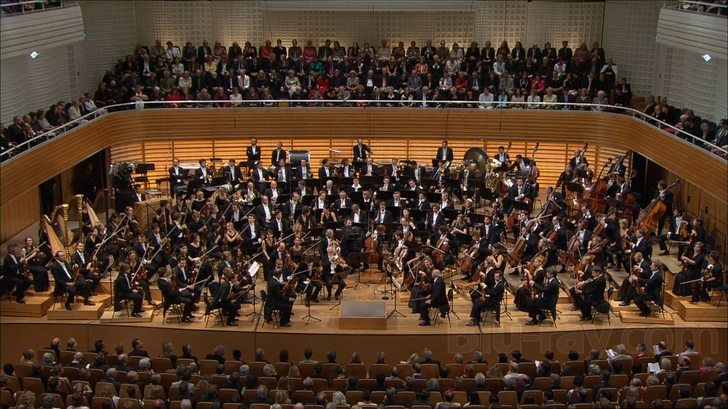
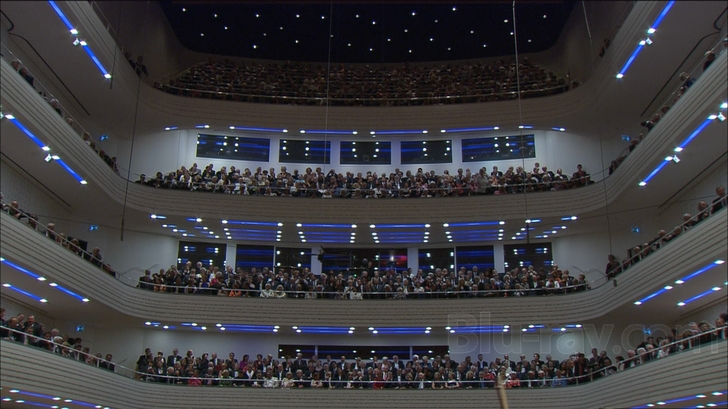
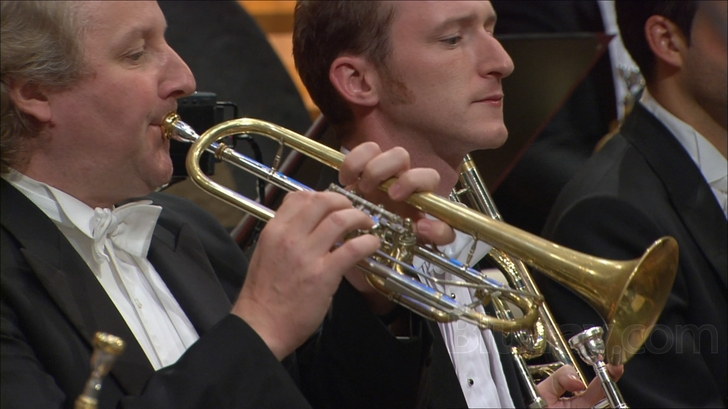
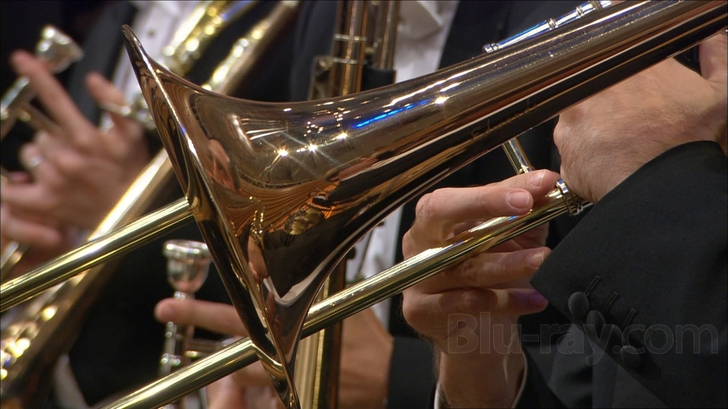
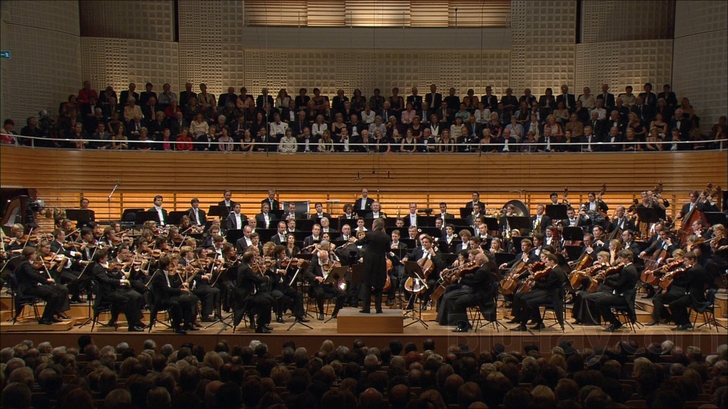
Despite being encoded with the older MPEG-2 protocol, Mahler: Symphony No. 6 looks decently sharp, with excellent detail, especially in the close-ups, in its 1080i 1.78:1 presentation. This 2006 performance is in the ultramodern Lucerne Festival Hall, a gleaming white palace of horizontal lines which never dissolves into aliasing. The orchestral coverage here is fantastic, with all of Mahler's quasi-soli, sectional and otherwise, captured brilliantly by the multiple cameras. While flesh tones are just a bit on the anemic side, detail is quite good throughout, so that every fiber on some of the violin bows can be seen, and reflections in the bells of the brass are clear, if bizarre looking.
Mahler: Symphony No. 6 Blu-ray Movie, Audio Quality
This new Blu-ray is given two lossless audio options, a DTS-HD Master Audio 5.1 mix and an LPCM 2.0 fold down. This is an exceptionally well recorded piece, with some brilliant separation and, even better, an attention to detail when various instruments are highlighted visually. Individual instruments are solidly placed around the soundfield, and should a section show up for a moment onscreen, the mix adjusts accordingly, if subtly. Overall, the hall ambience is nicely reverberant, giving just enough space around the crushing tutti sections to keep things from sonically bleeding. Playing here simply couldn't be better. I was especially won over by the incredible reeds on display here, with impeccably facile playing from the clarinets and oboes. But as in all Mahler symphonies, the strings and the horns take over for large swaths of individual movements, and the DTS track supports them brilliantly, offering crystal clear fidelity and some really impressive dynamic range.
Mahler: Symphony No. 6 Blu-ray Movie, Special Features and Extras
No supplements are included on the disc. The insert booklet has the requisite excellent essay.
Mahler: Symphony No. 6 Blu-ray Movie, Overall Score and Recommendation
Scherzo, schmerzo. Abbado takes control of not just how to order the movements, but how to order the whole Symphony. This is a brilliantly measured performance which evokes both the lyrical tenderness and the world weary cynicism that seem to exist side by side eternally in Mahler's writing. The unparalleled excellence of the Lucerne Festival Orchestra makes this performance very, very special. Highly recommended.