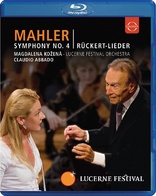
Mahler: Symphony No. 4 / Rückert-Lieder Blu-ray Movie
HomeMahler: Symphony No. 4 / Rückert-Lieder Blu-ray Movie 
Lucerne FestivalEUROARTS | 2009 | 88 min | Not rated | Nov 16, 2010

Movie rating
7.5 | / 10 |
Blu-ray rating
| Users |  | 2.5 |
| Reviewer |  | 4.5 |
| Overall |  | 3.8 |
Overview
Mahler: Symphony No. 4 / Rückert-Lieder (2009)
Claudio Abbado's Mahler cycle continues with performances from his hand-picked Lucerne Festival Orchestra.
Starring: Magdalena KozenáDirector: Michael Beyer
| Music | 100% |
Specifications
Video
Video codec: MPEG-2
Video resolution: 1080i
Aspect ratio: 1.78:1
Original aspect ratio: 1.78:1
Audio
Music: DTS-HD Master Audio 5.1
Music: LPCM 2.0
Subtitles
English, French, Spanish, German, Italian
Discs
25GB Blu-ray Disc
Single disc (1 BD)
Playback
Region free
Review
Rating summary
| Movie | | 4.5 |
| Video | | 4.0 |
| Audio | | 4.5 |
| Extras |  | 0.0 |
| Overall | | 4.5 |
Mahler: Symphony No. 4 / Rückert-Lieder Blu-ray Movie Review
Mahler and happiness usually go together like. . .well, they usually just don't go together.
Reviewed by Jeffrey Kauffman January 3, 2011Gustav Mahler’s life was one fraught with emotional tumult and questioning, and as such, his musical output is often a storm tossed sea of conflicting ideas, styles and mannerisms. Possibly no other composer is able to graft humor and horror as effortlessly as did Mahler, and probably at the very least no other late 19th-early 20th century composer moved so easily between achingly serene lyricism and brittle, astringent bitterness. Mahler was always appreciated—at least in certain circles—in his own lifetime, probably as much if not more for his conducting skills than for his writing, but his music was more than a little ahead of its time, in emotional content if not in its actual musical elements, which hewed fairly strongly to the already developed tropes of people like Richard Strauss and Wagner (despite what contemporary critics may have thought). Mahler was of course incredibly ingenious and quite innovative in how he structured things, but his tonal language rarely if ever varied from the expanded chromaticism still rooted in a tenuous tonality which had been the norm for several years by the time his compositions started being performed. But it’s that very expanded chromaticism, along with the unusual emotional element, which probably kept Mahler’s music from being as readily appreciated in the late 19th and early 20th centuries as it became later under the aegis of Bruno Walter and especially Leonard Bernstein. Mahler’s symphonies are notably recondite works which challenge listeners to enter their often arcane quasi-programmatic worlds. Mahler can veer precipitously from bombastic Wagnerian hyperbole to the bizarrely mordant in a breath, and listeners must be prepared for sudden, and more often than not, unexpected changes in the musical weather. Mahler’s preoccupation with death colors many of his works, making the listening experience an up close and personal interaction with thoughts of mortality. And so what is one to make of the often relatively “easy listening” world of Mahler’s Fourth? This is a piece which is built around the foundation of one song, and as such has a more cohesive seeming structure than some of his other symphonic output (though truth be told Mahler was a supreme architect in even his most ostensibly “wandering” pieces). The Fourth also presents Mahler at his most instantly accessible and melodic, even some would argue simplistic. But it’s definitely Mahler hiding in the shadows throughout every bar of this piece, and as Claudio Abbado’s Lucerne Festival cycle of Mahler Symphonies continues to see the Blu-ray light of day, it gives listeners a new opportunity to examine and appreciate what has, for perhaps the wrong reasons, become the most popular symphony in Mahler’s oeuvre.
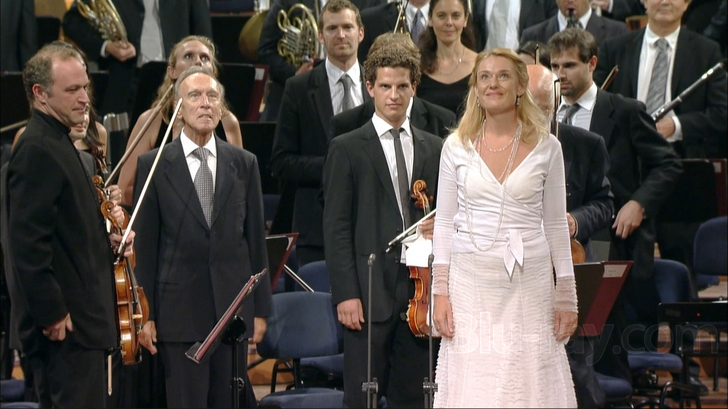
Claudio Abbado is following in the rather large footsteps of the esteemed Arturo Toscanini, with Abbado’s own hand picked roster of musicians filling out the summer season Lucerne Festival Orchestra. In fact, even casual viewers will notice the unusual collegiality and especially the animation of these players. This is a group which doesn’t hustle off the stage as soon as a performance is over, but instead lingers, hugging each other, exchanging appreciative comments, and throwing petals at Abbado’s feet. That incredible rapport is one of the wonderful elements in all of the Lucerne Festival Blu-rays released thus far, and it makes this combo offering of Mahler’s Rückert-Lieder song cycle and his Fourth Symphony such a joy to behold and listen to. As with Mahler’s better known Das Lied Von der Erde, the Rückert-Lieder are alternately performed with different voice classifications, and though they were premiered posthumously with a baritone, here butter-voiced mezzo Magdalena Kozená assumes the vocal duties, as she does with the finale of the symphony. This still relatively young Czech has been receiving more and more acclaim on international stages, and it’s not hard to see in either of her performances here. Not only is she vocally assured, she acts the songs (and the symphonic movement) with inerrant grace and often just a dash of Mahlerian humor.
Mahler was of course incredibly influenced throughout his compositional career with Des Knaben Wunderhorn, the compilation of “folk poems” which caught not just Mahler’s particular fancy, but that of several other composers, including Mendelssohn, Schumann and Brahms. But it has long been Mahler’s settings of the texts which have become iconic, and both the Rückert-Lieder and the Fourth Symphony owe their genesis, at least in part, to the inspiration “The Youth’s Magic Horn” granted Mahler. Though the Rückert-Lieder (named after the author of their texts, poet Friedrich Rückert) are in fact independent entities, they’re often lumped together, even in publishing, with Mahler’s settings of Des Knaben Wunderhorn. Here, separated from the pack as it were, they offer an glittering glimpse into Mahler’s ineffable melodic sense as well as his philosophically questioning proclivities.
His Fourth Symphony is, despite its gargantuan orchestration, one of his simpler, more basic efforts, but it is the simplicity of genius, one filled with mirror images of motives and sequences, sprinkled throughout its fourth movements. As odd as it may sound, and perhaps mostly due to Mahler’s evocative use of sleigh bells, his Fourth has always struck me as a sort of counterpart to Prokofiev’s Lieutenant Kije. In fact, large swaths of Mahler’s Fourth are almost Slavic in character, with huge, abundantly emotional melodies pouring over sturdy and stalwart open fifths in the brass and winds. For those new to experiencing Mahler, there’s certainly no better place to start than with the Fourth, a piece which is positively Haydn-esque one moment and then bitingly modern and trenchant the next.
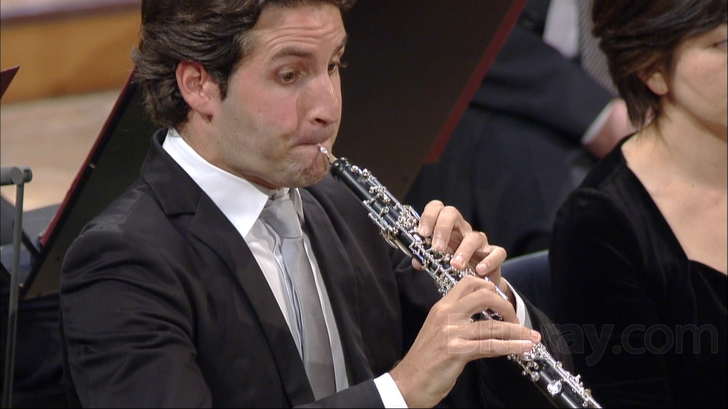
Abbado is assured and in command in both of these performances, conducting without a score (or baton, for that matter). But as convincingly brilliant as he is, it’s the genuine “conversations” occurring in the orchestra which make these performances so incredibly splendid. Clarinetists bob up and down in their seats, cellists seem to virtually saw away at their instruments’ necks, and the graceful hands of the harpist pluck deliberately at accent notes. It’s almost like watching a piece of choreography at times, accompanied of course by some of the most glorious music ever written. Mahler may not have expressed much unfettered joy in his compositional life, but the Fourth and the Rückert-Lieder are both transcendently rapturous experiences, even if they, as so many of Mahler’s pieces do, stare death squarely in the face.
Mahler: Symphony No. 4 / Rückert-Lieder Blu-ray Movie, Video Quality
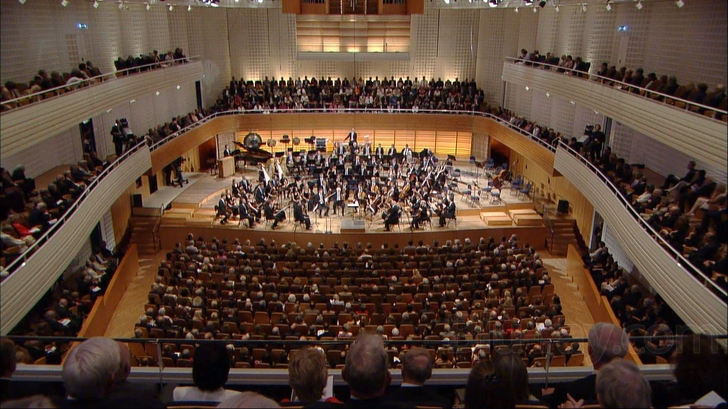
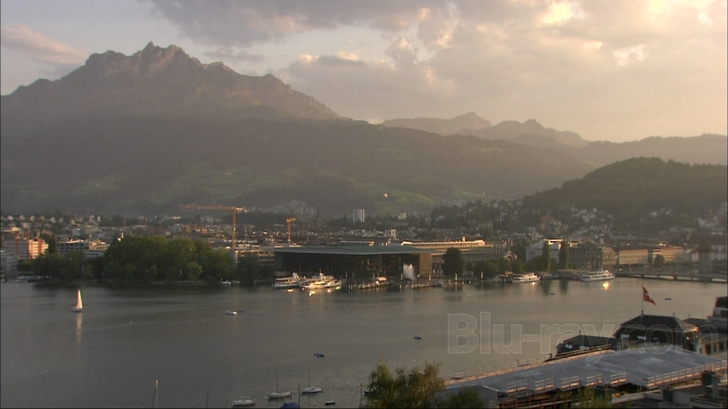
Despite being encoded with the older MPEG-2 regimen, this Blu-ray looks appealingly sharp and well defined. I personally would have loved a bit more footage of the gorgeous environs of Lucerne (a brief credits prelude provides the only chance to view the glories of the Swiss countryside), but once we enter the concert hall itself, detail is for the most part quite excellent, with everything from the flyaway hair of Kozená (and the sparse hair of Abbado) to the fine lines of close-ups on hands and fingers offering the viewer a lot to look at. This is one of the more competently directed concert Blu-rays in recent memory, with really superb coverage of sections and various soli, and the Blu-ray offers abundantly saturated colors and generally excellent fine detail.
Mahler: Symphony No. 4 / Rückert-Lieder Blu-ray Movie, Audio Quality
While both the lossless DTS-HD Master Audio 5.1 and LPCM 2.0 mixes are manifestly excellent, this is one of the very rare cases where I actually recommend toggling between the two for the two different elements in this program. I personally found the added spaciousness of the 5.1 mix acted to the detriment of the Rückert-Lieder, tending to dissipate the beautiful focus of Kozená's voice too broadly over the soundfield. The LPCM 2.0 track, while obviously narrower, keeps the mezzo's fine, liquid tone beautifully centered, with just enough orchestral support. On the other hand, the Fourth sounds magnificent in the 5.1 surround mix, with really good balance between sections and a wonderfully full and rich hall ambience. Both of the tracks sport brilliant fidelity, with excellent dynamic range and flawless reproduction of all frequency ranges.
Mahler: Symphony No. 4 / Rückert-Lieder Blu-ray Movie, Special Features and Extras
No supplements are offered on the Blu-ray.
Mahler: Symphony No. 4 / Rückert-Lieder Blu-ray Movie, Overall Score and Recommendation
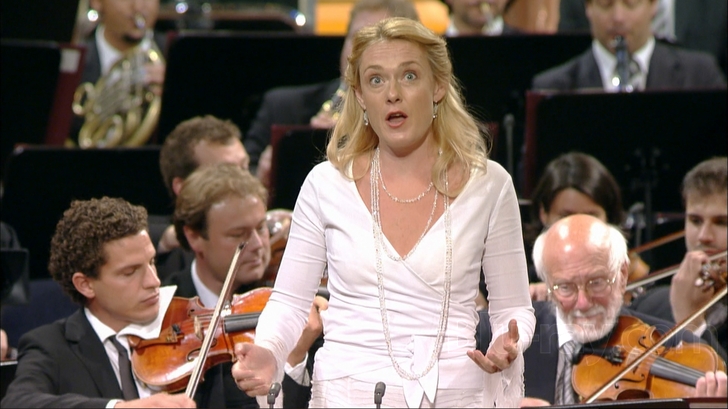
If you've never experienced the tumultuous world of Mahler, take my advice and start with the Fourth Symphony. Unusually melodic, easily accessible (in a good way), but supremely complex and full of Mahler's mordant humor, this is a Symphony which sings with virtually every bar. Along with the lesser known Rückert-Lieder, this wonderful concert is a brilliant example of virtuosic orchestral playing, and Kozená is equally fine in the vocal department. Highly recommended.