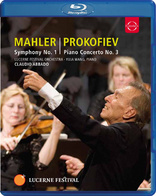
Mahler: Symphony No. 1 / Prokoviev: Piano Concerto No.3 Blu-ray Movie
HomeMahler: Symphony No. 1 / Prokoviev: Piano Concerto No.3 Blu-ray Movie 
Abbado - Lucerne FestivalEUROARTS | 91 min | Not rated | Oct 26, 2010

Movie rating
7.6 | / 10 |
Blu-ray rating
| Users |  | 5.0 |
| Reviewer |  | 4.0 |
| Overall | | 4.0 |
Overview
Mahler: Symphony No. 1 / Prokoviev: Piano Concerto No.3 ()
| Music | 100% |
Specifications
Video
Video codec: MPEG-2
Video resolution: 1080i
Aspect ratio: 1.78:1
Original aspect ratio: 1.78:1
Audio
Music: DTS-HD Master Audio 5.1
Music: LPCM 2.0
Subtitles
None
Discs
25GB Blu-ray Disc
Single disc (1 BD)
Playback
Region A (B, C untested)
Review
Rating summary
| Movie | | 4.0 |
| Video |  | 3.5 |
| Audio |  | 4.5 |
| Extras |  | 0.0 |
| Overall | | 4.0 |
Mahler: Symphony No. 1 / Prokoviev: Piano Concerto No.3 Blu-ray Movie Review
Abbado continues with his Mahler cycle, and throws a little Prokofiev into the mix just for good measure.
Reviewed by Jeffrey Kauffman January 19, 2011Gustav Mahler and Sergey Prokofiev might at first glance seem to be odd musical bedfellows, and yet upon closer examination, they really have more in common than might initially be expected. Both composers are inherently dramatic, with large sweeping melodies and a finely tuned ear for the unexpected chromatic dissonance. But what really unites them is their sardonic senses of humor, a trait that comes through quite clearly in a lot of their compositions. That astringent aspect is especially noteworthy (sorry, couldn’t resist) when one takes into account the tribulations both composers encountered through their professional and personal lives. Mahler of course was beset with all sorts of personal tragedies and at least occasional career setbacks, and he himself considered his writing as an avocation, with his conducting duties being his primary focus, at least in terms of making a living. If Prokofiev didn’t quite experience the level of sadness and even tragedy that Mahler did, he nonetheless found himself the victim—like his compatriot Shostakovich—of the vagaries of the Soviet system, when, to paraphrase Heidi Klum on Project Runway, “One day you’re in, the next, you’re out.” Both composers are also notoriously difficult to interpret and conduct, but Claudio Abbado has been at the forefront of recent Mahler releases, including this splendid cycle he’s been doing with his hand-picked Lucerne Festival Orchestra, and he adds a vigorous reading of Prokofiev’s Third Piano Concerto to the mix on this Blu-ray. The Third, one of the most daunting in 20th century piano literature, is a propulsive and sometimes mechanistic piece that brings to mind some of the “industrial” sounding moments of Prokofiev’s symphonic oeuvre.
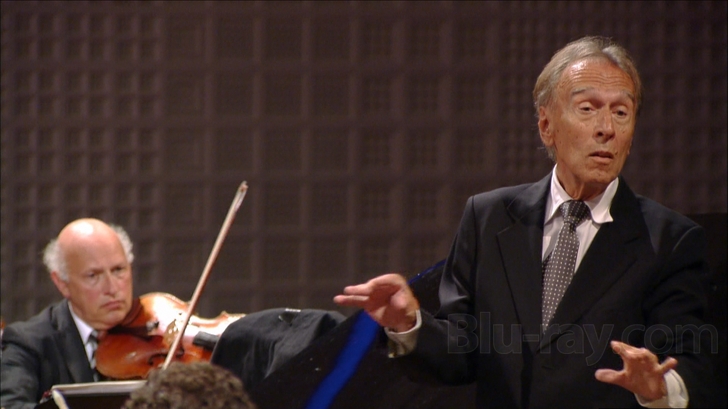
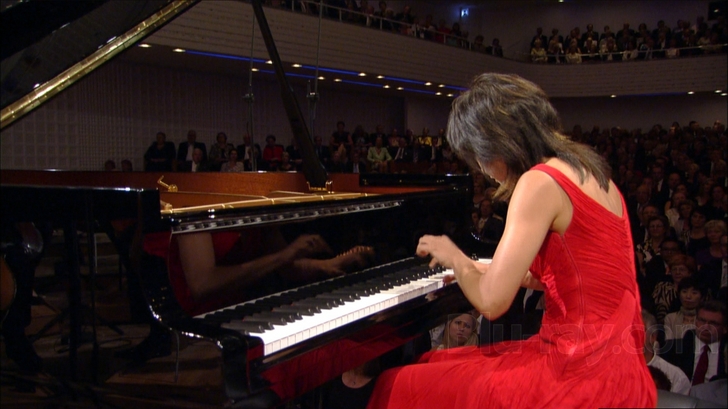
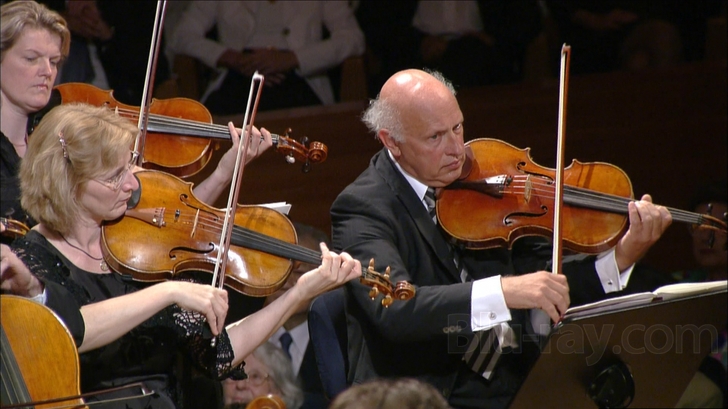
Abbado founded this iteration of the Lucerne Festival Orchestra in 2003, in conjunction with the Festival’s Artistic and Executive Director Michael Haefliger. This ensemble consists of personally chosen soloists and ensemble members from the finest European orchestras and chamber groups, and that level of expertise shows in virtually every note the group plays. Abbado follows in the redolent footsteps of Arturo Toscanini, who founded the original Lucerne Festival Orchestra in 1938. Abbado and his players are joined in this recital by twenty two year old Chinese pianist Yuja Wang, whose youthful exuberance matches some of the energy Prokofiev invested in this commanding piece.
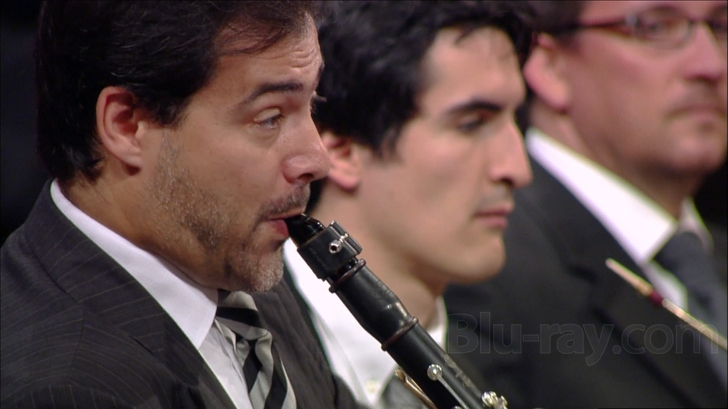
The concert in fact begins with the Prokofiev Concerto, and right off the bat we’re privy to a gorgeously languid clarinet solo, just the tip of the orchestral iceberg in terms of incredibly nuanced soli which dot both this piece and the Mahler which follows. An ensemble at this level means each appointed soloist is most likely going to be presenting impeccable musicianship, and that’s certainly the case here. As the strings enter with their brisk ascending scales, and then Wang bursts in with the somewhat unexpected first statement from the piano, we’re off on a whirlwind tour through Prokofiev’s often biting wit and casually dissonant presence.
Wang is still rather young, and if she doesn’t quite have the interpretive capabilities of Lang Lang, she’s well on her way to proving herself one of the instrument’s new masters in waiting. Her phrasing is excellent, albeit occasionally a bit mushy and rushed, but in a piece this physically demanding, those passing issues are perhaps more readily understandable than they would be in a less challenging piece. The orchestra plays with an assured fluidity, and in fact Prokofiev doesn’t really relegate the orchestra to its typical “supporting” role in this concerto; it’s a full fledged partner here, and the Lucerne Festival Orchestra makes the most of that partnership.
Mahler’s First also receives a brilliant interpretation here. As is typical with Mahler’s Symphonic output, there’s a program of sorts which describes various images and ideas. As is also typical with Mahler, a lot of the symphony springs from the world of nature, with the first movement being a musical depiction of youth and spring. It wouldn’t be Mahler if this initial sunniness soon turned to darker despair, and indeed we get a second half which is subtitled “Human Comedy” but which also contains the soubriquets “Shipwrecked” and “Dell’inferno at Paradiso.” Mahler traipses through a sort of sardonic folk song ethos through much of this Symphony, evoking an almost Grimm’s Fairy Tale world of sound at times, where famous tunes like “Bruder Martin” get an ominous and minor reworking.
Abbado’s interpretive powers are top notch throughout this piece. He shapes his phrases carefully and expressively and delivers a visceral and vigorous experience. This is one of Mahler’s most easily accessible works, albeit perhaps not as “simple” sounding as the Fourth, but Abbado wrests every last drop of drama out of his reading of the score, and the orchestra plays fabulously throughout, though there were some perhaps surprising (if very, very brief) intonation problems from the horns and some unexpected brightness on occasion from the reeds.
Mahler: Symphony No. 1 / Prokoviev: Piano Concerto No.3 Blu-ray Movie, Video Quality
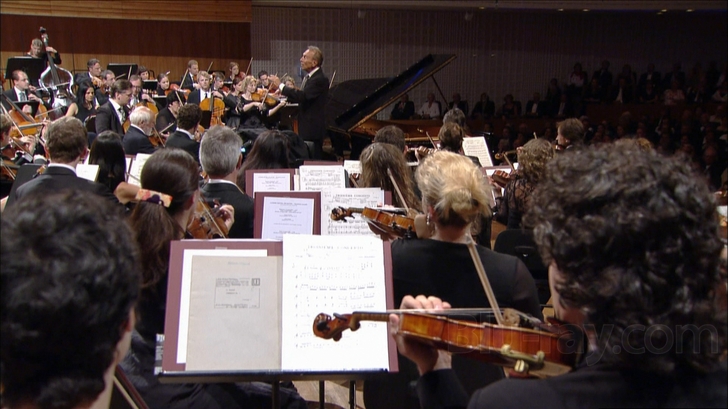
This 2009 concert, like others in the Mahler cycle from EuroArts, arrives on Blu-ray with an MPEG-2 encode, in 1080i and 1.78:1. While there's nothing horrible to report about this image, it really doesn't pop with hi-def grandeur the way some other Naxos distributed titles have. While colors are relatively robust (and Wang's bright red dress just barely manages to avoid blooming), there's an overall softness to a lot of the image. Midrange and far range shots (the latter being a relative term, meaning from the back of the concert hall) are really nowhere near as sharp as they should be, and the far range shots are actually kind of a muddle, with no clear delineation of forms. Close-ups are quite a bit better, and the good news is this concert receives really smart coverage, with ample shots of various orchestral players and soloist Wang.
Mahler: Symphony No. 1 / Prokoviev: Piano Concerto No.3 Blu-ray Movie, Audio Quality
Both of the lossless audio options offered on this disc are very well rendered. Both the DTS-HD Master Audio 5.1 and LPCM 2.0 mixes sport brilliant fidelity and impressive dynamic range. The piano sounds marvelous on the Prokofiev, with no tinniness or overarching brightness. The DTS track amply supports the huge frequency ranges both composers use in these works, especially Prokofiev's awesome spanning of the keyboard, often in massed clusters, all of which ring through with absolute clarity. As reported above, there are a few very brief issues on the Mahler, and the reeds at times sound overly bright, even a bit brash. Otherwise, this is a nicely burnished sounding mix that offers beautiful hall ambience and an inviting clarity throughout both performances.
Mahler: Symphony No. 1 / Prokoviev: Piano Concerto No.3 Blu-ray Movie, Special Features and Extras
No supplements are offered on this Blu-ray.
Mahler: Symphony No. 1 / Prokoviev: Piano Concerto No.3 Blu-ray Movie, Overall Score and Recommendation
Abbado's Mahler cycle is turning out to be one of the glories of current classical music releases, and the First follows in that tradition admirably. The Prokofiev is a brisk and demanding piece which receives an athletic interpretation here and which makes a surprisingly facile companion to the Mahler First. Recommended.