Mahler: Symphonies 1-7 Blu-ray Movie
HomeMahler: Symphonies 1-7 Blu-ray Movie 
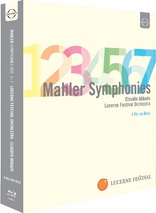
Abbado Conducts Mahler - Lucerne FestivalEUROARTS | 2008-2011 | 7 Movies | 610 min | Not rated | Apr 26, 2011
Price
List price:Not available to order

Movie rating
7.9 | / 10 |
Blu-ray rating
| Users |  | 4.2 |
| Reviewer |  | 4.5 |
| Overall | | 4.2 |
Overview
Mahler: Symphonies 1-7 (2008-2011)
The unforgettable performances by Claudio Abbado and the LUCERNE FESTIVAL ORCHESTRA of Mahler’s Symphonies Nos. 1−7 are newly celebrated in a set which showcases their exceptional quality – both audiovisual and musical. Claudio Abbado has set new standards in the interpretation of Gustav Mahler’s works; he and his exclusive ensemble of hand-picked musicians held audiences spellbound in these concerts. REPERTOIRE: Mahler: Symphonies Nos. 1-7; Five lieder based on poems by Friedrich Rückert; Sergei Prokofiev: Piano Concerto No. 3 in C Major, Op. 26
| Music | 100% |
Specifications
Video
Video codec: MPEG-2
Video resolution: 1080i
Aspect ratio: 1.78:1
Original aspect ratio: 1.78:1
Audio
German: DTS-HD Master Audio 5.1
German: LPCM 2.0
Subtitles
English, French, German, Italian, Spanish
Discs
50GB Blu-ray Disc
Four-disc set (4 BDs)
Playback
Region free
Review
Rating summary
| Movie | | 4.5 |
| Video | | 4.0 |
| Audio | | 4.5 |
| Extras |  | 0.0 |
| Overall | | 4.5 |
Mahler: Symphonies 1-7 Blu-ray Movie Review
Abbado's Mahler is back in this new boxed set, with corrected audio.
Reviewed by Jeffrey Kauffman May 15, 2011Very few composers in the post-Beethoven universe have managed to equal his output of nine symphonies, and in fact probably only Dvorak, Mahler, Brückner and Shostakovich spring instantly to the minds of a lot of classical music aficionados. Mahler’s nine symphonies hold a special place even among the rarified stratosphere that these very few composers inhabit, if only because his outings were so frequently gargantuan efforts the likes of which had never been heard before. Routinely augmenting his orchestra with all sorts of added instruments (something Brückner would also do), Mahler seemed to want to literally storm the gates of heaven with his sound worlds, and some would argue that he at the very least came close with some of his most bombastic movements. We’ve been very fortunate in the Blu-ray era to get a remarkable account of (as of this writing) the first seven of Mahler’s symphonies by the redoubtable Claudio Abbado and his hand-picked Lucerne Festival Orchestra. While those of us who grew up listening to iconic renditions of the Mahler symphonies by such conductors as Bruno Walter or Walter’s protégé Leonard Bernstein will probably still return to those recordings for the “comfort food” they offer, the fact is Abbado has staked out a rather formidable claim to be the leading Mahler interpreter currently wielding his baton. Inerrantly musical without giving into Mahler’s penchant for hyperbolic statements, Abbado has managed to craft a largely impeccable set of readings that have instantly jumped to the forefront of Mahler interpretations, at least in the relatively recent high definition audio era.

While it may be a bit odd for EuroArts to be releasing only the first seven of Mahler’s nine symphonies, classical music lovers will probably be more inclined to pick up this release than they might have otherwise due to some problematic audio that cropped up on the initial standalone release of Mahler’s Second Symphony. (Some listeners insisted the same problem was apparent on the Fourth Symphony, but I personally found that not to be the case). Though I personally wasn’t as taken aback by the repurposed stereo mix on the initial release of the Second as some alert listeners were, it was taken seriously enough by EuroArts that they went back to the audio drawing board and provided a true discrete 5.1 mix on a repressed Blu-ray, audio which is offered here as well. While one of our more ardent readers mentions some synch issues with the audio and visual elements on the Second, my personal opinion is that these are negligible, and in fact I believe the one moment with the bass drum was perhaps misperceived by our reader, as the percussionist is actually holding another brush to the side where it can't be seen from the angle from which it's being shot. Even granting minor synch issues, one way or the other, there are probably no more persnickety audiophiles than classical music lovers (no matter what the kids who frequent summer action blockbusters may insist), and so this is on the whole very good news for this admittedly niche audience.
The Mahler Symphonies remind me in a way of musical fractals. Fractals are those incredible paisley geometric shapes which can be split into parts, with each part being a mirror image in microcosm of the fractal as a whole. This bizarre trait is called self-similarity, and it is a trait shared at least in part by all of Mahler's symphonic output. Any individual Mahler Symphony seems similarly cut from the same cloth, and there are so many cross references Mahler provides throughout his symphonic oeuvre that it’s truly astounding at times. For those new to the Mahler soundworld (and there’s probably no better place to start than with these Abbado Lucerne Festival BDs), the most easily accessible symphonies are probably the First and the Fourth. These are the “smallest” (small being a decidedly relative term in the Mahler universe) symphonies and both feature easily graspable themes and structures that help invite the listener into the alternately bizarrely mordant, playfully childlike and rhapsodically lyrical moments that Mahler segues to and from, sometimes at the drop of a veritable hat (and/or measure).
As of the writing of this review of this new boxed set, the only standalone releases which we’ve not yet covered individually are the new releases of the Fifth and the Seventh, so I refer readers to the previous standalone release reviews for more in-depth thoughts on each of the Symphonies and occasional bonus content that is found on those standalone releases (click on the Overview tab on the main product page for easily accessible links to all of the previous standalone reviews). Individual reviews of the Fifth and Seventh, review copies of which have only recently gotten to me, will be posted as soon as possible.
If Beethoven’s opening motive in his Fifth Symphony is often described as opportunity knocking, what are we to make of a really rather similar motive which bursts figuratively through the door as Mahler’s Fifth gets underway? Mahler has the audacity to start his symphony with a funeral march, and this triplet motive can perhaps then only be thought of as Death tapping incessantly to gain our attention. The Fifth is a symphony of huge extremes, large even by Mahlerian standards. The relative calm, albeit a calm of that incessant triplet motive, soon gives way to the chaos of emotion and fury as the death march really swings into full gear. Abbado martials the orchestral forces brilliantly here, giving the listener huge waves of sound which crash about with a sonic savageness that then suddenly quells into relatively quietude.
The Fifth is sometimes alluded to as Mahler's most "traditional" symphony, which is ironic, to say the least. Mahler stretches and bends the formal envelope of what was generally considered to be "proper" throughout this symphony, giving the listener one of the longest symphonies of its era, and one which is so emotionally laden with highs and lows it almost single-handedly puts a stop to "reserved" traditional classicism. Abbado's measured approach throughout this symphony is masterful, delivering a clear architecture that lets the listener perceive the overall unity within this piece's roiling individual movements.
As for the Seventh, Abbado once again proves his mastery, conducting as is his wont without a score. The Seventh begins with an oddly ruminative, tentative opening, as if Mahler is joining the Symphony mid-sentence as it were. Once the first subject is announced, however, we’re once again off on a whirlwind tour through Mahler’s overactive psyche, full of bombast and melancholy one moment, and then biting humor and lyricism the next.
The Seventh is notable for its two Nachtmusik (Nightmusic) movements, typically dark fairy tales that evoke the shadowy worlds of the Brothers Grimm at their most gruesome. That’s especially true of the first Nachtmusik, where Mahler introduces a panoply of instruments one by one which caterwaul around each other in a sort of witches’ dance. Clarinets, oboes, flutes and brass start dueling for airspace until the entire orchestra careens downward as if catapulting down a slide. The second Nachtmusik is notable for the use of a guitar. Mahler often evoked folk song and folk music in general in at least one movement of each of his symphonies, but the guitar here is an unabashed reference to the folk idiom and it’s an unusual coloristic element for Mahler.
The Symphony also presents a thesaurus of unusual string techniques, including col legno and lots of glissandi and portamenti which seem at times to be the aural equivalent of Mahler letting us in on some sort of inside joke. The final movement here is an Abbado-Lucerne tour de force, with an incredibly dynamic timpani flourish to get us off on our Rondo with aplomb. The momentum rarely lets up from that moment and the entire final movement is like a mad rush toward some mystically hidden goal.
Mahler: Symphonies 1-7 Blu-ray Movie, Video Quality
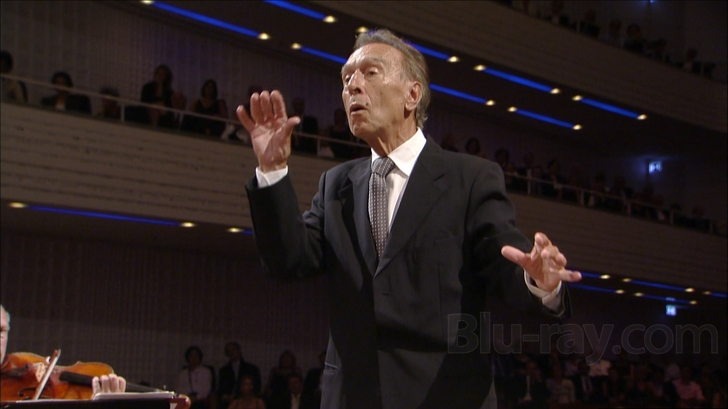
For the record, the first three discs in this four disc set are BD50s and hold two symphonies each. The fourth disc is a BD25 and is essentially the same disc as the standalone release of the Seventh. Despite being encoded via the "old school" MPEG-2 protocol, all of these Mahler symphonies offer well above average image quality, and in a couple of cases, it's decidedly better than that. Colors are well saturated, precise and accurate, and fine detail is abundantly apparent in any of the many close-ups which populate this series. Occasionally midrange and far range shots suffer from murkiness, and there are very minor and occasional aliasing issues that crop up from time to time, mostly to do with the ultra modern Lucerne concert hall where these performances took place, as well as fast moving bows in the string section. But all of these very minor issues fade into the background when one considers the brilliant performances and the stunning audio this release affords.
Mahler: Symphonies 1-7 Blu-ray Movie, Audio Quality
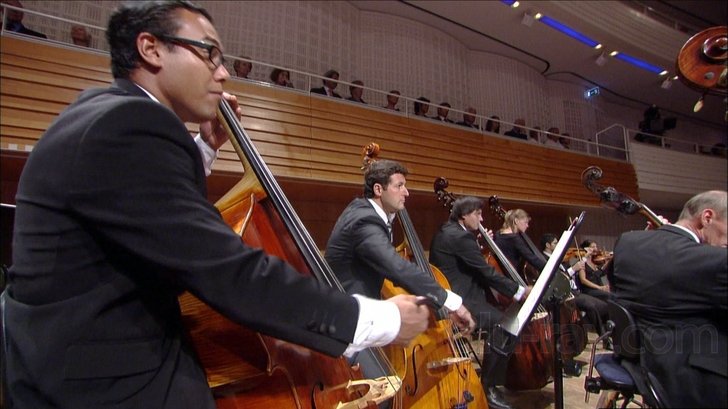
Aside from the redone Second Symphony (more about which later), there's another interesting change in this boxed set from the original standalone releases, at least with regard to the standalone release of the Third Symphony, and one which has not been addressed online by anyone that I've been able to find. While all of the standalone releases offered two lossless tracks, the surround track on the Third Symphony was actually an uncompressed LPCM 5.1 track, rather than this set's DTS-HD Master Audio 5.1. (Why this should be so is rather odd, as the Third is not chronologically the oldest in this set, and both older and newer releases offer DTS-HD Master Audio 5.1 lossless surround mixes on their standalone versions). Both the standalone and boxed set offer LPCM 2.0 mixes as the uncompressed stereo option. Is there a difference between the LPCM 5.1 and the DTS-HD Master Audio 5.1? If there is, it's extremely minor and in fact negligible. It's hard to do a simultaneous comparison, as one disc needs to be removed and another put in the player, and in the interim, aural impressions can fade. The bottom line is the DTS-HD Master Audio 5.1 mixes on all of these symphonies, including the Third, sound spectacular. As with the previous release, the Fourth probably comes off as the weakest of the bunch in terms of actual surround activity, but I still personally do not think we're dealing with a repurposed stereo mix here (but I could be wrong, it certainly wouldn't be the first time). What seems to be happening in the Fourth is actually some overly aggressive discrete channelization that may add to the feeling that there's not a "secure middle" in terms of massed sound. That dispersiont may add to the sense that some of the sonics are on the "skinny" side.
Aside from the Fourth and the Second (which we will get to, I promise), the rest of these Symphonies sound absolutely fantastic. Fidelity is unbelievably spot on and dynamic range is nothing short of miraculous. Few composers brave the huge dynamic leaps that Mahler does, sometime literally from beat to beat, and under the sure leadership of Abbado and the impeccable playing of the Lucerne Festival Orchestra, all of those sudden drops and ascensions are magnificently reproduced and are literally overwhelming at times.
There is a radical and distinct improvement in the new DTS-HD Master Audio 5.1 track on the Second which should delight any Mahler aficionado. While the bulk of the symphony sounds clearer and is much more authentically immersive than it was before, the biggest difference here is in dynamic range, which simply blows the previous mix out of the water. The bombastic splashes of color that open the fifth movement are especially impressive, but the entire Symphony glistens now with amazing color and nuance, with the huge changes in dynamics brilliantly reproduced on this exceptional DTS-HD Master Audio 5.1 track.
Mahler: Symphonies 1-7 Blu-ray Movie, Special Features and Extras
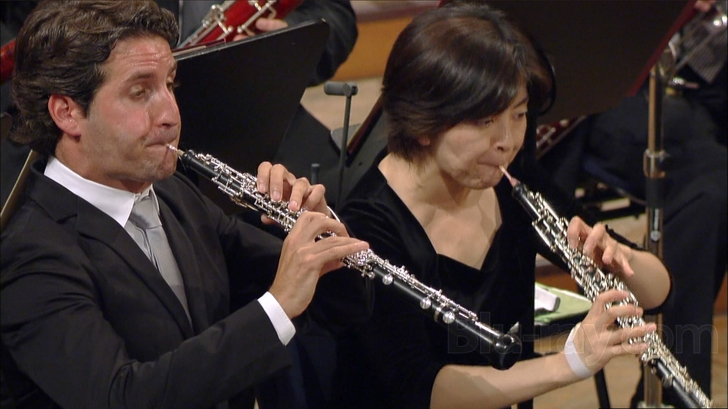
No extras per se are offered on the discs, aside from the bonus performances of such pieces as the Rückert-Lieder and a piece by Prokofiev (see the individual standalone reviews for complete program details). The nicely slipcased boxed set includes a handsome booklet that reproduces all of the liner notes from the original standalone releases.
Mahler: Symphonies 1-7 Blu-ray Movie, Overall Score and Recommendation
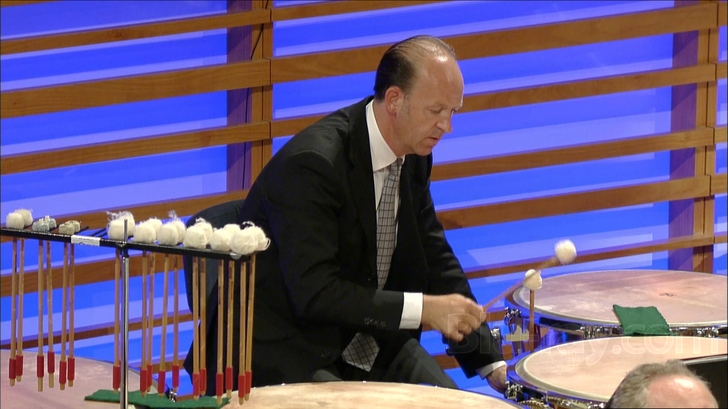
About the only qualms any Mahler fan should have with this set is wondering where the Eighth, Ninth and unfinished Tenth are. Aside from that perhaps irrelevant query, this is a Mahler Cycle for the high definition era, and one which, especially with the "corrected" audio on the Second, makes the most of Mahler's unique and challenging sound world. Abbado and the Lucerne Festival Orchestra have provided classical music lovers with one of the touchstones of this still developing Blu-ray era, and this release is most definitely Very highly recommended.
Similar titles
Similar titles you might also like
(Still not reliable for this title)

Pink Floyd: Wish You Were Here
Blu-ray Audio | 50th Anniversary Edition
1975

David Gilmour - Live at the Circus Maximus
2024

Prince and the Revolution: Purple Rain
Blu-ray Audio
1984

Fleetwood Mac: Rumours
Atmos Blu-ray Audio
1977

The Beatles: Let It Be
Super Deluxe Edition | Blu-ray Audio
1970

David Bowie: The Rise and Fall of Ziggy Stardust and the Spiders from Mars
Dolby Atmos Blu-ray Audio
1972
Depeche Mode: Strange Too
1990
Depeche Mode: Strange
1988

Pink Floyd: The Dark Side of the Moon
50th Anniversary Atmos Remix / Blu-ray Audio
1973

Roy Orbison: Black & White Night 30
1987-2017

Prince and the Revolution: Live
1985

John Williams: The Berlin Concert
Limited Deluxe Edition
2021

Pink Floyd: Pulse
1995

Pink Floyd: Animals
Atmos Remix / Blu-ray Audio
1977

Eric Clapton: The Lady in the Balcony - Lockdown Sessions 4K
2021

The World of Hans Zimmer: Live at Hollywood in Vienna
2018

Madonna: The Girlie Show - Live Down Under
1993

S&M2: Metallica and San Francisco Symphony
2019

John Williams - Live in Vienna
2020

Nick Mason's Saucerful of Secrets: Live at the Roundhouse
2019