Mahler: Symphonies 1-10; Totenfeier; Das Lied Von Der Erde Blu-ray Movie
HomeMahler: Symphonies 1-10; Totenfeier; Das Lied Von Der Erde Blu-ray Movie 
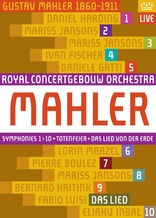
Royal Concertgebouw OrchestraHarmonia Mundi | 2009-2011 | 915 min | Rated G | Jan 08, 2013

Movie rating
6.7 | / 10 |
Blu-ray rating
| Users |  | 3.5 |
| Reviewer |  | 4.0 |
| Overall | | 3.5 |
Overview
Mahler: Symphonies 1-10; Totenfeier; Das Lied Von Der Erde (2009-2011)
| Music | 100% |
Specifications
Video
Video codec: MPEG-4 AVC
Video resolution: 1080i
Aspect ratio: 1.78:1
Original aspect ratio: 1.78:1
Audio
German: DTS-HD Master Audio 5.0
German: LPCM 2.0
Subtitles
None
Discs
25GB Blu-ray Disc
Eleven-disc set (11 BDs)
Packaging
Slipcover in original pressing
Playback
Region A (B, C untested)
Review
Rating summary
| Movie | | 4.0 |
| Video | | 4.0 |
| Audio |  | 4.5 |
| Extras |  | 0.0 |
| Overall | | 4.0 |
Mahler: Symphonies 1-10; Totenfeier; Das Lied Von Der Erde Blu-ray Movie Review
When is a Mahler Cycle not a Mahler Cycle?
Reviewed by Jeffrey Kauffman January 18, 2013It never ceases to surprise me when some classical music aficionados, and even some professional music critics, refer to Gustav Mahler’s music as “an acquired taste”. Arnold Schoenberg’s music might be an acquired taste, but Mahler’s? Mahler, of the gargantuan orchestral forces, the overwrought emotional content, and most of all the supremely melodic, at times achingly lyrical, approach to his compositional craft might initially seem to be almost intuitively accessible, even to those who don’t have a particular interest in classical music. But there’s obviously something about Mahler that doesn’t always speak to the masses. It may indeed be the sheer size of some of his symphonic output, or the sudden changes in emotional tone, which can vary from tragedy to acerbic humor in the space of one measure. But for those who have acquired a taste for Mahler, the high definition era has been paying some remarkable dividends over the past couple of years. Probably the most notable (no pun intended) of these has been the remarkable Mahler cycle conducted by Claudio Abbado with his hand picked Lucerne Festival Orchestra, which was released first in standalone offerings and then as Mahler: Symphonies 1-7. Those of you who know Mahler’s symphonic output will immediately recognize that this is an incomplete set, for Mahler completed his eighth and ninth symphonies before his untimely demise, and of course had also started work on his tenth, which has survived largely via its gorgeous Adagio, which Mahler did more or less finish before his passing. Rather strangely, there doesn’t appear to be an Eighth available on Blu-ray conducted by Abbado, though there are two performances of the Ninth available, one with the Gustav Mahler Jugendorchester and another with the Lucerne Festival Orchestra. Lovers of the eighth have had to “make do” with the appealing performance by Riccardo Chailly or the more recent Mahler: Symphony No 8. So this new box set of all of Mahler’s symphonic output, as well as Totenfeier and Das Lied Von der Erde offers the first inclusive collection available on Blu-ray. It can’t really be accurately termed a “cycle”, since there are a number of different conductors wielding the baton throughout these performances, but the often magnificent playing of the Royal Concertgebouw Orchestra in all of these outings does offer a semblance of continuity and consistency.
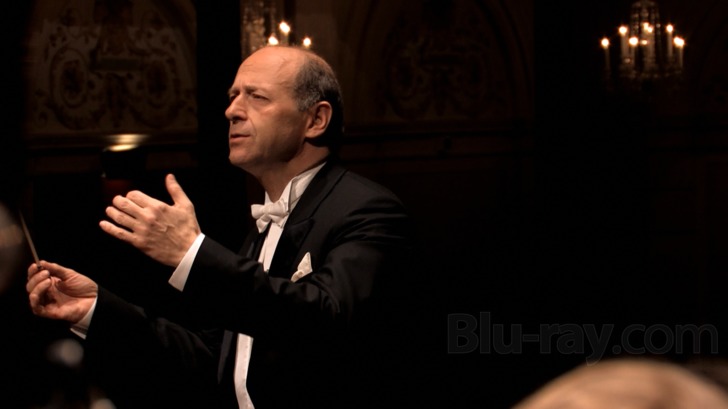
This set includes the following performances:
Symphony No. 1
Conducted by Daniel Harding
Performance Dates: September 30, October 1 and 2, 2009
This performance recorded live on September 30, 2009
Daniel Harding is a young British conductor who has risen incredibly fast in a rather short amount of time, helped along by some felicitous mentoring by Sir Simon Rattle. Harding brings a youthful insouciance to his interpretation of Mahler’s First, often given the soubriquet “The Titan”. Things don’t get off to a particularly promising start, with some minor synchronization issues in the “calm before the storm” opening which might remind some less classically inclined listeners just a little bit of the opening motive of the original Star Trek theme. But once the orchestra kicks into gear, Harding marshals the forces extremely well and his conducing of the almost lunatic Ländler second movement is quite impressive. The minor keyed Bruder Martin (AKA Frère Jacques) is another highlight, but the final bristling movement proves to be this performance’s true touchstone. Harding shapes the dynamics very well and the orchestra plays with incredible vigor and precision.
Symphony No. 2
Conducted by Mariss Jansons
Ricarda Merbeth, Soprano
Bernarda Fink, Mezzo-Soprano
Performance Dates: December 3, 4, and 6, 2009
This performance recorded live on December 3. 2009
Mahler was preoccupied with extremely weighty matters throughout his compositional life, and his Second Symphony (The Resurrection) deals with two interrelated subjects which were something of an obsession for the composer, death and the afterlife. One of the nice bonuses of this box set is that it includes a performance of Totenfeier (Funeral Rites), which is an early version of this symphony’s first movement. That first movement is indicative of what evidently distances the composer from some listeners, for it segues from brooding minor key ruminations to sudden bursts of glorious major key passages at the drop of a veritable hat. But that’s part of the dialectic that makes Mahler such a compelling figure in modern music. Mariss Jansons is able to bridge these huge changes in tempo, style and key with grace and élan, and this is in fact one of the better performances of the Second that I’ve heard recently. The singing by Bernarda Fink (a mezzo taking the role typically assigned to an alto) is especially lovely. Jansons' handling of the potentially unruly final movement is also very impressive, with finely nuanced transitions between the many contrasting moods and themes. Keep your eyes peeled for some brief but fun looks at the brass contingent out in an antechamber during this movement, helping to create one of Mahler's "spatial" effects. (Also note the somewhat comical sight of a clarinet player back in the concert hall putting in ear plugs before a particularly tempestuous moment.) One odd thing about this performance: the audience applauds between the first and second movements. That’s a definite “no no” in the hoity toity world of classical music.
Symphony No. 3
Conducted by Mariss Jansons
Bernarda Fink, Mezzo-Soprano
Performance Dates: February 3, 4, and 5, 2010
This performance recorded live on February 3 and 4, 2010
The Third Symphony is a not piece for the faint of heart or the tender of posteriors, for even a “quick” performance of this incredibly huge masterpiece typically runs well over an hour and a half (for the record, this performance clocks in at a somewhat lengthier than usual 103 minutes, including breaks). Mendelssohn was famous for writing music for A Midsummer Night’s Dream, but Mahler envisaged this symphony as a sort of Summer’s Midday Dream, a walking if not waking fantasy that incorporated the composer’s rather eclectic religious sensibilities by invoking everything from Pan to Nature in one hugely disparate piece of orchestral writing. Once again Mariss Jansons forges a uniquely consistent approach to all of the roiling content which can make this incredibly long piece often seem inchoate to the point of chaos. The orchestra plays with fine luster, including some gorgeous solos by the concertmaster in the first movement. Once again the audience applauds between movements, but in this case it’s a bit more understandable, since Bernarda Fink (once again taking a role typically assigned to an alto) makes her entrance between the first and second movements (though she doesn't sing until the fourth). Also once again we get a brass player in the antechamber watching the proceedings on closed circuit television and offering his contributions from a distance. I personally wish Fink had been mixed a little higher, something that afflicts many of the sung moments in this set, but at least part of this imbalance issue may be due to the peculiar layout of this hall, where the soloists in several of these outings are placed in back of the orchestra, just slightly in front of the larger choral masses.
Symphony No. 4
Conducted by Ivan Fischer
Miah Persson, Soprano
Performance Dates: April 22 and 23, 2010
This performance recorded live on April 22 and 23, 2010
Mahler’s Fourth is an often ebullient and uncommonly melodic piece, and as such it’s the perfect place to start for those wanting to test the Mahler symphonic waters. The Fourth makes a perfect companion piece to Prokofiev’s Classical Symphony, for both traffic in a sort of Haydn-esque musical vocabulary, albeit one highly colored by chromaticism and odd orchestral effects. What’s so pleasant in this interpretation helmed by the great Ivan Fischer is how malleable the phrasing is in what is at times an almost Neoclassical symphony. The first movement is especially notable in this regard, with wonderfully drawn out cadences and other “give and take” that makes this rather remarkably facile in terms of trundling down a symmetrically organized structure with a rather elastic approach to time and phrasing. Opera superstar Miah Persson offers a wonderfully heartfelt and lyrical “The Heavenly Life”, one of Mahler’s most effortlessly melodic offerings. (As an aside to those of you who are familiar with it, listen to how similar some of the musical content and orchestral flourishes are to Prokofiev's later Lieutenant Kije Suite.
Symphony No. 5
Conducted by Daniele Gatti
Performance Dates: June 23, 24, and 25, 2010
This performance recorded live on June 25, 2010
There’s little doubt that Mahler had at least a little Beethoven on his mind as he wrote his Fifth. The opening trumpet motive seems almost like a topsy turvy version of Beethoven’s iconic opening motive for his Fifth Symphony. Instead of Beethoven tracing of a minor triad from the fifth to the minor third, Mahler (literally) inverts that idea, starting on the tonic, then tracing upward to the minor third, fifth and ultimately the octave. There’s the same “fatalistic” content to Mahler’s Fifth as has often been ascribed to Beethoven’s, but the two obviously couldn’t be more different in terms of size, scope and ultimate musical content. Conductor Daniele Gatti may be one of the lesser known leaders to some coming to this set, but he has been a champion of Mahler’s music for some time and has conducted a Mahler cycle of his own with his Orchestre National de France. He does a commendable job for the most part with this gargantuan piece, though the orchestra seems occasionally a bit timid on some entrances, leading to some minor collisions and intonation problems, mostly with the brass. I personally would have preferred a bit more precision to the playing in the second movement, which Gatti invests with a lot of energy if not a lot of nuance.
Symphony No. 6
Conducted by Lorin Maazel
Performance Dates: October 20, 21, 22 and 24, 2010
This performance recorded live on October 20, 2010
Former wunderkind Lorin Maazel has carved out a rather formidable career as a conductor and he does an admirable job with what is often seen, rightly or wrongly, as one of Mahler’s more “problematic” symphonic opuses. What’s odd about this perception is that in some ways the Sixth remains Mahler’s most conventional piece of symphonic writing, albeit in the case of Mahler “conventional” is of course a decidedly relative term. There are still the astounding leaps of emotional content, and even the more formal supposed peccadilloes of not clearly delineating what “key” the piece is in (the first movement makes a mockery of keys, with a main motive which repeatedly ping pongs back and forth between A major and A minor). This is also the symphony that has had a somewhat muddled history in terms of how the movements should be ordered, but Maazel and the Royal Concertgebouw follow the now more or less conventional approach of placing the Scherzo second and the Andante third. This symphony is also notable for its use of percussion, including a lot of tympani, glockenspiel and, in the final movement, a hammer! (You might be forgiven in you think that's Gallagher wielding the huge "weapon", as the percussionist brings it down with so much force little pieces of wood go flying every which way.)
Symphony No. 7
Conducted by Pierre Boulez
Performance Dates: January 20 and 21, 2011
This performance recorded live on January 20 and 21, 2011
Not to be too cavalier about bandying about soubriquets, one might understand if this symphony’s subtitle Song of the Night (given to it by others, not the composer) might be slightly reworked, with a tap of the hat to Mozart, as A Big Night Music. Yet another gargantuan piece that spans five movements and runs for close to eighty minutes, the Seventh continues several ideas that were put forth in the Sixth, including tempestuous changes in tempi and pure musical content, as well as an intentional ambiguity in tonal centers, fostered once again by parallel major and minor triads. It’s notable that erstwhile provocateur Pierre Boulez conducts this piece, for in many ways this is one of Mahler’s most “in your face” symphonies, one which completely confused audiences and critics at the time of its premiere and remained one of the composer’s least appreciated pieces for decades afterwards. Part of this is no doubt due to the symphony’s almost halting, stuttering introduction of various motifs which on first (and perhaps even second) listen don’t have much to do with each other, but there’s certainly a wealth of inspiration running throughout the work, perhaps most apparent to uninitiated listeners in some of the gorgeous, more relatively quiet and lyrical, writing for solo brass. Also note the use of such atypical instruments as the acoustic guitar in the fourth movement.
Symphony No. 8
Conducted by Mariss Jansons
Christine Brewer, Soprano
Camilla Nylund, Soprano
Maria Espada, Soprano
Stephanie Blythe, Mezzo-Soprano
Mihoko Fujimura, Alto
Robert Dean Smith, Tenor
Tommi Hakala, Baritone
Stefan Kocan, Bass
Performance Dates: March 4 and 6, 2011
This performance recorded live on March 4 and 6, 2011
In many ways Mahler’s Eighth is my favorite among his symphonies, if for no other reason than the astoundingly sumptuous choral opening movement, which I have often referred to as Ode to Joy: The Next Generation. Veni, Creator Spiritus is among Mahler’s most supremely melodic achievements, and here under the formidable baton of Mariss Jansons, it becomes a surprisingly rhythmic offering as well. Jansons quite artfully shapes the dotted rhythms that are inherent in the opening phrase, drawing a more pointed syncopated interpretation than I personally am used to hearing. The orchestral and choral forces of this immense piece can be overwhelming, but Jansons shapes everything very intelligently, letting the symphony “breathe” in appealing moments of ebb and flow. The one qualm I had with this particular performance is in the sound mixing. The soloists are almost completely subsumed by the orchestral forces at times, to the point where they almost seem to be mute, simply moving their lips with no sound emitting. Otherwise, though, this is a glorious performance of an almost immaculately conceived symphonic masterpiece.
Symphony No. 9
Conducted by Bernard Haitink
Performance Dates: May 11, 12, 13 and 15, 2011
This performance was recorded live on May 13 and 15, 2011.
My introduction to Mahler came courtesy of a boyfriend of one of my elder sisters, a man who back in the day ran a classical music record shop out of his spacious apartment. My sister had taken me over to meet him one day, and the guy took one look at me and handed me an LP box set, stating, “You need to go home and listen to this. Now.” It turned out to be the (even in those days) old Columbia set of Bruno Walter conducting Mahler’s Ninth and Das Lied von der Erde. Some might consider this jumping head first into the deep end of Mahler, but for me personally it was a transcendent listening experience and though I was initially in those days more immediately drawn to Das Lied than to the Ninth, I’ve realized in the (many) ensuing years that the Ninth probably had a more profound impact on my developing musical consciousness and overall psyche. The Ninth has often been termed Mahler’s farewell to the world, and it has an elegiac, almost resigned quality to it a lot of the time. That said, it is among Mahler’s most supremely meditative pieces (even in its more raucous sections) and the final movement is certainly among the greatest orchestral achievements of all time. Bernard Haitink, the conductor many of us who grew up listening to the Royal Concertgebouw Orchestra most associate with the troupe and who is now its Conductor Laureate, effortlessly leads his longtime home orchestra through their paces, exacting a wealth of emotionally nuanced content out of the score while never sacrificing overall architecture. There’s a really fine balance Haitink achieves between the almost lethargic slow sections and the more vividly energetic dance elements, like Mahler’s favorite, the Ländler, which in the Ninth becomes almost a demonically inspired orgy of sound.
Symphony No. 10
Conducted by Eliahu Inbal
Performance Date: June 30, 2011
This performance recorded live on June 30, 2011
Mahler’s Tenth is easily his most problematic symphony from a number of standpoints. From a purely technical perspective, Mahler left the symphony unfinished at the time of his death, with only the first movement, a haunting Adagio, in a completed enough form to warrant easy performance, and in fact it was only the Adagio that most people heard for some time after Mahler’s death. A number of high profile composers were enlisted by Mahler’s widow to get the short score and orchestrated passages into some sort of workable condition, but it fell to musicologist Deryck Cooke to come up with the version which is most often used for performances and recordings today, and which is in fact used for this performance. To get back to some of the problems inherent in this symphony for a moment, though, on an emotional level, Mahler was in a complete state of personal disarray during the composition of this piece, and it shows quite clearly in the often halting, dissonant tenor of the piece. Mahler was more than aware that his health was failing and his days were numbered, but perhaps even more debilitating was his discovery of his wife’s infidelity. The Tenth is therefore a troubled and troubling listening experience, full of aching quandary and a roiling musical subtext. While Cooke’s efforts were no doubt well intended, I’ve personally always had an issue with them, for they seem like someone pretending to be Mahler, especially with regard to orchestral effects that seem lifted from other, completed, Mahler symphonies like pieces assembled for a patchwork quilt. Eliahu Inbal does a formidable job of knitting all of the trauma and turmoil together into a mostly satisfying whole, however, and despite what one may think of Cooke’s efforts, there’s always that ravishing Adagio, which is almost entirely Mahler’s own doing.
Totenfeier and Das Lied von der Erde
Conducted by Fabio Luisi
Anna Larsson, Alto
Robert Dean Smith, Tenor
Performance Dates: May 18 and 20, 2011
This performance recorded live on May 18 and 20, 2011
This “bonus” disc of sorts gathers together two pieces which aren’t formally part of Mahler’s actual symphonic oeuvre, but which are in their own way inseparable from it. As discussed above, Totenfeier serves as a sort of “first draft” for the opening movement of Mahler’s Second Symphony, and as such offers a compelling window into the composer’s redevelopment of already existing material for other uses. Das Lied von der Erde was in a very real way Mahler’s true Ninth Symphony, having been composed directly after the Eighth and featuring a subtitle which overtly describes it as “A Symphony for Tenor, Contralto and Large Orchestra”, though perhaps only too aware of the so-called “curse of the ninth” refused to number the piece and include it as part of his more formal symphonic output. (That “curse” proved to be only too true for Mahler, who expired before he could finish his Tenth Symphony.) Das Lied von der Erde is a gorgeously lyrical “song symphony” which includes Oriental motifs as a sort of musical homage to the texts, which were culled from ancient Chinese poetry. Mahler protégé Bruno Walter considered Das Lied to be his mentor’s most personal musical composition, an opinion evidently shared by Mahler himself. This is an often stunning interpretation, with incredible color coaxed from the orchestra by conductor Fabio Luisi, though I once again wished that the singers had been mixed a little bit more forward.
Mahler: Symphonies 1-10; Totenfeier; Das Lied Von Der Erde Blu-ray Movie, Video Quality

Mahler: Symphonies 1 – 10 + Totenfeier + Das Lied von der Erde is presented on Blu-ray courtesy of a consortium including the Royal Concertgebouw Orchestra, Arvo and distributor Harmonia Mundi, with AVC encoded 1080i transfers in 1.78:1. As might be expected of a "cycle" recorded over the course of several years with different directors and (one assumes) varying crews, there are quality disparities as well throughout this immense set, though on the whole this is a remarkably clear and consistent high definition presentation. There are a few anomalies, however, which crop up from time to time. A perfect example is early in the performance of the First Symphony, when a wide angle panning shot taken from the back right of the auditorium (as you're facing the stage) is incredibly soft and fuzzy, almost to the point that it looks like it's in standard definition. There are also intermittent motion judder issues with quicker pans from what appear to be handheld cameras, as in Mariss Jansons' entrance from the back of the hall at the beginning of the performance of the Third Symphony. That sort of thing is thankfully the exception rather than the rule, for the bulk of these offerings are sometimes astoundingly sharp and well detailed, helped by the various directors' tendencies to take extreme close-ups of the instruments and players. There are some directorial missteps as well, however. Too often we get irrelevant shots of the hall or of sections who are not currently playing, and a time or two there are odd effects, as in a fish eye lens that is used from in back of the orchestra focused on the conductor which is visually unappealing and actually distracting. Occasionally there are laughs to be had, as in one recurrent shot of a father and son sitting behind the doublebasses, where the kid is obviously bored out of his mind and can barely stay awake. No one said being exposed to Art was going to be easy.
Mahler: Symphonies 1-10; Totenfeier; Das Lied Von Der Erde Blu-ray Movie, Audio Quality
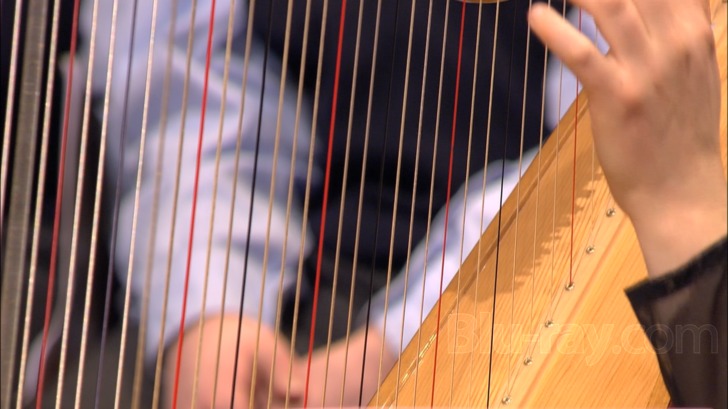
Mahler: Symphonies 1 – 10 + Totenfeier + Das Lied von der Erde features lossless DTS-HD Master Audio 5.0
surround mixes (96/24) as will as uncompressed LPCM 2.0 stereo fold downs on all of the symphonies. For the most part
these are astoundingly effective tracks, with some of the brightest (in a good way), clearest reproductions of Mahler's
immense orchestral (and/or vocal) forces imaginable. There are some occasional moments in the midrange where I wished
things were just a tad clearer (a notable example is in the opening of the First where the horns sound awfully
muddy), and as noted above in the main body of the review, there are some sporadic mixing issues which are occasionally
troubling. The LPCM 2.0 option is hobbled by what sounds like minor distortion in the midrange, especially in the sung
moments, an anomaly which is completely absent from the 5.0 option. But the clarity of these recordings taken as a whole
is truly remarkable, and the dynamic range is simply
awesome. Some of the percussive effects are astoundingly effective. There is rather more hall ambience on these
recordings than I personally would have opted for, to the point that things sound almost too spacious, especially
during softer sections. That said, the hall is able to absorb such huge quantities of sound during orchestral and choral
tuttis that it's a reasonable trade off. You will hear quite a bit of "tangential" noise from time to time with regard to
the audience and even occasionally the conductors and players.
Note: This set does not include subtitles on the choral movements, something which some prospective
consumers may find troubling.
Mahler: Symphonies 1-10; Totenfeier; Das Lied Von Der Erde Blu-ray Movie, Special Features and Extras
There are no supplements included on any of the eleven discs in this set.
Mahler: Symphonies 1-10; Totenfeier; Das Lied Von Der Erde Blu-ray Movie, Overall Score and Recommendation
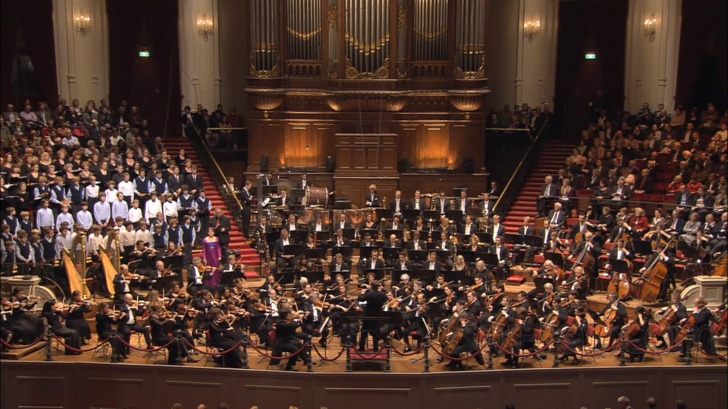
Those wanting a true "cycle" colored by one conductor's overall vision of a composer's work will probably want to stick with the Abbado versions of Mahler, even without any performance of the Eighth being currently available. However, there is a lot to love in this impressive new box set. All of the conductors do at least very good work here, and virtually all actually deliver commendable performances. The orchestra plays with a great deal of nuance and brilliant color, bringing Mahler's larger than life orchestrations vividly alive. The only real downside to this collection is the lack of subtitles as well as some niggling qualms with regard to balance between vocalists and orchestra. Otherwise, though, this set easily comes Highly recommended.