Mademoiselle Chambon Blu-ray Movie
HomeMademoiselle Chambon Blu-ray Movie 
Kino Lorber | 2009 | 101 min | Not rated | Dec 07, 2010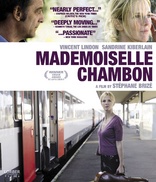
Price
List price:Amazon: $25.93 (Save 7%)
Third party: $25.93 (Save 7%)
Only 1 left in stock (more on the way).

Movie rating
6.7 | / 10 |
Blu-ray rating
| Users |  | 0.0 |
| Reviewer |  | 4.5 |
| Overall | | 4.5 |
Overview
Mademoiselle Chambon (2009)
Veronique Chambon leads a quiet, unassuming life in a provincial town, earning her living by teaching primary school and seemingly spending much of her free time in the quiet of her rented apartment. Having asked the parents of her pupils to visit her classroom and talk about what they do, one day she meets Jean, a home builder who somewhat shyly explains his daily routine. Somehow, a certain spark ignites between the reclusive teacher and the gruff contractor. Both sense that their budding attraction is impossible, yet neither will totally let it fade.
Starring: Sandrine Kiberlain, Vincent Lindon, Aure Atika, Jean-Marc Thibault, Arthur Le HouérouDirector: Stéphane Brizé
| Drama | Uncertain |
| Romance | Uncertain |
Specifications
Video
Video codec: MPEG-4 AVC
Video resolution: 1080p
Aspect ratio: 2.35:1
Original aspect ratio: 2.39:1
Audio
French: DTS-HD Master Audio 5.1
Subtitles
English
Discs
50GB Blu-ray Disc
Single disc (1 BD)
Playback
Region A, B (C untested)
Review
Rating summary
| Movie | | 4.5 |
| Video |  | 4.0 |
| Audio | | 4.0 |
| Extras |  | 2.0 |
| Overall | | 4.5 |
Mademoiselle Chambon Blu-ray Movie Review
Words are not enough in this bittersweet chamber drama.
Reviewed by Casey Broadwater December 6, 2010French director Stéphane Brizé (Je ne suis pas là pour être aimé) subtly introduces the metaphors that will inform the entirety of Mademoiselle Chambon—an exquisite chamber drama loosely based on a novel by Eric Holder—in the first two scenes. He opens with the film’s protagonist, Jean (Vincent Lindon), an introspective middle-aged mason and renovator, jackhammering through a concrete floor. The image is clear; Jean is a construction worker, but he spends just as much time deconstructing. The film will mirror this occupation, taking apart and examining the walls that we build around our emotions to guard ourselves. Soon after, we see Jean having a picnic with his wife, Anne-Marie (Aure Atika), and their grade school-aged son, Jérémy (Arthur le Houérou). Jean and Anne-Marie are trying to assist Jérémy with his homework, a lesson on how to identify the direct object of a sentence. Neither parent can remember what a direct object actually is, and in several cuts, we see them flipping through the textbook only to find a series of circular and obtuse definitions of grammatical terms. And so Mademoiselle Chambon is also deconstructive in the linguistic sense; that is, these two characters—and Jean in particular—will find that language is ultimately meaningless, unable to express their vast and often contradictory feelings.
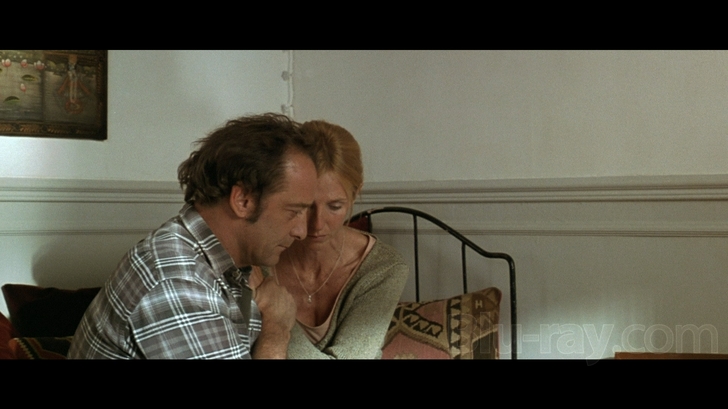
The film, then, is quiet and austere, not quite devoid of dialogue, but certainly more observational than expressive. On the surface, the story is extraordinarily simple. When Anne-Marie lightly injures her back at the factory where she works, Jean goes to pick up Jérémy from school and meets his teacher, the eponymous Mademoiselle Véronique Chambon (Sandrine Kiberlain), a willowy former violinist and itinerant substitute who has made a habit of not staying in one school for longer than a year. Later, she invites Jean to talk to her class about his career. As he fields questions from the kids and explains how many bricks go into the building of a house, Véronique watches him with a pained, complex expression that’s part sadness, part discovery, and all attraction. In the most literal sense, Jean is a home maker, and a real home is something Véronique has gone without for far too long. After class, she asks Jean if he could come by her flat to inspect a drafty window in need of repair. Here, we naturally get a sense of the inevitable—that Jean and Véronique will become romantically entangled—but the film is much too nuanced to play out like a typical tale of infidelity. For one, Jean’s marriage—from what we can tell—seems happy, satisfied. This isn’t a story of dysfunction and heartbreak and disillusionment, but rather, an assessment of desire as a force that can be both healing and achingly inconvenient.
Jean, masculine yet sensitive, is having a mid-life crisis of sorts, albeit, one that doesn’t express itself in the usual clichés, the sports cars and desperate attempts at youthfulness. Instead, through his relationship with his octogenarian father (Jean-Marc Thibault), we can tell that he’s facing his own mortality with self-reflective inner turmoil. Twice, we see him washing the old man’s feet, a sacrificial ritual of devotion, a servile act that foreshadows his own eventual dependence on others. During one especially affecting scene, Jean accompanies his père to a coffin emporium so they can make preemptive funeral arrangements. Afterward, Brizé briefly shows Jean sitting silently at a bar, staring into his beer. This is a man for whom the emotions of growing older have no outlet. Véronique, then, is a temporary escape, and their nascent relationship is based less on passion than on a mutual need for understanding. In fact, their first fumbling attempt at intimacy—nothing more than a kiss and a short embrace— is so fraught with guilt, on his part, and apprehension, on hers, that we wouldn’t be surprised if they up and called off the whole illicit affair. And yet, their nearly wordless attachment grows. He is moved by her shy violin virtuosity and she sees a man with whom she might finally settle down. Both, however, seem to know that, no matter how much they wish it weren’t so, their love is fated to be short-lived. Life is simply too complicated. Jean loves his wife and family. He has an ailing father to care for. Running off with a lover—like buying a Ferrari or dressing like a twentysomething—is no solution to the emotional dilemmas inherent in growing older.
It’s no easy feat to make a character who cheats on his loving, supportive wife seem sympathetic, but Brizé does, primarily because he allows the film to explore the moral gray area between the black and white simplicity of our social expectations—we shouldn’t have affairs, we shouldn’t desire people other than our spouses—and the incredibly complex, sometimes contradictory thoughts and feelings and urges that dominate our conscious and unconscious minds. In this conflict between morality and—essentially—nature, everyday language fails. How could Jean possibly explain to his wife—whom he loves—that he also has intense feelings for Véronique? Never mind whether these feelings are right or wrong; they exist. How does Jean—and how do we—deal with that? In Jean’s case, it’s largely by internalization. As an audience, we do feel a certain frustration because the characters in Mademoiselle Chambon are so wont to leave things unsaid, but this is also one of the film’s greatest strengths—it knows that words are often insufficient to express our deepest selves. This is delicate material, and Brizé handles it with uncommon agility and intuition. He uses restraint literally as a form of tension, keeping Jean and Véronique from rushing too quickly into passion, and letting the story unreel slowly. He also allows the actors to do all of the tonal heavy lifting. There’s no manipulation here, no forcing us to feel a certain way; we’re moved, instead, by the honesty of the actors’ performances, the purity of their emotions. We feel what they feel—longing, regret, and finally, grace.
Mademoiselle Chambon Blu-ray Movie, Video Quality
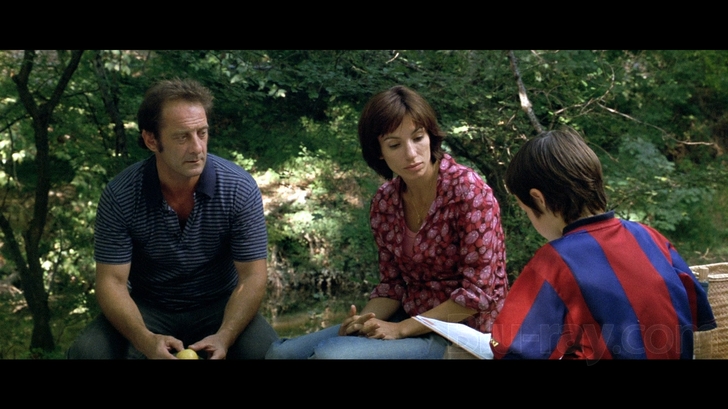
Kino-Lorber has graced Mademoiselle Chambon with a 1080p/AVC-encoded transfer—framed closely to its original 2.39:1 aspect ratio—that's faithful and naturally filmic. The image may not be as glossy or crisp as the latest Hollywood romance, but the picture is astute, with fairly refined clarity and satisfying color reproduction. Though the film isn't sharp sharp, softness is never an issue and most scenes show an appreciable amount of fine detail in facial and clothing textures—the usual indicators. Color is warm, rich, and convincing, with suitable black levels and pleasing contrast, and skintones are balanced. There are, however, a few instances of mild overexposure—causing slightly blotchy colors—visible on facial and other highlights, like the brightest parts of the sky. This is an extremely minor quibble. Otherwise, I have no problems with this high definition transfer. Grain is unobtrusive and untouched, there are no severe compression issues—like macroblocking or banding—and no evidence of edge enhancement or any other unneeded digital tinkering.
Mademoiselle Chambon Blu-ray Movie, Audio Quality
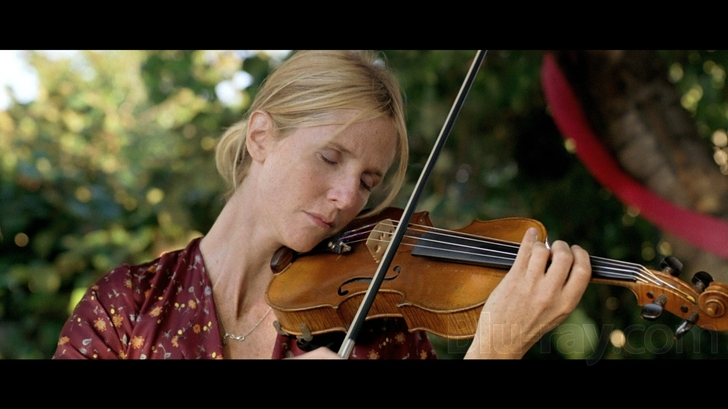
If you read the entirety of my review above, you've probably already guessed that Mademoiselle Chambon is a quiet, reserved film. You can't even call it "dialogue-driven," as unnecessary talking is kept to a minimum. While there's nothing here that will tax your home theater system, the film's French DTS-HD Master Audio 5.1 surround track is nimble and assured, with careful consideration given to ambience and acoustic accuracy. There are few chances for the track to really roar, so to speak—the repetitive jackhammer and factory sounds come to mind—so the mix is at its best when dealing with quiet everyday noises, like the wind in the trees and other atmospherics sounds that periodically fill the space around us. Of course, Véronique's violin music plays a huge role in the film, and it's presented with all the dynamic richness you'd hope for; the instrument's reedy timbre is exceptionally clear, high notes are clean, and lows have a deep, satisfying resonance. When the film isn't dwelling in a state of hushed near-silence, the dialogue is clear and perfectly balanced. No real issues here.
Mademoiselle Chambon Blu-ray Movie, Special Features and Extras
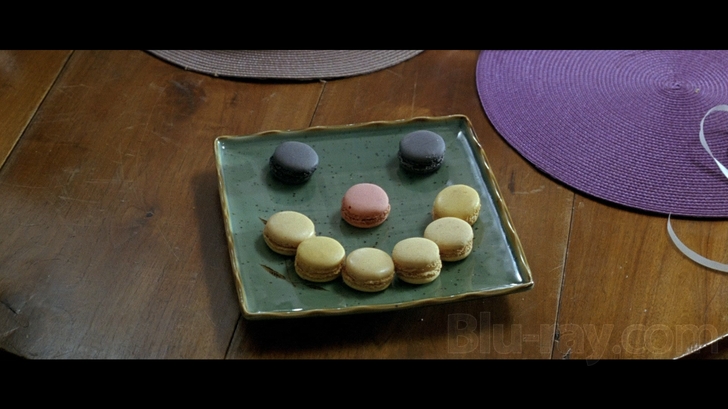
There's not much included here, but it's all well worth watching, especially the interview with director Stéphane Brizé.
- Intervew (1080i, 31:32): Director Stéphane Brizé sits down to discuss the film's characters, themes, and execution with film scholar Stéphane Goudet.
- Deleted Scenes (1080i, 11:41): Goudet also introduces the deleted scenes, which have been cut into a short film of sorts--you don't see that everyday! Here, the character of Anne-Marie is more developed and we see her beginning to suspect that Jean might be having an affair.
- Trailers (1080p, 1:50 and 1:43): Includes theatrical trailers for Mademoiselle Chambon and Home.
- Stills (1080p): A user-directed gallery with 16 publicity stills.
Mademoiselle Chambon Blu-ray Movie, Overall Score and Recommendation
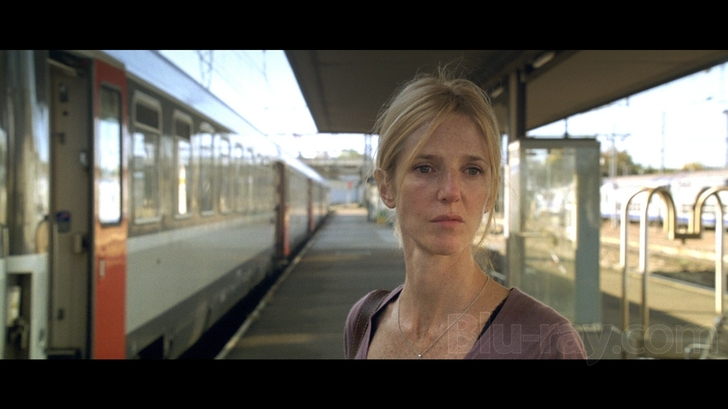
Love affairs aren't always torrid, revenge-motivated downward spirals; in the case of Mademoiselle Chambon, we observe two people who are more emotionally than sexually needy. The resulting film, unflinching about the complexity of desire and the impossibility of words to express exactly how we feel, is moving and mature. Make sure to watch the included interview with director Stéphane Brizé. Highly recommended!
Similar titles
Similar titles you might also like

Le Week-End
2013

Things to Come
L'avenir
2016

The Class
Entre les murs
2008

The Earrings of Madame de...
Madame de...
1953

Love 3D
2015

Before Midnight
2013

35 Shots of Rum
35 rhums
2008

Mustang
2015

The Image Book
Le livre d'image
2018

Indiscretion of an American Wife
Terminal Station / Stazione Termini
1953

A Man and a Woman
Un homme et une femme / Includes "C’était un rendez-vous" (1976)
1966

Torment
L'enfer
1994

Bastards
Les Salauds / Slipcover in Original Pressing
2013

Masculin Féminin
1966

Laurence Anyways
2012

Children of Paradise
Les enfants du paradis
1945

Certain Women
2016

Betty Blue
37°2 le matin | Director's Cut
1986

L' Atalante
1934

Jules and Jim
Jules et Jim
1962