Lulu on the Bridge Blu-ray Movie
HomeLulu on the Bridge Blu-ray Movie 
Imprint | 1998 | 104 min | Rated ACB: M | Oct 29, 2025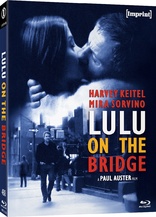

Movie rating
6 | / 10 |
Blu-ray rating
| Users |  | 0.0 |
| Reviewer |  | 3.5 |
| Overall | | 3.5 |
Overview
Lulu on the Bridge (1998)
A jazz saxophonist's life is permanently changed when he is hit by a stray bullet.
Starring: Harvey Keitel, Mira Sorvino, Willem Dafoe, Gina Gershon, Mandy PatinkinDirector: Paul Auster
| Romance | Uncertain |
| Drama | Uncertain |
| Mystery | Uncertain |
Specifications
Video
Video codec: MPEG-4 AVC
Video resolution: 1080p
Aspect ratio: 1.78:1
Original aspect ratio: 1.85:1
Audio
English: LPCM 2.0 (48kHz, 24-bit)
English: LPCM 2.0 (48kHz, 24-bit)
Subtitles
English SDH
Discs
Blu-ray Disc
Single disc (1 BD)
Packaging
Slipcover in original pressing
Playback
Region free
Review
Rating summary
| Movie | | 3.5 |
| Video | | 3.5 |
| Audio |  | 4.5 |
| Extras |  | 3.0 |
| Overall | | 3.5 |
Lulu on the Bridge Blu-ray Movie Review
Reviewed by Dr. Svet Atanasov December 24, 2025Paul Auster's "Lulu on the Bridge" (1998) arrives on Blu-ray courtesy of Imprint Films. The supplemental features on the release include archival audio commentary by Paul Auster, producer Peter Newman, editor Tim Squyres, and cinematographer Alik Sakharov; multiple deleted scenes; and vintage trailer. In English, with optional English SDH subtitles for the main feature. Region-Free.
The jazzman
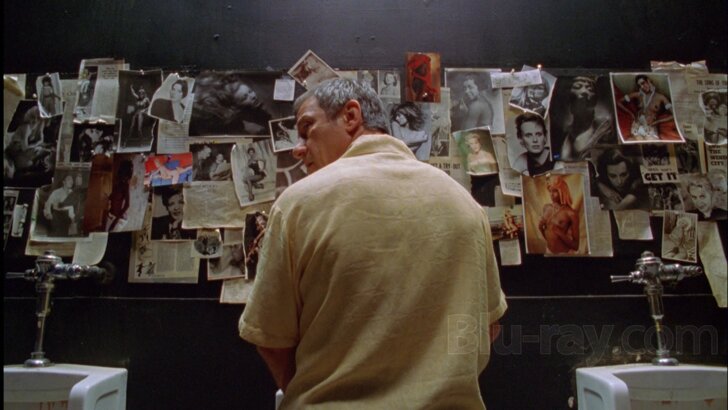
In a small but popular jazz club in New York City, veteran saxophonist Izzy Maurer (Harvey Keitel), while performing with his band, is shot by a psychopath, screaming the name of a woman, presumably his girlfriend, who may or may not have cheated on him. Maurer instantly collapses and begins blacking out -- and then wakes up in a hospital room, where a specialist informs him that he has dodged a bullet. Sort of. Had the psychopath’s bullet struck him a few millimeters to the right, he would have been a dead man. Maurer also learns that he will never be able to play the saxophone again.
Several weeks later, now fully recovered but deeply depressed because his life has irreversibly changed, Maurer is invited by his ex-wife (Gina Gershon) to have dinner with her, his replacement (Mandy Patinkin), and an acquaintance of his replacement (Vanessa Redgrave). While enjoying himself, Maurer learns that his replacement, who is an old friend and a veteran film producer, and his acquaintance have teamed up to do a contemporary remake of Pandora’s Box in Ireland, and are actively looking for the right actress to take on Louise Brooks’ famous character. A few hours later, while heading home, in a dark alley, Maurer discovers the cold body of a stranger, taken out with a single bullet lodged in his head, and instinctively picks up the briefcase next to him.
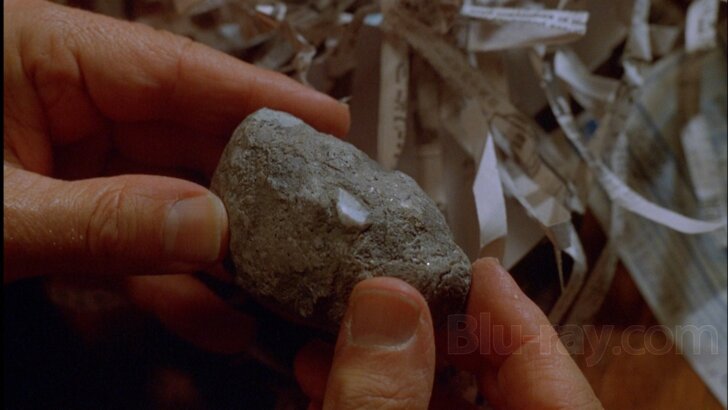
At his place, after downing a double shot of whiskey, Maurer empties the briefcase and discovers the dead man’s name, a napkin with a phone number, and a miniature box with a tiny stone in it. Later that night, after Maurer turns off the lights to go to sleep, the stone comes alive and fills his apartment with a strikingly rich blue light.
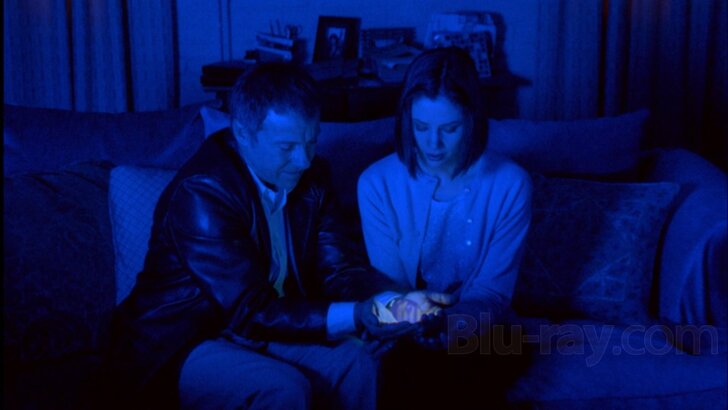
The phone number from the napkin connects Maurer to Celia Burns (Mira Sorvino), a struggling young actress making ends meet as a waitress, who has recently discovered his music. The two arrange to meet at her place, and after Maurer shows her the magic stone, they begin falling in love. However, despite feeling happy for the first time in years, Maurer and Burns are forced in opposite directions, and soon after, their lives begin to unravel.
Paul Auster made a name for himself through his involvement as a director and writer with a couple of rather unusual independent films during the 1990s, when various smaller and bigger studios gambled on different auteur projects as the great neo-noir renaissance peaked. Keitel appeared in three of these films, and the final, Lulu on the Bridge, was the most intriguing.
In Lulu on the Bridge, which Auster penned and directed, a murder becomes the catalyst for an intriguing examination of the nature of existence and its relationship with time. However, the examination gets a structure only after the murder creates relationships and produces drama that give Lulu on the Bridge an unmistakable neo-noirish identity. The overlapping of the contrasting material, which lasts until the final act, then infuses Lulu on the Bridge with a strange atmosphere that effectively peels away from the neo-noirish identity.
The fluid narrative will not be everyone’s cup of tea. A few segments of it also have an arty flavor that feels a tad too artificial. However, the disintegration of Maurer and Burns’ relationship does force the rational mind to ponder several interesting questions. For example, how exactly does the mind behave in the final moments before the soul it has served for years abandons it? Also, how long do these moments last? And can these last moments be properly assessed via the conventional definition of time?
*While there is a world of difference between the two, Lulu on the Bridge and Mirror are undoubtedly looking outward together in the same direction, and are drawn to the same possibilities.
Lulu on the Bridge Blu-ray Movie, Video Quality
Presented in an aspect ratio of 1.78:1, encoded with MPEG-4 AVC and granted a 1080p transfer, Lulu on the Bridge arrives on Blu-ray courtesy of Imprint Films.
The release is sourced from an old but good master. Virtually all visuals boast quite good delineation, clarity, and depth. There are no stability issues either. More importantly, there are no traces of any problematic digital corrections. Color reproduction is convincing, but if the film is redone in 2K or 4K, several primaries and supporting nuances will look fresher and healthier. These improvements will strengthen the dynamic range of the visuals as well. The current master handles darker areas, where older masters tend to reveal inconsistencies, surprisingly well. There is room for small encoding optimizations, but I did not notice any disturbing anomalies. The surface of the visuals is healthy. My score is 3.75/5.00. (Note: This is a Region-Free Blu-ray release. Therefore, you will be able to play it on your player regardless of your geographical location).
Lulu on the Bridge Blu-ray Movie, Audio Quality
There is only one standard audio track on this Blu-ray release: LPCM 2.0. Optional English SDH subtitles are provided for the main feature.
Jazz tunes and other harmonies composed by John Lurie and Graeme Revell are used in various ways to create an interesting atmosphere throughout the film. However, dynamic contrasts are still modest. There is no serious action material either. The dialogue is very clear, clean, and easy to follow. I had the volume of my system turned up quite a bit and did not notice any anomalies in the upper register.
Lulu on the Bridge Blu-ray Movie, Special Features and Extras
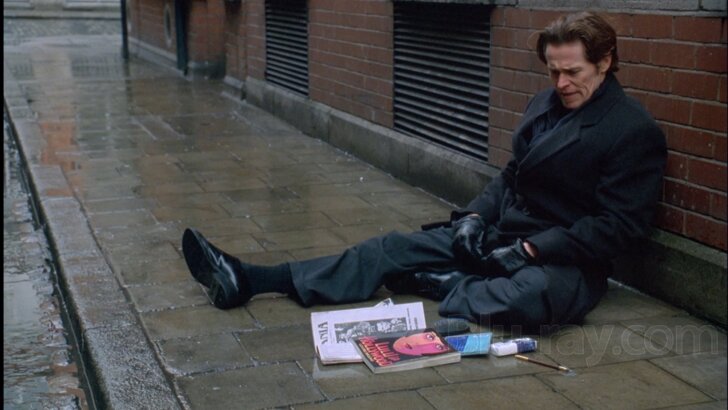
- Commentary - this archival audio commentary was recorded by director/writer Paul Auster, producer Peter Newman, editor Tim Squyres, and cinematographer Alik Sakharov. It is a very detailed commentary, breaking down the entire narrative and producing plenty of observations about the different themes that compete for dominance in it. However, I must say that some of the granular information is a bit too far-fetched. There is good information about some of the stylization/special effects work in the film as well.
- Deleted Scenes - presented here is a large selection of deleted scenes, several of which are excellent. In English, not subtitled. (22 min).
- Theatrical Trailer - presented here is a vintage trailer for Lulu on the Bridge. In English, not subtitled. (2 min).
Lulu on the Bridge Blu-ray Movie, Overall Score and Recommendation

A murder and a magic stone unite two jaded loners who have been living in the same city, surrounded by strangers pretending to care about them, hoping that a lucky break will reset their lives and make them more fulfilling. But after quickly falling in love, fate pushes them apart. This is the setup that Paul Auster's Lulu on the Bridge uses to produce an intriguing examination of the nature of existence and its relationship with time. While there is a world of difference between the two, Lulu on the Bridge and Andrei Tarkovsky's Mirror ask virtually the same questions and, perhaps unsurprisingly, are drawn to many of the same possibilities. RECOMMENDED.
Similar titles
Similar titles you might also like
(Still not reliable for this title)

Winter's Tale
2014

Roman Holiday 4K
1953

August Rush
2007

Finding Neverland
2004

A Place in the Sun
Imprint #08
1951

The Jane Austen Book Club
2007

The Lake House
2006

Like Water for Chocolate
Como agua para chocolate
1992

W.E.
2011

Magic in the Moonlight
2014

Saawariya
2007

Just One Day
At Middleton
2014

Chaos Theory
2008

Sabrina
1954

Breakfast at Tiffany's
50th Anniversary Edition
1961

Sommersby
1993

The Red Shoes
1948

Water for Elephants
2011

(500) Days of Summer
2009

One from the Heart: Reprise
Classics Remastered
1982