Lully: Atys Blu-ray Movie
HomeLully: Atys Blu-ray Movie 
FRA Productions | 2011 | 295 min | Rated G | Nov 08, 2011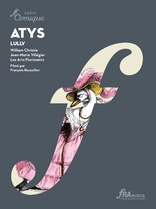
Price
List price:Listed on Amazon marketplace

Movie rating
7.5 | / 10 |
Blu-ray rating
| Users |  | 5.0 |
| Reviewer |  | 4.0 |
| Overall | | 4.1 |
Overview
Lully: Atys (2011)
Jean-Baptiste Lully's opera 'Atys' is performed by Opera Comique and William Christie's Les Arts Florissants.
Starring: Bernard Richter, Stephanie d'OustracDirector: François Roussillon, Jean-Marie Villégier
| Music | Uncertain |
| Foreign | Uncertain |
Specifications
Video
Video codec: MPEG-4 AVC
Video resolution: 1080i
Aspect ratio: 1.78:1
Original aspect ratio: 1.78:1
Audio
French: DTS-HD Master Audio 5.1
French: LPCM 2.0
Subtitles
English, French, Spanish, German, Italian
Discs
50GB Blu-ray Disc
Two-disc set (2 BDs)
Playback
Region A (B, C untested)
Review
Rating summary
| Movie | | 4.0 |
| Video | | 4.0 |
| Audio |  | 4.5 |
| Extras |  | 3.0 |
| Overall | | 4.0 |
Lully: Atys Blu-ray Movie Review
It's not nice to fool Mother Nature.
Reviewed by Jeffrey Kauffman October 25, 2011Opera tends to evoke images of inherently “heavy” 19th century pieces usually of Italian or German origin, but of course the art form is a much broader and more diverse entity than that particular subset. It’s a bit ironic, then, that one of the chief examples of “anti-opera” (if I may be permitted to coin a term), meaning something at the opposite pole of the 19th century grand opera tradition, are the pieces by a composer born in Italy but who forsook the Italian model and associated himself with France, actually becoming a French subject along the way, and professionally becoming eternally linked with the court music of King Louis XIV. While he’s known today by his Frenchified name, Jean-Baptiste Lully, the composer was actually born Giovanni Battisti Lulli in Florence, Italy in 1622. Italy was then, as it continued to be for centuries afterward, Ground Zero for opera, the breeding ground not just for the art form itself, but for its supposedly inviolable rules of creation. Lully was a colorful character, to say the least, one who ingratiated himself quickly into the court of King Louis XIV, but who repeatedly became embroiled in scandal (often of a lascivious nature), though his friendship with his King always seemed to protect him from absolute disparagement and banishment from the court. Along the way, Lully eschewed the then prevalent Italianate ideas of recitative and aria, deciding to blend them together into a form he felt was more in tune (no pun intended) with the French language and temperament. While it’s somewhat amusing to read scholarly essays claiming that Lully also wanted to create shorter, more compact operas than were then the norm, the fact is that Atys, to give just one salient example, clocks in at well over three hours, certainly something of Wagnerian proportions from a time standpoint if not from a musical or theatrical one.
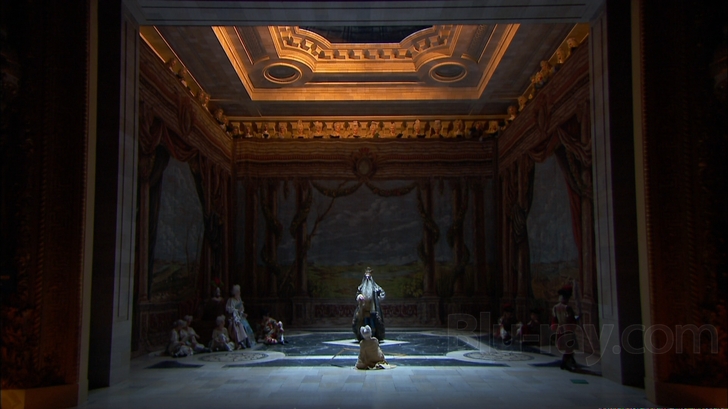
As is discussed in the fascinating supplemental documentary which graces the second disc of this two disc set, Lully’s Atys was dubbed “the King’s opera” due to how much Louis XIV loved it, and it was frequently performed during Lully’s lifetime, despite a certain lack of appreciation by the general public. After Lully’s death and that of Louis XIV, however, the opera fell into decline and was rarely if ever performed for centuries afterward. In the late 1980s, baroque specialist William Christie, founder and conductor of period instrument ensemble Les Arts Florissants, resurrected Atys in a glorious production by Paris’ Opéra Comique (despite Atys being a “tragédie en musique”) directed by Jean-Marie Villégier. Opulent but relatively small scale, the production was a sensation, but chances of it being revived under normal circumstances were in the slim to none category. However, the Fates were smiling upon Lully and his creation, for one of the people who caught Atys in Paris and was dumbstruck by the opera’s brilliance as well as this particular production’s particular genius, was Ronald P. Stanton, a New York businessman and philanthropist who was a longtime patron of the Brooklyn Academy of Music. (BAM, as it’s known in shorthand, had actually done other version of Atys in 1989 and 1992). Stanton was so enamored of Christie and Villégier’s Atys that he approached BAM’s President, Karen Brooks Hopkins, suggesting a co-production might be to everyone’s benefit, and offered to underwrite a remounting himself. Thus was this 2011 production (and ensuing international tour) born, ending up being co-produced by Opéra Comique, the Brooklyn Academy of Music, Théâtre de Caen, Opéra National de Bordeaux and Les Arts Florissants.
As is typical in French opera of this period, Atys begins with a Prologue not especially well linked to the main storyline of the opera itself. We get Time (Bernard Deletré) and the Hours celebration King Louis XIV and the real life approach of a war (with the Netherlands). This prelude includes some nice dance movements (French opera, especially in Lully’s hands—Lully was a dancer, is filled with dance) before Iris (Rachel Redmond) halts a conflict erupting among the Gods, urging everyone to “just get along” so that the story of Cybèle (Stéphanie d’Oustrac) and Atys (Bernard Richter) might be told. With a great theatrical sleight of hand, the Gods’ palatial room comes crashing down and we’re thrust (after a brief interlude) into more Earthly realms, albeit realms which are in direct communication with divinities like Cybèle.
Lully’s librettist Philippe Quinalt bases his Atys on sections of Ovid’s Fasti, and deals with sets of star- crossed lovers, in this case lovers who are both mortal and Divine. Atys pines for Sangaride (Emmanuelle de Negri), despite her impending nuptials to King Célénus (Nicolas Rivenq), and Sangaride returns the favor, despite the fact the Cybèle has some very un-Goddess like pinings for Atys and has chosen him to her Grand Priest, a role which necessitates his sacrifice (worshiping was so convoluted back in the day). Atys, sensing he’s not long for this world, decides it’s best to lay his heart’s cards on the table and he and Sangaride devise a mad plan to escape and make a life together. Needless to say, Cybèle will have none of it, and while things may not be as deathly as, say, the final few moments of Hamlet, there are a couple of deceased major characters onstage by the time Atys winds up its story.
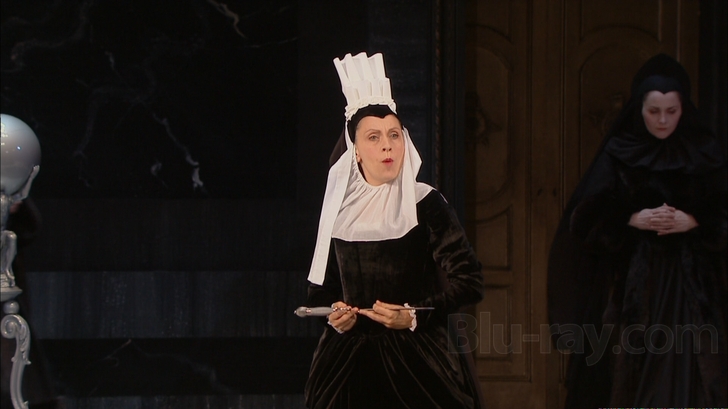
Though it’s not explicitly stated in the insert booklet, I assume this production was filmed at the Opéra Comique, in an opulent but smallish proscenium stage that suits the smaller scale of Atys perfectly. Atys plays almost like a chamber opera at times, despite its mythic setting and its larger than life characters, not to mention a rather large ensemble. The production is opulently mounted, with beautiful costumes and a well realized, albeit rather minimalist, set design. Despite the tragic nature of Atys, this is a surprisingly light evening at the opera, one which is helped immeasurably by Lully’s gorgeous instrumental interludes, many of which incorporate some facile dancing. As should be expected by anyone who is a fan of Christie or the Opéra Comique, the performances here are uniformly top notch, with beautiful singing and some very spry and even athletic playing by Les Arts Florissants.
Lully: Atys Blu-ray Movie, Video Quality
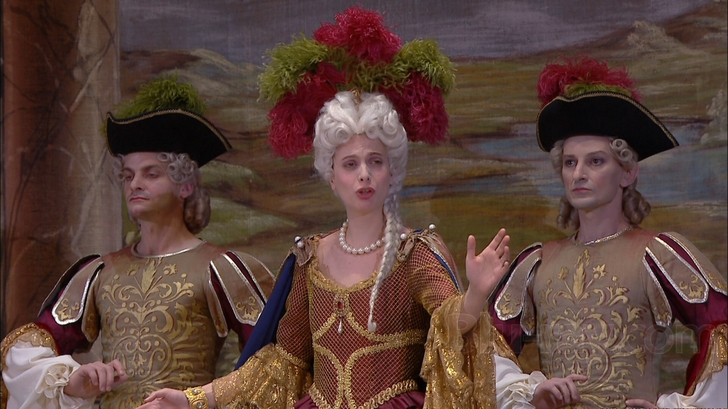
Atys is presented on Blu-ray courtesy of FRA Musica with an AVC encoded 1080i transfer in 1.78:1. This is an opulent looking production which pops very nicely on this Blu-ray, with excellent fine detail, especially with regard to the bejeweled costumes. There are some occasional artifacts, including noticeable shimmer on a couple of heavily cross-stitched costumes as well as the frond that Cybèle carries around. Black levels are solid and shadow detail is quite good, especially in some of the blue lit dimmer moments in the opera. One oddity which isn't a factor of the actual transfer but which may bother some viewers: two of the necks of the instruments rise up above the pit and are clearly visible in a lot of wide shots (you'll see them poking up in a couple of the screen captures I've posted with this review).
Lully: Atys Blu-ray Movie, Audio Quality
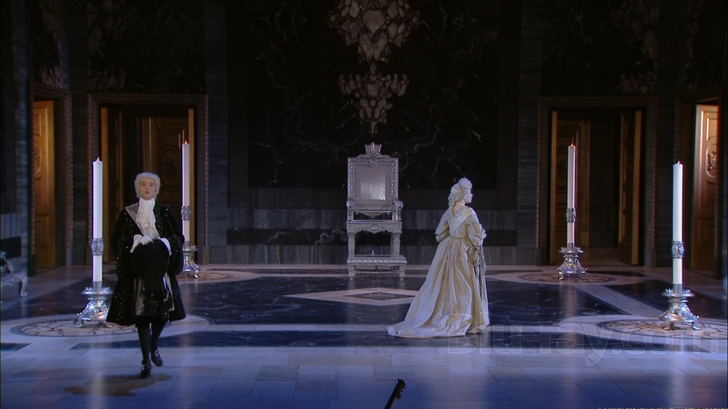
William Christie and Les Arts Florissants are non pareil in the world of period instrument performance and especially Baroque interpretation, and that excellence shines through both of the lossless audio options included on this Blu-ray, a DTS-HD Master Audio 5.1 surround mix and an LPCM 2.0 stereo fold down. The playing here is superb and extremely nuanced. Lully was one of the first operatic composers to play with tempi as liberally as he does, and so we get a surprisingly varied array of the jaunty interspersed with the more regal and restrained. The continuo here is especially formidable, as it usually is in Christie/Florissants performances. Singing is uniformly excellent throughout this production and balance between the orchestra, soloists and ensemble is expertly handled. Fidelity is top notch and dynamic range, despite the period instruments which don't always have the facility that modern instruments do, is quite impressive. One irrelevant but kind of amusing note (no pun intended): watch how much Christie tends to favor turning toward the violins in the pit, turning his back on the rest of the orchestra. I guess he felt they could fend for themselves).
Lully: Atys Blu-ray Movie, Special Features and Extras
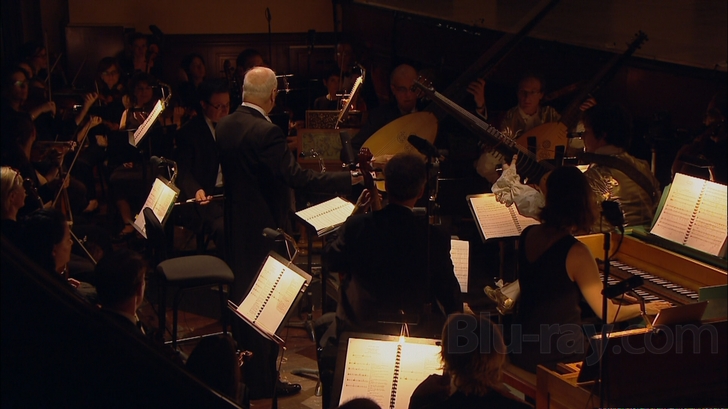
Atys Supplement (1080i; 1:38:54). This generically named featurette is actually a very interesting set of interviews with various creative staff, including William Christie, who talk about the opera's history as well as its rather quick decline into oblivion, from which Christie helped resurrect it in the late eighties. In French (including Christie) with optional subtitles.
Lully: Atys Blu-ray Movie, Overall Score and Recommendation
Anyone who tires (rightly or wrongly) of Puccini or Verdi or Wagner or any other proponent of "bigger is better" might want to check out this delicious Lully opera, especially since it's so lovingly performed here. There is probably no finer Baroque conductor working today than Christie, and his love for this project is palpable in virtually every note. With an opulent but not overblown production, this Atys is a joy to watch and hear, and it comes Highly recommended.
