Losing Ground Blu-ray Movie
HomeLosing Ground Blu-ray Movie 
Milestone | 1982 | 86 min | Not rated | Apr 05, 2016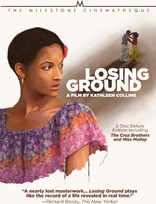

Movie rating
6.3 | / 10 |
Blu-ray rating
| Users |  | 0.0 |
| Reviewer |  | 4.0 |
| Overall | | 4.0 |
Overview
Losing Ground (1982)
Sara Rogers, a professor of philosophy, is writing a dissertation on the nature of “ecstatic” experience in art and religion. Her husband, Victor, is a painter of abstract canvases who finds his eye drawn to people and landscapes. When the couple rents a country house for the summer, the intellectual and emotional boundaries defining their world begin to shift, as Victor turns to painting realistic pictures featuring a local girl, while Sara agrees to act in a film made by one of her students.
Starring: Seret Scott, Bill Gunn, Duane Jones, Billie Allen, Gary BollingDirector: Kathleen Collins
| Drama | 100% |
| Comedy | Insignificant |
Specifications
Video
Video codec: MPEG-4 AVC
Video resolution: 1080p
Aspect ratio: 1.33:1
Original aspect ratio: 1.37:1
Audio
English: LPCM 2.0 Mono (48kHz, 16-bit)
Subtitles
English SDH
Discs
25GB Blu-ray Disc
Two-disc set (2 BDs)
Playback
Region A (B, C untested)
Review
Rating summary
| Movie |  | 3.5 |
| Video | | 4.0 |
| Audio | | 4.0 |
| Extras |  | 5.0 |
| Overall | | 4.0 |
Losing Ground Blu-ray Movie Review
The Life of the Mind
Reviewed by Michael Reuben April 15, 2016The playwright Lorraine Hansberry died at the youthful age of 34, but she left an indelible mark
on American theater with her groundbreaking drama, A Raisin in the Sun. Hansberry's cinematic
counterpart was Kathleen Collins, who consciously modeled herself on Hansberry and, sadly,
also died young at the age of 46. After studying literature and cinema at the Sorbonne in Paris,
Collins became a professor of film at City University of New York. While teaching classes, she
also developed her own projects and struggled to finance them in an era before the notion of
"independent cinema" gained currency. She managed to complete one feature, Losing Ground,
before her death in 1988.
After playing a number of festivals, Losing Ground acquired an afterlife in 16mm prints and,
eventually, a self-published DVD, but it remained largely unknown outside academic circles. All of that
changed when Collins' daughter, Nina, received letters from New York's venerable DuArt Labs
asking her to retrieve her mother's stored film cans, because DuArt was clearing out its
warehouse. As described in the extras, Nina Collins ultimately brought the original materials to
Milestone Films, whose dedication to the recovery and preservation of lost classics is second to
none. After extensive restoration, Losing Ground opened a festival of independent black cinema
at New York's Lincoln Center in 2015, where it received rapturous reviews. "Had it screened
widely in its time", wrote Richard Brody of The New Yorker, "it would have marked film
history."
Though Collins completed Losing Ground in 1982, in form and style it more closely resembles
the character-driven experiments of the preceding decade. Steeped in the French New Wave and
a particular fan of the observational dramas of Eric Rohmer, Collins brought their techniques to
the artistic and intellectual world she knew and that, at the time, had not yet been portrayed on
film.
For the Blu-ray release of Losing Ground, Milestone has supplied not only the film itself but also
a wealth of supporting materials, both old and new, providing an invaluable digital archive for
exploring the life and work of this cinematic pioneer.
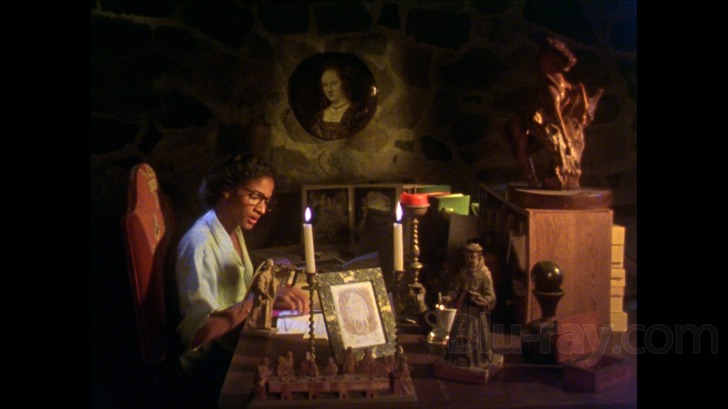
Losing Ground is the story of someone who has reached a crossroads in life that, at first, feels like an impasse. That the someone in question is a professional African-American woman is both noteworthy and secondary. It's noteworthy because, even in the freewheeling Seventies, no one was making films about such people. It's secondary because the film's heroine isn't defined by race or sex. Those are aspects of her identity, along with family history, nationality and the time in which she lives.
Like the writer/director who first imagined her, Sara Rogers (Seret Scott) is a professor at CCNY, except that Sara's subject is philosophy. She teaches a popular course on existentialism, but her current research project is a treatise on "ecstasy" as an aesthetic concept. It's an unlikely topic for someone so orderly and contained. As Sara confesses to her actress mother (Billie Allen), she doesn't know what it means to be transported outside herself. The closest she comes is an occasional moment of intellectual illumination while studying an abstract text.
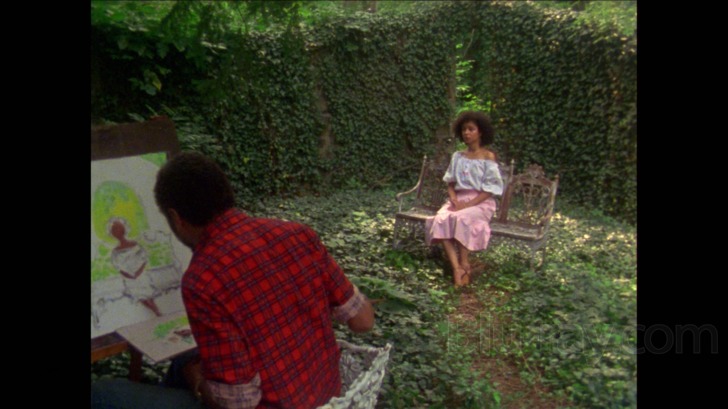
Sara's husband, Victor (Bill Gunn, Ganja & Hess ), is her temperamental opposite: ebullient, effusive and outgoing. A painter who has just sold his first canvas to a major museum, Victor is now seized by a desire to explore new artistic territory, replacing his usual abstract forms with landscapes and people. In a burst of enthusiasm, Victor rents the couple a house in Upstate New York for the summer, where he finds subjects to paint in every direction, including—indeed, especially—a local Puerto Rican woman named Celia (Maritza Rivera), who is both amused and flattered by the painter's attentions. Sara doesn't share Victor's passion for the country, but she indulges him, even though it means regular commutes to the city because the local library does not have the academic volumes her work requires.
But new vistas appear for Sara when a member of her class, George (Gary Bolling), asks her to star in the student film he is directing. There she is paired with an elegant and urbane older actor named Duke (Duane Jones, star of the original Night of the Living Dead) playing professional dancers in a story based on the classic song "Franky and Johnny". Cast in the role of a deceived lover who shoots her long-time partner in a jealous rage, Sara finds herself being transformed by the experience of acting out another woman's emotions—or are they her own emotions emerging at long last? Victor certainly senses the change. Even as he pursues his romance with country light and the beautiful Celia, he can feel Sara slipping away.
Collins doesn't traffic in melodrama, and Losing Ground does not lead to violent confrontations or abrupt changes in relationships. At most, there are raised voices during a weekend gathering hosted by Victor and Sara for Duke, Celia and Victor's fellow painter and mentor, Carlos (Noberto Kerner). The film is filled with quiet and intense exchanges among adults, where what is left unsaid is just as important as the words spoken aloud. Comic relief is provided by George's directorial antics as he struggles to get his shots (he is, no doubt, a sly self-parody of Collins), but the film's most lyrical moments involve wordless dancing, either Victor romancing Celia or Sara performing with Duke for the camera—and perhaps, in the process, opening herself toward some version of the transformative ecstasy that, until now, she has known only in theory.
Losing Ground Blu-ray Movie, Video Quality
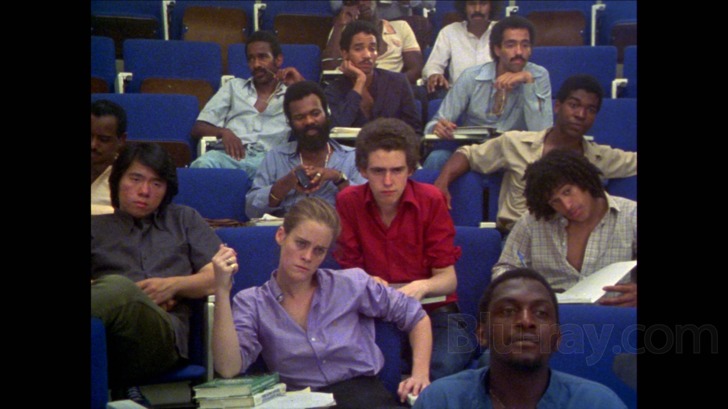
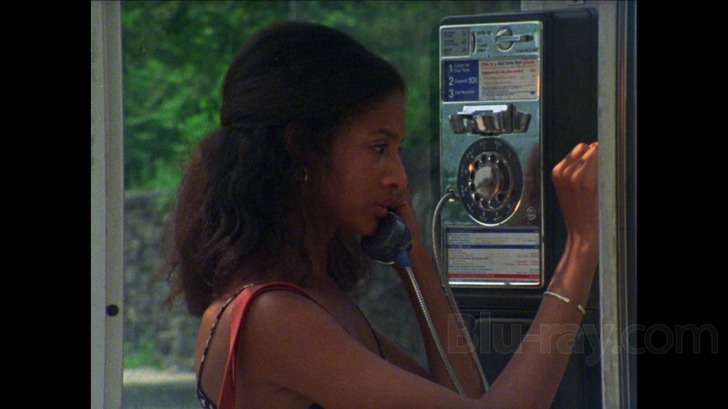
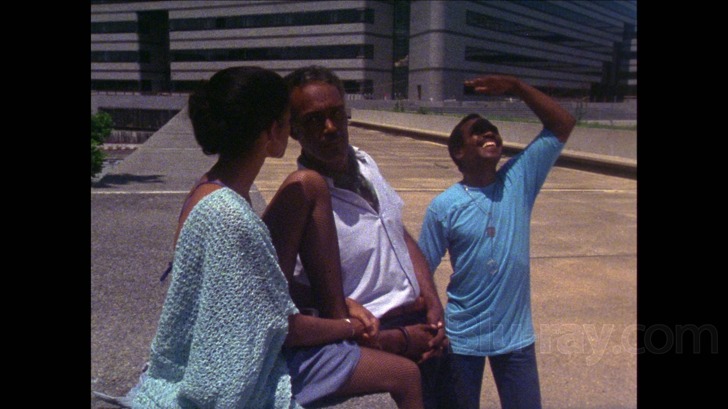
Losing Ground was shot by cinematographer Ronald K. Gray on 16mm film on a shoestring
budget and a tight schedule, with Gray repeatedly "pushing" shots for exposure at night and
indoors. The shooting circumstances, combined with the limitations of early Eighties film stocks,
give Losing Ground a rough and grainy texture. Nevertheless, the shots have been carefully
composed, and the director and DP often use bright colors to emphasize their visual design. The
wardrobe in particular seems to have been chosen to pop characters out of the frame, usually Sara.
For this 1080p, AVC-encoded Blu-ray, Milestone has scanned the 16mm negative, maintaining
the grainy texture without any de-noising or filtering, and preserving the vivid palette that keeps
the image visually alive even in frames (and there are many) where detail is less distinct. The
director's daughter, Nina, consulted on the transfer, and the results have been subsequently
approved by DP Gray. Milestone has mastered Losing Ground with an average bitrate of 31.99
Mbps, giving the copious grain all the bandwidth it can get. The company has also formatted the
film with its full-frame aspect ratio, which is how it was shown at festivals. (A general release in 1982 would probably have required that it be matted to
1.85:1, but there wasn't one.)
Note: As with another restored 16mm film I have reviewed, The American Dreamer, the video
score for this title reflects the accuracy of Milestone's translation of Losing Ground to Blu-ray,
not a judgment on the "prettiness" of the image. I happen to think that many of Collins' and
Gray's shots are beautiful, but eyes accustomed to digital cinema may see things differently.
Losing Ground Blu-ray Movie, Audio Quality
The original magnetic tracks for Losing Ground have been lost, and the Blu-ray's audio has been
taken from an optical track, which has been extensively restored to remove background hiss and
improve clarity. Still, the film's low-budget origins are just as evident in the sound (encoded in
lossless PCM 2.0) as in the image. The dialogue is frequently flat and muffled, and although the
musical score by Michael Minard, with its jazz and Latin beats, can be heard clearly enough to
create the shifting moods intended by the director, the dynamic range is compressed and fidelity
is weak. All of these issues trace back to budget constraints, and Milestone appears to have made
the best of what they had to work with.
Losing Ground presents an additional audio issue, because the voices and lip movements are
frequently out of sync, especially at the beginning of the film. After reviewing existing prints,
Milestone determined that the sync issues had existed from the beginning and decided to make
only minor adjustments, on the theory that the film should be preserved in its original form and
not "improved" with current technology. Whether or not one agrees with the artistic decision, the
important point is that the sync issues are inherent to the source and not the product of faulty
mastering.
Losing Ground Blu-ray Movie, Special Features and Extras
- Commentary with Terri Francis and Lamonda Horton Stallings: Francis is a film scholar who teaches at Indiana University, while Stallings is a Professor of Women's Studies at the University of Maryland. Both are long-time fans of the film, and their familiarity with its nuances prompts an informative examination of Collins' dramatic and visual strategies, as well as the social context of Sara's story. There are pauses, but none of them last too long.
- Theatrical Trailer (disc 1) (1080p; 1.33:1; 2:03): This is the 2016 trailer for Milestone's re-release of the film.
- The Cruz Brothers and Miss Malloy (disc 2) (1080p; 1.33:1; 49:15): This short film from 1980 was Collins' first cinematic effort. Co-directed with, and photographed by, Ronald K. Gray, the film follows three orphaned brothers—Victor, Jose and Felipe—as they undertake an unusual job of home repair for an elderly lady. Unlike Losing Ground, which maintains a naturalistic surface, The Cruz Brothers is infused with magical realism, including dialogue between Victor and the spirit of his late father, who watches over his sons and co-narrates the film.
- Commentary on The Cruz Brothers with Kathleen Collins and Henry H. Roth (disc 2): Although not a commentary in the traditional sense, this alternate track to The Brothers Cruz is yet another example of Milestone's archival thoroughness, presenting a Q&A session with Collins and author Henry Roth, following a screening of the film for a seminar sponsored by public television. Speakers other than Collins and Roth are not identified.
- Transmagnifican Dambamuality (disc 2) (1080p; 1.33:1; 7:03): The subtitle of this 1976 short, "A Quiet, Domestic Drama", is ironic, because Ronald K. Gray's simple but ingenious idea is to accompany the everyday domestic bickering of a family with sound effects appropriate to a war film. The dramatic and sonic resolution occurs when the teenage son sits down at the piano and begins to play jazz.
- Interview with Ronald K. Gray (disc 2) (1080p; 1.78:1; 46:33): In this wide-ranging interview, Collins' cinematographer and co-editor recounts his own background, the establishment of his collaboration with Collins and the experience of shooting and completing Losing Ground. Gray also speaks movingly about Collins' battle with cancer, which she kept to herself until near the very end. Gray is a forceful personality and an interesting speaker, and the interview has been intelligently edited so that it remains lively and engaging throughout.
- Interview with Seret Scott (disc 2) (1080i; 1.78:1; 40:17): Interviewed in 2015, Scott recalls her long friendship with Collins, as well as their artistic collaboration, which included theatrical productions in addition to film. She describes the experience of working with Bill Gunn and Duane Jones on Losing Ground and also talks about other film projects that Collins was attempting to finance.
- Interview with Nina Lorez Collins (disc 2) (1080i; 1.78:1; 26:24): In this often emotional interview, Collins' daughter provides a biography of her mother and describes being surrounded at age 12 by the cast and crew of Losing Ground, many of whom lived in the Collins household during pre- and post-production. It was Nina Collins who brought the negatives of Losing Ground and The Cruz Brothers to Milestone, after she was contacted by DuArt Labs in New York City, which was clearing out their film warehouse as part of their conversion to digital.
- Interview with Kathleen Collins by Phyllis R. Klotham (disc 2) (480i; 1.33:1; 22:42): This interview was recorded in 1984 for Indiana University Television by the Afro-American Studies department. The first half of the interview focuses on Collins' career as a filmmaker; in the second, she speaks at length about teaching classes in filmmaking and describes the projects she assigns to educate her students about such basics as editing and camera movement.
Losing Ground Blu-ray Movie, Overall Score and Recommendation
Like many modern dramatists, Collins broke new ground because of her determination to put
the people she knew on stage and screen. Losing Ground doesn't fit neatly into any genre box,
but it features memorable characters and captures a specific artistic and social milieu of its era
from a unique perspective. Milestone has restored the film to its best possible presentation and
has assembled a rich library of materials for study. This is film preservation and scholarship at its
finest. Highly recommended.

Similar titles
Similar titles you might also like
(Still not reliable for this title)

Diary of a Mad Housewife
1970

The Last Hurrah
Limited Edition to 3000
1958

Funny Ha Ha
Slipcover in Original Pressing
2002

Raining Stones
1993

Sidewalk Stories
1989

Watermelon Man
1970

The Sun Shines Bright
1953

Gray's Anatomy
1996

Girl Stroke Boy
Indicator Series | Limited Edition
1971
Bagdad Café
Out Of Rosenheim
1987

Bob & Carol & Ted & Alice
Limited Edition to 3000
1969

Frownland
2007

The Farewell
2019

Love and Anarchy
Film d'amore e d'anarchia, ovvero 'stamattina alle 10 in via dei Fiori nella nota casa di tolleranza...'
1973

Le Havre
2011

Good Morning
お早よう / Ohayô / + I Was Born, But... and A Straightforward Boy
1959

Crimes and Misdemeanors
Limited Edition to 3000 - SOLD OUT
1989

Quiet Days in Clichy
Stille dage i Clichy
1970

Lions Love (...and Lies)
1969

Irma Vep
1996