Living Landscapes: Zen Garden Blu-ray Movie
HomeLiving Landscapes: Zen Garden Blu-ray Movie 
Digital Environments | 54 min | Not rated | Oct 12, 2010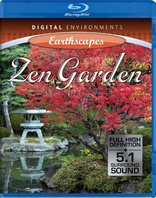
Price
List price:Listed on Amazon marketplace

Movie rating
6.5 | / 10 |
Blu-ray rating
| Users |  | 0.0 |
| Reviewer |  | 3.5 |
| Overall | | 3.5 |
Overview
Living Landscapes: Zen Garden ()
| Other | Uncertain |
| Nature | Uncertain |
Specifications
Video
Video codec: MPEG-4 AVC
Video resolution: 1080i
Aspect ratio: 1.78:1
Original aspect ratio: 1.78:1
Audio
Music: Dolby Digital 5.1
Subtitles
None
Discs
25GB Blu-ray Disc
Single disc (1 BD)
Playback
Region A (B, C untested)
Review
Rating summary
| Movie | | 3.5 |
| Video | | 3.5 |
| Audio |  | 4.0 |
| Extras | | 0.0 |
| Overall | | 3.5 |
Living Landscapes: Zen Garden Blu-ray Movie Review
What is the sound of one Blu-ray clapping?
Reviewed by Jeffrey Kauffman March 22, 2011The word "Zen" has become something of a joke to a lot of Western cynics, a sort of all encompassing symbol for nothingness, an absence of content. At the same time, the word has been appropriated by all sorts of literary types that have given us everything from the famous Zen and the Art of Motorcycle Maintenance by Robert M. Pirsig to the perhaps more questionable Zen and the Art of the Internet by someone who should probably remain nameless. This trend has become such an epidemic over the past several years that real Zen enthusiasts are increasingly taking umbrage at the appropriation of the term for all sorts of product that has devolved to the level of a book entitled The Zen of Farting. The actual etymology of the Japanese word "Zen" is actually pretty fascinating, and shows a cross-cultural link to what is arguably Zen's most lasting contribution to world culture: meditation. Zen is the Japanese form of the Chinese word Chan which itself was adapted from the Sanskrit word Dhyana, a term describing meditation generally or more specifically a meditative state. And for adherents of Zen Buddhism, nothing can help achieve that state than meditating on the wonders of nature. The Western mystical tradition has a longstanding motto of “As above, so below,” and in fact the interlocking, opposite facing triangles of the Star of David are often pointed to as an evocative glyph of that idea. But Zen Buddhism seems to favor the idea of a specific microcosm mirroring larger “universal” (in both senses of the term) truths. Therefore, their meditations on natural phenomena sometimes include miniatures of various species as well as delicate arrangements that seek to invoke a sort of small scale order in a sometimes chaotic world. One of the more frequent methods of invoking that order in Japanese tradition is the beautifully arranged garden, and whether large, as in several municipal varieties, or small, as in an individual’s backyard, these refuges seem by their very nature to grant a peaceful and, well, meditative ambience.
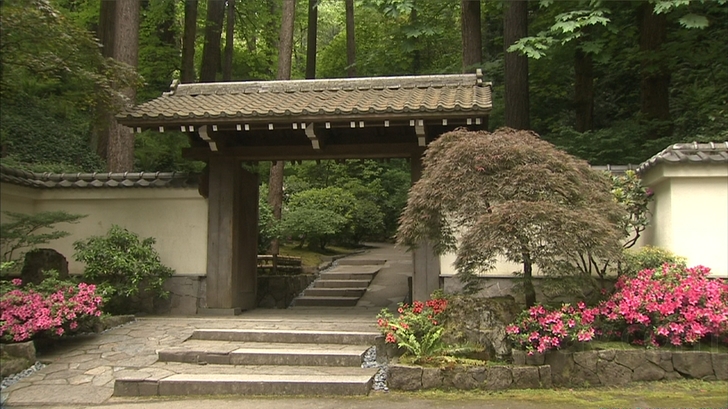
My hometown of Portland, Oregon is home to the beautiful Japanese Garden, part of the impressively expansive Washington Park acreage that flows over Portland’s mystical West Hills and is also home to the world famous Rose Test Garden, where hundreds of varieties of roses fill the spring and summer air with appealingly variegated aromas. Visitors from all over the world flock to Washington Park to take in the abundant greenery and peaceful ambience, and the somewhat more reclusively placed Japanese Garden element of Washington Park is probably the most peaceful part of the park in general. The Japanese Garden itself is situated on well over five acres of lush greenery and incredible floral displays, and it also features traditional Japanese elements like a Tea Garden, a Strolling Pond Garden, and of course a Sand and Stone Garden.
Zen Garden, in case you haven’t already guessed, takes a leisurely hour or so visit to Portland’s Japanese Garden, visiting various nooks and crannies of the Garden while an evocative soundtrack featuring ethnic Japanese instruments like the koto and shakuhachi play in the background, sometimes mixed with fairly minimal ambient environmental sounds like water dripping from a bamboo “pipe” into a pond. While the Japanese Garden has five fairly distinct areas, Zen Garden doesn’t really make a point of traversing the huge areas the Garden offers, and instead prefers to settle down for stationary views of various elements of the Garden.
The “tour,” so to speak, opens with a nice shot of the impressive traditional gate welcoming visitors, accompanied by some sonorous gong tones. A long droning gives way to some perhaps startlingly brittle notes on the koto, and then we’re off on some nicely varied views. The Japanese Garden is such an expansive locale that Zen Garden could have probably easily been twice the length it is and still not have thoroughly explored what the Garden has to offer. The Flat Garden offers a sterling example of the “dry landscape” technique which has become a traditional feature of Japanese gardens for countless generations. Here, all four seasons are represented by various elements found within the Garden. Zen Garden spends some time at the gorgeous weeping cherry tree, filled with delicate pink blossoms, which represents spring. The cherry tree’s sibling, a laceleaf maple which is more than century old, also is seen, representing autumn, and the incredibly intricate stone garden, which is meant to depict water, is the Garden’s symbol for summer. (Portland’s omnipresent pine trees symbolize winter).
One of the problems, albeit perhaps minor, of utilizing the Portland Japanese Garden is Portland’s rather uniform climate, which deprives the Japanese Garden from really exploiting the variety of the seasons. Portland is after all pretty mild most of the year, with an abundant (and infamous) volume of precipitation, and that means an overwhelming amount of green, with sometimes fairly tepid colors in some of the other, supposedly more bright, plant life. At times Zen Garden may therefore resemble something more traditionally northwest in genesis like Digital Environments Earthscapes Olympic Rainforest, another release in this series. There are nonetheless some unexpected sights along the way. One of the stone and sand gardens features huge moss covered rocks that look for all the world like stony seals rising up out of sandy "waters".
This is one of the more bare-boned Digital Environments releases of late, with no credits information (especially unfortunate considering the lovely traditional Japanese music which accompanies the imagery). But anyone who has picked up any of the many other Digital Environments releases will know that they're going to get an impressively visual experience, albeit one here bathed in an inordinate amount of green due to Portland's wet climate. Maybe that's a cue for me to write Zen and the Art of Surviving Rain.
Living Landscapes: Zen Garden Blu-ray Movie, Video Quality
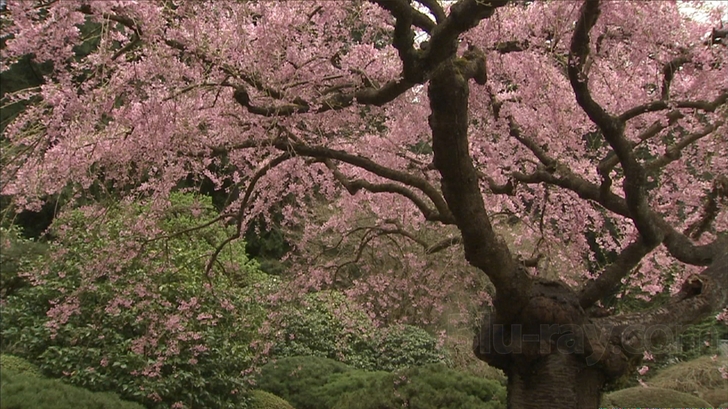
Zen Garden is presented with an AVC encoded 1080i image in 1.78:1. This is one of the softer looking releases from Digital Environments Earthscapes. Whether or not that can be attributed to how this was filmed, or in fact is the result of Portland's misty, rainy weather is debatable, but the fact remains that this release, unlike many others in this series, is just a bit mushier than usual, robbing some of the image of abundant fine detail. While some of the imagery is suitably sharp and well defined, overall Zen Garden often looks like it was filmed in soft focus, especially with regard to some of the plants and trees. Strangely, the rock and stone elements look considerably sharper. As with some of the other Digital Environments releases, we get minor to moderate amounts of digital noise in busier sequences (frequently featuring lots of foliage or in a case or two, the raked sand). Colors here are somewhat muted which I attribute squarely to Portland's climate. It's rare here to see bright, robust colors throughout the year, unless you really hunt for them. There are certainly some very nice shades of pink and red here, but nothing really pops in an overwhelming manner.
Living Landscapes: Zen Garden Blu-ray Movie, Audio Quality
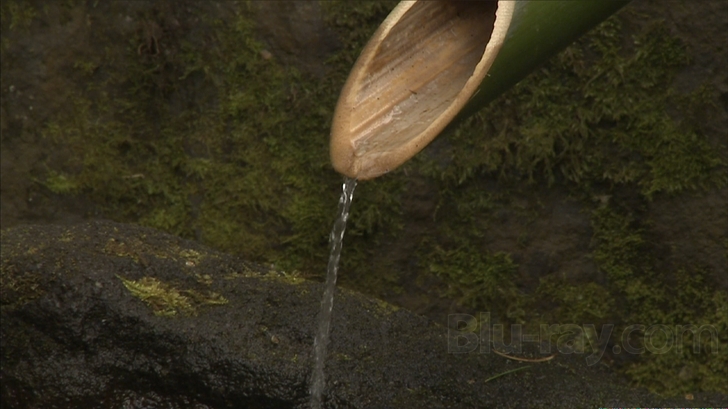
Most if not all of the Digital Environments Earthscapes series haven't yet stepped up to the lossless audio plate, and Zen Garden follows suit with a standard Dolby Digital 5.1 mix. The bulk of this release's soundtrack is given over to a nicely evocative music track (there are no options on this release to toggle between Music Only and Ambient Environmental Sounds, as there have been on some previous releases). Unfortunately there are no closing credits on Zen Garden, as it would have been nice to know who provided this calming music. With low droning tones and the occasional punctuation from a koto or the soothing tones of a shakuhachi, this is yet another very nice and calming soundtrack from Digital Environments. There aren't an abundance of ambient environmental sounds mixed in here, and in fact almost all of them are simple water sounds when we visit some of the ponds and streams in Portland's Japanese Gardens. The mix is well positioned around the soundfield, and the listener can in fact kind of "dissolve" into the music as they watch the images float by. Fidelity is very good, though a lossless track certainly would have provided more "oomph" on the low end especially.
Living Landscapes: Zen Garden Blu-ray Movie, Special Features and Extras

As with all of the Digital Environments Earthscapes releases, no supplements are offered on this budget priced Blu-ray.
Living Landscapes: Zen Garden Blu-ray Movie, Overall Score and Recommendation
Having spent many an hour in the calming refuge of Portland's Japanese Garden, I may be biased in having hoped we had seen a little more of what the Garden has to offer on Zen Garden. Those without any personal experience in one of Portland's most beautiful spots will probably be lulled into an appropriately meditative state by long, lingering visions of Japanese Elms, bamboo and the soft, gurgling sounds of water. This is another good example of why "ambient television" has become such an appealing use of high definition home theaters for so many consumers. This is a release that warrants attention being paid to it, without ever demanding that selfsame attention. Graced by some appealing imagery and one of the better soundtracks from Digital Environments Earthscapes, Zen Garden should appeal especially to world weary urban dwellers who pine for an hour or so of absolute calm and stress free viewing and listening. Though this release has a much softer image than a lot of Digital Environments Earthscapes releases, the inviting soundtrack (though delivered via lossy Dolby audio) helps to make up for that shortcoming, and this release is still Recommended.