Lisa and the Devil / The House of Exorcism Blu-ray Movie
HomeLisa and the Devil / The House of Exorcism Blu-ray Movie 
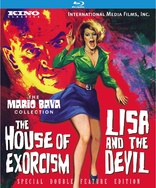
Lisa e il diavolo | Special Double Feature Edition | The Mario Bava CollectionKino Lorber | 1973-1975 | 2 Movies | 92 min | Rated R | Sep 18, 2012

Movie rating
Movie has not been rated yetBlu-ray rating
| Users |  | 0.0 |
| Reviewer |  | 3.5 |
| Overall | | 3.5 |
Overview
Lisa and the Devil / The House of Exorcism (1973-1975)
A woman is a tourist in an ancient city and gets lost, she finds shelter in a old mansion. Soon she is sucked into strange and evil events.
| Horror | 100% |
| Foreign | 70% |
| Fantasy | Insignificant |
| Romance | Insignificant |
Specifications
Video
Video codec: MPEG-4 AVC
Video resolution: 1080p
Aspect ratio: 1.78:1
Original aspect ratio: 1.85:1
Audio
English: LPCM Mono
48kHz, 16-bit
Subtitles
None
Discs
50GB Blu-ray Disc
Single disc (1 BD)
Playback
Region A (locked)
Review
Rating summary
| Movie | | 3.5 |
| Video | | 3.5 |
| Audio | | 3.5 |
| Extras | | 3.5 |
| Overall | | 3.5 |
Lisa and the Devil / The House of Exorcism Blu-ray Movie Review
From Art-House Fantasy to Crass Commercialism
Reviewed by Casey Broadwater December 17, 2013After co-producing several of his most successful films—dating back to his solo directorial debut with 1960's Black Sunday—American Pictures
International promptly dropped giallo godfather Mario Bava when his movies later in the decade failed to draw an audience. But Bava wasn't quite
finished. His 1971 proto-slasher Twitch of the Death Nerve, while not exactly celebrated in its time, would go on to inspire the Friday the
13th series, and though its followup, Baron Blood, was—and still is—poorly received, it gave Bava a relationship with Italian-American
producer Alfredo Leone. Leone so enjoyed working with the director that he offered Bava a rare opportunity: a budget and carte blanche to do
whatever he wanted for his next film. Bava took him up and made Lisa and the Devil, his most personal and arguably most inscrutable
movie, a semi-surrealist thriller involving mannequins, ghostly time loops, and a story governed by a free-form nightmare logic.
Bold but decidedly uncommercial, Lisa and the Devil failed to get picked up for distribution after its Cannes premiere. Leone—looking to recoup
his potential losses—then pressured Bava into doing extensive reshoots and re-editing in order to create an alternate movie that would capitalize on the
demon possession craze following in the wake of William Friedkin's The Exorcist. The result was House of Exorcism, which ramped up
the gore and sexuality and blasphemy to such an extent that Bava—who, despite what his previous output might suggest, did have his limits when it
came to adult content—took his name off of the film entirely . The director's credit ultimately went to "Mickey Lion," Leone's pseudonym, and House
of Exorcism would go down in infamy as one of the many ham-fisted Exorcist knockoffs. Cult enthusiasm being what it is—valuing the so-
bad-it's-good just as much as the genuinely great—each version of the film now has a following for different reasons. Lisa and the Devil is
spooky and uneasy, with the sort of narrative ambiguity David Lynch would later co-opt for Lost Highway and Mulholland Drive, while
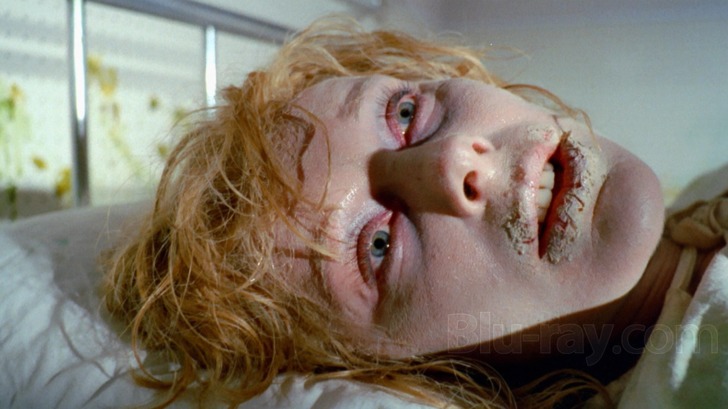
House of Exorcism is ridiculously over-the-top, all pea-soup-spewing and cracked lips and frog vomit. (Vomiting up frogs, that is, not frogs
vomiting.) For our comparison, Kino-Lorber has included both cuts in their single-disc Blu-ray release, which also features two commentary tracks and
an interview with Bava's son.
House of Exorcism
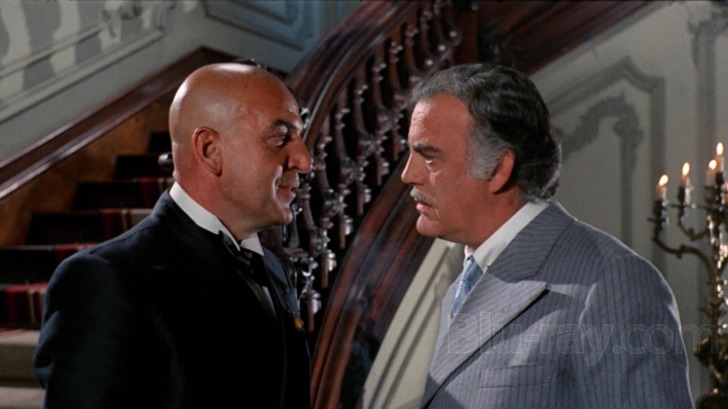
Without a doubt, Lisa and the Devil is the better film. Baron Blood's beautiful Elke Sommer plays Lisa, an American tourist in Toledo— Spain, not Ohio—as part of a tour group. While her group stops to admire a medieval mural of Satan taking the souls of the dead, Lisa wanders off into an antique shop, where she meets Leandro (Telly Sevalas), the spitting image of the devil in the painting. He's just purchased a mannequin of a mustachioed man, and later—lost and hopelessly disoriented—Lisa sees the "real" version of this man out on the street. He approaches her as if he knows her, grabbing her and calling her "Elena," and in a scuffle she accidentally pushes him down a flight of stone steps, killing him. Bava's camera zooms in on the man's broken pocket watch—glass smashed out, hour and minute hands crossed—as an omen suggesting that time is no longer a certainty in this story.
Out hitchhiking, the distraught Lisa gets picked up by the wealthy Francis (Eduardo Fajardo) and his much-younger wife Sophia (Sylva Koscina), who's having a barely disguised affair with their chauffeur, George (Gabriele Tinti). Shortly thereafter, their car breaks down outside a derelict-looking chateaux, where they're greeted by none other than Leandro, the apparent butler. Inside, they meet the blind, widowed countess who owns the place (Suspiria's Alida Valli) and her handsome but deranged son, Maximilian (Alessio Orano), who takes a quick shine to Lisa. Our heroine is understandably spooked about running into Leandro again, but her heebie-jeebies turn to outright terror when she starts seeing both living and dead versions of the mustache-man she pushed down the stairs earlier. To get into his identity—and the dark history that occurred in the chateaux—would be revealing too much, but it's sufficient to say that Lisa is, in essence, unmoored in time, stuck in a hellish loop that forces her and the other characters to continuously relive their sins.
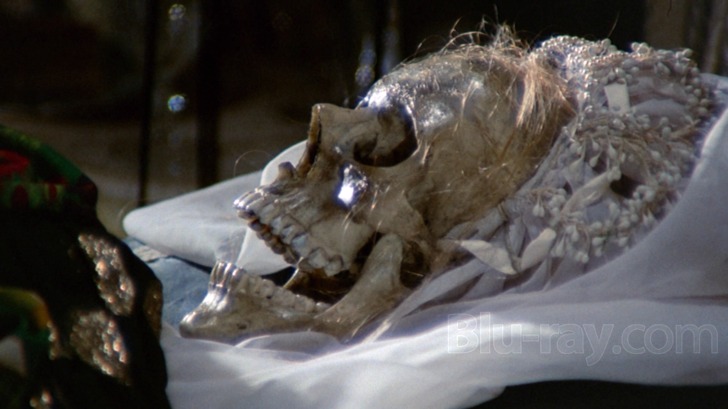
There's a bit of Dante's Inferno here, and a little of Faulkner's "A Rose for Emily," with Bava exploring ideas of both purgatorial punishment and romantic obsession gone awry, complete with a desiccated corpse locked in a bedroom. (Along with some Psycho-esque mommy issues.) A few moments of gruesome violence give the film some visceral, tactile horror—a bludgeoning, a pair of broken ankles, a character who gets run over multiple times—but Bava is more fond of atmosphere, of creeping dread and existential uncertainty. Literal existential uncertainty. By the end, we're not entirely sure if "Lisa" is—or ever was—who she appeared to be. It's confusing, and not easily followed, but Bava—who was under no obligation to tell a cut-and-dry story—does at least imbue Lisa and the Devil with a kind of intuitive sense.
Though this dreamy vagueness is precisely why the film continues to hypnotize fans, it wasn't enough for distributors to feel confident in shelling out for the North American rights. Subsequently, Alfredo Leone—a year after the movie's box office bombing in Italy—came up with the not-so-great idea of turning Lisa and the Devil into an Exorcist clone. Robert Alda was cast as a concerned priest, Elke Sommer was brought back in to shoot new scenes, and the existing footage was rejiggered to simplify the events of the original film and turn them into a series of flashbacks explaining how Lisa came to be possessed. After a delicate, troubled performance in Lisa and the Devil, Sommer's new work in House of Exorcism is a shock. She's basically in grown-up Linda Blair mode, contorting her body, lewdly propositioning the priest, and straining against her restraints, eyes bulging and teeth bared. Unfortunately, it's more goofy than terrifying, and House of Exorcism folds under the weight of its rip-off ambitions. That's not to say it doesn't have entertainment value, of course—the vomiting scenes and rampant cursing are unintentionally hilarious—but House of Exorcism is definitely the lesser of two evils.
Lisa and the Devil / The House of Exorcism Blu-ray Movie, Video Quality
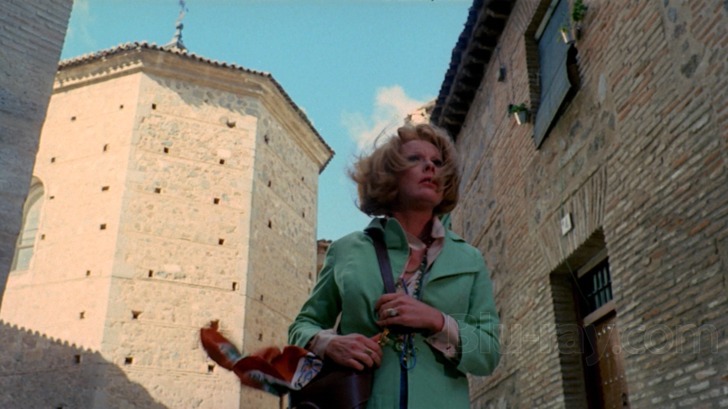
Lisa and the Devil and House of Exorcism ship together on a single 50 GB disc, each with a 1080p/AVC-encoded transfer that's true to source and a true upgrade from their DVD counterparts. As with Kino's other Bava releases, the prints are essentially presented "as-is," with little in the way of digital cleanup. You will notice occasional specks, scratches, and hairs stuck at the edge of the film gate, but nothing distracting or unusual. Grain remains visible and the image in general has a very filmic appearance, with no traces of digital noise reduction, edge enhancement, or other unnecessary embellishments. Though the image is fairly hazy, clarity gets a decent boost from the dated-looking DVDs, with far finer textures and better detail in the actors' faces and clothing. (Despite cinematographer Cecilio Paniagua's frequent use of soft focus filters.) Color in both cuts seems balanced and accurate, with good contrast and skin tones. No issues here.
Lisa and the Devil / The House of Exorcism Blu-ray Movie, Audio Quality
Both cuts of the film feature uncompressed Linear PCM 2.0 mono tracks that similarly show the film's age—expect a light, low-level hiss and occasional crackles—but are otherwise listenable and reproduce the groovy/spooky musical scores well. Dialogue is reasonably clear and easy to follow, and the rare effects—like the sickening crunch of a pair of ankles snapping—sound as good as can be expected. The lone disappointment here is that, unlike Arrow Video's U.K. release, Kino hasn't included Lisa and the Devil's Italian audio track. Also note that there are no subtitle options for either cut.
Lisa and the Devil / The House of Exorcism Blu-ray Movie, Special Features and Extras
Both cuts of the film are on a single disc, with an initial menu allowing you to choose one or the other. Each film then has its own "top-menu," where
you'll find audio options and cut-specific bonus materials.
Lisa and the Devil
- Audio Commentary by Tim Lucas: Video Watchdog founder and Bava expert Tim Lucas—who has appeared on many of Kino's Bava releases—provides yet another highly informative commentary track, filled with the kinds of details and insights it would normally take several viewings to glean.
- Bava on Bava (SD, 18:15): A 2004 interview with Lamberto Bava, Mario Bava's son, produced by Daniel Gouyette. Bava the younger discusses his family's history in cinema, starting with his grandfather and then spending most of the time discussing his father's working methods.
- Mario Bava Trailers: Includes trailers for Lisa and the Devil, Black Sunday, Hatchet for the Honeymoon, and Baron Blood.
- Audio Commentary by Actress Elke Sommer and Producer Alfredo Leone: Leone dominates this track, unapologetic—in fact, quite proud— about the cuts and reshoots he made in order to turn Lisa and the Devil into House of Exorcism. He's the source of a lot of great anecdotal history though, especially in the way he describes Mario Bava's on-set personality and unwillingness to shoot any material that was sexually explicit or generally "vulgar." Sommer chimes in occasionally with stories of her own.
- Trailer 1 (HD, 3:12)
- Trailer 2 (HD, 1:08)
- Radio Spot (Audio Only, 00:59)
Lisa and the Devil / The House of Exorcism Blu-ray Movie, Overall Score and Recommendation

Lisa and the Devil is one of Mario Bava's most enigmatic films—atmospheric and nightmarish and surreal—but it became a perfect illustration of how, in the movie industry, money almost always trumps artistry. Reshot and reedited into House of Exorcism, a crass knockoff of The Exorcist, the film became a dim reflection of the director's original vision of terror. Each version is fun to watch for different reasons—Lisa for its mystery, House for its over-the-top kookiness—and both are presented on Kino-Lorber's Blu-ray release, with also includes two commentary tracks, and interview with Bava's son, and more. Recommended for all fans of 1970s euro-horror.