Life Is a Bed of Roses Blu-ray Movie
HomeLife Is a Bed of Roses Blu-ray Movie 
La vie est un romanCohen Media Group | 1983 | 112 min | Not rated | Jul 21, 2015

Price
Movie rating
6.4 | / 10 |
Blu-ray rating
| Users |  | 0.0 |
| Reviewer |  | 3.0 |
| Overall | | 3.0 |
Overview
Life Is a Bed of Roses (1983)
Starring: Fanny Ardant, Cathy Berberian, Vittorio Gassman, Ruggero Raimondi, Geraldine ChaplinDirector: Alain Resnais
| Foreign | 100% |
| Drama | 81% |
| Romance | 33% |
| Comedy | Insignificant |
Specifications
Video
Video codec: MPEG-4 AVC
Video resolution: 1080p
Aspect ratio: 1.67:1
Original aspect ratio: 1.66:1
Audio
French: LPCM 2.0
Subtitles
English
Discs
25GB Blu-ray Disc
Single disc (1 BD)
Playback
Region A (B, C untested)
Review
Rating summary
| Movie | | 3.0 |
| Video |  | 3.5 |
| Audio | | 3.5 |
| Extras |  | 1.5 |
| Overall | | 3.0 |
Life Is a Bed of Roses Blu-ray Movie Review
Into the woods.
Reviewed by Jeffrey Kauffman July 20, 2015Note: This film is currently available as part of the double feature Love Unto Death / Life Is a Bed of Roses.
Film Theory and/or Film History classes at the college level often introduce students to Alain Resnais with his iconic films Hiroshima mon amour and Last Year at Marienbad, sometimes attempting to
pigeonhole the noted auteur into the French New Wave, a categorization that doesn’t always “fit”. Even Resnais himself shied away
from being lumped in with the likes of Jean-Luc Godard and François Truffaut, not because of any animus or other dislike, but merely because
Resnais’ own deconstructionist tendencies were distinctly his own, ones not shaped by any so-called “movement.” As is mentioned
in one of the commentaries included in the new Cohen Film Collection of two of Resnais’ 1980s outings (filmed back to back, in fact, and with
many of the same cast members participating), Resnais had come up through the French film industry for decades before really making his
mark with Hiroshima mon amour in 1959 (dramatically speaking, after Resnais made waves in 1955 for his chilling documentary Night and Fog), and that history made him as aware of tradition as any of
the nouvelle vague
theorists and (ultimately) filmmakers. Resnais, like the iconoclasts who would come to be identified with the French New Wave, definitely
wanted to react to that tradition, but his techniques, while at times dovetailing into some of the New Wave’s strategies, could be markedly
different and almost maddeningly metaphysical. Resnais can therefore be a very tough nut to crack at times, as evidenced by the
commentary on Love Unto Death where regular Cohen commentators Wade Major and Andy Klein rather sheepishly state they have
only ephemeral ideas about what various things “mean” in the film. Neither Love Unto Death nor Life is a Bed of Roses
present some of the thornier issues and concepts that Hiroshima mon amour and Last Year at Marienbad do, but each is a
fascinating film in its own way, and both rather strangely forsake the somewhat surreal ambience of Resnais’ earlier films for something that
approaches a fairy tale ethos at times.
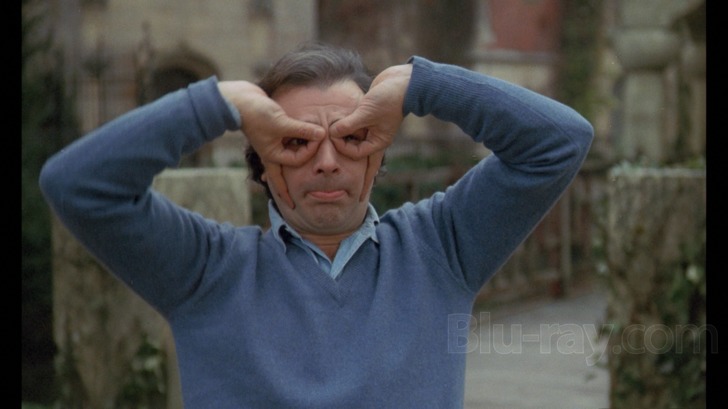
Time has often been a character in Resnais’ films, a sometimes inchoate essence which is played with like silly putty, forged and squeezed into whatever “shape” Resnais requires to his at times unfathomable ends. Time is refracted rather playfully throughout Life is a Bed of Roses, a film whose original French title La vie est un roman would have been better translated as “Life is a book,” which commentators Andy Klein and Wade Major suggest might be further (and better) “translated” as “Life is a fairy tale.” As in the redolent works of Mother Goose, “once upon a time” and “happily ever after” are appropriately indefinite, almost supernatural postulations that simply need to be accepted as fact and not questioned further. In Life is a Bed of Roses, Resnais posits three distinct timelines which intersect in a variety of odd ways, not necessarily informing each other so much as simply colliding in a metaphysical version of montage theory.
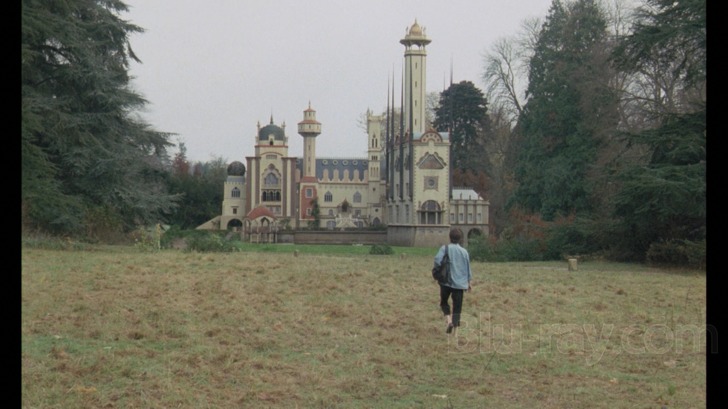
In what almost seems like a presaging of some of the gingerbread architecture of Wes Anderson’s The Grand Budapest Hotel, a scale model of a planned complex is revealed by Michel Forbek (Ruggero Raimondi) to some assorted pre-World War I elites, a gaggle which includes Forbek’s fiancée, Livia Ceraskier (Fanny Ardant), to whom Forbek dedicates the structures. In some mythical antediluvian (and apparently underground) world, a royal baby is hustled to safety by a nurse (famous Berio vocalist Cathy Berberian). And in “contemporary” (meaning early eighties) times, a convention of teachers has gathered at the remains of Forbek’s planned estate. These three disparate tales unfold “simultaneously,” as it were, with Resnais merely cutting from story to story seemingly willy-nilly, with little to no bridging material offering any sort of a segue.
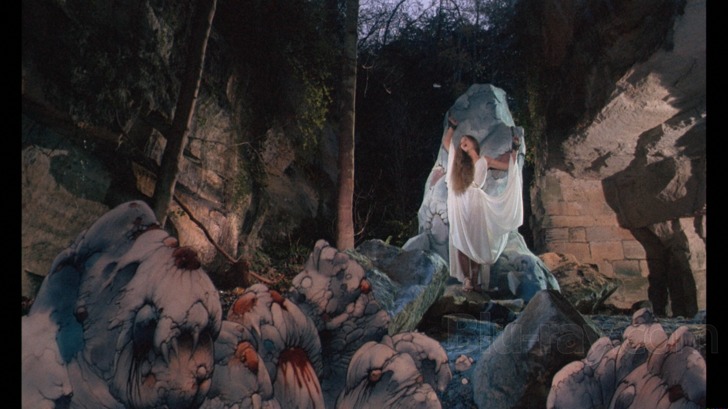
Resnais indulges in outright whimsy throughout Life is a Bed of Roses, offering elements as odd as the model Forbek shows to his guests set on fire somewhat later in the film in order to ostensibly detail World War I. The “fairy tale” story of the royal baby is also accompanied by somewhat florid production design, which includes elements like gargoyle like trees designed by Enki Bilal which spill into the contemporary time frame as well. Throughout all of this, Resnais has the further insouciance to have various characters actually break into song, or at least something like it, with brief phrases sometimes chanted like some weird kind of mantra. (Those with an interest in classical music will recognize not just the name of Cathy Berberian, but of Ruggero Raimondi as well.)
The problem with Life is a Bed of Roses is that these three tales are never really organically integrated into each other, a decision which, while problematic, seems to be intentional on the part of Resnais and scenarist Jean Gruault. Instead, a series of unconnected vignettes plays out, and whatever dramatic momentum is achieved happens courtesy of each individual story’s arc, rather than through any combination of the different elements. The fairy tale is probably the least realized of the three, despite having the most memorable setting. Forbek’s story, which comes to fruition after World War I, is probably the most compelling, and deals with traditional Resnaisian ideas of memory and unrequited love. The contemporary story dealing with the summit of education experts is lightweight but goofily enjoyable on its own terms.
Life Is a Bed of Roses Blu-ray Movie, Video Quality
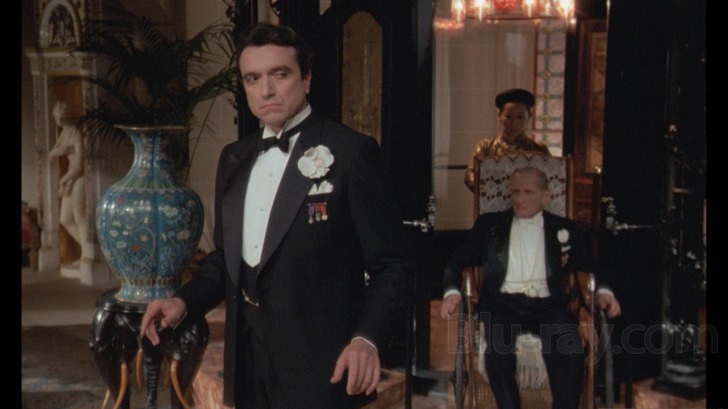
Life is a Bed of Roses is presented on Blu-ray courtesy of Cohen Film Collection with an AVC encoded 1080p transfer in 1.67:1. As is discussed in the commentary included on this new Blu-ray, Resnais and director of photographer Bruno Nuytten opted to use two different stocks to help delineate the differences in time periods. The fantasy fairy tale and World War I sequences were shot with Kodak (Eastmancolor) film, and the "contemporary" sequences with Fujicolor. As Wade Major mentions, that gives an appropriately "vintage" look to the older time periods, with an emphasis on reds, blues and browns, while the contemporary sequences indulge in the greens which Fuji film tends to realize so effectively. Unfortunately, the elements do seem to have faded a bit, so that none of the three time frames totally pops, though it must be granted that the reds (especially) in the World War I era sequences are rather ravishing. There's a fairly heavy grain field in evidence, something that adds a crosshatched appearance to many shots and which can incrementally mask fine detail. The overall look of the transfer is a bit on the soft side, though that actually plays into the surreal ambience of the film. Elements have quite a bit of wear and tear, including typical small white flecks and dirt, but also a couple of pretty major scratches.
Life Is a Bed of Roses Blu-ray Movie, Audio Quality
Life is a Bed of Roses features a workmanlike LPCM 2.0 mono mix which capably supports the film's dialogue and sung moments. Music in Resnais' films is typically quite important, albeit often subliminally so, but here it's more of a featured element. Hans Werner Henze's score is often quite playful in its sung elements, but his dramatic cues seem (perhaps intentionally) to echo Stephen Sondheim at times (Resnais fans will of course know that Sondheim scored Resnais' Stavisky). Fidelity is very good, though dynamic range somewhat constrained on this problem free track.
Life Is a Bed of Roses Blu-ray Movie, Special Features and Extras
- 2014 Re-Release Trailer (1080p; 2:15)
- Feature Length Audio Commentary by Wade Major and Andy Klein. Cohen's regular commentator pair are a bit more able to offer insight into this film than they are with Love Unto Death , offering good assessments of both technical aspects like the different film stocks Resnais used to some of the themes he explores in the film.
Life Is a Bed of Roses Blu-ray Movie, Overall Score and Recommendation

Life is a Bed of Roses is often extremely enjoyable and rather unexpectedly (for a Resnais film, anyway) funny, but it really doesn't hang together in any meaningful way, existing more as a series of weirdly interwoven vignettes than any overarching "statement" attempting to integrate different stories and indeed eras. Performances are wonderful, and the truly odd addition of semi-sung moments makes this a Resnais musical in a bizarre kind of way, something that may either add to the allure or annoyance various viewers will experience. Technical merits are generally very good, and Life is a Bed of Roses comes Recommended.
Similar titles
Similar titles you might also like
(Still not reliable for this title)

The Witches
Le streghe
1967

Jules and Jim
Jules et Jim
1962

And the Ship Sails On
E la nave va
1983

The Canterbury Tales
I racconti di Canterbury
1972

The Decameron
Il Decameron
1971

Boyfriends and Girlfriends
1987

Les visiteurs du soir
The Devil's Envoys
1942

The Aviator's Wife
La femme de l'aviateur
1981

La Collectionneuse
The Collector
1967

Love in the Afternoon
L'amour l'après-midi / Chloe in the Afternoon
1972

My Night at Maud's
Ma nuit chez Maud
1969

Four Adventures of Reinette and Mirabelle
1987

Jamón Jamón
1992

The White Sheik
Lo sceicco bianco
1952

A Woman Is a Woman
Une femme est une femme
1961

Marius
1931

A Lesson in Love
En lektion i kärlek
1954

Le grand amour
The Great Love
1969

A Tale of Autumn
Conte d'automne / Autumn Tale
1998
The Man Who Loved Women
L'homme qui aimait les femmes
1978