Korngold: Das Wunder der Heliane Blu-ray Movie
HomeKorngold: Das Wunder der Heliane Blu-ray Movie 
Naxos | 2018 | 167 min | Not rated | Jun 14, 2019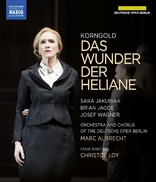

Movie rating
7.3 | / 10 |
Blu-ray rating
| Users |  | 0.0 |
| Reviewer |  | 4.0 |
| Overall | | 4.0 |
Overview
Korngold: Das Wunder der Heliane (2018)
Starring: Sara Jakubiak| Music | 100% |
| Foreign | 26% |
Specifications
Video
Video codec: MPEG-4 AVC
Video resolution: 1080i
Aspect ratio: 1.78:1
Original aspect ratio: 1.78:1
Audio
German: LPCM 2.0
German: DTS-HD Master Audio 5.1
Subtitles
English, French, German, Japanese, Korean
Discs
Blu-ray Disc
Single disc (1 BD)
Playback
Region A (B, C untested)
Review
Rating summary
| Movie | | 4.0 |
| Video | | 4.0 |
| Audio |  | 4.5 |
| Extras |  | 2.0 |
| Overall | | 4.0 |
Korngold: Das Wunder der Heliane Blu-ray Movie Review
Reviewed by Jeffrey Kauffman June 26, 2019Regular habitues of Blu-ray.com probably will easily recognize Erich Wolgang Korngold as having contributed some of the most iconic scores in motion picture history, including such venerable classics as A Midsummer Night's Dream, Captain Blood, The Adventures of Robin Hood, The Sea Hawk, The Sea Wolf and Kings Row. But even some ardent film fans who love Korngold’s patented blend of motif building and orchestration flourishes that recall Richard Strauss may not be aware of what an interesting assortment of non-film music he pumped out in his rather relatively brief life (he died at the age of 60). This Wikipedia page devoted to a listing of Korngold compositions gives some indication of the breadth and scope that Korngold offered in a really rather sumptuous oeuvre which may frankly not be huge by some “classical master standards”, but which is often quite inviting and perhaps unsurprisingly cinematic.
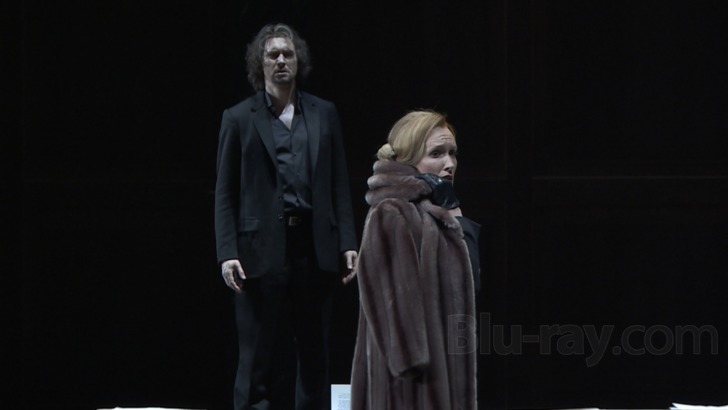
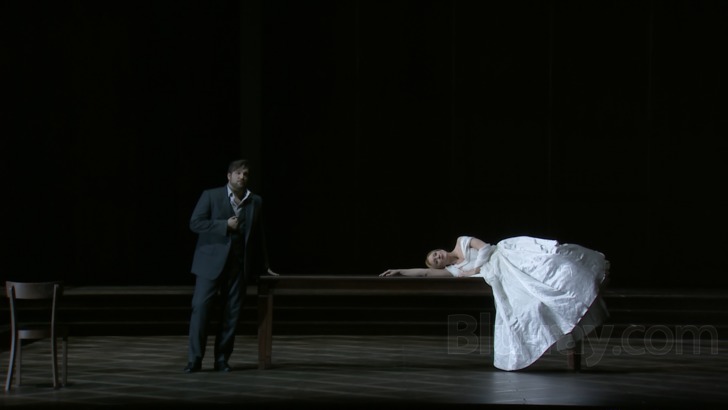
If you don’t attend much opera due to its relative lack of full frontal nudity, you’re in luck! While I’m kind of joking, there is one element in this staging that may strike some as coming dangerously close to so-called “Eurotrash” sensibilities, but the occasional naked female here is actually part of a larger metaphorical or perhaps more accurately allegorical approach that turns out to be rather shockingly prescient of our current roiling sociopolitical climate. A kind of pseudo-Messiah named The Stranger (Brian Jagde) has wreaked havoc in the land of The Ruler (Josef Wagner) by bringing The Ruler’s subjects the one thing The Ruler never has: happiness. The resulting trauma has exacerbated already existing problems between The Ruler and his wife Heliane (Sara Jakubiak), with The Ruler initially sentencing The Stranger to death, but Heliane at least seeming to try to intervene in a rather unusual way, which is where the full frontal bits come into play.
This is a rather thorny (no pun intended, considering the obviously Christ like attributes of The Stranger) piece that may strike some as too “philosophical”, though its passions are “operatic” in the best sense. Korngold’s music is both theatrical and cinematic, in that it layers lietmotifs brilliantly while also helping to underline the emotional content of the scenes. The orchestration is often florid and may evoke memories of Gustav Mahler as well as Richard Strauss.
Korngold: Das Wunder der Heliane Blu-ray Movie, Video Quality
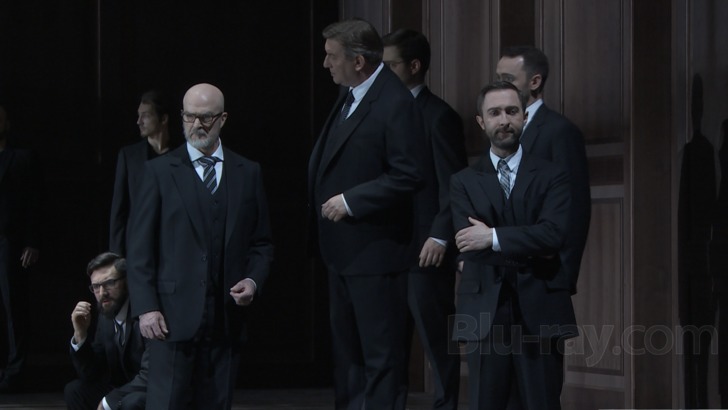
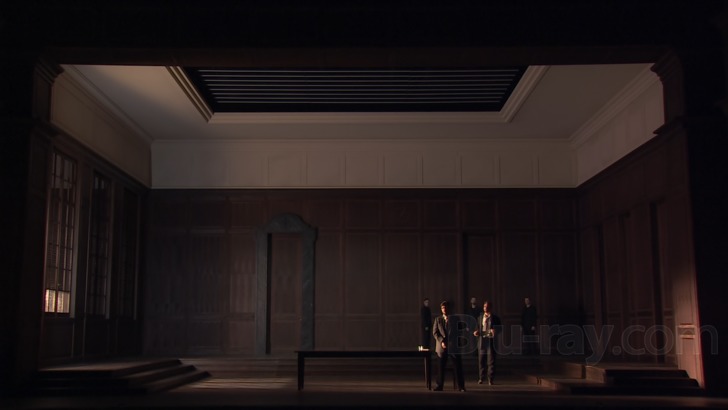
Das Wunder der Heliane is presented on Blu-ray courtesy of Naxos and Deutsche Oper Berlin with an AVC encoded 1080i transfer in 1.78:1. As can probably be made out quite easily in the screenshots accompanying this review, this is a rather spare production that emphasizes the almost overwhelming space of the "cell" where The Stranger is being held. The palette is also intentionally tamped down almost all of the time, with a surplus of slate grays, blues and blacks, and only occasional pops of anything else. Video Director Gotz Filenius tends to often frame things in wide shots that capture the entire proscenium, and as such fine detail levels can be fairly variable. In midrange and close-ups, fine detail understandably perks up, though the absence of any really profound textures on either sets or costumes may strike some viewers as a potential deficit. Clarity and sharpness are generally excellent and delineations of grays and blacks is typically very good as well. There are some very minor issues with banding, typically at the corners of the frame, but nothing that I'd term overly problematic.
Korngold: Das Wunder der Heliane Blu-ray Movie, Audio Quality
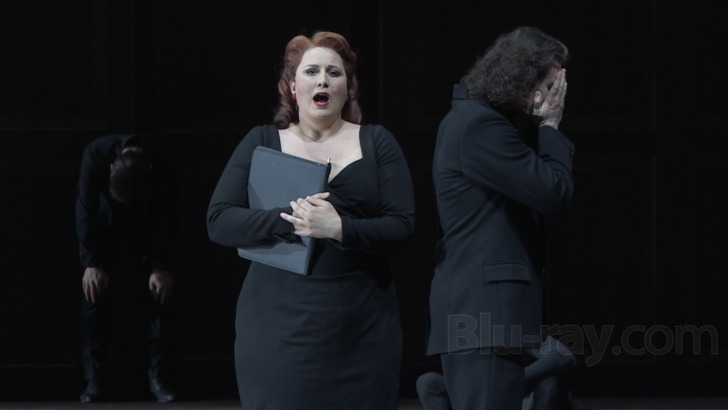
Das Wunder der Heliane features LPCM 2.0 and DTS-HD Master Audio 5.1 tracks in the original German. Korngold's musical language is dense, but it's often very lyrical. There's not a gigantic difference in the stereo and surround tracks in terms of overall fidelity, especially since so many scenes play out between only two or three characters, but the surround track does provide a noticeable spaciousness, especially with regard to some of the orchestral textures, that the stereo track can't quite muster. The vocals are prioritized very well in both mixes. Jagde is an energetic tenor and delivers a powerful performance which is rendered flawlessly on this disc's audio. Jakubiak's soaring soprano is rather warm, considering a certain iciness that Heliane has to display at least with regard to The Ruler. The orchestra and chorus of the Deutsche Oper Berlin sound great under the baton of Marc Albrecht (Jeremy Bines is Chorus Master). There's some interesting choral work that's part of what amounts to the Overture, and the surround track nicely splays the singing to indicate it doesn't seem to be emanating from the pit.
Korngold: Das Wunder der Heliane Blu-ray Movie, Special Features and Extras
Supplemental material comes from something The Brendan G. Carroll collection. Carroll is author of a Korngold biography entitled The Last Prodigy.
- Zwischenspiel (1080i; 7:59) is a really amazing audio recording done for Odeon Records in 1928, which is exceedingly rare since it was evidently withdrawn from release with the advent of Nazism and the "banishment" of Jewish conductors like this outing's Frieder Weissman. This was evidently a studio session orchestra which nonetheless featured many musicians who had performed Korngold at the Berlin State Opera. The fidelity on this thing is absolutely mind boggling; it's only toward the end that you can even discern any real signs of age related wear and tear. This plays to some introductory text and then a still of Weissmann.
- Picture Gallery (1080i; 6:00) has some really fun and interesting archival material. This has been authored to advance automatically, so have your Pause button handy on your remote in case you want to linger on any given image.
Korngold: Das Wunder der Heliane Blu-ray Movie, Overall Score and Recommendation
Das Wunder der Heliane is an opera stuffed to the gills with ideas, and that proclivity combined with the complexities of Korngold's music may make this a "hard sell", even for some diehard music theater aficionados. That said, I was really struck by the ideas Korngold and librettist Hans Muller-Einigen offer here, though some "true believers" may chafe at some of the underlying allusions to faith and what might be cheekily termed "personal eschatology" (i.e., death and/or resurrection). While the physical production here is intentionally spare, the performances are compelling, and the orchestral and choral forces very powerful. Recommended.