Katanagatari: Volume 1 Blu-ray Movie
HomeKatanagatari: Volume 1 Blu-ray Movie 
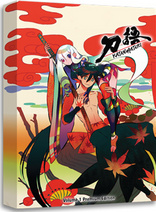
Premium Edition / Blu-ray + DVDNIS America | 2010 | 308 min | Rated PG-13 | Jul 05, 2011

Movie rating
7.3 | / 10 |
Blu-ray rating
| Users |  | 0.0 |
| Reviewer |  | 3.5 |
| Overall | | 3.5 |
Overview
Katanagatari: Volume 1 (2010)
This story teakes place in the Edo era where Yasuri Shichika is the seventh head of the Kyotou school of Japanese sword martial arts living in Fushou Island with his sister Nanami. With the order from a female samurai general Togame, he sets out for a trip to collect the twelve treasured swords created by a legendary swordsmith Shikizaki Kiki.
Starring: Yoshimasa Hosoya, Yukari Tamura, Masako Ikeda, Haruka Tomatsu, Rikiya KoyamaDirector: Keitarô Motonaga
| Anime | Uncertain |
| Foreign | Uncertain |
| Fantasy | Uncertain |
| Action | Uncertain |
| Romance | Uncertain |
| Martial arts | Uncertain |
| Adventure | Uncertain |
| Drama | Uncertain |
Specifications
Video
Video codec: MPEG-4 AVC
Video resolution: 1080p
Aspect ratio: 1.78:1
Original aspect ratio: 1.78:1
Audio
Japanese: LPCM 2.0
Subtitles
English
Discs
50GB Blu-ray Disc
Four-disc set (2 BDs, 2 DVDs)
DVD copy
Playback
Region A (locked)
Review
Rating summary
| Movie | | 3.5 |
| Video |  | 4.5 |
| Audio |  | 4.0 |
| Extras |  | 2.5 |
| Overall | | 3.5 |
Katanagatari: Volume 1 Blu-ray Movie Review
When 'Seven Swords' aren't quite enough. . .
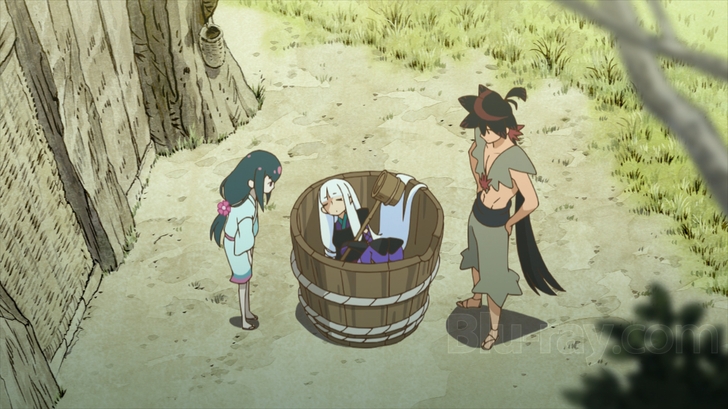
Reviewed by Jeffrey Kauffman August 11, 2011Seven Swords was a huge and at time overwhelming film from auteur Tsui Hark, one which ever so slightly twisted Kurosawa’s Seven Samurai and Sturges’ The Magnificent Seven and gave viewers a septet of heroes dealing with another septet—that of a set of mystically empowered swords. I kept thinking of Seven Swords as I made my way through the appealing, if at times formulaic, Katanagatari, an interesting anime offering from White Fox which gives us a dozen mystically empowered swords, but only two main heroes on a quest to find them. This expedition of sorts plays out almost like those old Quinn Martin episodic series like The Fugitive or even The Invaders: the hero wanders into town, deals with a new set of characters for that week’s episode, solves a few (sometimes more than a few) problems, and then moves on to his next challenge. In that case of Katangatari, we have two main characters, Shichika Yasuri, son and heir of a master of an iconic “No-Sword” fighting method, and Togame, a female strategist for the Shogun’s army who comes calling to the island where Shichika’s family had been banishes years earlier in order. Togame is on a quest of her own, namely to find Shichika’s father, whom she is hoping to convince to help her find the twelve swords crafted by master Kiki Shizaki, swords which may help tip the balance of power in favor of the Shogun and help peace reign over a divided land. Unfortunately Togame soon finds out that Shichika’s father has been dead for years, and only Shichika and his sister remain on the island. That doesn’t stop the exuberant if foolhardy Togame for long—she simply assumes that Shichika being the designated heir to his father’s mastery will no doubt have the skills she needs, and she enlists him to aid her in her quest. And that is basically the gist of Katangatari, a series which then plays out in a kind of “Sword of the Week” style, as the heroes venture near and far, encountering a number of different nemeses, few of whom want to relinquish their magically invested swords, at least not without the requisite battle.
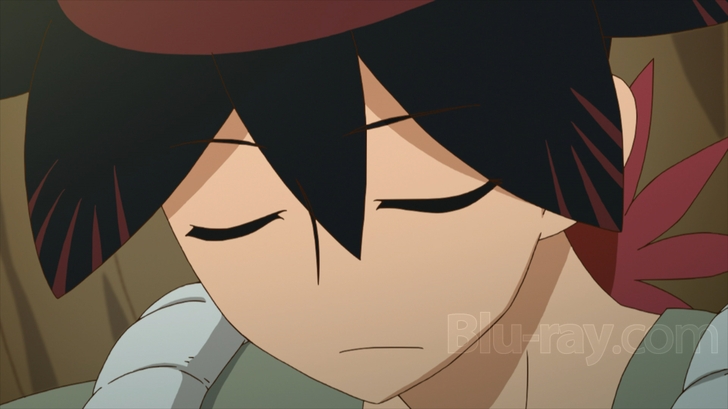
Katangatari might sound like a typical jidaigeki-chanbara, a period sword fighting drama, and in some ways, that’s inarguably true. But the literally episodic nature of Katanagatari makes this series a bit more dependent on two seemingly disparate elements from which it derives most of its interest: first, our two heroes, Yasuri and Togame, and secondly, the episode by episode “guest stars” of various sword wielders with whom they come in contact. The first element is probably the more successful of the two, as our heroes are such a mismatched pair, and they each carry a certain amount of baggage, that their heroes’ quest turns out to be a series of calamities more than some of the time. The various episodic guest stars turn out to be a somewhat more variable lot, but it’s to the series’ credit that not all of them are virtual super-beings, and in fact a couple of them are surprisingly lame.
If you’re familiar with the works of Nisio Isin, whose “light novel” provided the source inspiration for Katanagatari, you’re probably already familiar with genre skewing proclivities of the author. Both his adaptation of the Death Note franchise, as well as his previous sensation Bakemonogatari have proven him to be one of the most facile storytellers of his generation, and one who isn’t afraid to blend disparate elements in order to modernize his subject matter. In the case of Katanagatari that blending is probably more a case of tone rather than content. Rather than the deadly seriousness which this genre typically breeds, Katanagatari has an often goofy sense of humor, one just as prone to devolve into slapstick as it is to evoke the stone faced ambience of a warrior class. That tonal disconnect may actually throw off some viewers, but it gives Katanagatari part of its playful edge and keeps the series from being too predictable.
This first volume comprised of the series’ first six episodes highlights both the strengths and the weaknesses of the enterprise. On the plus side, the two lead characters are inviting, well delineated ones who have their own agendas which are frequently at least temporarily in conflict with each other. The two are also the requisite opposites in experience and temperament, leading to both some drama and comedy. On the minus side, the show gets into its “battle of the week” rut almost immediately and stays there. There are some minor variations on this theme, but with a show made up of a total of twelve episodes, with twelve magical swords to procure, there’s really not much mystery to the eventual outcome.
Katanagatari does best when it actually defies its genre expectations, which it does with a fair amount of regularity and even occasional ingenuity. The perhaps disappointing aspect is that this defiance typically comes in the form of comedy, rather than anythng really jaw droppingly original. At the halfway point through the series, this first volume presents two interesting characters whose motivations might not exactly be what they seem, but that mystery is probably not going to be resolved until closer to the series' conclusion. While this may not be the most innovative anime ever, it has enough intriguing elements that that second half may well elevate it above typical swordplay fare. The seventh through twelfth swords will ultimately tell the tale of how successful Katanagatari is.
Katanagatari: Volume 1 Blu-ray Movie, Video Quality
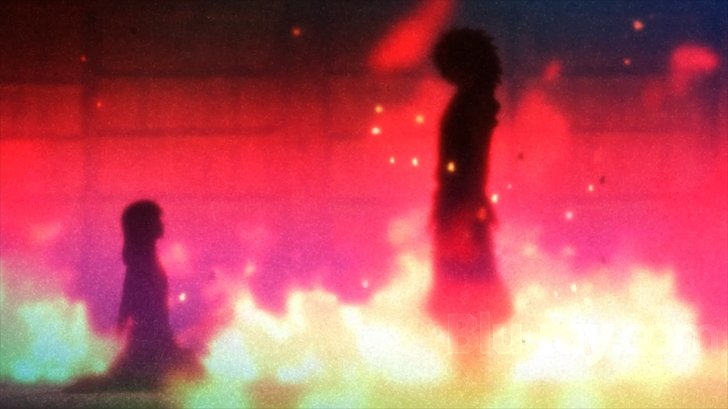
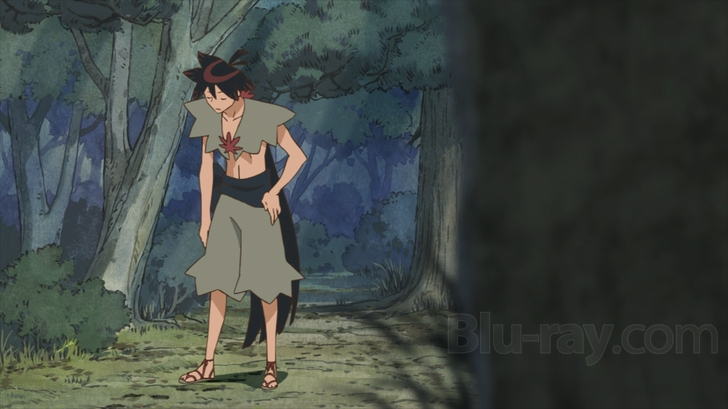
Katanagatari is presented on Blu-ray courtesy of Aniplex and NIS America with an AVC encoded 1080p transfer in 1.78:1. This is a bright, colorful and very appealingly designed series that looks fantastic on Blu-ray. Line detail is sharp and vivid, and colors are really exceptional throughout the series' first six episodes. There are a couple of weird design choices—why, for example, do Yasuri and Togame go around with nothing but vertical lines indicating their noses about 90% of the time? (Oddly, sometimes the noses appear magically out of thin air, albeit only for a brief moment). A lot of the supporting characters are given rather dramatic designs and the overall look of the show is really distinctive and well done, if not exactly innovative. There are occasional nice graphic elements added to episodes which evoke classic Japanese silk paintings and the like, and those also look really sharp and well defined in this very enjoyable high definition presentation.
Katanagatari: Volume 1 Blu-ray Movie, Audio Quality
Like NIS America's other recent release, Arakawa Under the Bridge, Katanagatari is presented with only its original Japanese language track, delivered via an uncompressed LPCM 2.0 mix. There's of course no real immersion in this track, and yet it's surprisingly robust, with abundant LFE in some of the battle scenes, and with good voicework and score adding to the overall enjoyment factor. Despite being stereo, there are some narrow panning effects occasionally with some of the swordplay which at least give a minimal indication of immersion, and fidelity and dynamic range throughout this track are excellent. As with the other NIS release, probably because of no English dub included, there is no way to turn off the subtitles on Katanagatari, which might bother some viewers who want to just look at the beautiful images without the words embossed across the screen.
Katanagatari: Volume 1 Blu-ray Movie, Special Features and Extras
As with NIS America's other recent anime release, Arakawa Under the Bridge, Katanagatari comes in deluxe packaging which includes a heavy slipcover as well as nicely illustrated hardback book published on glossy paper. The book contains episode summaries, character information, transliterations of the (many) theme songs' lyrics, and perhaps most welcome, a long and detailed glossary giving definitions of some of the idiomatic language used in the show.
- Clean Opening (HD; 1:31)
- Clean Ending 1 (HD; 1:31)
- Clean Ending 2 (HD; 1:30)
- Clean Ending 3 (HD; 1:30)
- Clean Ending 4 (HD; 1:30)
- Clean Ending 5 (HD; 1:30)
- Clean Ending 6 (HD; 1:30)
Katanagatari: Volume 1 Blu-ray Movie, Overall Score and Recommendation

Katanagatari might have suffered somewhat from my having seen it right after the other recent NIS America anime release Arakawa Under the Bridge. The irony here is that Katanagatari is by far the more standard show but it may well be the more easily accessible and mainstream of the two series, and so may well appeal to a much wider swath of the general populace. That said, Katanagatari falls into its "battle of the week" rut almost immediately and is never quite able to fully extricate itself from it. The two lead characters are both very interesting and compelling, and the show itself looks fantastic (especially in this sparkling hi-def presentation), so some of its flaws can be overlooked. However, as we reach the halfway point in this first volume of the quest shared by two heroes, some might be wondering when the real magic is going to begin. Despite these qualms, my hunch is a lot of chanbara lovers will probably get a kick out of Katanagatari, and the fact is the show does manage to slightly tweak some of the genre conventions here rather artfully, and so I'll err on the side of the charitable and deem Katanagatari Recommended.

Similar titles
Similar titles you might also like
(Still not reliable for this title)

Angel Beats!: Complete Collection
2010

Canaan: Complete Collection
2009

Children Who Chase Lost Voices
Hoshi o Ou Kodomo / 星を追う子ども
2011

Eden of the East: Complete Series
Higashi no Eden / 東のエデン
2009

Spice & Wolf: Complete Series
Anime Classics
2008-2009

Tsubasa RESERVoir CHRoNiCLE: Season One
S.A.V.E. Edition
2005

Bakemonogatari
化物語 | Limited Edition
2009-2010

Yona of the Dawn: The Complete Series
Akatsuki no Yona
2014

Basilisk: Complete Series
Anime Classics
2005

Is It Wrong to Try to Pick Up Girls in a Dungeon? V: Complete Collection
Limited Edition
2024-2025

Beyond the Boundary The Movie: I'll Be Here - The Past
劇場版 境界の彼方 I’LL BE HERE 過去篇
2015

Beyond the Boundary The Movie: I'll Be Here - The Future
劇場版 境界の彼方 I’LL BE HERE 未来篇
2015

Escaflowne: The Movie
2000

Howl's Moving Castle
ハウルの動く城 / Hauru no Ugoku Shiro
2004

The Last: Naruto The Movie
2014

The Rising of the Shield Hero: Season Four
2025

Ninja Scroll
獣兵衛忍風帖 / Jūbei Ninpūchō
1993

InuYasha the Movie: Affections Touching Across Time
2001

InuYasha the Movie 2: The Castle Beyond the Looking Glass
2002

Naruto Shippuden: The Movie - Bonds
2008