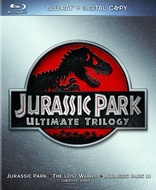
Jurassic Park: Ultimate Trilogy Blu-ray Movie
HomeJurassic Park: Ultimate Trilogy Blu-ray Movie 
Blu-ray + Digital CopyUniversal Studios | 1993-2001 | 3 Movies | 348 min | Rated PG-13 | Oct 25, 2011

Movie rating
Movie has not been rated yetBlu-ray rating
| Users |  | 4.1 |
| Reviewer |  | 4.5 |
| Overall | | 4.3 |
Overview
Jurassic Park: Ultimate Trilogy (1993-2001)
See individual titles for their synopses.
| Adventure | 100% |
| Action | 96% |
| Sci-Fi | 76% |
| Thriller | 39% |
Specifications
Video
Video codec: VC-1
Video resolution: 1080p
Aspect ratio: 1.85:1
Original aspect ratio: 1.85:1
Audio
See individual releases
Subtitles
None
Discs
50GB Blu-ray Disc
Three-disc set (3 BDs)
Digital copy (as download)
BD-Live
D-Box
Mobile features
Packaging
Slipcover in original pressing
Playback
Region free
Review
Rating summary
| Movie | | 4.0 |
| Video | | 4.0 |
| Audio |  | 5.0 |
| Extras | | 4.0 |
| Overall | | 4.5 |
Jurassic Park: Ultimate Trilogy Blu-ray Movie Review
Your DVDs of the 'Jurassic Park' trilogy just became extinct.
Reviewed by Jeffrey Kauffman October 12, 2011Note: The scores above are averages spread over the three films collectively. See below for detailed ratings for
each film individually.
Those of you between the ages of, say, 20 and 30 probably have little if any memory of a pre-CGI universe (literally and
figuratively) in the world of film, and therefore may perhaps be surprised at the excitement and anticipation that early
word of Jurassic Park engendered. No one even really understood what computer generated imagery might
mean within the confines of a special effects extravaganza, but everyone seemed to understand intuitively that a new
age had begun for film. Certainly everyone involved in the production of the film understood that Jurassic Park
was establishing an entire new modus operandi for special effects crew, and the model builders and other
practical effects technicians who were informed during pre-production that the film was going largely digital in terms of
visual effects are on record as stating that they quickly realized that they had become the dinosaurs of their
particular niche in show business. (It’s no big secret that Spielberg and co-screenwriter David Koepp actually worked in
some real life dialogue about these craftsmen becoming “extinct” into the early dialogue of the film, when the various
characters are touring the museum that the Richard Attenborough character has developed). The fact is the long
journey of cinema is littered with technical innovations that didn’t just end up in the dustbin of history, but which never
truly elevated any given film which may have utilized these innovation to anything above run of the mill status. And
that is where Jurassic Park may have really made an impact, for the film was hugely exciting, filled with
rip-roaring adventure, fantastic set pieces and some unusually well developed characters (of the human variety) that
worked in tandem with the then state of the art special effects to create a one of a kind entertainment spectacular.

Jurassic Park
Film: 4.5 stars
Video: 4.0 stars
Audio: 5 stars
Supplements: 4.5 stars
Jurassic Park is not about dinosaurs, at least according to Steven Spielberg. That may come as something of a surprise to most readers, but Spielberg avers the film is really about paleontologist Dr. Alan Grant (Sam Neill), his inability to commit to his girlfriend, fellow paleontologist Dr. Ellie Sattler (Laura Dern), and Grant’s sudden “immersion therapy” in parenting when he’s forced to shepherd two children, Tim (Joseph Mazzello) and Lex (Ariana Richards) through a series of prehistoric obstacles when the “amusement park” created by the kids’ grandfather, billionaire John Hammond (Richard Attenborough) has a major malfunction and its inhabitants, dinosaurs reconstituted from DNA found in amber, run amok. And that’s really what makes Jurassic Park the rip-roaring adventure it is: the human element, as opposed to the various long-toothed and improbably short-armed beasts which torment the poor people scattering like, well, birds before prey. (One of Grant’s major theses in the film is that dinosaurs eventually evolved into birds). Spielberg is at his best throughout this film, eschewing the overly sentimental approach which sometimes mars even his strongest efforts, and instead delivering one incredibly visceral set piece after another.
While the film’s special effects got most of the notice when Jurassic Park was initially released, seen now from a few decades’ vantage point, it’s actually the interplay between the human characters that delivers the bulk of the film’s suspense and undeniably riveting energy. Wandering, almost stumbling Columbo-like, in between Grant and Sattler is chaos theory proponent Dr. Ian Malcolm (Jeff Goldblum), whose attentions to Ellie aren’t appreciated or very well tolerated by Grant. But when a tropical storm hits the island where Jurassic Park has been set up, all hell literally breaks loose, the characters are thrown asunder, most of them left to fend for themselves, and that’s when Spielberg unleashes one fanstastic sequence after another. Yes, the film occasionally cashes in on cheap thrills (dinosaur heads suddenly erupting from unexpected places and the like), but what is so remarkable about Spielberg’s approach here is how almost proto-Hitchcockian he is in crafting real, honest to goodness suspense segments where the audience knows what the danger is, but about which the on screen personnel people may not be completely aware— yet.
There are occasional missteps in Jurassic Park, and they mostly have to do with the two children, who are alternately sympathetic and then hideously annoying. Richards’ Lex is especially egregious in this regard, a girl who on the one hand is a quivering idiot incapable of turning off a dangerous flashlight, the next moment a quivering idiot incapable of stopping screaming, and then, completely improbably, the heroine saving the day when her knowledge of UNIX (now, that’s comedy!) gets the park’s computer system up and running after a power outage. By the time the film crashes into one last dinosaur versus humans battle, there is probably more than one audience member secretly hoping that a big dinosaur jaw will encircle Lex and finally put an end to her incessant caterwauling.
These are small concerns, though, in an otherwise completely engrossing film experience. Speilberg, original author Michael Crichton and co-scenarist David Koepp do a fantastic job which doesn’t concentrate on the scientific aspect to the point of turning off the public at large, but which still invests the film with a very real “well, this could indeed happen” sort of feeling. The performances are uniformly top notch, and there are a handful of standout sequences in Jurassic Park which belong in any All Time Greatest Hits moments in any assessment of the adventure genre.
The Lost World: Jurassic Park II
Film: 3.5 stars
Video: 4.0 stars
Audio: 5.0 stars
Supplements: 3.5 stars
It’s of course no mere coincidence that the first Jurassic Park sequel is named after one of Arthur Conan Doyle’s best remembered works of science fiction, and one which itself became a groundbreaking special effects film extravaganza in 1925, utilizing pioneering stop-motion techniques by the iconic Willis O’Brien. O’Brien of course would go on to even greater glory a few years later when he performed similar duty on King Kong. As Steven Spielberg mentions in one of the many supplementary documentaries included on this new Blu-ray set, the explosion of CGI capabilities between the release of the first Jurassic Park and The Lost World: Jurassic Park II was truly mind boggling. Spielberg states that though some might not believe him, the first film only had about 62 or 63 digital effects (many of Jurassic Park’s most well remembered sequences featured practical effects designed by Stan Winston), while The Lost World: Jurassic Park II upped that total into the several hundreds. What’s so remarkable about the second film, though, is how brilliantly the effects team—both digital animators and practical effects puppet-masters—managed to blend their work into a seamless whole, one which might include a CGI dinosaur in a master shot, and then cut effortlessly to a maquette in a close-up. But while technology is certainly part and parcel of the Jurassic Park franchise, once again Spielberg and his team manage—albeit a bit less successfully than in the first film—to create some actual human drama in the midst of all the dinosaur mayhem.
Jeff Goldblum’s Ian Malcolm character comes front and center in The Lost World: Jurassic Park II, when Dr. Hammond (Richard Attenborough) reveals that though Jurassic Park itself was shut down after the disasters that befell the first film, there is another island, a breeding ground of sorts, where dinosaurs have been allowed to roam freely. Once again Spielberg, a la Hitchcock, has already let the audience in on that secret—albeit a bit discursively—in a brilliantly structured prologue where a vacationing family encounters a little surprise in the bushes. Hammond of course wants Malcolm and a new team of scientists to travel to the island to understand how the dinosaurs have managed to flourish despite having been bred with a lysine deficiency which should have killed them after a week. And so we’re off on another fantastic journey to prehistoric times, and it doesn’t take a rocket scientist (and/or world famous chaos theorist) to know that things are not going to end well.
Malcolm has his own love interest in this film, paleontologist Sarah Harding (Julianne Moore). Also along for the destructive ride is a documentary filmmaker named Nick Van Owen (Vince Vaughn). One of the interesting subtexts of the Jurassic Park franchise is how funding plays into scientific research, and Dr. Hammond’s company InGen is in desperate straits as The Lost World: Jurassic Park II begins, due to the calamitous events of the first film. That has led to Hammond actually losing control of his company, which is now being run by his greedy and nefarious nephew, Peter Ludlow (Arliss Howard). It’s interesting to note that the first Jurassic Park didn’t have a traditional villain (yes, the scheming Wayne Knight character had “issues,” and Martin Ferrero’s attorney is equally hiss- worthy). The Lost World: Jurassic Park II is much more conventional in this regard, positing Ludlow as the scheming corporate bean counter who is out to reap profits no matter what the consequences might be.
Overall, The Lost World: Jurassic Park II is an exciting enough sequel, with several top notch sequences (the scene with Goldblum and Moore dangling over the cliff on a winch rope is fantastic), but the whole film has a slightly stale, “been there, seen that” feel. The final half hour or so is just flat out silly, albeit undeniably exciting, when a T-Rex demolishes downtown San Diego in good old fashioned Japanese behemoth rampage style. Goldblum’s stuttering, halting antics may be a bit too much for some in this film, and he makes for a rather unlikely hero, but Moore brings some nice energy to her role. At least we don’t have screaming children this time—unless one counts the kidnapped T- Rex baby.
Jurassic Park III
Film: 3.0 stars
Video: 4.0 stars
Audio: 5.0 stars
Supplements: 3.5 stars
The law of diminishing returns almost always catches up with franchises which try to outstay their welcome and/or capitalize on their particular cash cow (or in this particular instance cash T-Rex), and that’s certainly the case with Jurassic Park III. Spielberg handed over directing reins on this outing to Joe Johnston, who had actually wanted to helm The Lost World: Jurassic Park II, but the problems with Jurassic Park III can’t be traced entirely to this change. Probably more to blame is an episodic and cliché-ridden screenplay co-written by Peter Buchman, Alexander Payne and Jim Taylor, one which simply goes to the same old, same old well one too many times to ever create any substance or real suspense. In fact it’s rather instructive to view this film’s approach to humans in peril with that essayed by Spielberg in the first two films. Spielberg plays his cards rather close to his vest on several occasions, letting suspense build slowly and surely and sometimes not even showing the horror, instead leaving it to the viewer’s imagination, which is almost always more horrific than an actual onscreen display of violence could be. Here, though, it’s all there, plastered on the screen, and after a while, the viewer simply ceases to care very much, one way or the other.
Jurassic Park III brings back Dr. Grant (Sam Neill), who is duped into visiting Isla Soma, the “free range” dinosaur breeding ground that was introduced in The Lost World: Jurassic Park II. Grant is approached by two people he thinks are wealthy investors and who can fund his current (mainland) dig, Paul (William H. Macy) and Amanda Kirby (Tea Leoni), who in fact turn out to be divorced small time businesspeople who are actually distraught over the disappearance of their son Ben and Amanda’s soon to be second husband. The two missing people are of course thought to be wandering around Isla Soma. Jurassic Park III also introduces a whole slew of frankly unnecessary secondary characters who are out to make their own fortunes with patently insane plots dealing with various dinosaurs, subplots that adds nothing other than opportunities to see various bad guys get chomped, sliced and diced by various dinosaurs.
As I’ve mentioned in the reviews of the first two Jurassic Park films, despite these films’ technological wizardry (and the advancement in CGI means that this is arguably the most impressive film of the three from a purely technical standpoint), it was the human element which ultimately elevated the films above mere special effects spectacle. The human element became at least slightly less interesting in The Lost World: Jurassic Park II and here in Jurassic Park III it’s virtually non-existent, despite the tried and true trope of a child being (repeatedly, ad nauseum) in peril. Neill still makes for a compelling hero, but the rest of this cast seems like little more than dinosaur fodder, and the fact is many of them turn out to be just that. This is by the numbers filmmaking, and while it’s inarguably well crafted, it’s like watching a shiny, computer generated facsimile of something which once seemed incredibly real.
Jurassic Park: Ultimate Trilogy Blu-ray Movie, Video Quality

For those prone to pre-judging releases, Jurassic Park Ultimate Trilogy will have two strikes against it going in: first off, it's a Universal catalog titles, and those have long been the bane of high definition aficionados, and second of all it's encoded via the VC-1 codec, which for some reason is the Rodney Dangerfield of video compression techniques. All three films are presented in their original 1.85:1 aspect ratio in 1080p. Let's dispense with the usual furor over Universal catalog releases, and that is the perceived overuse of digital noise reduction. I'm the first person to admit that DNR, at least when applied judiciously, does not bother me in the slightest, though it evidently drives other videophiles to froth-mouthed fury. The good news is if—and that's a big if—DNR has been applied to any of these three releases, it has been done so extremely judiciously, and I doubt very many people are going to complain about an overly smooth and waxy texture to any of these films. (It should be noted that at least sometimes when people claim a film has been slathered in DNR—as in the recent brouhaha over Breakfast at Tiffany's--the truth is they are mistaking either original filming techniques like soft focus or not completely understanding other elements endemic to the source material). In fact the one issue that videophiles might indeed complain about is the very noticeable haloing in all three films courtesy of edge enhancement. Edge enhancement actually grates on my eyes far more than DNR ever does, and even though I find it bothersome, while evident, it's still not of any considerable concern here, it's simply being mentioned for those who like to view films looking for any potential problems. The good news is very good indeed, for all three films bristle with fine detail, and the CGI elements look especially fantastic in that regard. CGI skins of the dinosaurs all look absolutely crystal clear, and the scales and reptilian textures on many of them are virtually tangible. As with many Universal releases, while colors are robust and extremely well saturated, I personally found the color timing of these releases just slightly skewed too much toward the red side of things, but again, this is of no huge concern. There is some very minor shimmer evident in some of the scenes involving crane shots over the dense foliage on Isla Soma and Jurassic Park itself, but otherwise these are sharp, well defined Blu- rays that offer a considerable upgrade in video quality from the DVDs.
Jurassic Park: Ultimate Trilogy Blu-ray Movie, Audio Quality

All three films have been granted lossless DTS-HD Master Audio 7.1 mixes and the results are, to put it simply, reference quality. It goes without saying that all three film's mixes sport brilliant fidelity, with absolutely incredible dynamic range, fulsome low end (with some absolutely wall shattering LFE courtesy of little dinosaur footsteps in the night and some great dinosaur roars), with well prioritized dialogue, effects and that anthemic John Williams score. (Isn't it interesting that for the most part Williams forsakes his "scary" Jaws approach and instead gives us a soaring theme that seems to evoke man's greatest hopes rather than his darkest fears?) But what again and again impresses throughout all three of these films is the incredible attention to detail with regard to foley effects, some of which are almost hilariously brilliant (the little clicking noise the velociraptors' claws make on the kitchen floor in the first film is a great example). Directionality is also spot on throughout all three films, and each film is awash in fantastic panning effects, especially when one of the dinosaurs lumbers into view. But even in more subtle moments, we get some incredibly smart use of the surround channels. About halfway through Jurassic Park III, for example, Macy and Leoni wander off stage left and their voices clearly travel with them, even when the main action is still anchored in front of us. Again and again throughout all three films "little" moments like this help elevate the film's sonic majesty as much as the humongous effects surrounding the dinosaurs do. Jurassic Park Ultimate Trilogy will certainly go down as one of the stellar releases of 2011 with regard to its impeccable lossless audio.
Jurassic Park: Ultimate Trilogy Blu-ray Movie, Special Features and Extras

Each of the three Blu-rays offers copious supplements, including the all-new six part documentary Return to 'Jurassic
Park' as well as previously released supplements that were originally included on various DVD releases of the films.
Jurassic Park Supplements
- Return to Jurassic Park: Dawn of a New Era (HD; 25:25). The first part of this all-new documentary concentrates on the seismic sea change that the filmmakers encountered when they realized that CGI was the way to most effectively create many of the special effects in the film.
- Return to Jurassic Park: Making Prehistory (HD; 20:16). This section concentrates on the film's impressive production design with regard to recreating the Jurassic era on film, most of which was done on soundstages. There's also some cool footage of some stop-motion previz work done on some sequences.
- Return to Jurassic Park: The Next Step in Evolution (HD; 15:03) is a more in-depth look at the development of the CGI elements in the film, many of which were composited very late in the production. The learning curve was steep and incredibly fast on this film, since this was such a new technology at the time, with some shots being improved literally on a day to day basis.
- Archival Featurettes include:
The Making of 'Jurassic Park' (SD; 49:39) is a very well done, generalist overview of the production of the film.
Original Featurette on the Making of the Film (SD; 4:50) is a brief promo piece that probably ran as a quasi-trailer theatrically.
Steven Spielberg Directs 'Jurassic Park' (SD; 9:07) is an interesting look at the director on set and on location.
Hurricane in Kauai Featurette (SD; 2:09). As if the rigors of making a movie this monumental weren't enough, on a day inscribed in memory for another reason—September 11—in 1992, a category 5 hurricane named Iniki hit Hawaii where the filmmakers were doing location shooting. - Behind the Scenes includes:
Early Pre-Production Meetings (SD; 6:20)
Location Scouting (SD; 1:59)
Phil Tippett Animatics: Raptors in the Kitchen (SD; 3:04)
Animatics: T-Rex Attack (SD; 7:21)
ILM and 'Jurassic Park': Before and After Visual Effects (SD; 6:32)
Foley Artists (SD; 1:25)
Storyboards
Production Archives - Theatrical Trailer (SD; 1:18)
- Jurassic Park: Making the Game (1080i; 4:43) is a quick look at a new game produced by Telltale.
- Return to Jurassic Park: Finding The Lost World (HD; 27:40) deals with Spielberg's decision to tackle this sequel after the exhausting years of making the original and then Schindler's List.
- Return to Jurassic Park: Something Survived (HD; 16:30) talks about the increase in use of CGI between the first and second features, but also how seamlessly the practical effects by Stan Winston were combined with the purely digital effects, often within the same sequence.
- Archival Featurettes include:
The Making of 'The Lost World' (SD; 53:14) offers scenes from the film as well as behind the scenes footage and interviews with Spielberg, Crichton, Goldblum, Moore, Vaughn and others in the cast and crew.
Original Featurette on the Making of the Film (SD; 13:17) is a somewhat longer companion piece to the similar featurette included on the original Jurassic Park Blu-ray, and includes some good Spielberg commentary via interviews and voiceover.
The 'Jurassic Park' Phenomenon: A Discussion with Author Michael Crichton (SD; 15:27) is a really interesting interview with Crichton, who discusses how an original screenplay he wrote which was never produced (and which Crichton admits never really worked) slowly morphed into Jurassic Park.
The Compie Dance Number: Thank You Steven Spielberg from ILM (SD; 1:38) is a goofy little send up ILM produced in response to a comment by screenwriter David Koepp who said the challenge after getting people to believe dinosaurs were real in the first Jurassic Park was getting the beasts to dance effectively. - Behind the Scenes includes:
ILM and "The Lost World': Before and After Visual Effects (SD; 20:44)
Storyboards
Production Archives - Deleted Scenes (SD; 7:09) offers some interesting additional bits, including the nefarious bean counters at InGen, but the video quality of these deleted scenes is problematic.
- Theatrical Trailer (SD; 1:58)
- Return to Jurassic Park: The Third Adventure (HD; 25:20). Perhaps oddly, this outing deals initially with the Universal Theme Park's Jurassic Park ride, and then only tangentially gets into the production of Jurassic Park III. This includes interviews with Joe Johnston, the cast and crew, as well as Spielberg.
- Archival Featurettes include:
The Making of 'Jurassic Park III' (SD; 22:43) is a decent enough overview, featuring people like Kathleen Kennedy and Sam Neill talking about the franchise as a whole as well as how this particular iteration was done.
The Dinosaurs of 'Jurassic Park III' (SD; 7:52) has lots of clips of dinosaurs feasting on humans as well as a quick review of various beasts that populate this film, including the Spinosaurus.
The Special Effects of 'Jurassic Park III' (SD; 10:31) is a nice look at both the CGI and the practical effects utilized in the film.
The Industrial Light and Magic Press Reel (SD; 10:14) is a cool promo ILM produced touting its work on the franchise.
The Sounds of 'Jurassic Park III' (SD; 13:35) is a tribute to the great sound design of the film, and features interviews with Christopher Boyes, the film's sound designer and re-recording mixer.
The Art of 'Jurassic Park III' (SD; 7:55) deals with pre-production and items like storyboards and the production design of Ed Verraus.
Montana: Finding New Dinosaurs SD; 4:21) is an interesting piece documenting real life paleontologists who are following in the footsteps of the man who dug up the first T-Rex in Montana in 1903. - Behind the Scenes includes:
Tour of Stan Winston Studio (SD; 3:14)
Spinosaurus Attacks the Plane (SD; 1:48)
Raptors Attack Udesky (SD; 00:59)
The Lake (SD; 1:38)
A Visit to ILM (SD; 14:52) features Concepts, The Process, Muscle Simulation and Compositing
Dinosaur Turntables (SD; 6:23) features 11 species included in the film
Storyboards to Final Feature Comparison
Production Photographs - Theatrical Trailer (SD; 1:16)
- Feature Commentary with the Special Effects Team features Stan Winston, John Rosengrant, Dan Taylor, and Michael Lantieri, who give some great detail into how the film's many effects shots were constructed and composited. This really isn't overly technical and is a very enjoyable commentary that helps to show what immense effort went into doing the visual effects in this film.
Jurassic Park: Ultimate Trilogy Blu-ray Movie, Overall Score and Recommendation

The first Jurassic Park stands as one of the most iconic films of the last several decades, not simply for its technological innovations but for Spielberg's immaculate mastery of craft. The next two films take rather deliberate downward steps from the perhaps impossible to match highs of the first film, but they each have at least some elements that make them enjoyable in their own way. This new 3 BD set is packed to the gills with supplementary material, features fantastic video and reference quality audio, and it comes Highly recommended.