Julian Schnabel: A Private Portrait Blu-ray Movie
HomeJulian Schnabel: A Private Portrait Blu-ray Movie 
Cohen Media Group | 2016 | 85 min | Not rated | Nov 07, 2017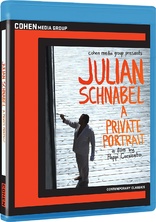

Movie rating
6.6 | / 10 |
Blu-ray rating
| Users |  | 0.0 |
| Reviewer |  | 3.0 |
| Overall | | 3.0 |
Overview
Julian Schnabel: A Private Portrait (2016)
This documentary profiles painter and filmmaker Julian Schnabel, tracing his life from his upbringing in Brownsville, TX, to his reputation today as a widely acclaimed artist. The film includes footage from his archives, as well as interviews with Schnabel and his friends, family, and colleagues.
Starring: Julian SchnabelDirector: Pappi Corsicato
| Documentary | 100% |
Specifications
Video
Video codec: MPEG-4 AVC
Video resolution: 1080p
Aspect ratio: 1.78:1
Original aspect ratio: 1.85:1
Audio
English: DTS-HD Master Audio 5.1
English: Dolby Digital 5.1
Subtitles
English SDH
Discs
Blu-ray Disc
Single disc (1 BD)
Playback
Region A (B, C untested)
Review
Rating summary
| Movie | | 3.0 |
| Video |  | 3.5 |
| Audio |  | 4.0 |
| Extras |  | 0.5 |
| Overall | | 3.0 |
Julian Schnabel: A Private Portrait Blu-ray Movie Review
Reviewed by Jeffrey Kauffman November 24, 2017Mention New York City to many (maybe even most) people, and they'll probably almost inevitably think of iconic locations like the confluence of Broadway and Seventh Avenue, otherwise known as Times Square. My own personal memories tend to focus more on the "bohemian" enclaves a bit further downtown, centered around Greenwich Village. My uncles had a prosperous real estate business and owned quite a bit of property throughout Manhattan and the other boroughs, but I tended to stay in lower Manhattan when I would visit them, at times in a really beautifully restored brownstone on West 11th between 5th and 6th Avenues. For a kid from the “backwater” of Utah, traipsing around the West Village with its incredibly colorful buildings and even more incredibly colorful residents was a formative experience of delight and amazement, and one I will probably never forget. That said, one of the area’s most iconic (and colorful) buildings hadn’t yet made headlines when I first visited my New York family decades ago. Just a few blocks further west from one of my family’s New York City’s “homesteads” on West 11th is a curious structure that has become one of the West Village’s most notorious buildings, the so-called Palazzo Chupi, a former horse stable that artist and filmmaker Julian Schnabel purchased and then remade in his own image (so to speak), transforming the historical structure into something approaching a Spanish or even Italianate palace, replete with porticos, arches, and, most spectacularly, a bright pink color. Schnabel’s distinctive stylization of the building was met with a certain amount of umbrage by other West Village denizens, not just because of the facade’s anachronistic architecture and eye popping color, but because Schnabel seemingly willfully defied the region’s code limiting the vertical height buildings can be (the West Village tends to be a so-called “low rise” community, without the spectacular skyscrapers that are more of a feature in midtown). The Palazzo Chupi can therefore probably rightly be seen as either a testament to Schnabel's outsized ego, or as a symbol of his insistence on free expression for the Artist (capital A), depending on how you personally react to such a patently "in your face" approach. Schnabel may not be an overly familiar name to many filmgoers, despite the fact that he received an Academy Award nomination for Best Director for The Diving Bell and the Butterfly. Julian Schnabel: A Private Portrait does ultimately delve into Schnabel's filmmaking career, but it's more uniquely focused on his work as a painter, and the documentary may therefore appeal more to those with an interest in visual media than this particular creative force's work in cinema.

Julian Schnabel A Private Portrait seems to take the tack that anyone coming to the documentary is probably going to have at least a baseline knowledge of Schnabel’s life and output, and so Pappi Corsicato’s structure isn’t typically chronological, though it does at least gloss over large swaths of Schnabel’s history. That said, the film does in fact only gloss over a number of formative elements, including a move to Texas that is described as being epochal to Schnabel’s artistic and psychological development, but which is never really fully explored in this piece.
The film does a bit better when it lets Schnabel and a host of other talking heads (including members of his family and notables like Al Pacino) wax philosophical about what exactly Schnabel’s contributions to the world of modern art have been. Some of the documentary’s most visceral content is simply scenes of Schnabel painting, especially since he tends to favor absolutely huge “canvases” (no matter what he’s actually painting on). It’s kind of thrilling to see Schnabel on a tall ladder in front of an immense work, where he literally applies paint by hand (as in using his hands).
While Schnabel’s childhood arguably gets the short shrift in Julian Schnabel A Private Portrait, the documentary does do a good job of detailing Schnabel’s emergence in scenes like New York City’s “underground” art movements, where Schnabel became friendly with the likes of Andy Warhol and Lou Reed. A large section later in the documentary has some really interesting interactions between Schnabel and Reed during a time Schnabel was more or less designing one of Reed’s tours.
Though it’s not arguably the most prevalent focus of the documentary, there is some interesting data shared about Schnabel’s work in the film world. Schnabel’s own directorial choices in trying to show what “locked in syndrome” is like in The Diving Bell and the Butterfly provides some of the most interesting asides in the entire documentary and helps to point up how thoughtful Schnabel can be when approaching a “logistical” issue like this. The fact that Schnabel would even attempt a film with such built in limitations is perhaps another indication of what an “upstart” he likes to be, or perhaps likes to be perceived as being. Case in point: Paluzzo Chupi on West 11th in Greenwich Village.
Julian Schnabel: A Private Portrait Blu-ray Movie, Video Quality
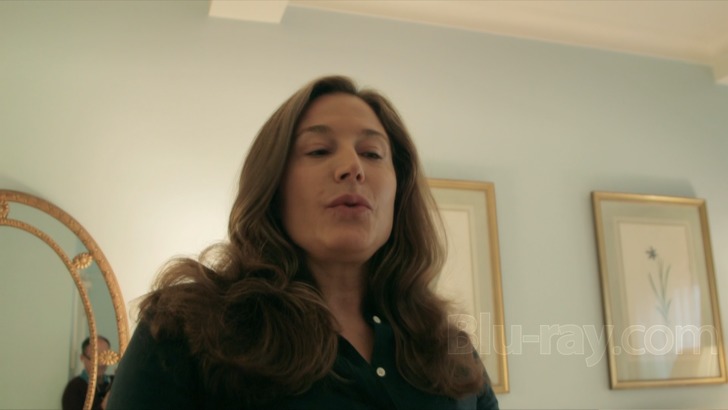
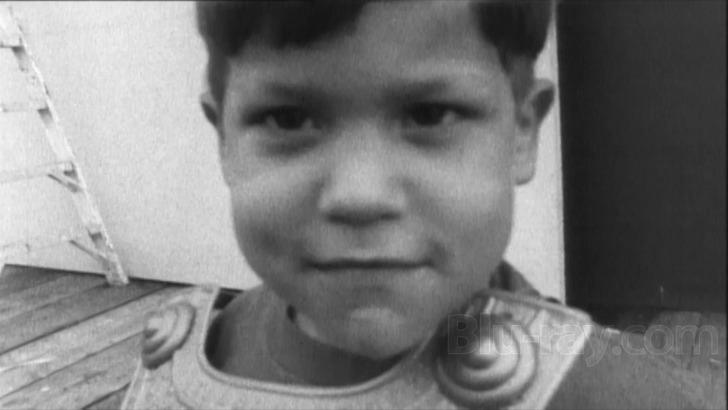
Julian Schnabel A Private Portrait is presented on Blu-ray courtesy of Cohen Media Group with an AVC encoded 1080p transfer in 1.78:1. As should be expected from a documentary cobbled together from any number of differing sources, there's a fairly heterogeneous appearance, with more contemporary talking heads sequences looking nicely sharp and well detailed, and a lot of the archival video looking fairly ragged, to the point that in some cases facial features can't be clearly discerned. Though this is a progressive presentation, a number of the source elements look like they may have been interlaced, as eagle eyed viewers will be able to see various anomalies crop up from time to time. The palette is rather robust looking in several scenes showing Schnabel creating pieces of art, but otherwise can be a little on the drab side. Some of the sharpest looking material in the entire documentary are the ubiquitous still photographs utilized.
Julian Schnabel: A Private Portrait Blu-ray Movie, Audio Quality
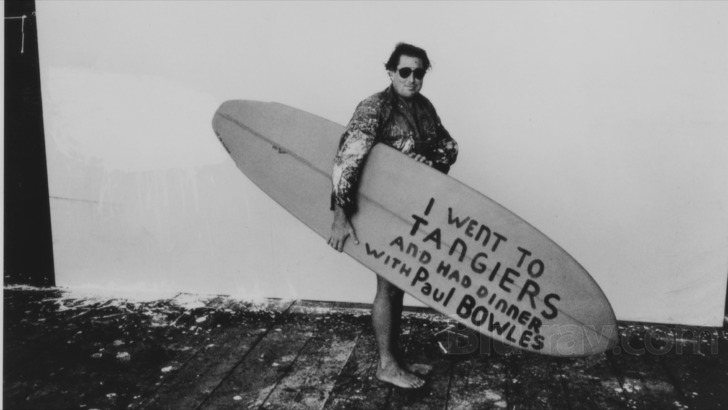
Julian Schnabel A Private Portrait features a DTS-HD Master Audio 5.1 track which simply doesn't have that many opportunities to really "strut its stuff", since the bulk of the film is simply first person confessionals or other talking head sequences. Occasional outdoor material at least creates moments of immersion, but this is a fairly straightforward track that offers perfectly excellent fidelity but not that much impressive surround activity.
Julian Schnabel: A Private Portrait Blu-ray Movie, Special Features and Extras
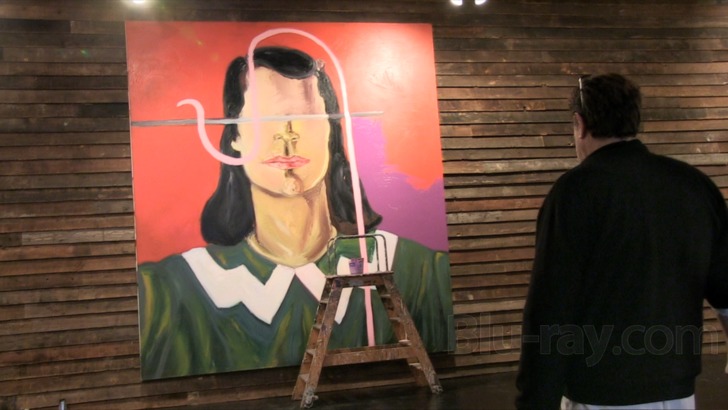
- Theatrical Trailer (1080p; 2:10)
Julian Schnabel: A Private Portrait Blu-ray Movie, Overall Score and Recommendation
Julian Schnabel A Private Portrait should interest fans of Schnabel's film work, or perhaps a more generalist audience interested in some relatively recent movements in modern art. The documentary isn't exactly revelatory in any major or meaningful way, but, like its subject, it's never less than interesting. Technical merits are generally very good for those considering a purchase.
