John Cage: Journeys in Sound Blu-ray Movie
HomeJohn Cage: Journeys in Sound Blu-ray Movie 
Accentus | 2012 | 61 min | Not rated | Oct 30, 2012

Movie rating
Movie has not been rated yetBlu-ray rating
| Users |  | 0.0 |
| Reviewer |  | 4.0 |
| Overall | | 4.0 |
Overview
John Cage: Journeys in Sound (2012)
Starring: John Cage, Merce Cunningham, Yoko Ono, John Lennon| Music | Uncertain |
| Documentary | Uncertain |
Specifications
Video
Video codec: MPEG-4 AVC
Video resolution: 1080p
Aspect ratio: 1.78:1
Original aspect ratio: 1.78:1
Audio
English: DTS-HD Master Audio 5.1
English: LPCM 2.0
Subtitles
English, French, German, Mandarin (Simplified)
Discs
25GB Blu-ray Disc
Single disc (1 BD)
Playback
Region A (B, C untested)
Review
Rating summary
| Movie | | 4.0 |
| Video |  | 3.5 |
| Audio | | 4.0 |
| Extras |  | 2.5 |
| Overall | | 4.0 |
John Cage: Journeys in Sound Blu-ray Movie Review
A Cage espousing freedom.
Reviewed by Jeffrey Kauffman October 24, 2012At least a few of us were in on the joke our college Composition and Theory professor was playing on his class, but none of us dared to blow the punch line for those not in the know. This particular professor had graduated from Juilliard at some absurdly young age (I want to say 14 or 15) and had gone on to an illustrious concert piano and conducting career. He was still quite young even as a professor, and while he was “hip and happening”, at least within the somewhat staid confines of the classical music world, he also had an “old world” quality about him that did not suffer musical fools gladly, and in fact one of his favorite phrases was informing his students that various things should be “intuitively obvious”, shorthand for asking “how stupid are you really?” But on this particular day, our teacher had brought in an album (yes, that’s how long ago I was in college) of what he claimed was one of the masterpieces of twentieth century classical music, putting the record on the turntable, affixing the stylus to the disc and then settling back as we all listened to: nothing. About thirty seconds into this enterprise, a few kids started giggling a little, at which point our professor scolded, “Shhh! This is the best part!”, something that sent the entire class into gales of laughter. Of course what we were being “entertained” by was a faux “recording” of one of the most famous experiments in contemporary musical literature, John Cage’s 4’33”, a “composition” that consists of nothing but the “performer” showing up at his instrument and sitting there for the appointed four minutes and thirty three seconds. Cage’s intent was not just ironic (though there’s no denying that aspect to the piece), and indeed many think that the piece is about silence, when it is in fact a listening exercise to see what happens sonically during that brief time period, even in the absence of instrumental music.
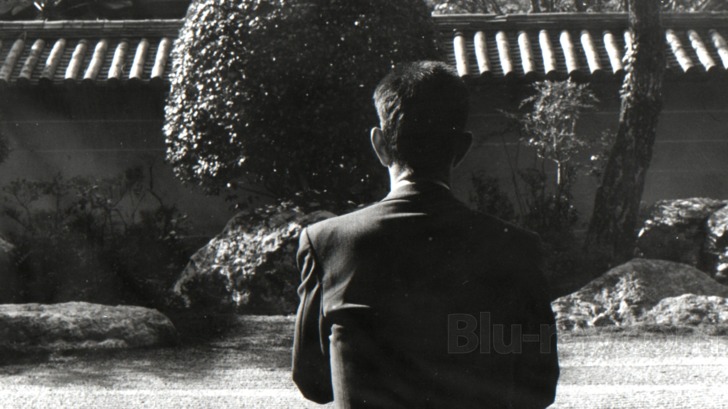
John Cage had the intuitive brilliance to ask a question that perhaps had never really even been thought of before, namely just what exactly is music? Is it only organized tonal sounds produced by instruments? Cage’s assertion was that it most definitely was not, and one of his most daring innovations was the introduction of “mere” noise into his compositions. This fascinating documentary by Allan Miller and Paul Smaczny actually starts with a wild and rather funny clip from a 1960 episode of I’ve Got a Secret, the old CBS game show hosted by the squarer than square Garry Moore. Moore introduces Cage as one of the most controversial figures in modern music and then asks aloud if Cage considers what he does to be music. Cage answers in the affirmative, and then Moore asks a follow up question: will Cage mind if some of the “nice” (in Moore’s verbiage) audience breaks out into laughter once Cage starts performing? In typically self-effacing manner, Cage responds, “I much prefer laughter to tears,” at which point the curtain opens to reveal a stage full of a rather unlikely assortment of “instruments”, including a bathtub, watering pail a prepared piano and various other accoutrements through which Cage strolls, making his own indelible form of music.
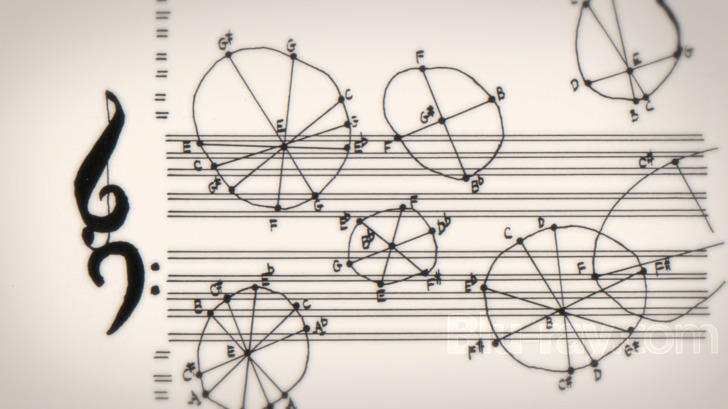
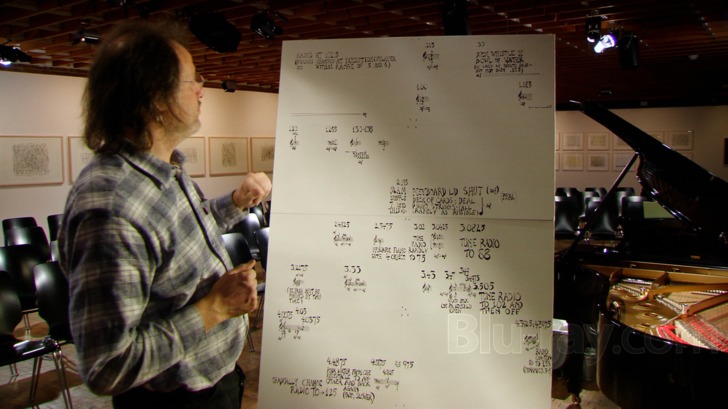
Those of you who either read music or are at least conversant enough with notation to recognize staves and notes know that for centuries music was written in a linear fashion that sought to visually approximate the passage of time as each bar was played (and/or looked at). Even some twentieth century scores that incorporated the then trendy “indeterminate” elements, like Terry Riley’s In C, still notated things traditionally, albeit in little snippets of a bar or two that each player could add to the orchestral assemblage more or less whenever they wanted to. But looking at Cage’s score is almost like going to an art exhibition, as John Cage: Journeys in Sound makes clear with several startling examples. A representative of Cage’s long time publishing house Peters who talks about the rather surprising strength of Cage’s catalog in the marketplace takes us on a tour of some of his scores, admitting up front even he doesn’t understand how some of the graphical interfaces work. A pianist performing Cage’s Water Music is a bit more assured in pointing out how Cage’s placard sized score works and how precise it actually is.
There’s something undeniably funny in watching some of these pieces being performed, but that whimsy was part of Cage’s very real contributions to musical thought. Some more cynical types may feel themselves tipping over into a sort of Luis Buñuel-esque surrealism at times, though, seeing a decidedly middle class audience raptly listening to grown men blow duck whistles into tubs filled with gurgling water. But there was a serious intent behind the whimsy, as several archival interviews with Cage (who died in 1992 make quite clear. Cage was fascinated with questions of chance and indeterminism and those ideas inform most, if not all, of his pieces. That still doesn’t preclude some of these clips from verging awfully close to self-indulgence, as in one hilarious clip of Cage with John Lennon and Yoko Ono. Cage begins growling and mewing, making frankly indescribable sounds with his voice, which Yoko and John both greet enthusiastically as an artistic triumph.
The often hoity toity world of classical music didn’t know quite what to think of anachronistic characters like John Cage (or others like Harry Partch, a fellow traveler in spirit if not technique). The fact that Cage managed to be as successful as he was is testament not only to his vision but all his perseverance in proclaiming that everyday sounds could be and were in fact music. The lasting influence of Cage’s thinking in any number of genres of music prove just how “intuitively obvious” Cage’s basic thesis really was.
John Cage: Journeys in Sound Blu-ray Movie, Video Quality
John Cage: Journeys in Sound is presented on Blu-ray courtesy of Accentus Music with an AVC encoded 1080p transfer in 1.78:1 (with a few archival elements in 1.33:1). The contemporary interview segments fare best in this documentary, as should be expected, with good detail and clarity, and fairly robust and well saturated color. The documentary does make use of a great deal of archival footage, and some of that is pretty ragged looking by comparison, with fuzziness and ghosting in some of the older videotape segments. Surprisingly, the I've Got a Secret snippet looks pretty decent, perhaps because it's delivered in a small scale form, inserted into an old cabinet television. The documentary does have some visual ingenuity, including a great sequence toward the end where a bunch of performers and talking heads are interpolated into the noisy neon circus of Times Square.
John Cage: Journeys in Sound Blu-ray Movie, Audio Quality
John Cage: Journeys in Sound features both a lossless DTS-HD Master Audio 5.1 surround track as well as an uncompressed LPCM 2.0 stereo fold down, but some may question as to why a surround track was included in the first place, since the documentary only tends to exploit the side and rear channels in some relatively brief snippets from Cage's music, as well as a couple of noisy cityscape sequences. That said, the 5.1 mix does significantly open up some of the ensemble pieces excerpted here, allowing a greater clarity to infuse the combination of more traditional elements with Cage's anarchic use of everything from nuts and bolts to odd percussion instruments to really breathe. As might be expected, the talking head segments and archival footage are resolutely anchored in the front channels and sound fine.
John Cage: Journeys in Sound Blu-ray Movie, Special Features and Extras
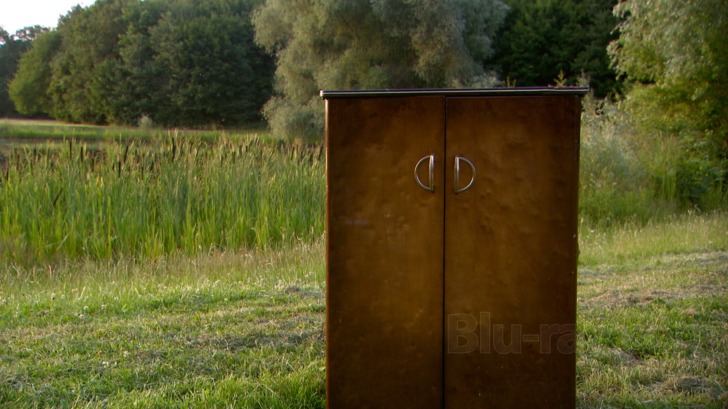
- John Cage: 4'33" performed by David Tudor (including interview) (1080i; 22:00) begins with Tudor at the keyboard (replete with stopwatch), as a scrolling subtitle invites viewers to turn down the volume of their televisions and listen to the ambient sounds around them, the real point of Cage's exercise. The interview is perhaps unintentionally funny at times as Tudor haltingly explains how it took Cage many months of arduous work to "compose" the piece.
- John Cage: Second Construction performed by Schlagquartett Köln (HD; 8:54)
- John Cage: Sonata I from Sonatas and Interludes for Prepared Piano performed by Steffen Schleiermacher (HD; 3:39)
- John Cage: Water Music performed by Steffen Schleiemacher (HD; 8:04). It would have been nice to have had some subtitles to decipher Schleiemacher's spoken introduction. No subtitles necessary for the pails and bathtub, thankfully.
- Interview with John Cage, Merce Cunningham and Robert Rauschenberg (1080i; 6:38) is in pretty rough shape from a video standpoint but is an interesting examination of the trio's collaboration. This includes some brief snippets of performances of various works.
John Cage: Journeys in Sound Blu-ray Movie, Overall Score and Recommendation
John Cage: Journeys in Sound is an absolutely fascinating documentary, even if it is at times only surface deep. The archival footage with Cage, his life partner choreographer Merce Cunningham, and several artists is the most interesting aspect, while the musical excerpts, while often too brief to really give an adequate idea of any given piece's overall impact, at least provide a smattering of Cage's idiosyncratic brilliance. This documentary may prove to be unexpectedly interesting even to those who have never heard of Cage or who, if they have heard of him, couldn't care less about his approach to music. Certainly anyone with an interest in twentieth century composition will want to check out this intriguing piece. Recommended.