Janacek: Katia Kabanova Blu-ray Movie
HomeJanacek: Katia Kabanova Blu-ray Movie 
Karita Mattila/Madrid 2008/BelohlavekFrapod | 2008 | 108 min | Not rated | Feb 08, 2011
Price
List price:Listed on Amazon marketplace

Movie rating
7.2 | / 10 |
Blu-ray rating
| Users |  | 4.0 |
| Reviewer | | 4.0 |
| Overall | | 4.0 |
Overview
Janacek: Katia Kabanova (2008)
The oppressive atmosphere before a storm and the tragic fate of a tormented young woman form the indivisible elements of Katia Kabanova.
| Music | 100% |
Specifications
Video
Video codec: MPEG-4 AVC
Video resolution: 1080i
Aspect ratio: 1.78:1
Original aspect ratio: 1.78:1
Audio
Czech: DTS-HD Master Audio 5.1
Czech: LPCM 2.0
Subtitles
English, French, Spanish, German, Italian
Discs
25GB Blu-ray Disc
Single disc (1 BD)
Playback
Region A (B, C untested)
Review
Rating summary
| Movie | | 4.0 |
| Video |  | 3.5 |
| Audio |  | 4.5 |
| Extras |  | 3.0 |
| Overall | | 4.0 |
Janacek: Katia Kabanova Blu-ray Movie Review
Water, water, everywhere.
Reviewed by Jeffrey Kauffman February 23, 2011The 19th century saw the rise of a whole strain of nationalism that spread rather potently beyond “mere” political events to inform a whole range of artistic pursuits. How odd, then, that in the relatively insular world of what was then Czechoslovokia three world class composers should arise within just a few years of each other. What’s perhaps even stranger is that one of them achieved world wide renown and is still a mainstay of orchestral repertoire everywhere, while the second is known chiefly for a couple of evocative tone poems. And the third? Well, there’s the rub. The first two are, not to state the obvious, Antonin Dvorak (1841-1904) and Bedrich Smetana (1824-1884). Bringing up the rear, perhaps both figuratively and literally, is the lesser known and more infrequently performed Leos Janacek (1854-1928), the last born of the three but often the most disparaged and disregarded, at least within the hoity-toity world of classical music criticism. If Smetana gave birth to the Czech national consciousness with regard to symphonic music, and Dvorak raised Smetana’s “child” to adulthood, Janacek is often seen as the bastard cousin who really shouldn’t be having children to begin with, considering his spotty “genetic” background. Part of the shame with regard to Janacek is that his extreme originality rubbed the academic ranks the wrong way, and his less than disciplined approach toward orchestration made him an enfant terrible to those more schooled in that art, leading to a whole raft of Janacek’s music having been “improved” by subsequent people who came along and thought with a little tweaking and editing they could shove the square peg that is Janacek into the round hole of accepted classical music norm. Really not until musicologists and conductors like Charles Mackerras came along to try to restore Janacek’s original conceptions have we had a clearer conception of just how innovative and expressive this transitional Czech voice really was. Janacek has managed to squirrel his way at least partially into operatic houses worldwide with a trifecta of challenging and highly original pieces, Jenufa, The Cunning Little Vixen and the piece that is performed on this interesting new Blu-ray release, Katia Kabanova (you’ll see the title transliterated in all sorts of interesting, vowel-challenged, ways due to the idiosyncrasies of the Czech language).
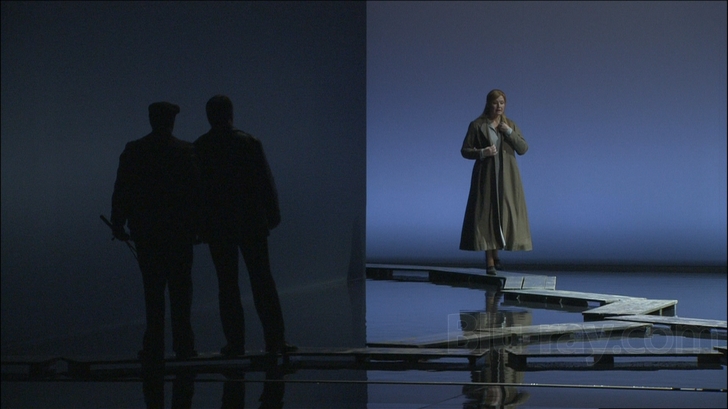
Katia Kabanova features a fairly standard starcrossed love affair scenario, but Janacek places it all in a decidedly psychological setting which, in this production at least, emphasizes a whole host of Jungian and Freudian references. Katia (Karita Mattila) is stuck in a stultifying marriage to Tichon (Guy De May). Tichon seems to be basically a well meaning chap, if not overly affectionate, but he is under the thumb of his domineering Mother, Kabanicha (Dalia Schaechter), who does not attempt to disguise her dislike for Katia. Katia is loved from afar by villager Boris (Miroslav Dvorsky), who has troubles of his own in the form of his rude and uncouth Uncle, Dikoj (Oleg Bryjak), a buffoonish older man who takes great delight in demeaning his nephew, knowing that the lad can’t fight back, at least if he want an inheritance. Into this really rather slim libretto Janacek manages to imbue Katia Kabanova with some incredibly evocative and beautiful music.
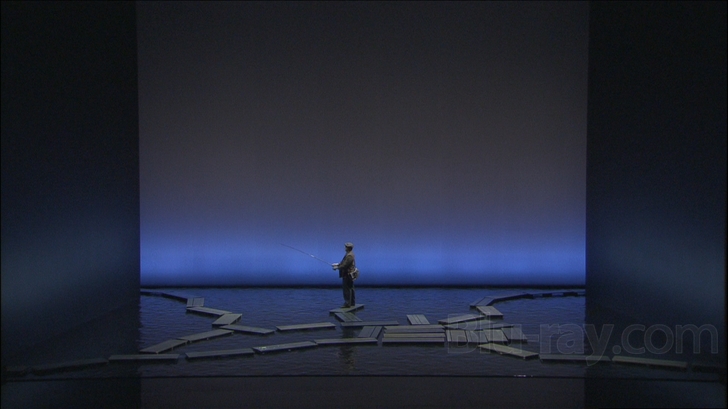
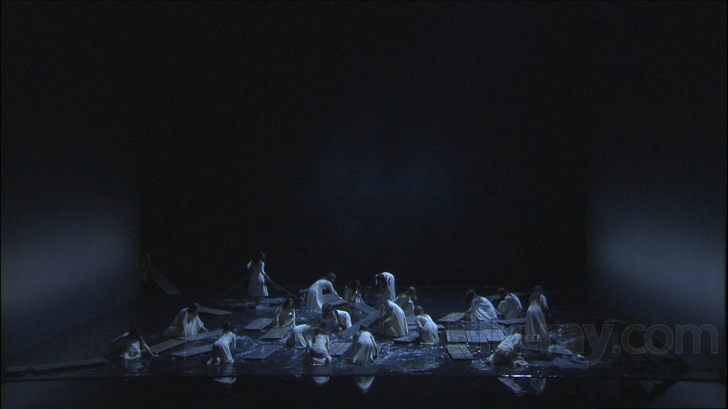
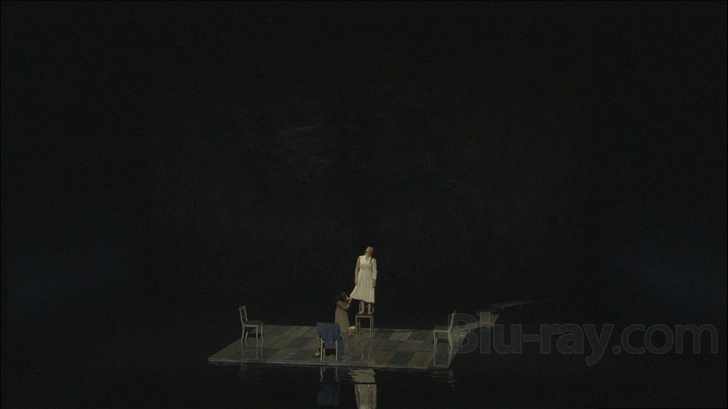
What may actually be the real calling card here, as sad as it may be for those rooting for Janacek to finally get his due, is the rather alarming physical production Robert Carsen helmed for this December 2008 offering from Madrid Teatro Real. Katia Kabanova takes place in the backwoods of Russia, and the Volga River is a recurring motif, to the point where it almost is its own character in the piece. In Carsen’s production, the Volga is another character—the stage is literally awash in a flow of water for all of the opera’s three acts. The actors therefore splash into the fray, and just as often as not seem to be literally teetering on the edge as they move across the streams of liquid on well placed platforms. Both the prelude and several interstitials feature an ensemble of women, wraiths perhaps, or, to borrow liberally from Wagner, “Volga Maidens,” who presage the opera’s climactic “showdown” between Katia and the iconic river.
Janacek tended to cut to the bone in all of his operatic adaptations, three of which were inspired by his long unrequited love of a woman several decades his junior. Katia Kabanova both benefits and suffers from this tendency. On one hand, there’s virtually no wasted emotions or plot points here. Everything moves inexorably toward its tragic conclusion. On the other hand, things are so condensed that first time audiences may wonder about various characters’ motives and rationales.
This is an impeccably well sung and played production, especially on the part of Mattila as Katia, who brings a fulsome tone to some of Janacek’s florid arias. Mattila, who has also done an acclaimed Jenufa, is perhaps too Wagnerian in tone and stature to naturally convey the frailty and vulnerability of Katia, but she overcomes this genetic predisposition with sometimes very affecting results, especially in the long third act solo section, where she commands the stage effortlessly. Schaechter’s Kabanicha is also notable for its strident quasi-Freudian approach; this is a mother not about to let her son go gentle into that good wife, so to speak. The odd, much discussed final line of this opera, which is Kabanicha’s, is here delivered as a sort of ironic commentary on the futility of the mother’s attempts to grasp at something that is truly no longer hers.
As Mackerras and others have helped modern audiences approach a new appreciation for the solid, if idiosyncratic, wonders of Janacek’s oeuvre, we’re beginning to see a new generation of houses and directors take on the sometimes challenging world of this too often thought of as “third string” Czech composer. This new Katia Kabanova will hopefully allow people to realize there’s certainly nothing third rate about Janacek’s contribution to operatic art.
Janacek: Katia Kabanova Blu-ray Movie, Video Quality
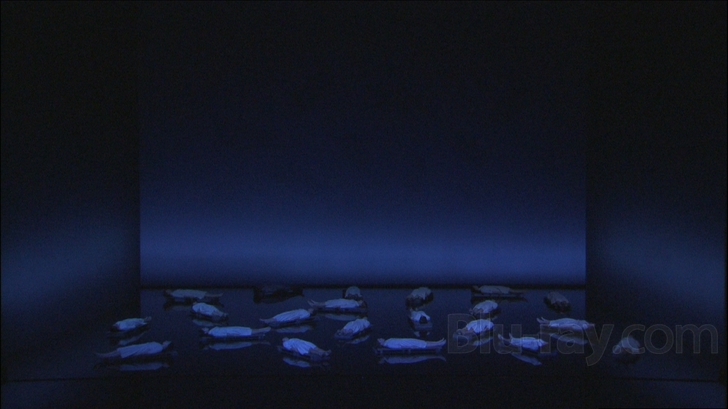
Katia Kabanova debuts on Blu-ray with an AVC encoded 1080i transfer in 1.78:1. The biggest issue with the image quality here is the pallid saturation of a rather bland palette, which is due largely to the blue lighting scheme which gives the bulk of the opera its ghostly hue. Flesh tones are anemic and sometimes bizarre looking, and the blue lighting robs a lot of the opera of fine detail, at least from midrange shots. Close-ups are much better in this regard, but the overall look of this piece is on the soft side. The opera has been filmed in a sort of quasi-epic style at times, with some brief tracking and dollying shots that help to break up the monotony of what is essentially a minimalist production which utilizes the distinctiveness of the onstage water, as well as several interesting projections, many of those watery as well, to create a claustrophobic atmosphere.
Janacek: Katia Kabanova Blu-ray Movie, Audio Quality
Both of the lossless audio options on this Blu-ray disc, a DTS-HD Master Audio 5.1 and an LPCM 2.0, sound quite robust and offer excellent fidelity. Janacek's writing is quite pungent and dry at times, and the brisk reed work here comes through magnificently, with several outstanding uses of oboe and English horn. The orchestra, under the direction of Jiri Belohlavek, plays with admirable balance and restraint, just hinting at the emotions roiling beneath the surface of the often folksong like ambience of Katia. All of the singing sounds marvelous, and the balance between the soloists and the orchestra is also very good. Janacek uses the ensemble in some very unusual ways, including some offstage vocalese in the opera's closing moments, and the surround track nicely separates these segments with some smart utilization of side and rear channels.
Janacek: Katia Kabanova Blu-ray Movie, Special Features and Extras
Interview with Robert Carsen and Jiri Belohlavek (1080i; 23:43) offers the director and conductor giving some interesting and insightful thoughts about the symbology of the opera as well as Janacek's place in the world of both Czechoslovokia in particular and the international world in general.
Janacek: Katia Kabanova Blu-ray Movie, Overall Score and Recommendation
Katia Kabanova proves that Janacek was one of the most incisive operatic composers of his era. There's virtually not a wasted gesture throughout this tight and relentless piece, and it receives an admirably innovative production here, highlighted by a tour de force performance by Mattila in the title role. Recommended.