Jakoman and Tetsu Blu-ray Movie
HomeJakoman and Tetsu Blu-ray Movie 
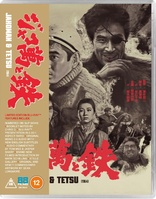
ジャコ萬と鉄 | Jakoman to Tetsu | Limited Edition88 Films | 1964 | 100 min | Rated BBFC: 12 | Apr 21, 2025

Movie rating
6.8 | / 10 |
Blu-ray rating
| Users |  | 0.0 |
| Reviewer |  | 3.5 |
| Overall | | 3.5 |
Overview
Jakoman and Tetsu (1964)
In a village subsisting on its herring fishery, a one-eyed criminal named Jakoman terrorizes the inhabitants. One of them, the son of the head of one of the fish companies by the name of Tetsu, decides to overthrow Jakoman and his cohorts.
Starring: Ken Takakura, Tetsurô Tanba, Isao Yamagata, Yôko Minamida, Kumeko UrabeDirector: Kinji Fukasaku
| Foreign | Uncertain |
| Drama | Uncertain |
Specifications
Video
Video codec: MPEG-4 AVC
Video resolution: 1080p
Aspect ratio: 2.38:1
Original aspect ratio: 2.35:1
Audio
Japanese: LPCM 2.0
Subtitles
English
Discs
Blu-ray Disc
Single disc (1 BD)
Playback
Region B, A (locked)
Review
Rating summary
| Movie | | 3.5 |
| Video |  | 4.0 |
| Audio |  | 4.5 |
| Extras |  | 2.5 |
| Overall | | 3.5 |
Jakoman and Tetsu Blu-ray Movie Review
Reviewed by Dr. Svet Atanasov June 9, 2025Kinji Fukasaku's "Jakoman and Tetsu" (1964) arrives on Blu-ray courtesy of 88 Films. The supplemental features on the release include new filmed introduction by critic Mark Schilling and new audio commentary by critics Tom Mes and Jasper Sharp. In Japanese, with optional English subtitles for the main feature. Region-A/B "locked".
The avenger
Kinji Fukasaku’s film will always be compared to Senkichi Taniguchi’s film of the same name, which was completed nearly two decades earlier. However, even though both work with identical content from a short story by Keizo Kajino, which Akira Kurosawa adapted for the big screen, Fukasaku's film is not, as often claimed, a conventional remake.
It is an important piece from a big power play project. Indeed, if both films are closely examined, it becomes quite easy to conclude that the main objective of Fukasaku’s film was not to deliver a superior cinematic retelling of Kajino’s story, but to continue improving a relationship that had become very important to the studio that produced it, Toei. The reason for this is multi-layered and quite complex. However, most of it has to do with the fact that after the end of WWII, Toei quickly developed a reputation for mass-producing mainstream gangster films, which became very popular but limited its market presence, so to expand it, its leadership began diversifying its output with more ‘serious’ films. As a result, in the late 1950s and 1960s, while still mass-producing mainstream gangster films, Toei introduced various new 'serious' films that typically would have emerged from one of its most formidable rivals, Shochiku. Fukasaku’s film was, together with various other similar ‘serious’ films, a piece from this big power play project.
All of the drama in Fukasaku’s film takes place on a remote island that regularly welcomes migrant fishermen from different corners of Japan. As the fishing season begins, the aging opportunist Kyubei (Isao Yamagata) and his son-in-law Sotaro (Shiro Osaka) take a loan, purchase several massive fishing nets, and hire a big group of newcomers. Kyubei’s plan is to lead them to an area where he believes there will be enough fish to make a small fortune, and then spend the rest of his days without worrying about putting food on the table.
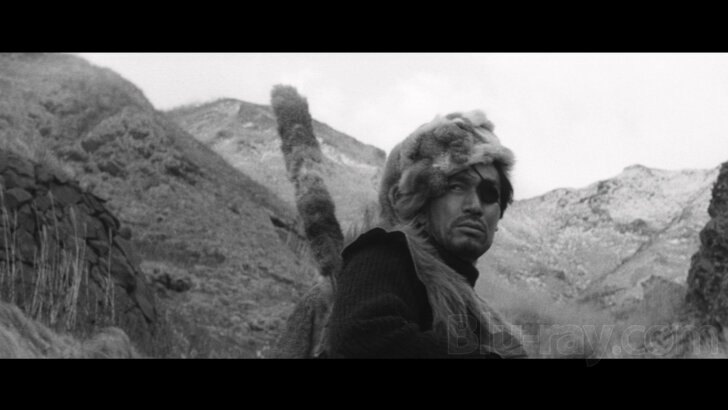
At the chosen area, as predicted by Kyuibei, the fish, all big and fat herring, appear, but so does a man from his past, threatening to ruin his plan to get rich quickly. The man’s name is Jakoman (Tetsuro Tamba), a one-eyed former soldier-turned-sailor, who, at the right time, publicly accuses Kyuibei of cheating him and ruining his life. After unpacking, Jakoman then begins his campaign to bankrupt Kyuibei and ensure that no fisherman ever thinks of doing business with him or any of his family members. However, as tensions quickly rise, another man from Kyuibei’s past reappears. It is his son, Tetsu (Ken Takakura), also a former soldier, who has been thought dead for years.
The management of the unknown in the drama draws an unmissable line between Fukasaku and Taniguchi’s films. In Fukasaku’s film, all key relationships are quickly established, and after that, the character transformations they must initiate become very easy to predict correctly. In Taniguchi’s film, the middle section, where Tetsu begins interfering with Jakoman’s revenge, has more gray. Because of it, the character transformations are more complex as well. Additionally, in Fukasaku’s film, the drama channels clearer social messaging of the type that a ‘serious’ film would produce. Its stars are fully aware of this development, too. Taniguchi’s film emphasizes casual realism that produces very similar contrasts and, to a certain extent, messaging, but its stars do not perform with the same awareness, which is why their characters are superior.
Jakoman and Tetsu Blu-ray Movie, Video Quality
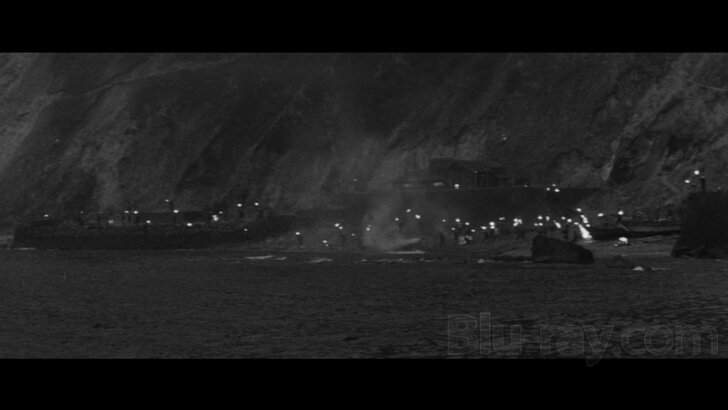
Presented in an aspect ratio of 2.38:1, encoded with MPEG-4 AVC and granted a 1080p transfer, Jakoman and Tetsu arrives on Blu-ray courtesy of 88 Films.
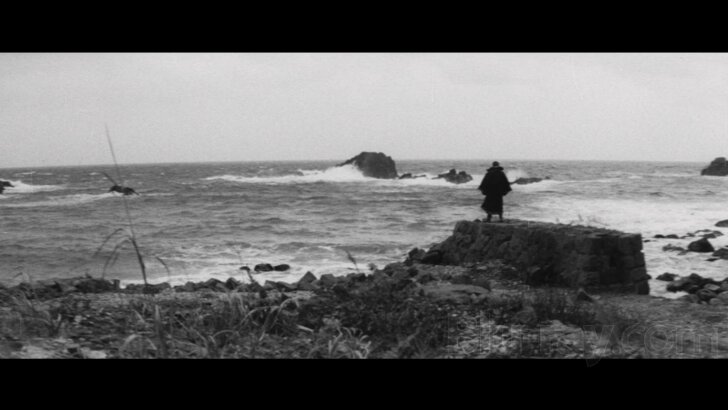
Despite a few rougher spots that reveal small surface imperfections -- mostly nicks and blemishes -- the overall quality of the visuals is very good. It is the type of quality that I would expect to see from a recent 2K master struck from an interpositive. Delineation, clarity, and depth are remain very pleasing throughout the entire film, though small density fluctuations, all inherited, not introduced by questionable digital work, are often easy to see. The grayscale is convincing. Darker areas, in particular, look very good because there is no crushing. Grain is nicely exposed, but in the areas where density fluctuations are noticeable it can appear a bit loose. The important detail here is that there are no anomalies to report. Image stability is good. All in all, while there is some room for improvements, primarily cosmetic, this release offers a very nice organic presentation of Jakoman and Tetsu. (Note: The release is Region-A/B "locked". Therefore, you must have a native Region-A, Region-B, or Region-Free player in order to access its content).
Jakoman and Tetsu Blu-ray Movie, Audio Quality
There is only one standard audio track on this Blu-ray release: Japanese LPCM 2.0. Optional English subtitles are provided for the main feature. When turned on, they appear inside the image frame.
The lossless track is very healthy. All exchanges are clear, sharp, and easy to follow. I would describe stability as good, too. However, in certain areas, small unevenness is easy to notice. I do not think that it is a byproduct of aging. Rather, I think that it is how the original soundtrack was finalized. Dynamic intensity is understandably limited. So, while some cosmetic improvements can be introduced, the quality of the lossless track is already near optimal.
Jakoman and Tetsu Blu-ray Movie, Special Features and Extras
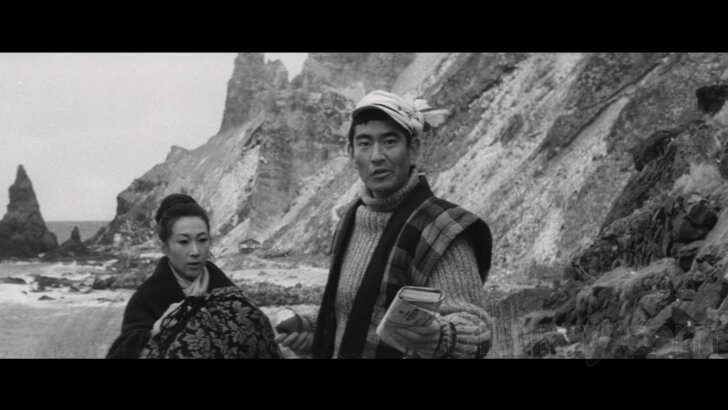
- Introduction - presented here is an exclusive new video introduction to Jakoman and Tetsu by critic Mark Schilling. In English, not subtitled. (19 min).
- Commentary - in this exclusive new audio commentary, critics Tom Mes and Jasper Sharp deconstruct Jakoman and Tetsu, and share plenty of information about the era from which it emerged, the original material that inspired it and Akira Kurosawa's adaptation of it, the cast that was assembled for the film, etc.
- Booklet - a 16-page illustrated booklet featuring an essay by critic Chris D. and technical credits.
- Cover - a reversible cover with vintage Japanese theatrical poster art for Jakoman and Tetsu.
Jakoman and Tetsu Blu-ray Movie, Overall Score and Recommendation
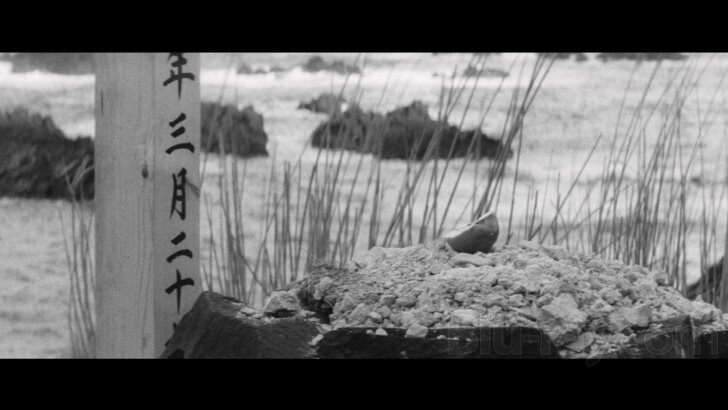
Senkichi Taniguchi's Jakoman and Tetsu is a distant relative of Luchino Visconti's La terra trema. Released nearly two decades later, Kinji Fukasaku's film works with the same material, but it is not a conventional remake of Taniguchi's film. It is a 'serious', shot to impress in a very particular way drama, part of a big power play project for the Toei studio. It is a good film worth seeing, but it is difficult to rank among the many great films Fukasaku and Ken Takakura made over the years. 88 Films' release offers a good presentation of it, and is Region-A/B "locked". RECOMMENDED.
Similar titles
Similar titles you might also like

Mustang
2015

Blue Spring
青い春 / Aoi haru
2001

Queen of the Blues
1979

The Playbirds
1978

Love & Peace
2015

Timbuktu
Le chagrin des oiseaux
2014

Mary Millington's True Blue Confessions
1980

Irezumi
刺青 / The Spider Tattoo
1966

Yakuza Wives
極道の妻たち / Gokudô no onna-tachi
1986

Luminous Woman
光る女 / Hikaru onna | Director's Company Edition
1987

Pleasure
2021

A Fantastic Woman
Una Mujer Fantástica
2017

Shoeshine 4K
Sciuscià
1946

I, the Executioner
みな殺しの霊歌 / Minagoroshi no reika | Standard Edition
1968

Killer's Mission
賞金稼ぎ / Shōkin kasegi
1969

Execution in Autumn
秋決 / Qiu jue | Masters of Cinema
1972

Harmonium
淵に立つ / Fuchi ni tatsu | Masters of Cinema
2016

Neon Bull
Boi Neon
2015

Les Enfants Terribles
1950

The Land of Hope
Kibô no kuni
2012