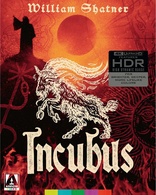
Incubus 4K Blu-ray Movie
HomeIncubus 4K Blu-ray Movie 
Limited Edition / 4K Ultra HD + Blu-rayArrow | 1966 | 1 Movie, 2 Cuts | 74 min | Not rated | Jan 14, 2025


Movie rating
6.5 | / 10 |
Blu-ray rating
| Users |  | 0.0 |
| Reviewer |  | 3.5 |
| Overall | | 3.5 |
Overview
Incubus 4K (1966)
Kia is a succubus, luring to their final perdition men who already have sinful habits and libertine inclinations. She tires of this, it's too easy, and these souls are going to Hell anyway. She wants to match wits and charm with someone who is good. So, against the advice of her sister Amael, Kia seeks out Marc, a man who has already faced death with courage. After a night together, Kia finds that not only is Marc's goodness still intact, but she has been ravaged by love. In anger, she and Amael conjure an incubus to deal with Marc. The incubus starts with Marc's sister, Arndis. Who will win the struggle for souls?
Starring: William Shatner, Allyson Ames, Eloise Hardt, Robert Fortier (I)Director: Leslie Stevens (I)
| Horror | Uncertain |
| Foreign | Uncertain |
Specifications
Video
Video codec: HEVC / H.265
Video resolution: 4K (2160p)
Aspect ratio: 1.37:1, 1.85:1
Original aspect ratio: 1.37:1
Audio
Esperanto: LPCM Mono
Subtitles
English
Discs
Blu-ray Disc
Single disc (1 BD)
4K Ultra HD
Packaging
Slipcover in original pressing
Playback
Region A (B, C untested)
Review
Rating summary
| Movie |  | 3.0 |
| Video | | 0.0 |
| Audio | | 3.5 |
| Extras |  | 5.0 |
| Overall | | 3.5 |
Incubus 4K Blu-ray Movie Review
Reviewed by Jeffrey Kauffman January 8, 2025Esperanto estis lingvo laŭvorte elpensita de L. L. Zamenhof en 1887 kiel "universala dua lingvo" kiu povis servi kiel helpa ponto por ĉiuj homoj dum
ili
vojaĝis al novaj landoj kaj eble ne konas la gepatran lingvon.
In case you haven't had your morning coffee or are perhaps wondering if you've experienced an undiagnosed stroke, the above comes courtesy of a
handy
dandy online tool which rather hilariously offers English to Esperanto translations. The original sentence in a probably more recognizable
language reads as follows:
Esperanto was a language literally invented by L. L. Zamenhof in 1887 as a "universal second language" that could serve as a helpful bridge for all
people as they traveled to new lands and might not know the native language.
Esperanto was just one of several such formulations that
started appearing in the 19th century in an effort to combat the modern Tower of Babel of languages that often interfered with clear communication
as people became more peripatetic. While still a cult item of sorts, Esperanto has proven to be more hardy than some of its "competitors", as
evidenced perhaps by another cult item of sorts, 1966's Incubus. The film has become famous (infamous?) for having utilized
Esperanto, even if, as some of the supplements get into, "real" Esperanto speakers find the pronunciations offered by the cast to be largely
inaccurate. Those stars include one William Shatner, who was just on the cusp of boldly going where no man had gone before, to which he may
have responded after making this film, "Yeah, tell me about it." On the crew side of things, this film proved to be a reunion of sorts, or maybe an
unusual "wrap party", for several alumni of The
Outer Limits, including writer and director Leslie Stevens, composer Dominic Frontiere (who simply repurposed some of his cues from the
series for the film) and, perhaps most incredibly, cinematographer Conrad Hall.

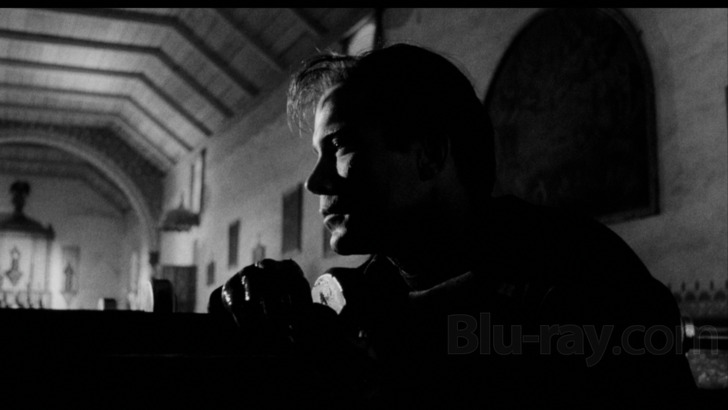
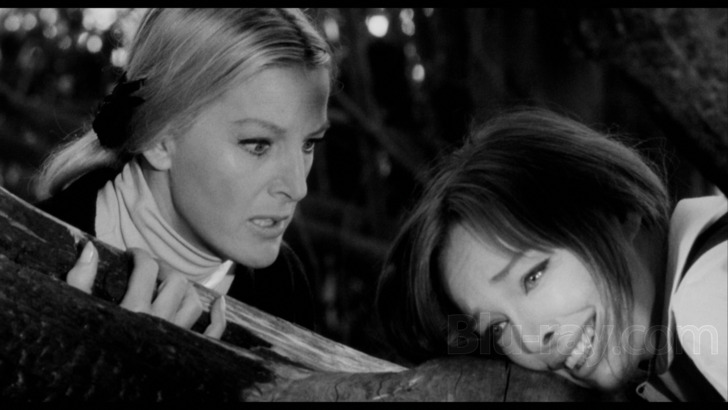
If it weren't for the Esperanto bit, Incubus might very well have been an episode on The Outer Limits, even without a prevalence of "monsters", at least of the horrifying creature variety (though there's arguably even one of those toward the end of the film). Kind of humorously, the very title Incubus might be something of a misnomer, since the film actually deals largely with female demons, who should properly be called succubi (or succubus in the singular). To be fair, an actual male incubus shows up late in the film, but some may joke that evidently even English (or at least Latin words ported over to English) provided some obstacles for the filmmakers at times. One way or the other, the story revolves around succubus Kia (Allyson Ames), who is tired of leading hapless men to their deaths, and who longs for a more meaningful "career". Enter wounded soldier Marc (William Shatner), who arrives with his sister to partake of the local village's supposed healing waters, waters which of course Kia and her kin use to kill unwitting visitors.
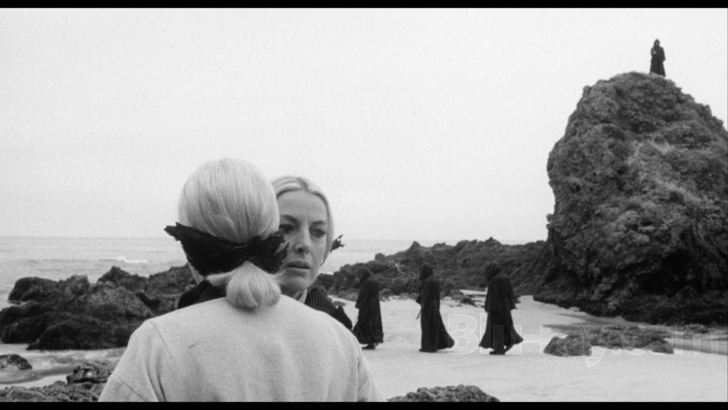
There's a subplot involving the sisters of both Kia and Marc, but it's a supposedly star crossed romance between Kia and Marc that forms the basis of much of the goings on. Things either descend or ascend (depending on your personal preference) into proto-Gothic territory toward the end, replete with an incubus who can transmogrify into a devilish goat. The entire story is surreal and kind of hypnotic to begin with, but things definitely go full gonzo in the final act, both narratively and maybe especially presentationally. Conrad Hall's gorgeous cinematography is a real bonus to a film that tends to deliver mood in droves, even if the story and performances can be iffy.
Incubus 4K Blu-ray Movie, Video Quality

Note: While this is a standalone 4K release without a 1080 disc, I am offering screenshots from Arrow's standalone 1080 release as I think
it actually provides a better representation of the look of the palette in particular, rather than offering screenshots from the 4K disc which are by
necessity downscaled to 1080 and in SDR. Because this release does not include a 1080 disc, the 2K video score above has been intentionally left
blank.
Incubus is presented in 4K UHD courtesy of Arrow Video with an HEVC / H.265 encoded 2160p transfer in 1.85:1 (supplements include a
1:37:1
version in 1080). Arrow provides the same insert booklet for both its 1080 and 4K UHD editions of this title with the following information about the
presentation:
Incubus was restored in 4K resolution by Le Chat Qui Fume, who supplied the restored masters to Arrow Films for this release. It is presented in 1.85:1 and 1.37:1 aspect ratios, the former in full 4K with HDR10 and Dolby Vision and the latter in SDR 1080p.With an understanding that the source element "is what it is", this is a rather stunning at times restoration, one which augments some of the high contrast cinematography courtesy of HDR / Dolby Vision. Some may argue about the aspect ratio offered in the main presentation, but I didn't notice any really horrible framings, and if there's good news, it's that the occasional French subtitles really don't intrude too far into the bottom of the frame. The film is awash in opticals and other stylistic bells and whistles, all of which can admittedly hamper fine detail levels and arguably keep this 4K version from consistently improving those detail levels, but in stationary framings without any interstitials like dissolves, there can be at least marginal improvement in fine detail levels when stacking this up against Arrow's 1080 version. But I'd argue it's in the increased tonal varieties of the sumptuous black and white cinematography courtesy of HDR / Dolby Vision that this 4K UHD version really tends to "strut its stuff" the most noticeably. A lot of the oceanside material in Incubus actually reminded me of another 1966 black and white opus featuring Bachannals on a California beach (albeit in Malibu rather than Big Sur like this film), Seconds, which garnered James Wong Howe a much deserved Academy Award nomination.
The original camera negative and other pre print materials for the film are missing presumed lost, believed to have been mistakenly destroyed by the facility housing them. The last known surviving 35mm print in the world, located in France and supplied by Emmanuel Rossi, was scanned for this new digital restoration. As the source is a French distribution print, you will see burn in subtitles within the frame that could not be removed without compromising the integrity of the image. We hope these subtitles do not affect your enjoyment of the film.
Incubus 4K Blu-ray Movie, Audio Quality
Note: Unsurprisingly, our audio spec database needs to be updated to handle the Esperanto LPCM Mono audio offered on this disc. That is in
process but may take a while to be updated.
This may be the only time in my reviewing career that I get to say a Blu-ray disc offers an Esperanto track in LPCM Mono, so maybe just give me a
moment. Joking aside, this is a decent if undeniably thin at times sounding track. Dominic Frontiere's repurposed Outer Limits score(s) can
sound a bit tinny and alert audiophiles will probably notice prevalent hiss in some of the cues. Sound effects and the all important Esperanto dialogue
tend to fare a good deal better, which may or may not be a good thing depending on how jaded your personal sensibilities are. As noted in the reprint
of Arrow's insert booklet, there are occasional burnt in French subtitles at the bottom of the frame. Optional English and (somewhat hilariously)
Esperanto subtitles are available.
Incubus 4K Blu-ray Movie, Special Features and Extras
- Commentaries
- Commentary by David J. Schow (2024)
- Commentary by William Shatner (2001)
- Commentary by Anthony Taylor, Conrad L. Hall and William Fraker (2001)
- Isolated Score Track is a newly assembled reconstruction by music historian Jason Kruppa presented in LPCM 2.0.
- Open Matte Feature (HD; 1:14:09) offers more information on the top and bottom of the frame, but also has more noticeable burnt in French subtitles. That requires the optional English subtitles to be presented in black boxes superimposed over the burnt in white French subtitles.
- Words and Worlds: Incubus and Esperanto in Cinema (HD; 43:20) is a new featurette produced by Severin Films featuring a very entertaining Stephen R. Bissette covering both the film and that well known genre, movies in Esperanto.
- Internacia Lingvo: A History of Esperanto (HD; 22:05) is another new Severin production, with Esther H. Schor getting into the history of the language.
- An Interview with the Makers of Incubus (HD; 19:15) is an archival piece with David J. Schow interviewing producer Anthony Taylor, cinematographer Conrad L. Hall and camera operator William Fraker.
- Video Trailer (HD; 2:23)
Incubus 4K Blu-ray Movie, Overall Score and Recommendation
Incubus is long on style and of course has the admittedly wacky allure of being in Esperanto (however evidently badly pronounced). That said, the film is certainly no undiscovered masterpiece, but it's probably just outré enough to satisfy the curious. Technical merits are solid given the historical context of the element, and as usual Arrow has aggregated some really appealing supplements. With caveats noted, Recommended.

Similar titles
Similar titles you might also like

Anthropophagous
1980

Horrors of Spider Island
Ein Toter hing im Netz / It's Hot in Paradise / Body in the Web
1960

REC 4: Apocalypse
[•REC]⁴: Apocalypse / [•REC]⁴: Apocalipsis
2014

Night of the Living Dead 4K
Theatrical (UHD/BD) and Workprint (BD) versions
1968

Cauldron of Blood
Blind Man’s Bluff
1968

The Haunted Palace
1963

The Crimson Cult
Curse of the Crimson Altar
1968
Humanoids from the Deep 4K
1980

Curse III: Blood Sacrifice
Curse III: Panga
1991

Cabin Fever: Patient Zero
2014

The Devil Rides Out
The Devil's Bride
1968

Dachra
Slipcover in Original Pressing
2018

The Howl of the Devil
Standard Edition | El Aullido del Diablo
1988

Demons 2
Dèmoni 2... l'incubo ritorna
1986

Dark Waters
Temnye vody
1993

Dr. Jekyll and the Werewolf
Doctor Jekyll y el Hombre Lobo / Dr. Jekyll vs. The Werewolf / Dr. Jekyll vs. the Wolfman / Dr. Jekyll and the Werewolf
1972
Black Sabbath
AIP Cut | 60th Anniversary
1963

Devil's Kiss
La perversa caricia de Satán
1976

Hunchback of the Morgue
El jorobado de la Morgue
1973

Great White
1981