In the Family Blu-ray Movie
HomeIn the Family Blu-ray Movie 
New Yorker Video | 2011 | 169 min | Not rated | Jun 25, 2013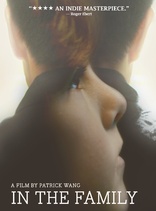
Price
List price:Listed on Amazon marketplace

Movie rating
6.6 | / 10 |
Blu-ray rating
| Users |  | 0.0 |
| Reviewer |  | 4.5 |
| Overall | | 4.5 |
Overview
In the Family (2011)
In the town of Martin, Tennessee, Chip Hines, a precocious six year old, has only known life with his two dads, Cody and Joey. When Cody dies suddenly, Joey and Chip struggle to find their footing again. Then Cody's will reveals that he named his sister as Chip's guardian.
Starring: Eugene Brell, Sebastian Banes, Elaine Bromka, Eisa Davis, Peter HermannDirector: Patrick Wang
| Drama | Insignificant |
| Romance | Insignificant |
Specifications
Video
Video codec: MPEG-4 AVC
Video resolution: 1080p
Aspect ratio: 1.78:1
Original aspect ratio: 1.85:1
Audio
English: Dolby Digital 5.1 (640 kbps)
English: LPCM 2.0
Subtitles
English SDH
Discs
50GB Blu-ray Disc
Single disc (1 BD)
Packaging
Slipcover in original pressing
Playback
Region free
Review
Rating summary
| Movie | | 4.5 |
| Video | | 4.5 |
| Audio |  | 3.5 |
| Extras |  | 4.0 |
| Overall | | 4.5 |
In the Family Blu-ray Movie Review
Doing the Right Thing
Reviewed by Michael Reuben June 23, 2013Patrick Wang's astonishing first feature, In the Family, does not look, sound or feel like anything audiences expect in contemporary films from either the studios or the independent realm. However, like every good craftsman, Wang provides clues to the film's "grammar" in its opening scenes. A young boy awakens to the sound of a space shuttle alarm clock, finds a surprise on his night table and runs excitedly into his parents' bedroom. There, one of his two fathers begins to explain the new object (it has something to do with dragons), while the other continues to get dressed. After a while, we join the three in their kitchen, where breakfast is consumed, lunch is packed for school, and typical morning conversations occur. Nothing seems to be happening, but volumes of information are being conveyed about the relationships within this family and the personalities of the individuals who comprise it. If you're still waiting for the film to start, it's time to catch up. It already has. Wang, who wrote, directed and, at the urging of producer Andrew van den Houten, starred in the film, has spoken admiringly of directors who "turn . . . intimate spaces into planets". His visual inspirations for In the Family were Ingmar Bergman's Scenes from a Marriage (1973) and John Cassavetes' A Woman Under the Influence (1974), both works that were considered radical when they first appeared forty years ago, even before technological changes such as the Steadicam and digital editing began shifting cinema's attention away from character, dialogue and performance. Wang doesn't object to moving the camera or cutting during a scene. He just doesn't believe in doing it for no reason. He'd rather tell the story through what the actors say and how they behave. It's no surprise that Wang comes from a theater background. Whether consciously or not, as a filmmaker he has self-selected his audience to those willing to pay close attention without the allure of eye-candy, which is why In the Family has played almost exclusively at festival screenings.
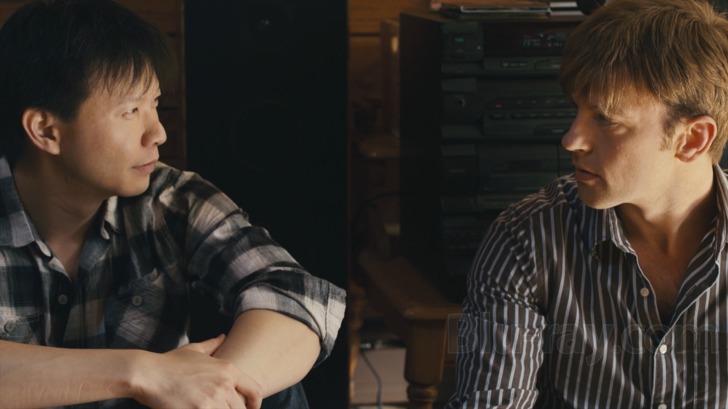
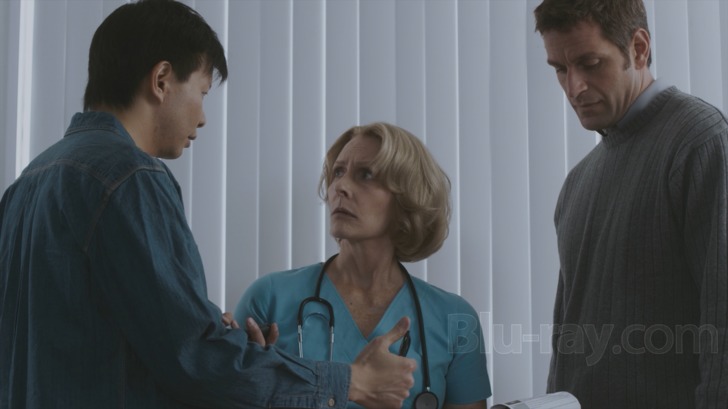
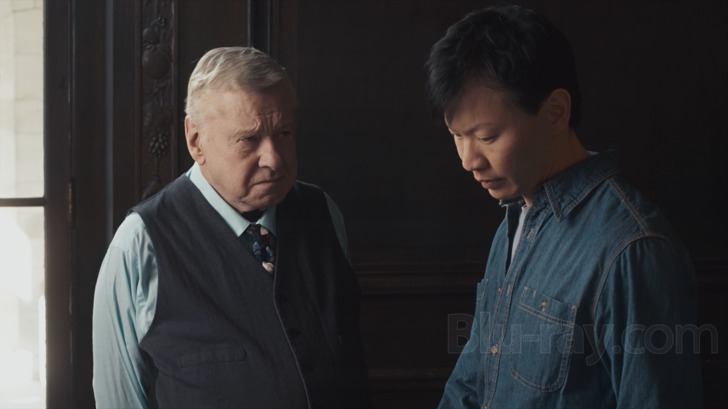
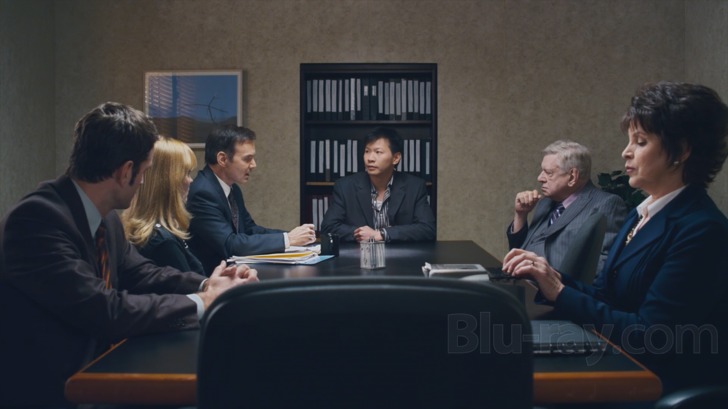
A description of In the Family's plot makes it sound like an "issue" movie, but one of its many special qualities is how Wang continually subverts that expectation by looking past "issues" to specific individuals grappling with difficult circumstances and struggling for honorable answers. Wang, who grew up in Texas and was educated in the Northeast, set the story in Martin, Tennessee, a real city of about 40,000 people that he'd never visited but knew because someone close to him had settled there. He has specifically said that he chose Martin because "modest sized cities and Southern cities don't often get a fair shake in movies". (The actual location for filming was Yonkers, New York.) In Martin, Joey Williams (Wang) lives with his partner, Cody Hines (Trevor St. John), and their six-year-old son, Chip (Sebastian Brodziak). Chip's mother is not in the picture—the exact circumstances are gradually revealed over the course of the film—and Cody and Joey have been together since Chip was an infant. Both are attentive fathers. Cody is a school teacher, and Joey is a contractor, who is currently working on a massive project restoring a mansion for Marge and Paul Hawks (Susan Kellermann and Brian Murray). Joey has no other family, but Cody's includes a mother, Sally (Park Overall); a sister, Eileen (Kelly McAndrew), and brother-in-law, Dave (Peter Hermann); and their children. Joey is on good terms with Cody's family, who has had the two of them and Chip for holidays and other family functions since the men became a couple. Then the unthinkable happens. Cody dies in a car accident. Barely has the funeral passed when Joey is informed by Eileen that Cody made a will shortly after Chip was born, in which he designated Eileen as both executor and guardian of Chip. Papers in Cody's desk suggest he considered making a new will, but never followed through. Eileen, who says she is simply trying to follow her brother's wishes, takes Chip to live with her. When Joey makes it clear that he does not approve of her decision, she has him served with a restraining order. Martin is a small enough town that many people who knew Cody rally to Joey's support and offer him advice and the names of lawyers. They include Gloria (Elaine Bromka), one of Cody's teaching colleagues; Helen (Zoe Winters), a designer working with Joey on the mansion restoration; and Anne (Eisa Davis), a local mom who grew up with Cody and Eileen and whose children play with Eileen's. But every lawyer whom Joey consults, including the top divorce lawyer to whom Gloria sends him (Matthew Boston) tells him the same thing: Joey has no case, because he never had legal custody of Chip. Only Cody did. One day, though, Paul Hawks, who is an attorney but retired, walks into the room where Joey is working, hands him a drink and asks if he'd like a lawyer. The two have bonded over a common love of old books, which Joey has been rebinding for the elderly gentleman. Over a lengthy career, Paul has come to view the law differently than most, and he does not believe it should set the limit on what people can accomplish together. Paul's intervention begins the film's remarkable third act, in which Joey finally begins speaking for himself and his son. Wang generally works in long, continuous takes, often without dialogue, in which the actions and interactions of characters and the changes in their expressions and demeanor are just as eloquent as words—but you have to be willing to follow his deliberate pace. The rewards are ample. The latter half of the film contains several extended flashbacks, as Joey, now on his own, recalls pivotal moments in his life with Cody, both because he is grieving and because he is trying to understand how his situation could have changed so quickly once Cody was out of the picture. These scenes also provide essential information about the legal and practical context in which the dispute over Chip's custody has arisen. One of the script's many artful touches is the realization that Joey's predicament isn't unique to gay couples. Under similar circumstances, and without such proper formalities as adoption, the survivor of a straight unmarried couple would face the same dilemma.
In the Family Blu-ray Movie, Video Quality
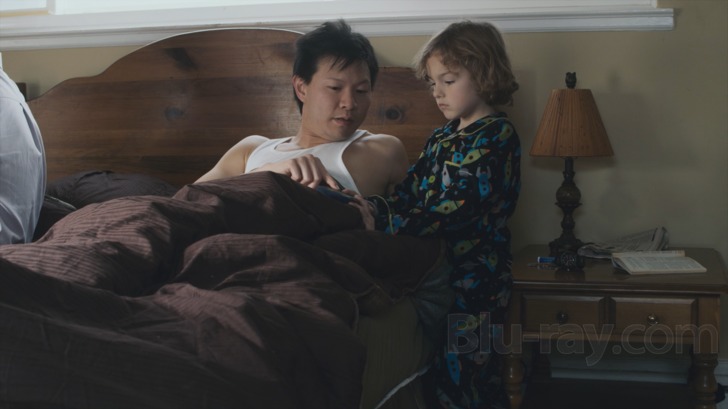
In the Family was shot on the Red system by Frank Barrera, a cinematographer and camera operator on numerous reality TV shows, which was good preparation for the many scenes in the film that were shot hand-held and required, as director Wang describes in the "Sculpting a Scene" extra, a delicate choreography between the actors and the camera crew. Also as demonstrated in "Sculpting a Scene", extensive color correction was done in post-production on a digital intermediate. New Yorker's 1080p, AVC-encoded Blu-ray appears to have been taken directly from digital files, with no intervening analog stage to introduce artifacts or any loss in resolution. The image has the clean, noiseless and detailed appearance that is typical of Red photography, with true blacks and colors that have been adjusted for realism, without exaggeration. In "Sculpting a Scene", Wang demonstrates how contrast can be altered and shadows added to help direct the eye (in most cases, subliminally) to an area of the frame or emphasize an aspect of the visual design. The Blu-ray's image conveys all these subtle effects accurately. The only visible artifact is occasional light banding, usually at fadeouts (the bête noire of Blu-ray). Otherwise, artifacts and compression errors were non-existent and noise was wholly absent. One may prefer something other than DP Barrera's down-to-earth style, but it has been properly reproduced.
In the Family Blu-ray Movie, Audio Quality
In the Family comes with two audio options, a lossless PCM 2.0 track and a lossy DD 5.1 track (at 640 kbps). I was unable to confirm whether the release format was 5.1 or 2.0 (although the back over of the slipcase lists the 5.1 track as "optional"). However, in switching back and forth between the two tracks, I found the DD 5.1 track to have an odd and distracting quality. Voices sounded hollow and detached, while the sound effects were exaggerated and overwhelmed the dialogue. On the 2.0 track, the balance was much better, and the vocal quality more natural. Ultimately, I elected to watch the bulk of the movie with the PCM 2.0 track, and I recommend the same choice to readers. Note that the PCM track must be selected manually, because the Blu-ray defaults to 5.1. In "Sculpting a Scene", Wang provides a few examples of rough "production sound" vs. a final mix, and the difference is noteworthy. In the Family does not have any score. Its music is all source-based within the film, especially the songs of Chip Taylor (who has a cameo in the film in a flashback as Cody's father). However, the ability of sound engineers to "sweeten" the vocal recordings made during filming is essential to their intelligibility in the final mix, and the addition of specific environmental noises (ventilation, cars passing, workmen at the mansion restoration project, etc.) is crucial to establishing each scene's credibility. All of these sounds come through in their proper balance on the PCM 2.0 track, and with good stereo separation.
In the Family Blu-ray Movie, Special Features and Extras
- Video Essay: "Simple Expressions of Absolute Values" by Kevin B. Lee (1080i; 1.78:1; 10:37): The term "video essay" means that author Lee presents insights about In the Family in voiceover that are simultaneously illustrated by excerpts and comparisons onscreen. Among other topics, he examines the film's positioning of characters in relation to each other, its repeated use of the same setting to indicate a progression in time, and its sparing use of edits in comparison to recent films like Lincoln and Amour.
- Video Essay: "The Mirror to Nature" by H.P. Mendoza (1080p; 1.78:1; 7:32): A filmmaker in his own right, Mendoza moderated Q&A sessions in San Francisco after showings of In the Family. In this video essay, he describes the experience, including a favorite scene in the film that he asked Patrick Wang to discuss for an audience.
- Video Essay: "A Tour of the Cutting Room" by Patrick Wang (1080p; 1.78:1; 12:52): This is director Wang's version of a "deleted scenes" section. His narration explains where each insert would have fit and why it wasn't included. Some scenes are presented in their full 1.78:1 aspect ratio, while others are presented in small windows side-by-side with a clip from the finished film where they would have been inserted.
- Video Essay: "Sculpting a Scene" by Patrick Wang (1080p; 1.78:1; 24:59): Unlike most directors, Wang "sculpts" his scenes on the set through a close collaboration among the actors and the camera crew. The primary focus of this video essay is the film's single longest scene, known as the "Drunk Cody" scene among the production team. Wang's comparative analysis of various takes illuminates how small adjustments in framing and blocking, and a lens change, radically altered the feel of the scene. He also demonstrates the role of color correction and sound mixing.
- Behind the Scenes (1080p; 1.78:1; 7:28): As noted at the beginning, no behind-the-scenes cameras were allowed on set. This featurette is composed of excerpts from audition tapes and discarded footage from principal photography.
- Theatrical Trailer (1080p; 1.78:1; 1:43): It's a great trailer, because it tells you what the film is about, but not much else.
- Insert Booklet
- "A Place at the Table" by Godfrey Cheshire
- "Joining the Family" by Michael Guillén
- "The Waiting Room" by Dave Boyle
- "Bringing It on Home" by Brian Hu
In the Family Blu-ray Movie, Overall Score and Recommendation
As I considered what to write for this review, I was struck by the degree to which Wang's film overlaps thematically with another that, on the surface, it in no way resembles. In the first chapter of Peter Jackson's blockbuster trilogy, The Hobbit, the wizard Gandalf is asked why he asked a "halfling" to join his dangerous mission. He replies: "I have found it is the small everyday deeds of ordinary folk that keep the darkness at bay. . . small acts of kindness and love." That sentiment is the emotional core of The Hobbit (and arguably, too, of The Lord of the Rings), and it is also the center of In the Family. Patrick Wang has said that the film is informed by his belief that there are good people in the world, and his story presents a thicket of potentially impenetrable ideological traps (family values, gay parenting, gender politics, racial stereotyping), all of which end up being defeated—or at least evaded—by the ability of good people to act towards one another with kindness and love. Peter Jackson's construction of mammoth spectacle on this simple foundation is a logistical triumph, but Wang's success at creating compelling intimate drama on the same theme is no less of a challenge. If it were easy, more people would do it. For those willing to make the effort, highest recommendation.
Similar titles
Similar titles you might also like
(Still not reliable for this title)

Chinese Puzzle
Casse-tête chinois
2013

Happy End
2017

Custody
Jusqu'à la garde
2017

Marriage Story
2019

Hester Street
1975
Great Expectations
1946

Millie
1931

Saraband
2003

El 4K
This Strange Passion
1953

The Bostonians
1984

Third Person
2013

Mississippi Masala
1991

Husbands and Wives
Limited Edition to 3000
1992
Hobson's Choice
1954

Rust and Bone
De rouille et d'os
2012

Wendy and Lucy
2008

Two for the Seesaw
1962

The Sweet Hereafter
1997

The Nun
La religieuse
1966

Earwig
2021