How the Earth Was Made: Complete Season 2 Blu-ray Movie
HomeHow the Earth Was Made: Complete Season 2 Blu-ray Movie 
A&E Home Video | 2010 | 611 min | Not rated | Feb 22, 2011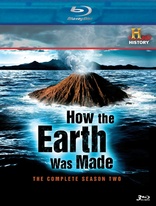
Price
List price:Listed on Amazon marketplace

Movie rating
6.6 | / 10 |
Blu-ray rating
| Users |  | 0.0 |
| Reviewer |  | 4.0 |
| Overall | | 4.0 |
Overview
How the Earth Was Made: Complete Season 2 (2010)
Spectacular on-location shooting, evidence from geologists in the field, and clear, dramatic graphics combine in this stunning series from History.
| Documentary | Uncertain |
| Nature | Uncertain |
| History | Uncertain |
Specifications
Video
Video codec: MPEG-4 AVC
Video resolution: 1080i
Aspect ratio: 1.78:1
Original aspect ratio: 1.78:1
Audio
English: DTS-HD Master Audio 2.0
Subtitles
English
Discs
50GB Blu-ray Disc
Three-disc set (3 BDs)
Playback
Region A (B, C untested)
Review
Rating summary
| Movie | | 4.0 |
| Video | | 4.0 |
| Audio |  | 4.5 |
| Extras | | 0.0 |
| Overall | | 4.0 |
How the Earth Was Made: Complete Season 2 Blu-ray Movie Review
Don't know much about geology? This surprisingly entertaining series can help.
Reviewed by Jeffrey Kauffman February 21, 2011Geography isn’t exactly a subject which screams “compelling television,” and yet History Channel’s How the Earth Was Made has rather surprisingly been one of the more consistently interesting and entertaining enterprises on the network. Very similar in tone and treatment to History’s more “far-reaching” outing The Universe, How the Earth Was Made benefits from a couple of elements which sets it perhaps above its starry cousin. First of all, though death and destruction certainly play a part in at least some of the episodes, unlike The Universe How the Earth Was Made doesn’t dwell on these issues, attempting to shoehorn sensationalism in wherever it can, as The Universe too frequently does. But perhaps even more importantly is the fact that there’s solid science and actual knowledge behind each episode in How the Earth Was Made, instead of the sometimes rampant speculation that fills a lot of The Universe. The mere fact that, not to state the obvious, we’re here on the planet and able to conduct actual experiments, instead of doing it at long range or even vicariously when it comes to outer space seems to give How the Earth Was Made a little edge over The Universe as it enters its second season on Blu-ray. Future seasons will tell the tale fully, and we’ll soon know if this series is able to keep it currently high level of interest without any padding or repetitiveness, another thing which tends to hobble The Universe, which is by now several seasons older.
This new 3 BD set contains all 13 episodes of the second season:
The Grand Canyon. Unlike the myth about The Great Wall of China, America’s Grand Canyon is indeed visible from space, so immense is it in depth and breadth. More than a mile deep, the Canyon measures 18 miles wide by 277 miles long. But what made this incredible chasm? This episode charts an epochal journey across tens of millions of years which sees everything from the tempestuous effects of the Colorado River to volcanic activity helping to dig out a canyon which, while actually not the widest or deepest around, remains the most iconic.
Vesuvius. It might be easy to think How the Earth Was Made is going the typical History doomsday route as it warns about the danger facing modern day Naples from this long active volcano, until one remembers not just the famous fate of Pompeii and the perhaps less well remembered destruction of Herculaneum (well covered in this episode). But perhaps the most chilling footage is of an eruption that probably very, very few even remember today, and the most amazing thing is it was relatively recent, on March 18, 1944. Newsreel footage shows the immense fury of this volcano and the swath of death and carnage it rained down on relatively modern day Italy.
Birth of the Earth. This is one of the least effective episodes of this season, if only because the same subject has been covered rather exhaustively in this series’ History cousin, The Universe. Billions of years are given a generalist overview, and while there’s certainly nothing wrong in any major way about this episode, it seems awfully familiar and redundant if you’ve been a fan of The Universe.
Sahara. How odd that this episode starts out talking about sea life! And yet, as so often happens in this season, we discover that current day conditions are obviously not the way things always have been. How is it that the hottest place on earth harbors evidene of sea creatures and actual fresh water fossils? As becomes so evident throughout this season, what is there today was certainly not there yesterday. While 20 million years ago there was a lush tropical swamp, today’s Sahara is an area as large as the United States and contains enough sand to bury the entire Earth eight inches deep. This episode does a good job giving a nice generalist overview of gigantic eons where, taken at a glance, things changed “abruptly.”
Yosemite. For my money this was easily the most picturesque episode of this season, full of glittering vistas that seemed lifted from a (colorized) Ansel Adams photograph. But the geologic history of this area is far from beautiful, entailing mammoth collisions of a variety of huge forces. This episode posits the question as to how a 3000 foot deep canyon could be carved from one of the hardest known substances, granite. As with other episodes in this season, we discover that Yosemite was once waterlogged, in this case as a coastal plane. The episode also has a rather startling segment on the regular occurrence of devastating rock falls. One of these on July 10, 1996 resulted in the fall of over 80,000 tons of material, resulting in one death and a devastating paralyzing injury to another tourist.
The Rockies. Once again we’re confronted with the odd occurrence of sea fossils buried in the highest peaks of one of our continent’s most defining mountain ranges. What becomes even more incredible is the realization, nicely revealed in a cool series of “growing” CGI shots, that the Rockies were once twice as high as they are now. The global phenomenon of plate tectonics is largely responsible for the massive mountain range, but this episode also has a very interesting segment on how at the southern tip of the Rockies, the Rio Grande Valley is “eating” them slowly but surely.
Ring of Fire. This is one of the more unusual episodes in this season, dealing with a phenomenon which may be only passingly familiar to a lot of viewers. As relatively little known as the “ring of fire” in the Pacific Ocean my be, it accounts for three quarters of the volcanoes on our planet, as well as 90% of earthquakes. In the last 200 years, over one million people have died as a result of activity of this mid-ocean hotbed of activity. And yet, in typical How the Earth Was Made enigmatic style, the episode starts to uncover clues as to why there’s so much activity in the middle of the ocean by visiting Mt. Lassen in California.
Everest. The highest place on Earth is explored by some courageous geologists who want to scale Everest’s peak to actually bring back rocks from the summit to do further research. That is commitment to one’s job! This episode features some nice footage, probably stock, of the various amazing vertiginous topographies in and around Everest. We get a nice idea of how India smashing into Asia created Everest and her sister peaks.
Death Valley. This lowest place in the United States is home to a surprising amount of life, but its history is once again deceptively different than one might initially think. The most interesting part of this episode is actually culled from its relatively recent 19th century history, when huge lodes of borax were discovered there and became a “money crop” equal if not more lucrative than gold. For anyone old enough to remember Ronald Reagan hosting Death Valley Days and the ubiquitous 20 Mule Team Borax commercials that ran endlessly within each episode, this sidebar to the main story of the Valley may actually turn out to be the most compelling and memorable.
Mt. St. Helens. I was in Portland on that sunny late spring Sunday in 1980 when Mt. St. Helens erupted and I can tell you until you’ve lived through something epochal like this you really have no idea of the gigantic forces at work within our planet. A neighbor buddy literally ran into my house screaming “Turn on the TV! Turn on the TV!” and we sat glued to live footage of the sky-borne wave of ash wafting toward our city. Within just a couple of hours the bright sunny day had turned to a murky dusk. Soon just about everyone was wearing surgical masks to aid their breathing (banks somewhat comically had notices on their entrance doors asking customers to remove the masks before coming inside), and the devastating effects of the eruption lasted literally for years (when I bought my first house here almost a decade after the eruption, I found inches of ash still encrusted in the home’s rain gutters). If you weren’t here like I was, this episode does a good job of recounting the build up to the event, the devastating eruption which tore off about a third of Mt. St. Helens’ bulk, and the lasting environmental effects on this entire region.
Earth’s Deadliest Eruption. As devastating as Mt. St. Helens’ eruption may have been, it pales in comparison to the one described in this unusual episode, another example of this series manages to literally dredge up lesser known phenomena and offer them to an audience in a cogent and compelling manner. This episode deals with the “Siberian traps,” which aren’t “traps” in the traditional sense of the word. Instead the word describes what we might more commonly call steppes, large plateaus of layered rock which were first systematically explored in 1863 by a political exile sequestered in this famous icy “jail” region of Russia.
America’s Ice Age. Any fan of Roland Emmerich’s The Day After Tomorrow should enjoy this episode, which might be thought of as The Day Before Yesterday. We get a frigid look at two million or so years ago, when temperatures averaged 26 degrees year ‘round and ice stretched as far south as Illinois. This last great ice age helped forge several iconic American scenic wonders, including the Great Lakes, the Mississippi River and Niagara Falls.
America’s Gold. It may surprise some viewers to hear that gold was actually created in outer space and then thrust, more or less, into earthly rock as the result of explosions. We get a kind of neat mini-history of the Gold Rush here, with a passing nod the the 49ers of California, but a more detailed look at a sister Rush which is perhaps less well known, one that spread east to Nevada. A nice sidebar lets us in on the violent history of Nevada Gold Rush town Bodie, where an average of one man a day was killed at the height of the Rush due to arguments between prospectors. One tenth of all gold found thus far on our planet has come from California and Nevada.
How the Earth Was Made: Complete Season 2 Blu-ray Movie, Video Quality

How the Earth Was Made: The Complete Season Two erupts onto Blu-ray with an AVC encoded 1080i transfer in 1.78:1. As is usually the case with History series, the image quality is completely dependent upon the various source elements. The good news is the vast majority of footage, even most of the stock footage, is sharp and clear and is really nicely saturated. The CGI elements, while very basic, are also obviously sharp as a tack and look great, minimally animated though they may be. All of the contemporary footage and interview segments have exceptional clarity and depth of field, and quite a bit of the stock footage is also well above average. There are some noticeable exceptions as you move through all of these episodes, including everything from some kind of ragged looking newsreel footage to even more relatively recent footage culled from NASA, but overall this second season of the series looks quite good indeed.
How the Earth Was Made: Complete Season 2 Blu-ray Movie, Audio Quality
Even better is How the Earth Was Made's lossless DTS-HD Master Audio 2.0 mix. This may be obviously set on a rather narrow soundfield, but the series excels at keenly articulated sound effects, with several boisterous LFE moments sprinkled liberally throughout the various episodes. Narration is clear and precise, and all of the onscreen talking heads also sound great. Fidelity is excellent and there is no hint of damage, as one would expect from a series of this recent vintage. This is actually one show that could benefit from a surround mix, at least when it comes to the many huge forces it portrays both visually and aurally.
How the Earth Was Made: Complete Season 2 Blu-ray Movie, Special Features and Extras

No supplements are offered on this three disc set.
How the Earth Was Made: Complete Season 2 Blu-ray Movie, Overall Score and Recommendation
How the Earth Was Made: The Complete Season Two is really rather surprisingly effective, even for those who, like I am, aren't especially enamored of geology. The show is very smartly honing in on fairly narrow focuses for the bulk of this season's episodes, and that helps the show maintain a cogent through-line, even while visiting some very interesting sidebars, as in the mining of borax in the Death Valley outing. With a solid video and especially audio presentation, this series is Recommended.

Similar titles
Similar titles you might also like
(Still not reliable for this title)

Yellowstone: Battle for Life
2009

Mummies: Secret of the Pharaohs
IMAX
2007

The Universe: The Complete Series Megaset
2007-2009

Cave of Forgotten Dreams 3D
2010

In the Shadow of the Moon
2007

Africa
2013

Nature's Most Amazing Events
2009

Earth: The Biography
2007

The National Parks: America's Best Idea
A Film by Ken Burns
2009

Earth - The Power of the Planet [BBC DVD]
2007

Shark Week: The Great Bites Collection
2008

Wild Pacific
2008

Over British Columbia

Galápagos
2006

The Hunt
2015

Hidden Kingdoms
2013

Human Planet: The Complete Series
BBC
2011

Deadliest Catch: Season 3
2007

Ganges
2007

Life Story
2014-2015