How the Earth Was Made Blu-ray Movie
HomeHow the Earth Was Made Blu-ray Movie 
A&E Home Video | 2007 | 94 min | Not rated | May 26, 2009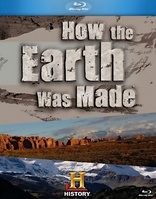

Movie rating
6.4 | / 10 |
Blu-ray rating
| Users |  | 0.0 |
| Reviewer |  | 3.0 |
| Overall | | 3.0 |
Overview
How the Earth Was Made (2007)
With remarkable on-location footage and stunning special effects, this informative program from "The Continents" series traces the course of the Earth's evolution from a bubbling mass of molten rock to the hospitable planet we live on today. Cutting-edge scientific insight and interviews with prominent geologists will fire your imagination and ensure that you'll never look at the Earth in quite the same way again.
| Documentary | Uncertain |
| Nature | Uncertain |
| History | Uncertain |
Specifications
Video
Video codec: VC-1
Video resolution: 1080p
Aspect ratio: 1.78:1
Audio
English: LPCM 2.0
Subtitles
English
Discs
25GB Blu-ray Disc
Single disc (1 BD)
Playback
Region free
Review
Rating summary
| Movie |  | 3.5 |
| Video |  | 2.5 |
| Audio | | 3.5 |
| Extras | | 3.0 |
| Overall | | 3.0 |
How the Earth Was Made Blu-ray Movie Review
A long time in the making. The Earth, I mean, not this History Channel documentary.
Reviewed by Casey Broadwater April 29, 2010Last week, in my review for the PBS program Becoming Human, I mentioned that I’m existentially paralyzed and fascinated by three things—the vastness of the universe, the uncharted depths of the oceans, and the thought of proto-humans traipsing across the plains of Africa millions of years ago. Clearly, I’ve got some kind of psychological hang-up about massive empty spaces and/or the passage of time. But I’m sure we all do, to some extent. There’s seriously nothing creepier to me than considering the countless empty planets out there, with their barren, windswept landscapes, poisonous atmospheres, and bizarre weather patterns. To think that Earth was once like that—a strange, lifeless chunk of space debris slowly subjected to geological forces—is a concept that simultaneously awes and freaks me out. As 18th century mathematician John Playfair put it, when observing the stratification of rock on the jagged coast of his native Scotland, “the mind seemed to grow giddy by looking so far into the abyss of time.” How the Earth Was Made looks way back into so-called “deep time,” beginning some 4.5 billion years ago, when our particular oasis in the universe coalesced and started to take shape.
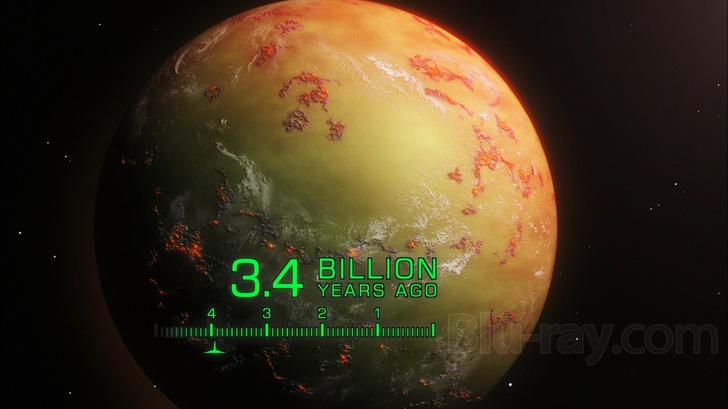
One old lookin' Earth...
As the pilot episode in a series that has now run for two seasons on The History Channel—the box sets are available on DVD, but not yet on Blu-ray—How the Earth Was Made is a broad overview of the Earth’s history and an introduction to the field of modern geology, which began in the 1780s when “maverick Scottish farmer” James Hutton noticed strata in rocky coastal outcropping and began to theorize about their origins. He realized that these layers could only be formed by extremely gradual geological processes, taking millions upon millions of years. This, of course, flew in the face of Church teaching, which conservatively estimated the Earth’s age—using the Old Testament’s and so-and-so begat so-and-so sections—at around 6,000 years. Irish archbishop James Ussher even proposed the exact date of the world’s formation as Sunday, October 23, 4004 BCE.
Like the slowly separating fault lines in Iceland that give measurable evidence of continental drift, the schism between religion and science would only grow wider from here. That said, science still has plenty of mysteries to unravel. One unexplained phenomena that the program only briefly touches upon is the origin of the Earth’s water supply. The most prevalent theory—itself highly contested—is that condensation created by volcanism was supplemented by water that entered the Earth’s atmosphere by piggybacking on meteors in ice form. As of now, though, there’s really no satisfyingly complete explanation for why 71% of the Earth’s surface is covered in water, while the remaining inner planets of our solar system are relatively barren. And this percentage used to be even higher. Four billion years ago, when our planet was a mere 500,000,000 years old, 90% of its surface was covered in iron-rich, olive green oceans. We wouldn’t become the “Blue Planet” for another two billion years, after superheated water and basaltic lava created granite, making the first continental crust, and coastal organisms called Stromatolites began to use photosynthesis to fill the oceans and atmosphere with purifying, blue-ifying oxygen.
In an hour and a half, How the Earth Was Made explores the planet’s molten, magma- covered beginnings, the formation and drift of the continents, the Cambrian explosion of life that gave rise to the dinosaurs, and eventually the ice age that cloaked the globe two million years ago. While programs about geology can often be as dry and slow-paced as the processes they’re explaining, How the Earth Was Made stays brisk and informative. Though it’s painting 4.5 billion years of geological history in the broadest of brush strokes—the following two seasons go into much greater detail—the program crams in as many facts and theories and presuppositions as is possible in its brief running time. Narrator Edward Hermann’s commanding baritone gives appropriate gravitas to the proceedings, and the various professors, experts, and other talking heads—who we also see out in the field, doing their geological grunt work—are charismatic and engaging. Most compellingly, Homo sapiens aren’t even mentioned until the last few minutes of the program, reminding us that we’ve only lately come to inherent this planet, and that our presence, on a time chart of Earth’s history, would occupy but a tiny, almost inconsequential sliver of space at the very end. For all of humankind’s influence on climate change and global warming, it’s nothing compared to the inexorable natural forces that will inevitably deep freeze the world yet again in a blanket of ice. It makes me wonder if future beings will study our history as we might look at the Neanderthals, a brief blip on the cosmic radar.
How the Earth Was Made Blu-ray Movie, Video Quality
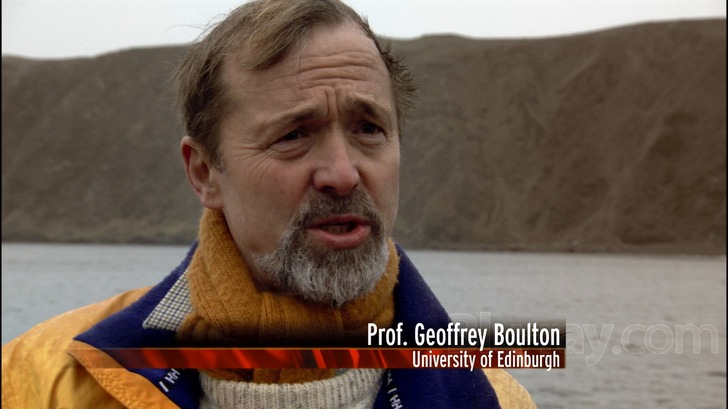
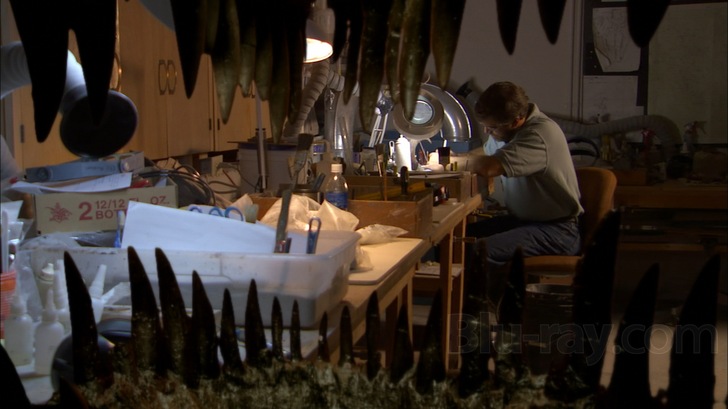
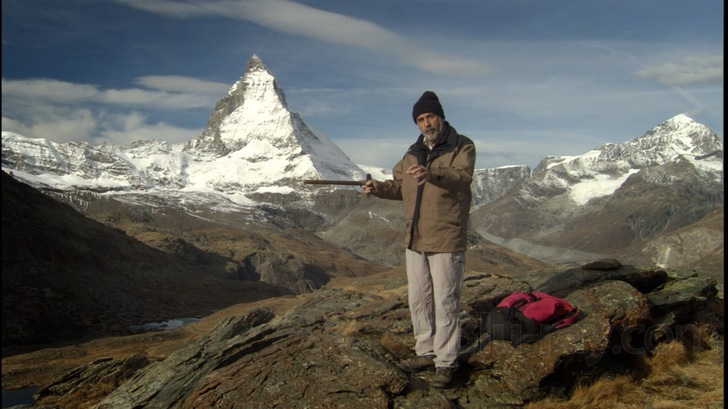
The History Channel's Blu-ray releases are generally pretty solid, but How the Earth Was Made—their first, released in May 2009—is a sloppy, 1080p/VC-1 encoded mishmash of high definition video, largely unimpressive graphs and graphics, and standard def stock material that's so blurry and macroblocky (sure, it's a real word) that you'd swear it was culled from YouTube. I'd say at least 1/4 of the documentary is comprised of upscaled, almost absurdly pixilated stock footage. Some of it is really, truly terrible, so bad at times—I'm thinking the CGI dinosaurs—that it's hard to tell what you're looking at. That said, when the production utilizes high definition video, the results are much better. Detail is decent—especially in the talking head close-ups—black levels are deep, and color is strictly natural, with some genuinely impressive displays, like bright molten lava oozing down a hill. Of course, the upscaled segments have a plethora of video-related problems, but the high definition footage isn't immune. Highlights are sometimes overblown, aliasing rears its jagged head, and you'll occasionally spot a color gradient broken up by stair-step banding. None of the issues render How the Earth Was Made unwatchable—well, the standard definition footage comes close—but don't expect a finely tuned high definition picture.
How the Earth Was Made Blu-ray Movie, Audio Quality
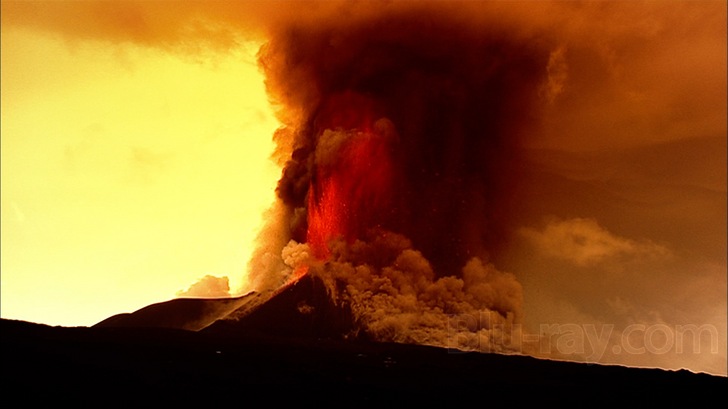
How the Earth Was Made features a TV broadcast-tailored, uncompressed PCM 2.0 stereo track that gets the job done. Considering the sonic subject matter—exploding volcanoes, shifting tectonic plates, meteor bombardments, etc.—that lack of a more immersive and bass-hefty 5.1 mix is surprising, but I really have no qualms about the audio experience here. Edward Herrmann's narration is the focus, and his voice carries plenty of punch, presence, and gravitas. Music is present, and sounds good, but it tends to recede into the background. Occasionally, the documentary throws a surprise knockout of a sound effect our way, like the rush of waves or the low-end rumble of a meteor shower. I detected no hisses, drop-outs, or other slip-ups.
How the Earth Was Made Blu-ray Movie, Special Features and Extras
Inside the Volcano (1080i, 1:30:35)
Talk about a bonus feature. Inside the Volcano is a complete 90-minute documentary
about volcanology that covers some of history's most infamous blasts—Thera and Vesuvius,
Tambora and Mt. St. Helens—and gives some insight into the science of predicting eruptions and
using volcanic heat to generate energy. The program does, however, succumb occasionally to
pseudoscience/history, proposing that the lost continent of Atlantis may have been sunk by a
massive volcano.
Additional Scenes (1080i, 10:06)
Included here are five deleted scenes from How the Earth Was Made, offering more info on
dinosaurs, gold, the Grand Canyon, the first life on Earth, and disappearing glaciers.
How the Earth Was Made Blu-ray Movie, Overall Score and Recommendation
How the Earth Was Made is yet another informative documentary from The History Channel, one that offers a satisfying introduction to the fields of geology and early Earth science. That said, I can't recommend the program for a purchase, simply because this really isn't the kind of material that holds up to multiple viewings. I could definitely get behind a box set of the entire two seasons of How the Earth Was Made, but this pilot episode is really only worth watching once. I'd say rent this one, or wait for The History Channel to air a re-run.
Similar titles
Similar titles you might also like
(Still not reliable for this title)

Yellowstone: Battle for Life
2009

Mummies: Secret of the Pharaohs
IMAX
2007

Cave of Forgotten Dreams 3D
2010

The Universe: The Complete Series Megaset
2007-2009

In the Shadow of the Moon
2007

Life Story
2014-2015

HOME
2009
The Story of India
2007

Hidden Kingdoms
2013

North America
+ Photo Booklet

The Blue Planet: Seas of Life
2001

Madagascar
BBC
2011

Human Planet: The Complete Series
BBC
2011

The Great Rift
2009

Volcanoes of the Deep Sea
IMAX
2004

Scenic National Parks: Yosemite
2008

Scenic National Parks: Yellowstone
2008

Great Barrier Reef
2012

Earth - The Power of the Planet [BBC DVD]
2007

Wild Pacific
2008