Honey Don't! Blu-ray Movie
HomeHoney Don't! Blu-ray Movie 
Universal Studios | 2025 | 89 min | Rated R | Oct 03, 2025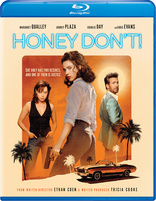

Movie rating
5.7 | / 10 |
Blu-ray rating
| Users |  | 0.0 |
| Reviewer |  | 3.5 |
| Overall | | 3.5 |
Overview
Honey Don't! (2025)
The second film in a planned triptych of "lesbian B-movie" comedies and a throwback to classic film noir.
Starring: Margaret Qualley, Chris Evans, Aubrey Plaza, Kristen Connolly, Charlie DayDirector: Ethan Coen
| Crime | Uncertain |
| Comedy | Uncertain |
Specifications
Video
Video codec: MPEG-4 AVC
Video resolution: 1080p
Aspect ratio: 1.85:1, 2.34:1
Original aspect ratio: 1.85:1
Audio
English: Dolby TrueHD 5.1
Subtitles
English SDH
Discs
Blu-ray Disc
Single disc (1 BD)
Playback
Region A (B, C untested)
Review
Rating summary
| Movie | | 3.5 |
| Video |  | 4.5 |
| Audio | | 4.5 |
| Extras | | 0.0 |
| Overall | | 3.5 |
Honey Don't! Blu-ray Movie Review
Reviewed by Justin Dekker November 10, 2025The second part of a planned trio of lesbian B-movies from filmmakers Ethan Coen ('The Big Lebowski') and Tricia Cooke ('O Brother Where Art
Thou?) (2024's 'Drive-Away Dolls'
was the first), 'Honey Don't!' arrives on Blu-ray disc courtesy of Universal. The film stars Margaret Qualley ('The Substance'), alongside Aubrey Plaza
('Parks and Recreation'), and Chris Evans ('The Avengers'). This release is absent any on-disc supplemental material. Neither a DVD nor a Digital Code
are included.
Something of a throw-back to the to the films of the 1970s, Honey Don't!'s Honey O'Donahue (Qualley) is a straight-shooting, no-nonsense
private investigator. Seeking to understand the events that led up to the death of a woman who had contacted her just prior to her demise, Honey's
search for answers will lead her to encounter a number of colorful and suspicious characters, the most colorful and suspicious of all being Reverend
Drew Devlin (Evans), the charismatic leader of The Four-Way Temple. As the bodies begin to pile up and the various plotlines begin to weave together,
can Honey solve what turns out to be the most important case?
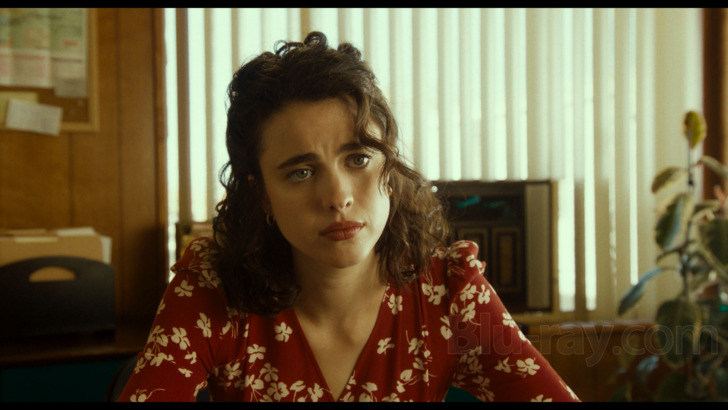
Part of a planned triptych of lesbian B-movies, it's important to note that the films are independent of each other. That said, it's also worth noting that these first two installments (2024's Drive-Away Dolls was the first) share some DNA. The first, and most important, piece of connective tissue between the two films is Qualley, though the characters she plays in the two films are markedly different. In Drive-Away Dolls, her Jamie is a fast-talking, promiscuous young woman, without any hint of stability in her life, be it familial, a relationship, or a steady job or occupation. Despite their differences. there are two commonalities between Jamie and Honey. The first is that at the start of Drive-Away Dolls, Jamie is a lesbian in a (doomed) relationship with a police officer, and in Honey Don't!, Honey is a lesbian who becomes involved with a police officer. Promiscuity is also a common character trait. A quick review of the lyrics from Carl Perkins' "Honey Don't", the song from which the film and Qualley's character derive their names, reveals the connection right from the start. The subject of Perkins' song is an alluring but inconstant lover with a perceived inability or lack of motivation to commit. While we don't spend a great deal of time with the film's Honey in this regard, there is sufficient evidence to suggest that she transitions between amorous partners with relative ease and frequency, which makes her cut from the same cloth as Dolls's Jamie. It also puts the capable, muscle car driving Honey on equal footing with the male detectives that populated similar films from the 1970s in every regard.
As with Drive-Away Dolls, sexuality is also front and center here. While the 2024 film was content to put the focus more on dialogue and discussion, Honey Don't! has no shortage of skin on display. Qualley has already proven she isn't shy about on-screen nudity as she most conclusively demonstrated in 2024's The Substance, a film which required extended and less-than-glamourous nude scenes of both her and co-star Demi Moore. Here, those moments are shot in a different light. Her on-screen pairing with Aubrey Plaza's MG is the most heated and genuine of the film. Though there is also a degree of humor, the relationship between Honey and MG is demonstrated as the film's most serious, and, at its outset, the healthiest. Heterosexual relationships and amorous adventures, non-existent in Drive-Away Dolls, are all the worse for the attention they receive here. Instead of simply ignoring them, hetero relationships and the people in them are presented with an unhealthy, illegal, and immoral mix of dominance and submission, whether they be the abusive relationship of which Honey's niece is a part, the domineering and soul crushing husband of a meek and a defeated woman Honey encounters as part of her investigation, or the sleazy sexual exploitation embodied by Evans's Reverend Devlin.
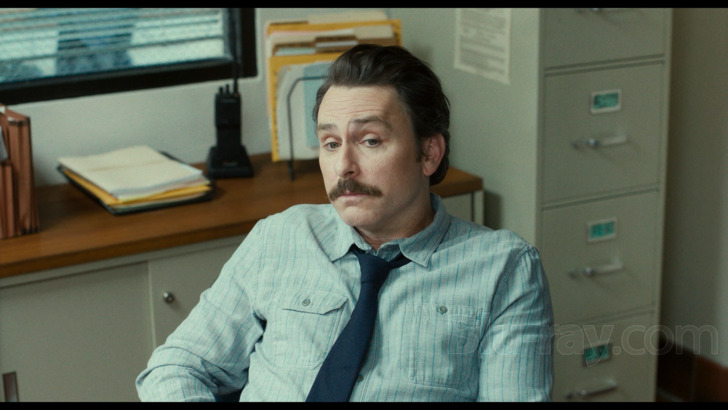
Just as Drive-Away Dolls was informed by the criminal misadventure films of the mid-to-late 1990s (Get Shorty, Snatch, et al), Honey Don't! finds itself influenced by a mixture of 1970s detective cinema and film noir of the 1950s. Drive-Away Dolls had the late 1990s as its setting, Honey Don't!, thanks to a COVID reference, is clearly a modern affair. That said, the sun-drenched and dusty Bakersfield the film calls home, seems to be a product of an earlier time. The wood-paneled office with its window-unit air conditioners would not be out of place in the decade of disco. Nor would the furnishings that adorn MG's home. Marty Metakawitch, a policeman played as only Charlie Day could, routinely demonstrates an attitude and understanding of sexuality that also seems to be straight from the 1970s. As he repeatedly and routinely propositions Qualley's Honey, he fails to comprehend the honesty and seriousness of her pat response, "I like girls". In his 1970s-era brain, located behind his 1970s-era moustache, no woman could resist his advances, and further, no woman he knows and is attracted to could possibly be a lesbian. These elements, and others besides, conspire to create a modern Bakersfield that is somehow strangely removed from the modern world. Qualley's typical line delivery here drips like honey (pardon the pun), though she's not incapable of a quick and incisive quip. And it's her vocal quality, along with her confidence and radiant sexuality, that allows her to bend others to her will in the tradition of the best femme fatales that the 1950s had to offer. Her attire is also in line with those influences, from the form-fitting red dress she wears to the crash site, to the black pencil skirt and "click-clacking heels" that are accompanied by a strut that is straight from the catwalks. Lera Abova's character Chère also fits this mold, being irresistibly icy and alluring. In Coen's fashion, her sex appeal is mixed with quirkiness and a dash of danger.
The script penned by Coen and Cooke also subverts audience expectations concerning family and religion. By the time we meet the film's characters, no intact families exist. The Novotny family comes the closest, however, it's their adult daughter Mia who perishes at the film's start, and it's her death that spurs the film's action. But the daughter was clearly lost, with her home life not providing her with what she needed. It's easy to see why. Her father is portrayed as a belligerent, ignorant, and dominating presence in the family's small home. Her mother is a mere shell of a woman, her spirit and will broken long ago by the brute. While Mia's experience in the home is never dissected, it's easy to extrapolate that she would have received very similar treatment to her mother, and her mother would have been unable to do anything to protect her. Honey's own family is similarly dysfunctional, with a long-absent father and only a struggling sister in the picture. But while her sister is present, she can do little to help or support the detective. She has numerous children of various ages, and it's assumed she's a single parent who's working frantically just to keep her head above water. So what better respite than religion for those looking for connection, support, hope, and purpose? However, the film's Four-Way Temple actually offers little of any of these. Evans' Reverend Devlin is certainly fiery and charismatic as he leads worship services with his flock, and while his sermons seem in line with what audiences may have heard from various televangelists over the years, one need not look too far below the surface to comprehend that his messaging is off-kilter. With submission being one of the fundamental tenets of the church and the suggestive nature of the organization's name, it doesn't require much deduction to realize that while Devlin may have his flock in mind, well, some of them anyway, it's not their souls that interested him.
Honey Don't! Blu-ray Movie, Video Quality
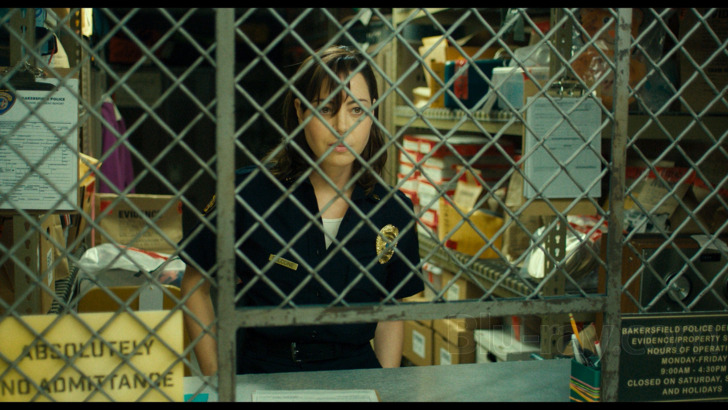
Honey Don't!'s AVC-encoded 1080p transfer looks quite pleasing in motion. From the opening moments where Lera Abova's Chère slinks down the rocky slope toward the overturned car for a purpose only she knows, viewers will note the high level of detail visible. Each rock and pebble is discernible, so too is each spot on her skintight leopard print leggings. Viewers are afforded the chance to peer into the ruined vehicle and observe every fragment of broken glass, the wrinkled and bloody deflated airbag, and the loose personal effects that now reside rather incongruously on the car's ceiling. Turning one's attention to the unfortunate victim, the lacy patterns and eyelets of her blouse are easy to spot, as are the numerous bruises on her arms, the abrasion on her cheek, and blood crusted around her nostrils. As Chère investigates an item taken from the scene, every fine line and wrinkle of her hands is well-defined, as are the swirls of her fingerprints. Skin tones are realistic and healthy here, and remain consistently so for the film's duration. In sun-drenched confines of Bakersfield, primaries are occasionally given a chance to pop and are best appreciated in the reds of Honey's dress, heels, and lipstick, the yellow of the tarp that covers the body in the desert, and the blues in the Reverend's room. It's a great transfer.
Honey Don't! Blu-ray Movie, Audio Quality
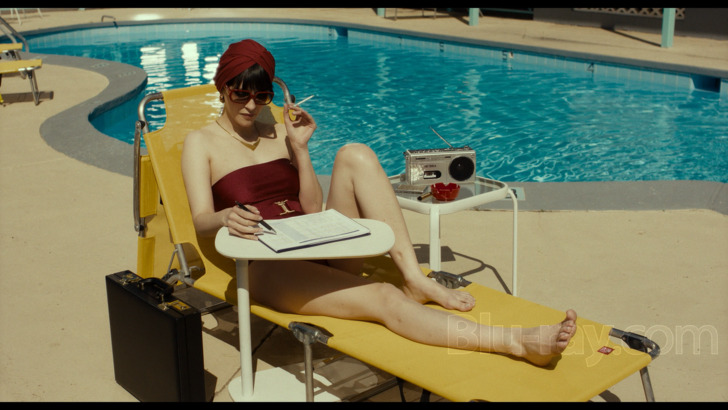
Honey Don't!'s English Dolby TrueHD 5.1 audio track, the only option on the disc, is rock-solid. It's routinely immersive, placing viewers in the middle of scenes as disparate as the parking lot outside of The Four-Way Temple and the bar where Honey inquires into Mia's disappearance. In such instances, truck noise surrounds the viewer in the former, and moody jazz piano stylings delight in the latter. Dialogue is kept front and center, and is never less than clear and intelligible. Even the quiet, hushed lines of dialogue are easy to understand. Directionality is precise. Moments when music is allowed to dominate demonstrate precise instrumentation and a solid bass support. Sound effects such as punches, kicks, car doors, squealing tires, and gunshots are all rendered well and with authority. Some may have hoped for a Dolby Atmos track, but the TrueHD track gets the job done with aplomb.
Honey Don't! Blu-ray Movie, Special Features and Extras
No on-disc supplemental features are included with this release.
Honey Don't! Blu-ray Movie, Overall Score and Recommendation
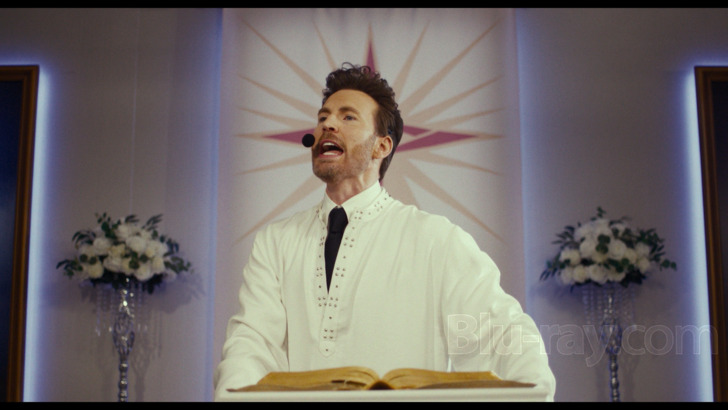
Honey Don't! is in no particular hurry to go anywhere, proceeding at the pace of Honey's slow, dripping drawl. As the film teases at several plot threads, it can take a bit of time to ascertain which of the mysteries is of the greatest importance and which simply reflect the distracting noise of Honey's every day life. Providing her with a distinctly different character than those which audiences have recently seen her embody, Qualley confirms her commanding screen presence, being capable of holding the audience's interest and attention even absent a more energetic script and outlandish goings on. While his physique is still somewhat on display, Evans's Reverend Devlin is far cry from his wholesome Steve Rogers/Captain America, and he does get a chance to stretch his (darkly) comedic legs beyond the occasional one-liners the super hero films afforded him and he's certainly up to the task. Plaza's performance is solid, though largely unsurprising as she leverages her trademark deadpan delivery and expressions in way that is strangely comforting in a film that can occasionally be a bit confusing and unsettling. Honey Don't! fulfills the expectations of a lesbian B-movie with it's low-fi charms and comes recommended to fans of the cast, and Coen and/or Cooke's work.
Similar titles
Similar titles you might also like

Trail of the Pink Panther
1982

My Blue Heaven
Warner Archive Collection
1990

Holy Matrimony
1994

Burglar
1987

Fun with Dick and Jane
2005
King's Ransom
2005
Lone Star State of Mind
2002
Analyze This
1999

The Con Is On
2018

Analyze That
2002

Dirty Rotten Scoundrels
Collector's Edition
1988

Amos & Andrew
1993
Corky Romano
2001

Undercover Blues
1993

Identity Thief
2013

Ruthless People
1986

My Cousin Vinny
1992

Cheech and Chong's Next Movie
1980

Little Man
Loaded With Extra Crap Edition
2006

Blame It on the Bellboy
1992