Homage to Robert Schumann Blu-ray Movie
HomeHomage to Robert Schumann Blu-ray Movie 
Arthaus Musik | 2010 | 77 min | Unrated | Sep 28, 2010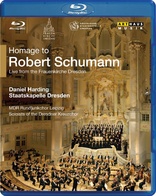

Movie rating
Movie has not been rated yetBlu-ray rating
| Users |  | 0.0 |
| Reviewer |  | 4.0 |
| Overall | | 4.0 |
Overview
Homage to Robert Schumann (2010)
Between 1844 and 1859 Robert Schumann lived in Dresden where he composed a third of his complete work. Todays concert marks the 200th anniversary of Robert Schumanns birth and offers a welcome opportunity for Daniel Harding and the Staatskapelle Dresden to introduce three of the most impressive but now too rarely performed works from his Dresden period (Overture to Genoveva, Requiem für Mignon and Nachtlied). Particular highlights - which will come as a surprise even to connoisseurs of his works - are a fi rst performance and a world premiere of rediscovered and reconstructed symphonic movements dating from the composers legendary symphony year'' of 1841. Moreover, the Rhenish Symphony, composed by Schumann after leaving Dresden and widely infl uenced by his impressions of the Cologne Cathedral, blends in perfectly with the sacral architecture of the Frauenkirche.
Starring: Markus ButterDirector: Ute Feudel
| Music | 100% |
Specifications
Video
Video codec: MPEG-4 AVC
Video resolution: 1080i
Aspect ratio: 1.78:1
Original aspect ratio: 1.78:1
Audio
Music: DTS-HD Master Audio 5.1
Music: LPCM 2.0
Subtitles
None
Discs
25GB Blu-ray Disc
Single disc (1 BD)
Playback
Region A (B, C untested)
Review
Rating summary
| Movie | | 4.0 |
| Video | | 4.0 |
| Audio |  | 4.5 |
| Extras | | 0.0 |
| Overall | | 4.0 |
Homage to Robert Schumann Blu-ray Movie Review
Several lesser known pieces of Schumann highlight this excellent concert offering.
Reviewed by Jeffrey Kauffman September 28, 2010There’s a fine line between madness and genius which a number of artists in a variety of genres have more or less erased as they went about their creative endeavors. Several of these gifted people have actually ended up in sanitariums and other “rest homes” as a result of their mental instability, an instability which nonetheless allowed them to proffer incredible works of inspiration to the public at large. Robert Schumann was inarguably one of the greatest composers of the 19th century, and yet he is all to often remembered solely for the debilitating emotional problems which led to his institutionalization. Anyone who loves the work of Brahms can hear Schumann’s titanic influence, and quite often if you don’t know one of these composers’ less well known pieces, you could easily mistake one for the other. To mark the 200th anniversary of Schumann’s birth, Staatskapelle Dresden, an orchestra with which Schumann himself had a long and rewarding relationship (actually conducting it on occasion), delved into some of Schumann’s work from the so-called “Dresden period”, offering a compelling portrait of an immensely gifted, if emotionally turbulent, composer. This concert also holds the distinction of also including a world premiere.
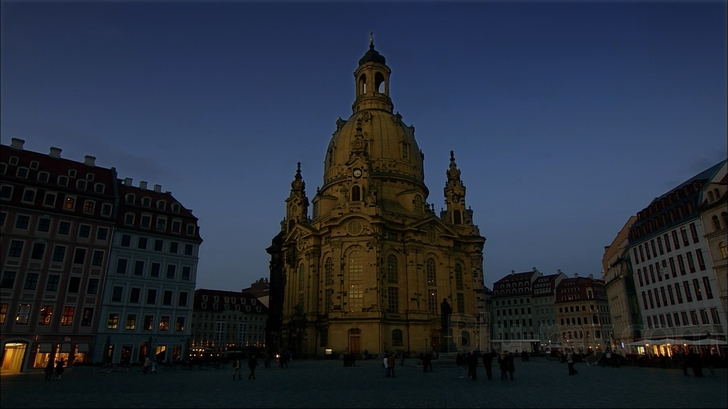
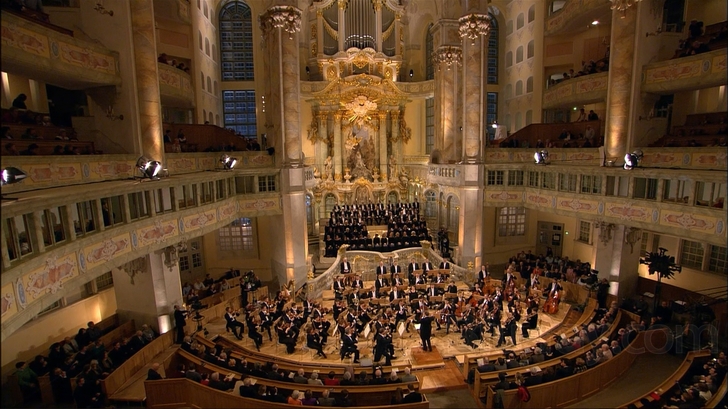
The ornate Frauenkirche Dresden.
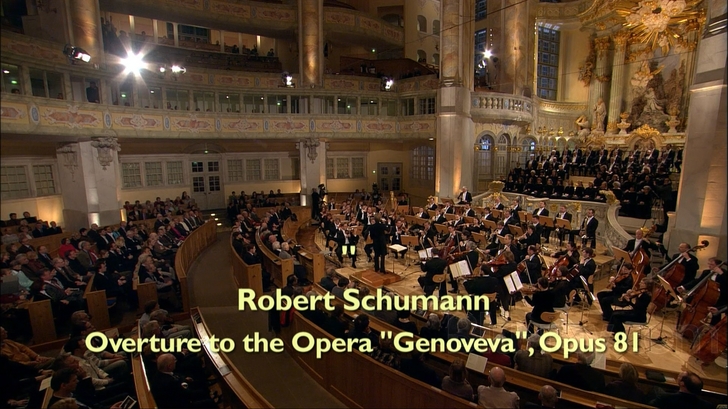
The concert gets off to a lovely beginning with Schumann’s Overture to the opera ‘Genoveva’. Interestingly, and against custom, Schumann actually composed this Overture before beginning work on the actual opera. While Genoveva has been critically lambasted for its dramatic failings, the music is often prime Schumann, and the Overture itself is a model of brilliant construction and soaring melody.
Schumann went through long periods of combined writer’s block and melancholy, two sibling maladies which seemed to feed off of each other. The composer had what (to my mind at least) seems like classic symptoms of manic-depression, for when he was in one his over the top creative phases, he could perform miracles, like writing his gorgeous Spring Symphony over the course of a mere four days in 1841. Schumann also kept copious diaries, which are both fascinating and often heartbreaking, and his October 1840 musings lament his inability to get anything written, while also mentioning he has started at least scraps of a Symphony. That never finished Symphony in C Minor provides one of the “reconstructions” by Joachim Draheim on this Blu-ray, a spritely and strangely “major” sounding Scherzo in G minor, originally reduced to piano score and published as part of Schumann’s Bunte Blütter. In fact this piece, which juxtaposes shifting major and minor tonalities with ease, may well be an apt musical analog for manic-depression itself.
Also originally published in Bunte Blütter was the Abendmusik in B flat major, which in this orchestral reconstruction is given its world premiere in this concert. This almost Mozartian serenade triptych is not particularly pianistic, despite its originally publishing form, and Draheim does an admirable job in recreating Schumann’s toneworld, with beautiful brass and string work augmented by luscious wind accents.
Though it hasn’t risen to the heights of fame of some of Schumann’s other works, the impeccable choral piece Nachtlied is up next. This gently flowing, yet occasionally tumultuous, piece is a setting of a poem by Friedrich Hebbel, whose text perhaps reflects Schumann’s own emotional upheaval:
Flowing, swelling night,
full of lights and stars:
in the endless distances,
speak: what has awakened out there?
The heart in my breast is crowded
with the rise and fall of life;
I feel it weaving about me, an immense thing
that squeezes mine out.
Sleep, you approach gently
as the nurse approaches a child;
and about this paltry flame
you form a protective circle.
Schumann had a special affinity for the writing of Goethe, and his Scenes from Goethe’s ‘Faust’ is arguably one of the finest settings of the author’s literary works. Schumann was especially drawn to a rather odd novel of Goethe’s entitled Wilhelm Meisters Lehrjahre, specifically to its supporting heroine, Mignon, an orphaned girl (from a family of tightrope walkers) who dies of a broken heart. The entire Goethe piece revolves around the conflict between a number of disparate elements, all of which Schumann found roiling around his own inner life, and so his Requiem for Mignon is an unusually autobiographical work, despite its literary genesis. Though this is a relatively small scale choral piece, it’s interesting to contrast it with Brahms’ more gargantuan German Requiem. Both pieces are both supremely emotional, while retaining a classical eye toward structure and symmetry. Schumann utilizes a solo harp here to very evocative ends.
Closing out the concert is an assured and forceful rendition of Schumann’s beloved ’Rhenish’ Symphony. This piece, which is labeled the Third despite being in reality Schumann’s fourth, is a fascinating journey at least partially in the direction of program music. One must remember in those days, there was the nascent feud brewing, which would soon erupt in full force after Schumann’s death, between adherents of “pure” music (later championed by Schumann’s protégé, Brahms) and more descriptive, theatrical music, which would become the calling card of the more adventurously bombastic Germans like Wagner and, later, Richard Strauss. This is a piece that Schumann wrote for the masses, something he never tried to hide, and the symphony offers a seemingly endless array of folk-like tunes that are both charming and easily accessible. Harding and the Staatskapelle Dresden present the piece in both its foundational simplicity, as well as its rather nuanced eloquence, with some nicely detailed rubato and fine attention paid to dynamics.
Homage to Robert Schumann Blu-ray Movie, Video Quality
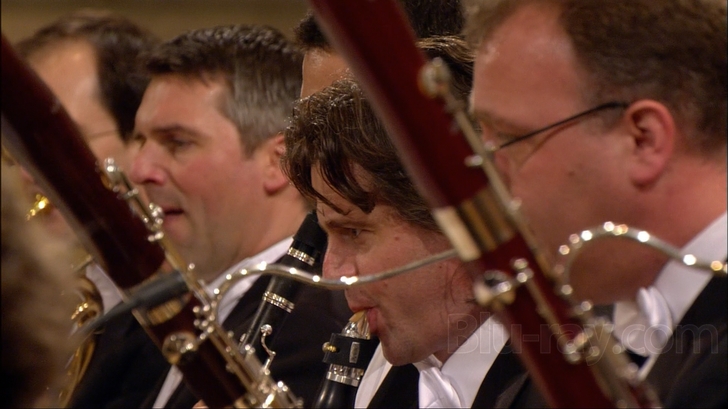
Homage to Robert Schumann looks generally excellent on Blu-ray with an AVC encoded 1080i image in 1.78:1. Colors are lifelike and well saturated and detail on the many close-ups of the orchestral players is superb. What annoyed me from time to time about this video presentation was the director's "arty" ambitions, which frequently aimed cameras squarely at stage lighting, creating explosions of white and yellow which obliterated everything in their midst. The ornate interior of the Frauenkirche Dresden look spectacular here, especially the rococo sunburst behind the orchestra.
Homage to Robert Schumann Blu-ray Movie, Audio Quality
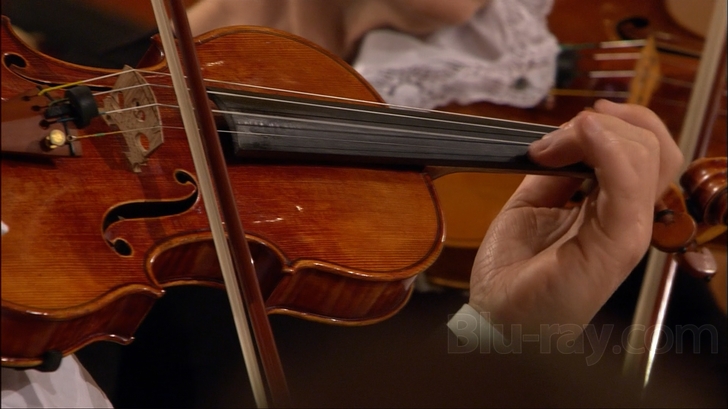
Two lossless audio mixes are offered on this Blu-ray, a DTS-HD Master Audio 5.1 and an LPCM 2.0 stereo fold down. The Frauenkirche Dresden appears to be a larger historical house and it frankly didn't appear to be very full for this concert, so there is a really nice hall ambience that spills through the 5.1 mix. The orchestra is beautifully placed spatially in the surrounds, and Schumann's effortless orchestration shines through brilliantly throughout the concert. Personally I would have wished for just a bit more fire in a couple of Schumann's more tempestuous moments, but overall Daniel Harding and the Staatskapelle Dresden offer a respectful (perhaps just a bit too respectful), intelligent interpretation of Schumann's works, and the recording supports them every step of the way. Fidelity is top notch and dynamic range is also exceptional.
Homage to Robert Schumann Blu-ray Movie, Special Features and Extras
No supplements are included on the disc. The insert booklet has in-depth information on all of the pieces included in this concert.
Homage to Robert Schumann Blu-ray Movie, Overall Score and Recommendation
Robert Schumann was a deeply troubled soul who nonetheless managed to give the world some of its most beautiful music. Kudos to Staatskapelle Dresden for honoring one of their "own," so to speak, and for introducing several lesser known Schumann pieces to the public at large. This is a varied and often very moving concert, and is recommended.