Holst: The Planets / Strauss: Also sprach Zarathustra Blu-ray Movie
HomeHolst: The Planets / Strauss: Also sprach Zarathustra Blu-ray Movie 
Blu-ray Audio / Blu-ray + CDDeutsche Grammophon | 1971 | 76 min | Not rated | Apr 06, 2018
Price
List price:Listed on Amazon marketplace

Movie rating
Movie has not been rated yetBlu-ray rating
| Users |  | 0.0 |
| Reviewer |  | 5.0 |
| Overall | | 5.0 |
Overview
Holst: The Planets / Strauss: Also sprach Zarathustra (1971)
Boston Symphony Orchestra, William Steinberg conducting; stereo CD; 4.0 quadraphonic surround Blu-ray Audio; newly remastered at 24 bit/192 kHz from the original 4-track tapes.
| Music | 100% |
Specifications
Video
Video codec: MPEG-4 AVC
Video resolution: 1080i
Aspect ratio: 1.78:1
Original aspect ratio: 1.78:1
Audio
Music: DTS-HD Master Audio 4.0 (192 kHz, 24-bit)
Music: LPCM 2.0 (192kHz, 24-bit)
Subtitles
None
Discs
Blu-ray Disc
Two-disc set (1 BD, 1 CD)
Playback
Region A (B, C untested)
Review
Rating summary
| Movie | | 5.0 |
| Video | | 0.0 |
| Audio | | 5.0 |
| Extras | | 0.0 |
| Overall | | 5.0 |
Holst: The Planets / Strauss: Also sprach Zarathustra Blu-ray Movie Review
Reviewed by Jeffrey Kauffman May 10, 2018Film fans without even one whit of interest in classical music will still probably recognize both the pieces offered on this spectacular new audio Blu-ray from Deutsche Grammophon, since both pieces have had rather iconic uses in film. While “second billed” on this release, Richard Strauss’ titanic tone poem Also Sprach Zarathustra became insanely popular when just the first few bars of it were memorably interpolated into Stanley Kubrick’s 2001: A Space Odyssey. That same main opening theme became a rather unlikely Top 10 hit when Brazilian keyboardist Deodato funked it up a couple of years later, ultimately winning a Grammy for Best Pop Instrumental Performance. While all of Gustav Holst’s similarly humongous The Planets hasn’t made it to film, kind of like the entirety of Also Sprach Zarathustra, in fact, the opening piece of Holst’s mighty work, Mars, has been utilized in any number of offerings and is a regular “supporting character” in everything from trailers to commercials. (Quite a few snippets from Planets other than Mars have indeed made it into both television and film over the years.) In the “who knew?” or maybe “who remembered?” department, it turns out that the venerable Deutsche Grammophon briefly toyed with quadrophonic recording technologies back in the early seventies when they were a short lived fad. There are probably no two orchestral examples better suited for surround sound than these two immense achievements, and this new release may appeal not just to dedicated audiophiles, but to film fans in general who might like to hear “the whole story” in terms of pieces that have been “redacted” for cinematic use.
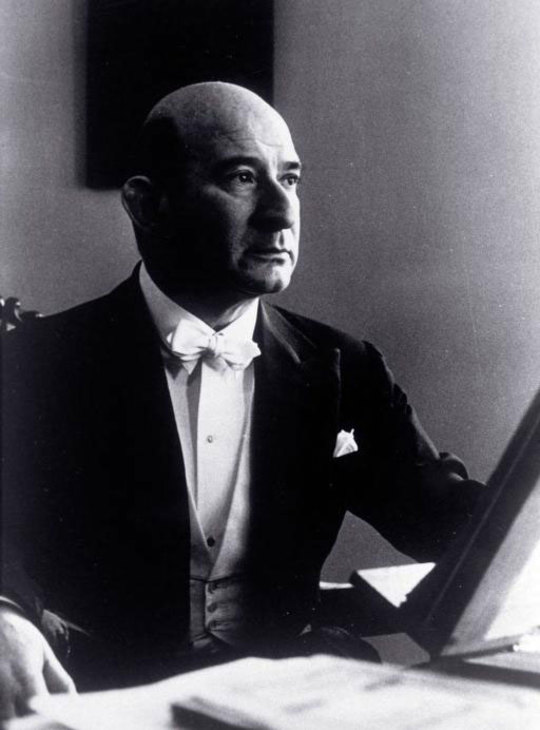
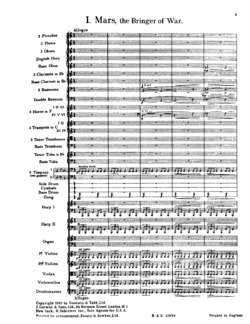
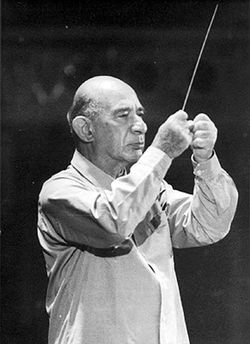
The Planets is actually celebrating its centennial this year, while Also Sprach Zarathustra bears a debut date of 1896, making it one of the last and most overwhelming orchestral pieces of the 19th century. Interestingly, the liner notes included with this release state that Steinberg had never conducted The Planets before Deutsche Grammophon asked him to when the Boston Symphony left its longtime home of RCA Records and moved over to the German label. That’s even more interesting since in my estimation the performance of The Planets on this disc is at least arguably more viscerally exciting than Steinberg’s somewhat reserved take on the Strauss masterpiece. Steinberg's tenure with the Boston Symphony lasted only around three years, and the liner notes included in this release state that he only recorded three albums for Deutsche Grammophon during that time, but The Planets at least proves that despite some health issues the liner notes mention, Steinberg could still whip "the band" up into a fairly energetic frenzy. Both of these pieces toy with tonality in inventive ways, though I wouldn’t really want to argue that, as modern as they both no doubt sounded in their era, they really push any “modernist” envelopes for today’s jaded ears. Both pieces are marvels of orchestration (I highly recommend that for those who have facility in score reading, try to follow along with a printed score as you listen — it can be a challenge, at least in my personal experience), and their rendering in the “everything old is new again” mode of “surround” sound is a rather remarkable listening experience.
Holst: The Planets / Strauss: Also sprach Zarathustra Blu-ray Movie, Video Quality
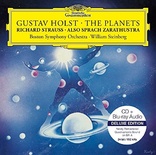
There's no real video content here, other than a static screen with a kind of "combo" illustration of a Zarathustra like figure (think the Star Child all grown up) floating amid several planetary orbs. There's a track listing available and a kind of menu showing that the red button on your remote will access the DTS-HD 4.0 mix and the yellow button will access the LPCM 2.0 mix. As with most audio Blu-rays, it really isn't necessary to even have a monitor on to enjoy this release. Audio can be toggled either with the colored buttons (as described above) or simply with the Audio button on your remote.
Holst: The Planets / Strauss: Also sprach Zarathustra Blu-ray Movie, Audio Quality

Gustav Holst: The Planets is presented on audio Blu-ray courtesy of Deutsche Grammophon with two audio options, both 24 bit, 192 kHz, DTS-HD Master Audio 4.0 and LPCM 2.0. Not to state the obvious, but the full quadrophonic mix is available on the 4.0 option, and the sound is consistently enveloping and what I'd call creamy. There's quite a bit of hall reverb on The Planets especially, but the clarity and precision of the playing is typically superb. Everything from the stabbing assaults in 5/4 that make Mars so memorable, to some of the more extended triadic writing in movements like Venus or Neptune resonate with excellent fidelity and a really warm tone. To my ears there's a bit less hall ambience on Also Sprach Zarathustra, but the resolution of this new release is such that you can quite easily hear quite a bit of (admittedly minor) noise that sounds like music stands being moved or maybe even Steinberg's baton occasionally hitting his lectern. It's not overly distracting and is certainly a new sonic window into the recording process, but it stuck out to me, especially in some relatively quiet moments of orchestral playing.
Holst: The Planets / Strauss: Also sprach Zarathustra Blu-ray Movie, Special Features and Extras
There are no supplements per se on this release, though it does come with a CD and nicely appointed insert booklet with an excellent essay by Michael Steinberg.
Holst: The Planets / Strauss: Also sprach Zarathustra Blu-ray Movie, Overall Score and Recommendation
I either never knew or had completely forgotten that Deutsche Grammophon indulged in the short lived fascination with quadrophonic sound back in the 1970s, but as any classical music fan will tell you, their engineering was always the touchstone by which all other classical recording labels were measured, and it certainly seems to have stayed intact for these four channel recordings. The sound here is impeccably rich and warm, with ample breathing space despite the almost gargantuan orchestral forces employed in both pieces. There's some intermittent and fairly unobtrusive studio noise that creeps into Also Sprach Zarathustra, and that performance isn't quite as exciting as I personally had hoped, but The Planets is a winner all the way both in terms of sonics and performance acumen. Highly recommended.