High Noon 4K Blu-ray Movie
HomeHigh Noon 4K Blu-ray Movie 
Masters of Cinema | Limited Edition / 4K Ultra HD + Blu-rayEureka Entertainment | 1952 | 85 min | Rated BBFC: U | Jul 28, 2025
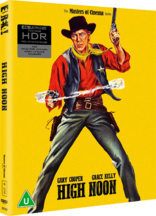

Movie rating
8.2 | / 10 |
Blu-ray rating
| Users |  | 0.0 |
| Reviewer |  | 4.5 |
| Overall | | 4.5 |
Overview
High Noon 4K (1952)
A retired Marshal must defend his town from a revengeful villain.
Starring: Gary Cooper, Thomas Mitchell (I), Lloyd Bridges, Katy Jurado, Grace KellyDirector: Fred Zinnemann
| Drama | Uncertain |
| Western | Uncertain |
| Thriller | Uncertain |
Specifications
Video
Video codec: HEVC / H.265
Video resolution: 4K (2160p)
Aspect ratio: 1.37:1
Original aspect ratio: 1.37:1
Audio
English: LPCM 2.0 Mono (48kHz, 24-bit)
Subtitles
English SDH
Discs
Blu-ray Disc
Single disc (1 BD)
4K Ultra HD
Packaging
Slipcover in original pressing
Playback
Region B (A, C untested)
Review
Rating summary
| Movie |  | 5.0 |
| Video | | 0.0 |
| Audio | | 5.0 |
| Extras |  | 4.0 |
| Overall | | 4.5 |
High Noon 4K Blu-ray Movie Review
Reviewed by Dr. Svet Atanasov July 12, 2025Fred Zinnemann's "High Noon" (1952) arrives on 4L Blu-ray courtesy of Eureka Entertainment. The supplemental features on the release include archival audio interview with Carl Foreman; archival documentary with critic Leonard Maltin; archival program with critic and author Neil Sinyard; and more. In English, with optional English SDH subtitles for the main feature. Region-Free.
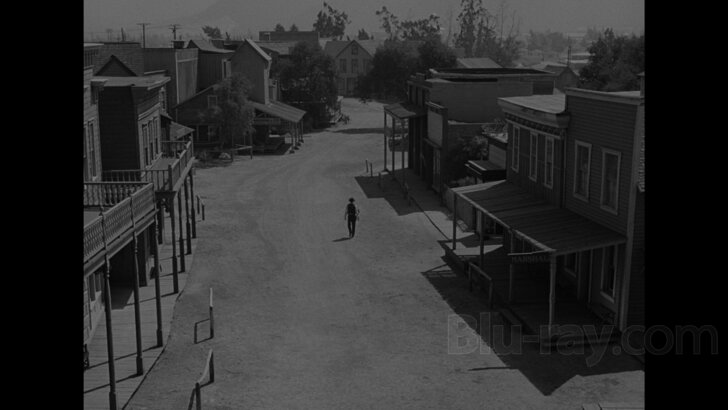
Fred Zinnemann's western High Noon has been discussed so much during the years that at this point, there is nothing one can write about it that has not already been written by someone else. One can probably only add that its ‘classic’ status is certainly deserved.
Sheriff Will Kaine (Gary Cooper) has found the perfect woman (Grace Kelly) to settle down with and is now ready to retire. She has asked him to do so, and he has given her his word that as soon as they are pronounced husband and wife, he will take off his badge and call it quits.
But on his final day on the job, Kaine is told that his replacement will be late and that the notorious gunslinger Frank Miller (Ian MacDonald) is coming back to town. This is bad news for Kaine because a few years ago, when he cleaned up the town, he placed Miller behind bars, and he vowed to put a bullet in his head.
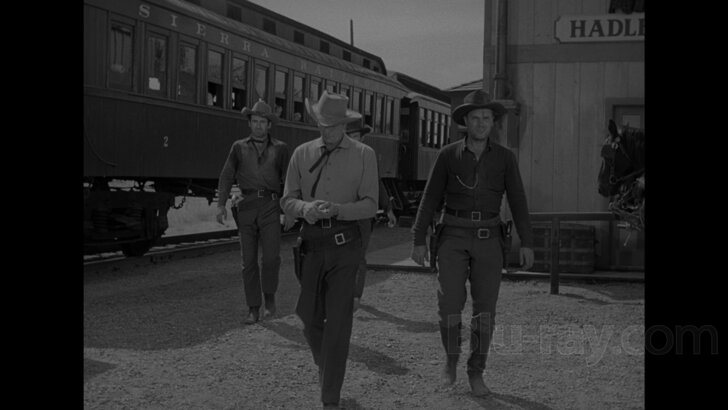
Miller is due to arrive on the noon train. He will be greeted by his three best men (one of them played by a very young-looking Lee Van Cleef), and then together they will go looking for Kaine.
The local residents urge Kaine to rush and leave town so that he can avoid confrontation with Miller, but he decides to stay and deal with the gunslinger once and for all. Shortly after, his wife abandons him, and then the town’s residents agree that it will be in their best interest to distance themselves and do the same.
The film has a very simple message: It is worth fighting and even dying for what is right. But during the years, there have been a number of very political interpretations of it that have been used to reframe it in different ways. One of these interpretations suggests that Miller portrayed the infamous Senator Joseph McCarthy and his gang as the HUAC (the House Un-American Activities Committee), while Kaine portrayed the film’s writer, Carl Foreman, who was a member of the Communist Party and was called before HUAC during the early 1950s. So the environment in which the clash between Kaine and Miller occurs apparently imitated the polarized and paranoid environment in which Foreman lived. There is another popular interpretation which suggests that the odd conflict between Kaine and the town’s residents reflected the division between people like Foreman and other communists who abandoned them and later on became informers and witnesses for McCarthy’s people. So in this interpretation, the focus of attention is actually on the erosion of trust between the communists as well as their bitter disillusionment.
It is also worth mentioning that during the Cold War era, the film resonated very differently with folks living behind the Iron Curtain. Kaine was seen as a promoter of the strength of American individualism, and his stance was interpreted as a veiled denunciation of the mass fear and hypocrisy that kept the communists and their lackeys in power for decades. So in this case, the film turned out to be quite effective as a pro-American piece with specific and surprisingly relevant political points.
Ultimately, however, the film’s strength isn’t in its ability to inspire political debates. Its technical qualities -- from the brilliant decision to shoot in real time to the careful framing choices to the great management of Dimitri Tiomkin’s score and the manner in which it enhances the tension and drama – are undeniably excellent.
The film is loosely based on John W. Cunningham's story "The Tin Star". According to various reports, however, producer Stanley Kramer bought the rights to the story after he discovered that Foreman’s script actually had plenty of similarities with the original story.
High Noon 4K Blu-ray Movie, Video Quality
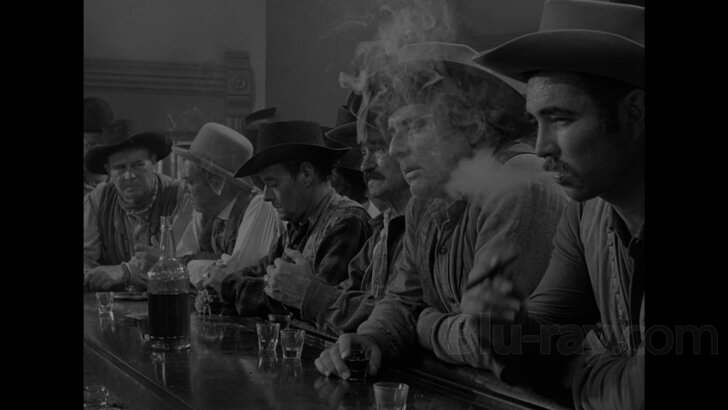
Eureka Entertainment's 4K Blu-ray release of High Noon does not have a Blu-ray copy of the film. If you need one, you should consider tracking down this Blu-ray release.
Please note that all screencaptures included with this article are taken from the 4K Blu-ray and downscaled to 1080p. Therefore, they do not accurately reflect the quality of the 4K content on the 4K Blu-ray.
The 4K Blu-ray offers a native presentation of the excellent 4K restoration of High Noon that was initially introduced on this Blu-ray release. In native 4K, the 4K restoration can be viewed with Dolby Vision and HDR grades. I chose to view it with Dolby Vision.
In America, High Noon was released on 4K Blu-ray by Kino Lorber in 2024. I think that High Noon looks good in native 4K there, but not perfect because select areas of it reveal fluctuations that introduce momentary flattening/softness. Previously, I have speculated that less-than-optimal encoding might be responsible for it. On this upcoming 4K Blu-ray, the same areas tend to look marginally better. However, the difference is small, and trained eyes will still notice that some flattening/softness is present. You can see examples here and here. Again, I am unsure what exactly is causing the anomalies, but I would like to mention two things. First, certain areas of the film have native fluctuations that make the grain appear subdued. Aging may have exacerbated a few, but they are part of the original cinematography. Second, neither the Dolby Vision nor the HDR grade is a perfect match for the original cinematography, and trained eyes should tell that many darker areas do not look perfect. I did quite a bit of testing to see how these areas look with Dolby Vision turned off, and at least on my system, virtually all become more convincing, especially where the flattening I mentioned earlier is easy to notice. So, keep this in mind if you begin noticing the inconsistencies that are now mentioned in two different reviews. This said, in native 4K High Noon still looks impressive, so I suspect that the overwhelming majority of viewers will be satisfied with its native 4K presentation.
High Noon 4K Blu-ray Movie, Audio Quality
There is only one standard audio track on this release: English LPCM 1.0. Optional English SDH subtitles are provided for the main feature.
While revisiting High Noon in native 4K last night, I did not notice any technical anomalies to report in our review. All exchanges are very clear, sharp, stable, and easy to follow. Dynamic variety is quite modest, but this is to be expected from a film directed in the early 1950s.
High Noon 4K Blu-ray Movie, Special Features and Extras
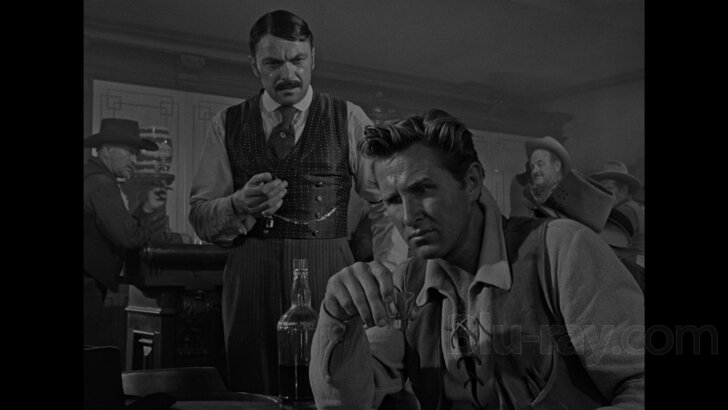
- Interview with Neil Sinyard - in this archival program, critic and author Neil Sinyard (Fred Zinnemann: Films of Character and Conscience discusses the production history of High Noon, as well as some popular myths about the nature of its story and what it supposedly symbolizes. In English, not subtitled. (30 min).
- Carl Foreman Interview - this archival audio interview with Carl Foreman was recorded at the National Film Theatre in London in 1969. It covers a wide range of topics, from Foreman's personal life to his contributions to various films. In English, not subtitled.
- Inside "High Noon' - this archival documentary focuses on the production history of High Noon and its image as one of America's greatest westerns. Included in it are clips from archival interviews with Maria Cooper Janis, Stephen Prince (Virginia Tech), Tim Zinnemann (son of Fred Zinnemann), and Bill Clinton, amongst others. Narrated by Frank Langella. Written and directed by John Mulholland. In English, not subtitled. (50 min).
- The Making of 'High Noon' (1992) - in this archival documentary, critic Leonard Maltin takes a closer look at High Noon and explains why it is one of the greatest westerns ever made. In English, not subtitled. (23 min).
- Behind 'High Noon' (2002) - this featurette was produced for the film's 50th anniversary in 2002. It features interviews with Maria Cooper, Jonathan Foreman, Tim Zinnemann, and Prince Albert of Monaco. In English, not subtitled. (10 min).
- Women of the West - this new video essay was created by J.E. Smyth. In English, not subtitled. (19 min).
- Audio Commentary One - an archival audio commentary by historian Glenn Frankel.
- Audio Commentary Two - an archival audio commentary by critic Stephen Prince.
- Audio Commentary Two - an archival audio commentary by critic Stephen Prince.
- Booklet - a limited edition collector's booklet featuring the original short story The Tin Star by John W. Cunningham, a 1974 essay by screenwriter Carl Foreman, and a retrospective review of the film from 1986.
High Noon 4K Blu-ray Movie, Overall Score and Recommendation
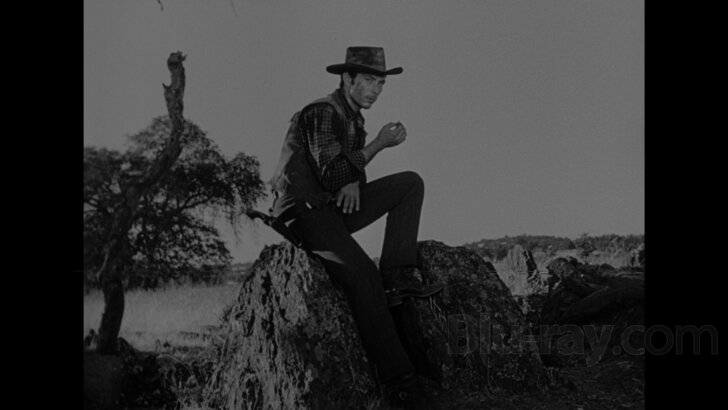
There have been some drastically different interpretations of the political overtones in Fred Zinnemann's High Noon, but I find them largely irrelevant now. The film is rightfully placed amongst the all-time greatest classics of the western genre because of its technical qualities, which are quite simply brilliant.
Both native 4K presentations of High Noon that I have seen to date look better on my system with Dolby Vision and HDR turned off. This development almost certainly will not be replicated by every single system out there, but if you choose to grab Eureka Entertainment's upcoming 4K Blu-ray release and notice that some areas of the 4K presentation of High Noon do not look as great as you feel they should, do some experimenting. You may also discover that on your system High Noon looks better without Dolby Vision and HDR. VERY HIGHLY RECOMMENDED.
Other editions
High Noon: Other Editions


Similar titles
Similar titles you might also like

The Man Who Shot Liberty Valance 4K
1962

Decision at Sundown
Indicator Series
1957

3:10 to Yuma
1957

Ride Lonesome
Indicator Series
1959

My Darling Clementine
Arrow Academy
1946

Unforgiven
1992

Rio Bravo 4K
1959

Winchester '73 4K
1950

A Fistful of Dollars 4K
Per un pugno di dollari | Special Edition
1964

Once Upon a Time in the West
C'era una volta il West
1968

High Plains Drifter
1973

One-Eyed Jacks
Arrow Academy
1961

Shane
Masters of Cinema
1953

The Proposition
Remastered | Limited Edition
2005

The Hired Hand
Arrow Academy
1971

The Searchers
1956

Buchanan Rides Alone
Indicator Series
1958

The Magnificent Seven
1960

The Wild Bunch
1969

For a Few Dollars More 4K
Per qualche dollaro in più | Special Edition
1965