Hells Angels on Wheels Blu-ray Movie
HomeHells Angels on Wheels Blu-ray Movie 
Blu-ray + DVDHen's Tooth Video | 1967 | 96 min | Not rated | Sep 03, 2013

Price
List price:Listed on Amazon marketplace

Movie rating
5.9 | / 10 |
Blu-ray rating
| Users |  | 0.0 |
| Reviewer |  | 3.5 |
| Overall | | 3.5 |
Overview
Hells Angels on Wheels (1967)
Poet, a rebellious gas station attendant, leaves his mundane life to blast down the open highway with the Hell's Angels. Then he makes the mistakes of falling for the gang leader's girlfriend.
Starring: Jack Nicholson, Adam Roarke, Jack Starrett, Bruno VeSota, Bob KelljanDirector: Richard Rush
| Thriller | Uncertain |
| Crime | Uncertain |
| Drama | Uncertain |
Specifications
Video
Video codec: MPEG-4 AVC
Video resolution: 1080p
Aspect ratio: 1.85:1
Original aspect ratio: 1.85:1
Audio
English: LPCM 2.0 (48kHz, 16-bit)
Subtitles
English SDH
Discs
25GB Blu-ray Disc
Two-disc set (1 BD, 1 DVD)
DVD copy
Playback
Region A (B, C untested)
Review
Rating summary
| Movie | | 3.5 |
| Video |  | 4.0 |
| Audio | | 3.5 |
| Extras |  | 2.5 |
| Overall | | 3.5 |
Hells Angels on Wheels Blu-ray Movie Review
Born to Be Wild
Reviewed by Michael Reuben August 28, 2013When producer Bert Schneider (the "S" in Seventies film company BBS Productions) set off with Peter Fonda and Dennis Hooper to make Easy Rider , he announced to everyone that they were making "a Richard Rush film" and screened three such films for the cast and crew, including Hells Angels on Wheels. But many in the production unit already knew the style, because Schneider had hired most of Rush's crew. They included the indispensable Hungarian-born cinematographer László Kovács, who, according to Rush, was the best hand-held operator in the world. Kovács shot "steadicam" before any such thing existed. Schneider has also borrowed one of the stars of Hells Angels on Wheels: a charismatic newcomer named Jack Nicholson. Nicholson's supporting turn in Easy Rider as a small-town lawyer with a drinking problem proved to be the launching pad for a movie star career. Both his trademark charm and the dangerous quality that energizes both his heroes and his villains are already there in Nicholson's early work for Rush. It's ironic, though in some ways fitting, that Rush is most commonly associated with outsider productions like Hells Angels on Wheels and The Stunt Man (his single greatest achievement). He began his career in the bastions of the establishment, making TV programs for the military during the Korean war. But Rush has always been difficult to pin down. He's the kind of iconoclast who looks at everything with a skeptical eye. As he relates on the new commentary track recorded for this Blu-ray disc, when he was offered the script for Hells Angels on Wheels because of his reputation as a rebel, his first instinct was to reject it. After he signed onto the project, he managed to secure the cooperation of Hells Angels president Sonny Barger (who appears briefly in the film in a non-speaking part), and then created an unapologetic film that neither glorified the Angels' lifestyle nor dismissed it. In the guise of so-called "exploitation film", Rush made a moody docudrama that paved the way for Easy Rider and other stylistic departures of the memorable period that was about to explode in American cinema.
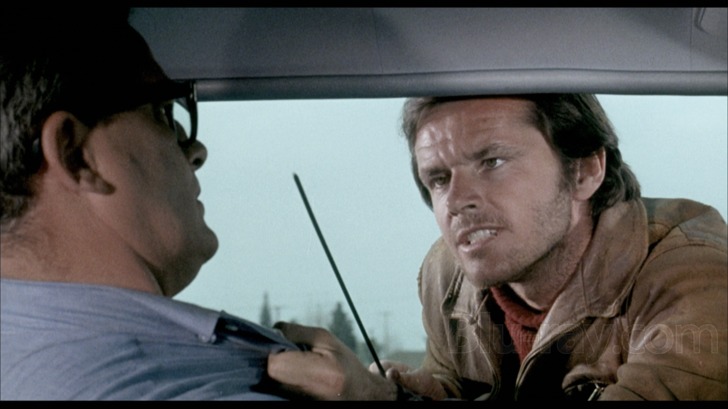
Hells Angels on Wheels has minimal plot, because it doesn't need much. Patrons bought tickets to be horrified, intimidated and fascinated by the boogeymen of the title. The opening features a large procession of Angels on the San Francisco Bay Bridge, and Rush carefully points out president Sonny Barger to establish the film's authenticity. Then he narrows in on an individual chapter led by Buddy (Adam Roarke, who would later appear in The Stunt Man). Buddy's group roars through a small California town on the very day when a gas station attendant who goes by the name of "Poet" (Nicholson) gets fired after an altercation with a customer. When a minor collision with the Angels leaves Poet's motorcycle with a broken headlight, Poet stands his ground, and Buddy, who is always on the lookout for new talent, recognizes a quality he can exploit. For his part, Poet is intrigued by Shill (Sabrina Sharf), who is Buddy's lady. Poet ends up riding out with Buddy's group as a new recruit. The dramatic arc of Hell's Angels on Wheels is Buddy's effort, and to some extent Shill's (the name is not an accident), to indoctrinate Poet into Angel society. Rush was fascinated by leaders like Sonny Barger who managed to maintain order and discipline within a coalition of individuals whose entire existence was devoted to rebelling against constraints and defying any form of authority. Throughout the film, he has Buddy and Shill coaxing Poet into a tightly knit surrogate family where every day is a party, then suddenly pushing him away, treating him coldly, making him feel left out. The goal of this on again, off again embrace is to make an outcast like Poet yearn for the leader's approval to the exclusion of all else, so that his entire sense of self becomes bound up in the leader's blessing and the group's well-being. It's a classic technique of cults, but Rush had observed a variation of it in the military, and he had come to believe that some variant of this indoctrination exists everywhere. ("Being unable to accept truth", he has been quoted as saying, "we have a tendency to accept systems.") Of course, much of this is subtext, while Rush delivers on the title's promise by showing the Angels drinking, fighting, carousing, riding the highway and generally raising hell. He is even imaginative enough to stage a party scene that feels like an orgy, even though almost no bare flesh is involved. Painting women's bodies with brushes serves as visual metaphor for sex, and it's effective within Kovács' crowded frame. A barroom brawl, a fight with sailors and a confrontation in an empty motel swimming pool supply the violence (and introduced Rush to stunt techniques he would later use in The Stunt Man). For a change of pace that is almost comical, one Angel and his lady get married, with the service performed by a less-than-willing minister who might as well be at gunpoint. A lone cop, Sgt. Bingham (Jack Starrett), appears from time to time to threaten Buddy with charges, but he is there more as an example of the law's impotence in the face of such brazen and well-organized resistance. The scene in which every member of the group spontaneously confesses to something of which Bingham is accusing Buddy (inaccurately, as it happens) is typical. Buddy's real risk is losing control of discipline within the ranks. In the film's last ten minutes, Rush buckles down to the necessary work of resolving the triangle among Poet, Buddy and Shill. Once that's done, he wisely rolls the credits. No one comes to an exploitation film for the drama.
Hells Angels on Wheels Blu-ray Movie, Video Quality
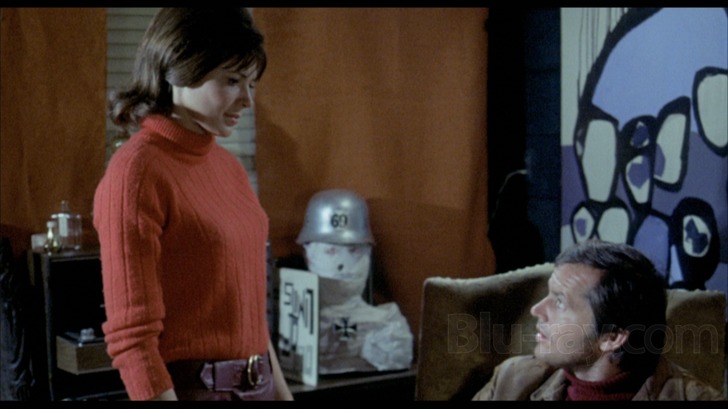
Although it was shot quickly on a low budget, Hells Angels on Wheels has a careful and deliberate visual design. Rush said that he wanted the towns to be neat and orderly and the landscapes to be beautiful, so that the Hells Angels would look like "litter". While not without its issues, the 1080p, AVC-encoded Blu-ray from specialty publisher Hen's Tooth Video presents the the late László Kovács' photography in a form closer to the original intention than has likely been seen since the film first played in theaters. The source element is in decent condition, though it has some flaws. For the first few minutes, two thin vertical black lines run closely together down the right side of the screen. They are more or less visible, and sometimes disappear altogether, depending on what is "behind" them. Then they vanish for good. Small scratches and print knicks appear throughout the film, but most only last for a single frame, and the eye doesn't detect them in playback; they only become evident if you go frame-by-frame. All in all, given the typical handling of film elements by studios, let alone independent distributors, in the era before home video, it is amazing to find Hells Angels on Wheels in such good condition. The image is soft but detailed, with a reasonably fine grain structure that does not appear to have fallen victim to inappropriate electronic manipulation. Long shots frequently appear to be blurry, but one has to recall that Kovács was acting as both camera operator and focus puller, and he was frequently anticipating an object in the foreground. A good example occurs in the wedding scene, where the minister and the makeshift "aisle" creating by the Angels and their bikes are slightly out of focus, because Kovács is clearly prepared for the bride and groom who he knows will enter the shot immediately in front of him. Colors are vivid, so that the green grass Rush wanted to emphasize is very green, and the outfits that scream "Sixties!" do so in all their pink and purple glory. The blacks that are so crucial to capturing the Angels garb (especially Buddy's) are well-represented, and the image, while bright, never appears to have too much contrast. With limited extras, the 95-minute film fits on a BD-25 with an average bitrate of 25 Mbps, which is enough to handle the lively fight scenes in between the quiet conversations.
Hells Angels on Wheels Blu-ray Movie, Audio Quality
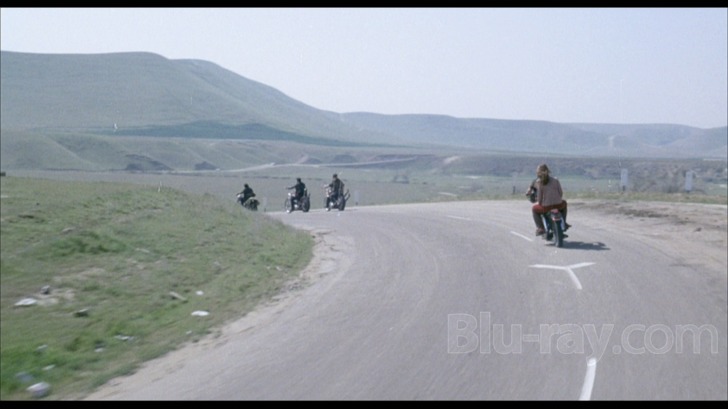
The film's original mono track is presented as PCM 2.0, and it's effective within the limits of the source. The dialogue is clear, and so are the sounds of fighting, beer bottles breaking, engines roaring and tires spinning. The dynamic range isn't nearly what you'd find in a contemporary soundtrack, but that's probably a good thing. A film like Hells Angels on Wheels would lose its low-budget, exploitation vibe if the Angels' hogs vibrated the viewing space from all sides with digitally enhanced capabilities offered by today's multi-channel sound formats.
Hells Angels on Wheels Blu-ray Movie, Special Features and Extras
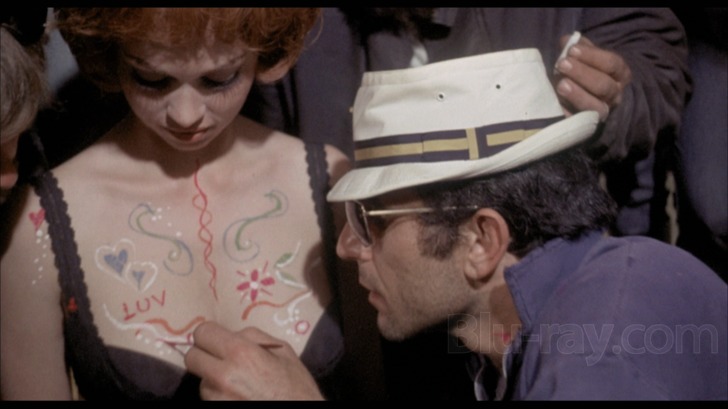
- Commentary with Director Richard Rush (located under "Setup"): Now 84 years old, Rush remains focused and interested, but his energy is obviously less than it used to be, and this newly recorded commentary has frequent pauses. Still, what's here is worthwhile, as Rush recalls the origin of the project, his research into the Angels, his experience working with Nicholson and Roarke, the contributions of cinematographer Kovács and his own fascination with the governing structure of the Angels organization. Rush also relates a revealing story of how he defused a potentially deadly situation involving himself, a young female assistant and a group of Bay Area Angels encountered by chance on a location scout.
- Photo Gallery (1080p; various; 1:45): There are only two actual "photos" here. Most of these are reviews of the film, clipped from their original publications, and vintage publicity materials, many of them furnished only to theater owners. Presumably these are from Rush's personal collection. The images have been mastered to play in quick succession, and they go by far too fast for anyone to read them; be prepared with the pause button.
Hells Angels on Wheels Blu-ray Movie, Overall Score and Recommendation
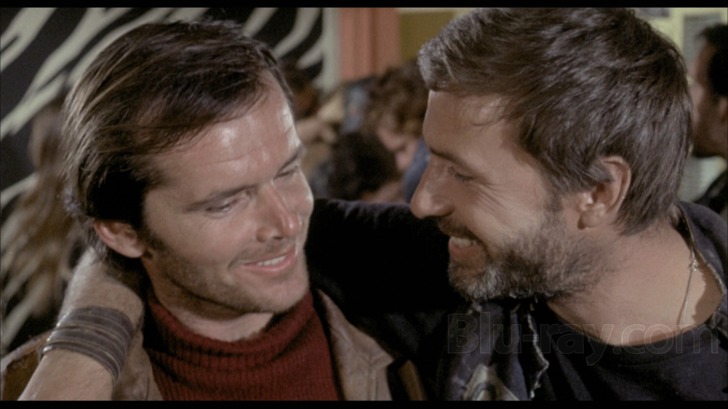
In roughly the same era that Rush was making Hells Angels on Wheels, novelist and Merry Prankster Ken Kesey was also spending time with the Hells Angels in exploits that would be documented by Tom Wolfe in The Electric Kool-Aid Acid Test. Wolfe's portrayal captures some of the same qualities that animate Rush's film, but because Wolfe's book was primarily about Kesey, he presented the Angels through Kesey's eyes. Rush was more direct, and he was working in a medium that is inherently more visceral. The film may not have the same impact today as in 1967, when the Hells Angels had a higher profile and many ordinary citizens were convinced that these brigands on motorbikes were an imminent threat to society (which is probably why Kesey found them fascinating). But Rush captured the mood of a moment in history. Recommended, but with the disclaimer that it's dated and the pacing is slow by contemporary standards.
Similar titles
Similar titles you might also like
(Still not reliable for this title)

Extremities
1986

Born Losers
1967

Messenger of Death
1988
The Female Bunch
A Time To Run
1971

Psych-Out
Extended Director's Cut
1968

Assassination
1987

Stone Cold
2K Restoration
1991

The Klansman
Klansman / The Burning Cross / KKK
1974

F/X
1986

Suspect
1960

Black Mama, White Mama
1973

Lust for Freedom
1987

Live Like a Cop, Die Like a Man
4K Restoration
1976

Body Fever
1969

Open House
2010

Elsewhere
2009

No Way Home
Black Friday Exclusive Limited Edition of 2,500
1996

The Ticket of Leave Man
Indicator Series
1937

Kalifornia
Collector's Edition
1993

Siege
Self Defense
1983