Heart of Stone Blu-ray Movie
HomeHeart of Stone Blu-ray Movie 
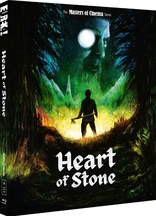
Das kalte Herz | Masters of Cinema | Limited EditionEureka Entertainment | 1950 | 104 min | Rated BBFC: PG | Jun 23, 2025

Movie rating
7.5 | / 10 |
Blu-ray rating
| Users |  | 0.0 |
| Reviewer |  | 3.0 |
| Overall | | 3.0 |
Overview
Heart of Stone (1950)
Peter Munk, a poor charcoal burner, lives with his mother in The Black Forest. Poverty prevents him from marrying Lisbeth, the girl he loves. When he comes across the Little Glass Man, the good spirit of the forest, the young man asks him for assistance. His wish is granted and he becomes rich. But the fool soon loses all his money after gambling at the inn. In desperation, he asks Dutch Michael, the evil spirit of the forest, to help him to become rich again. The mean giant agrees and gives Peter all the riches in the world, but on one condition: the young man will exchange his heart for a cold stone. He can now marry Lisbeth but can a heart of ice make you and the others happy...?
Starring: Lutz Moik, Hanna Rucker, Paul BildtDirector: Paul Verhoeven (II)
| Foreign | Uncertain |
| Romance | Uncertain |
| Family | Uncertain |
| Fantasy | Uncertain |
Specifications
Video
Video codec: MPEG-4 AVC
Video resolution: 1080p
Aspect ratio: 1.33:1
Original aspect ratio: 1.37:1
Audio
German: LPCM 2.0 Mono (48kHz, 24-bit)
Subtitles
English
Discs
Blu-ray Disc
Single disc (1 BD)
Packaging
Slipcover in original pressing
Playback
Region B (locked)
Review
Rating summary
| Movie |  | 3.5 |
| Video | | 3.0 |
| Audio |  | 4.5 |
| Extras | | 3.5 |
| Overall | | 3.0 |
Heart of Stone Blu-ray Movie Review
Reviewed by Dr. Svet Atanasov June 11, 2025Paul Verhoeven's "Heart of Stone" (1950) arrives on Blu-ray courtesy of Eureka Entertainment. The supplemental features on the release include new program with critic Claire Knight; new audio commentary by critic Sean Allan; vintage trailer; several short films from DEFA's archives; and more. In German, with optional English subtitles for the main feature. Region "locked".
During the Cold War era, the defunct German Democratic Republic (GDR) operated a massive film company called DEFA that copied everything the famous Soviet film company Mosfilm did. However, there were two crucial differences between DEFA and Mosfilm. Inside the Soviet Bloc, it was understood that DEFA could not directly compete with Mosfilm, so when each year film production in the GDR and the U.S.S.R. was pre-planned, both companies coordinated efforts to deliver ideologically safe films to counter western ‘propaganda’ films, the overwhelming majority of which were denied legal access by state censors. Additionally, while both DEFA and Mosfilm produced a massive number of true propaganda films praising the workers’ paradise that the Party had supposedly built, virtually all of DEFA’s output was meant for East Germans. The propaganda films made at Mosfilm were distributed all across the Soviet Bloc and in friendly countries in South America and Africa.
As the 1960s ended, censorship at DEFA became more flexible, and as various young filmmakers began testing the system, more diverse films snuck out of it. (The same trend was underway in Czechoslovakia, Poland, Hungary, Romania, and Bulgaria). Because virtually all young filmmakers were either secret agents or sons and daughters of prominent communist apparatchiks, the censors and the Party leaders were convinced that the ‘thawing’ they had allowed, which would eventually become the catalyst for perestroika, was a process they could continue to control. However, by the late 1970s and especially during the 1980s, as the Party gradually began replacing the post-war hardliners with slightly more flexible leaders sensing that changes were needed to avoid a complete economic collapse of the Soviet Bloc, censorship at DEFA (and other state-owned film companies in the satellite states) became largely a symbolic practice. During this period, which lasted approximately fifteen years, filmmakers in the Soviet Bloc and the U.S.S.R. made many rather surprisingly good films.
DEFA produced Heart of Stone in 1950, long before the initiation of the ‘thawing’. Because it was its first color film, it was a big production that attracted talent from outside the newly founded GDR. For this reason, it was very closely monitored by the Party.
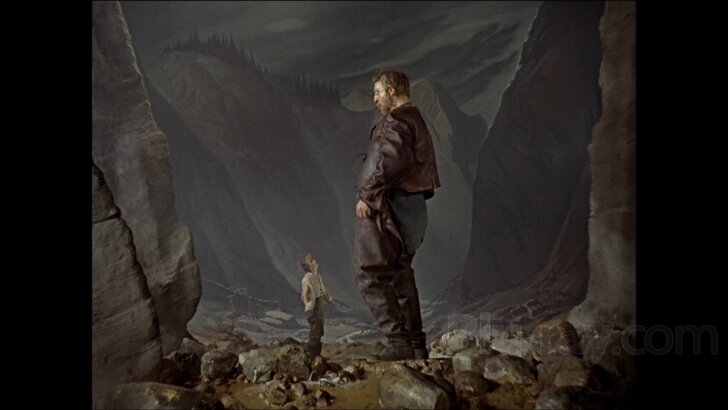
Heart of Stone presents a variation of a popular fairy tale, at the center of which are the young and poor Peter Munk (Lutz Moik) and the beautiful and slightly more fortunate Lisbeth (Hanna Rucker). In a desperate attempt to prevent the wealthy merchant Ezechiel (Paul Esser) from marrying Lisbeth, Peter enters the Dark Forest, where he meets and asks the Glass Imp (Paul Bildt) for help. After he misuses the two wishes that the Glass Imp grants him, Peter reaches out to the giant demon Dutch Michael (Erwin Geschonneck), notorious for helping desperate people get what they desire in exchange for their hearts.
Even though Heart of Stone looks very dated now, it is not difficult to tell that it was an enormously ambitious production that attempted to match the work of Hollywood producers and directors in America. It was very successful in the GDR and across the Soviet Bloc and remained one of DEFA’s most popular films.
The big character transformation that Peter undergoes is very predictable. On the other hand, excluding the youngest viewers, everyone who would have gone to see Heart of Stone would have known what happens before its final credits roll because it borrows material from an incredibly popular fairy tale.
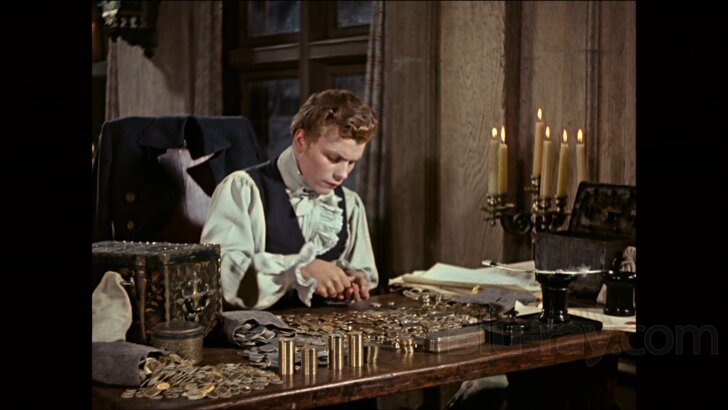
The slightly modernized messaging attached to the character transformation is equally predictable. For example, the wealthy are quickly profiled as egoistical, abusive parasites that target and destroy good people. All of them carry hearts of stone, too. The hard-working but poor around them are superior human beings who also happen to have happier lives. While it was often embellished in different ways, this messaging routinely appeared in the many films DEFA produced over the years.
Heart of Stone Blu-ray Movie, Video Quality
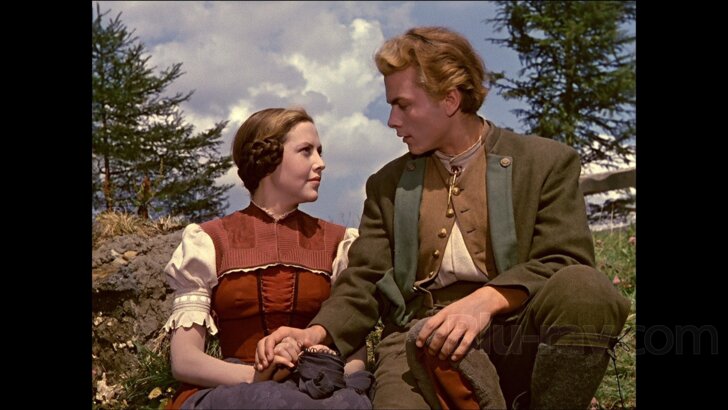
Presented in an aspect ratio of 1.33:1, encoded with MPEG-4 AVC and granted a 1080p transfer, Heart of Stone arrives on Blu-ray courtesy of Eureka Entertainment.
The release introduces a 2K restoration of the film that is quite disappointing. Indeed, the entire film is covered with some sort of odd sharpening, extremely similar and in many places practically identical to the damaging sharpening that scanner noise brings. In many areas, this off sharpening is accompanied by equally familiar smearing, which compromises a lot of fine nuances, clarity, and depth. Color balance and reproduction are fine. However, in many darker areas, both are affected by the anomalies I described. All of this is unfortunate because image stability is good and, from I could tell, the visual information under the odd sharpening is quite good. In summary, while it is not impossible to enjoy the film, the current presentation does not provide it with an attractive organic appearance. My score is 2.75/5.00. (Note: This is a Region-B "locked" Blu-ray release. Therefore, you must have a native Region-B or Region-Free player in order to access its content).
Heart of Stone Blu-ray Movie, Audio Quality
There is only one standard audio track on this Blu-ray release: German LPCM 2.0. Optional English subtitles are provided for the main feature.
The lossless audio is very nice. I did not encounter any serious age-related anomalies to report in our review. In a few areas, small fluctuations are noticeable, but they are clearly inherited. The music sounds lovely, and there are some decent effects that create interesting surprises. The English translation is excellent.
Heart of Stone Blu-ray Movie, Special Features and Extras
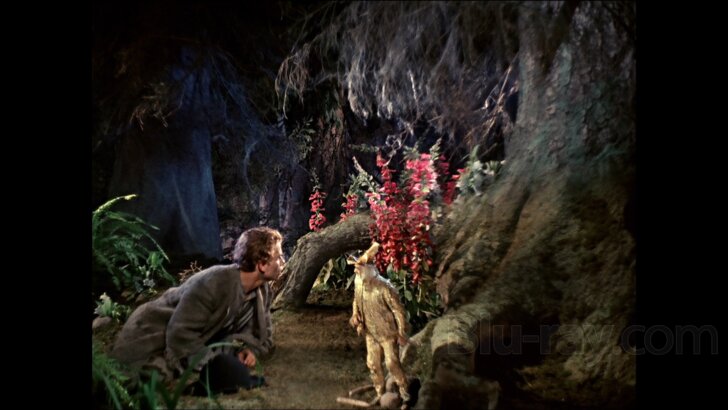
- Trailer - presented here is a restored vintage trailer for Heart of Stone. In German, with English subtitles. (3 min).
- Once Upon a Time in the East - in this new program, critic Claire Knight discusses Heart of Stone and the socio-political environment in which it was produced. In English, not subtitled. (24 min).
- Tales From the Black Forest - this new video essay was created by critic Mary Going. In English, not subtitled. (23 min).
- The Bremen Town Musicians - this short film from the DEFA archives was written and directed by Bruno J. Bottge in 1954. It is a cinematic adaptation of yet another popular fairy tale. In German, with English subtitles. (20 min).
- The Magic Ring - this short film from the DEFA archives was directed by Bruno J. Bottge in 1957. It is a cinematic adaptation of yet another popular fairy tale. In German, with English subtitles. (21 min).
- Thumbelina's Adventures - this short animated film from the DEFA archives was freely adapted from Hans Christian Andersen's writings. It was directed by Christl Wiemer. In German, with English subtitles. (17 min).
- Commentary - this exclusive new audio commentary was recorded by critic Sean Allan.
- Booklet - a limited edition collector's booklet featuring new writing on Heart of Stone by Qinna Shen, author of The Politics of Magic: DEFA Fairy-Tale Films, as well as technical credits.
Heart of Stone Blu-ray Movie, Overall Score and Recommendation
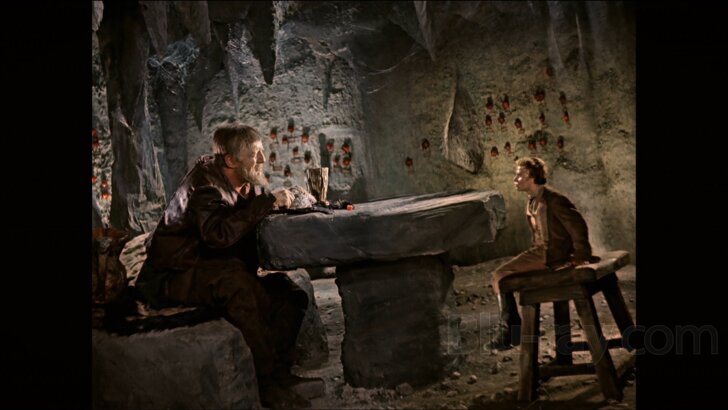
DEFA has a large catalog of films, many of them unseen on this side of the Atlantic, and some of the most interesting are the ones that the communist censors banned because they challenged their politics. During the DVD era, First Run Features introduced quite a few, but I do not believe they reached a big enough audience. Paul Verhoeven's Heart of Stone is one of the biggest films in DEFA's catalog, and probably the only one that is still popular amongst older Germans who endured the Cold War era. It looks predictably dated and channels a lot of political preaching, but it has an undeniable charm. Unfortunately, the 2K restoration that was prepared for it in Germany is unconvincing.
Similar titles
Similar titles you might also like

The Fabulous Baron Munchausen
Baron Prášil
1961

Fando y Lis
Fando and Lis
1968

Kagero-za
陽炎座 / Heat-Haze Theatre
1981

The Magic Flute
Trollflöjten
1975

White Snake
白蛇:缘起
2019

The Cassandra Cat
Až přijde kocour / When the Cat Comes
1963

Spione
Spies / Masters of Cinema
1928

Let's Make a Dream
Faisons un rêve...
1936
Shadows in Paradise
Varjoja paratiisissa
1986

Angel-A
2005
Phantom
Masters of Cinema
1922

The Great Yokai War
2005

Journey to the Shore
岸辺の旅 / Kishibe no tabi | Masters of Cinema
2015

The Mad Fox
恋や恋なすな恋 / Koi ya koi nasuna koi | Arrow Academy
1962

Smiles of a Summer Night
Sommarnattens leende
1955
Ich möchte kein Mann sein
I Don't Want to Be a Man / Masters of Cinema
1918

The Bride with White Hair
白髮魔女傳 / Bak fat moh lui zyun | Eureka Classics
1993

Beyond The Infinite Two Minutes
ドロステのはてで僕ら / Droste no hate de bokura
2021

Neo Chinpira: Zoom Goes the Bullet
オ チンピラ 鉄砲玉ぴゅ~
1990

Sailor Suit and Machine Gun
Sêrâ-fuku to kikanjû | Special Edition
1981