Heal the Living Blu-ray Movie
HomeHeal the Living Blu-ray Movie 
Réparer les vivantsCohen Media Group | 2016 | 105 min | Not rated | Aug 29, 2017

Price
List price:Listed on Amazon marketplace

Movie rating
6.7 | / 10 |
Blu-ray rating
| Users |  | 0.0 |
| Reviewer |  | 4.0 |
| Overall | | 4.0 |
Overview
Heal the Living (2016)
Three stories are carefully woven together: a group of friends on a road trip that ends in tragedy; a woman who learns that her heart is beginning to fail; and two teams of doctors and medical experts attempting to save lives.
Starring: Tahar Rahim, Emmanuelle Seigner, Anne Dorval, Bouli Lanners, Kool ShenDirector: Katell Quillévéré
| Foreign | 100% |
| Drama | 9% |
Specifications
Video
Video codec: MPEG-4 AVC
Video resolution: 1080p
Aspect ratio: 2.39:1
Original aspect ratio: 2.39:1
Audio
French: DTS-HD Master Audio 5.1
French: Dolby Digital 5.1
Subtitles
English SDH
Discs
Blu-ray Disc
Single disc (1 BD)
Playback
Region A (B, C untested)
Review
Rating summary
| Movie | | 4.0 |
| Video |  | 5.0 |
| Audio |  | 4.5 |
| Extras |  | 1.5 |
| Overall | | 4.0 |
Heal the Living Blu-ray Movie Review
First do no harm.
Reviewed by Jeffrey Kauffman August 24, 2017There’s probably no more devastating event a parent can experience than the death of a child. That’s just one of several underlying sadnesses that inform Heal the Living, an at times almost unbearably moving film that in lesser hands and with a less nuanced cast most likely could have played like a very special Lifetime made for television movie. Based on the prize winning novel Réparer les vivants by Maylis de Kerangal, the film deals with a number of issues, including the horrifying decisions regarding whether or not to allow organ donations from a brain dead relative, but in essence Heal the Living is an intense character study that often veers off into unexpected detours, some dealing with ostensibly minor characters. There are a few structural artifices that co-adapter and director Katell Quillévéré brings to the project, some of which are arguably either unnecessary or at least not very helpful, but the film has a raw emotional power that will most likely captivate most viewers. The film begins with a series of vignettes documenting the adventures of teenager Simon (Gabin Verdet), a seemingly sweet kid who appears to be secretly sleeping with his girlfriend (at least as evidenced by his exit through a bedroom window), who also loves zooming around the city on his bike and who is also an avid surfer. When one of his buddies meets him after the friend does some quasi-parkour moves across a series of roofs, there’s an underlying angst developing that seems to suggest, however subliminally, that perhaps some daredevil moves on the part of the boys is going to get them into some risky situation. But instead it’s a relatively mundane car crash that delivers Simon to a hospital already in a coma, where it’s soon discovered that all of his brain activity has flatlined. His distraught (and estranged) parents, Marianne (Emmanuelle Seigner) and Vincent (Kool Shen), arrive at the hospital separately and have a devastating chat with the slightly rumpled elder doctor Pierre Révol (Bouli Lanners), who attempts to deliver the news as gently as possible that for all intents and purposes Simon is dead. Perhaps wisely, Révol leaves an even more gut wrenching discussion to his underling, Thomas Rémige (Tahar Rahim), an organ donation specialist who has to mention the unimaginable to Marianne and Victor, both of whom are struggling to cope with the reality of the situation.
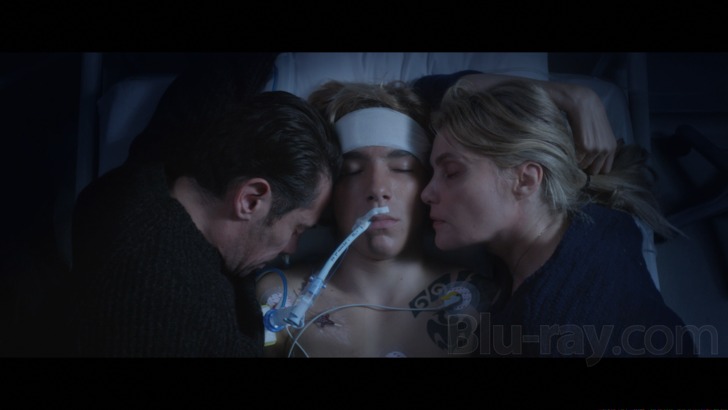
The first 45 minutes or so of Heal the Living deal with the horrifying events that ensnare Marianne and Victor, but even here Quillévéré darts off from time to time, at least for a moment or two, into some unexpected territories. The film has a rather large supporting cast in both this opening story and the subsequent one (detailed below) and it’s one of Heal the Living’s interesting if at times slightly enervating tendencies that it can suddenly make one of the supporting characters a brief focal point (in a conceit that reminded me perhaps oddly of certain structural tendencies in films like Magnolia). Therefore, even though the central heart (no pun intended, given the organ donation aspect) of the first part of the film is the agony suffered by Marianne and Victor, the story briefly deals with kind of peculiar elements like Thomas’ infatuation with goldfinches or an emergency room nurse named Jeanne (Monia Chokri), who suddenly drifts off into an erotic fantasy while in a hospital elevator. Are these “character beats” needed? Arguably, no, but they provide the film with a really distinctive flavor nonetheless.
But there are other structural artifices that are at least questionable if ultimately not detrimental to the emotional tenor of the story. After the hallucinatory crash sequence, one might reasonably expect the story to segue to Simon’s parents, but instead it’s Dr. Révol who is first to be introduced, and even he is shown in a context that seems to have nothing to do with the rest of the story. Somewhat later in this first story, there’s an admittedly extremely touching flashback showing Simon’s meeting with his girlfriend, except — whose flashback is it supposed to be? At that point, the film has more or less settled down on the parents for its point of view (temporarily, at least), but suddenly this vignette intrudes with no introduction, and it can’t be the memory of either Marianne or Victor. These are perhaps meaningless quibbles with a film that values a certain emotional honesty over presentational conceits, but they’re at least worth considering in analyzing why Heal the Living lands with such impact despite these perhaps unsettling elements.
The seemingly tangential character of Jeanne the nurse in fact brings the “first act” to a close with a kind of peculiar texting vignette, at which point the film offers a traditional fade which some folks may find momentarily discombobulating. The second story then takes over, with a woman named Claire (Anne Dorval) receiving the news that her heart condition is terminal and that she needs to decide whether or not to get on a transplant waiting list. Claire’s story is unfolded perhaps slightly more discursively than the events depicted in the first part of the film. It’s only slowly divulged that she has some kind of musical background and in fact had a romance with a famous concert pianist named Anne Guérande (Alice Taglioni). It doesn’t take a rocket scientist to figure out that the first story and the second story will be joined, and the film documents Claire’s arrival next to a hospital, where she shares some time with her two college aged kids Sam (Théo Cholbi) and Maxime (Finnegan Oldfield). There are some family dysfunctions at play in this section, though it’s notable that they’re dysfunctions born out of concern for others’ feelings, not drama summoned up simply to roil the emotional undercurrents.
I had a kind of interesting reaction to the two different if linked stories at play in Heal the Living. Despite virtually no context given for any of the characters, nor even any overt discussion about organ donation between the parents, the first part of the film was a devastating experience for me, perhaps because Simon is about the age of one of my sons. Kind of weirdly, then, the second part of the film, which is much more detailed in its depiction of the interpersonal relationships at play, played with a certain distance, almost like a procedural that was more concerned with trotting out the specifics of organ transplants than any emotional undercurrents.
Some may find some of the stylistic flourishes Quillévéré introduces as distracting, but the film builds to some genuine emotion in both stories. Performances are real feeling and often quite heartbreaking (though some, like me, may want to slap Claire for continuing to smoke when she has a heart condition). The film is at times unusually poetic, something that may in and of itself allow for certain presentational excesses.
Heal the Living Blu-ray Movie, Video Quality
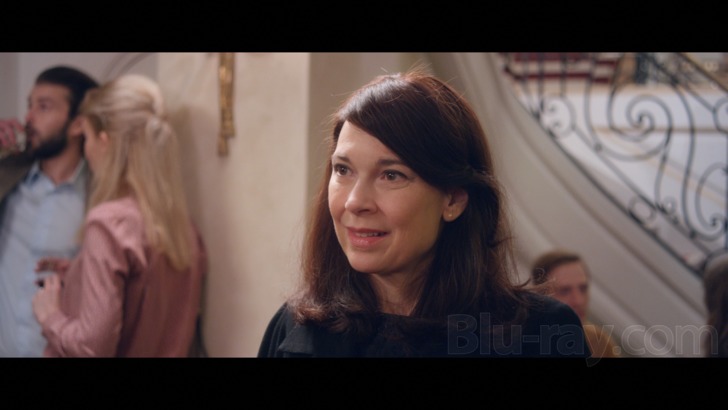
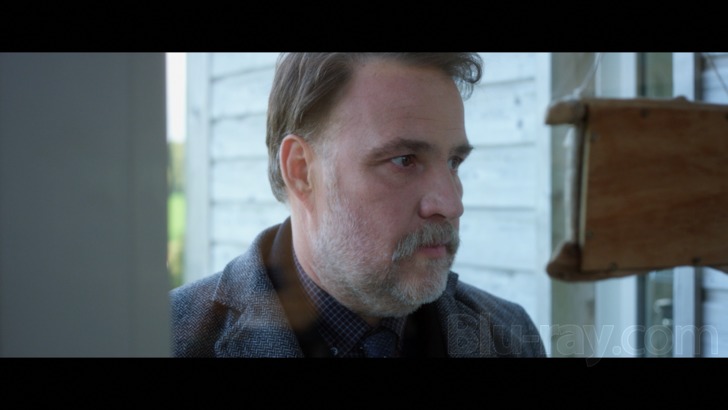
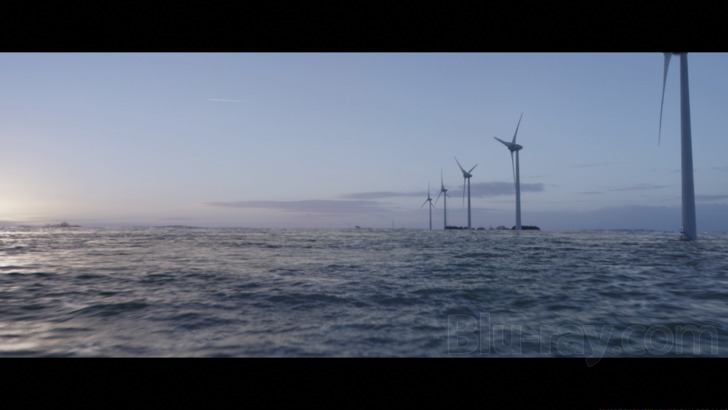
Heal the Living is presented on Blu-ray courtesy of Cohen Media Group with an AVC encoded 1080p transfer in 2.35:1. The IMDb lists the Red Epic Dragon as having been utilized, and I assume that things were finished at a 2K DI. This is a pretty much flawless presentation, with the typically sleek and smooth look of digital capture, but with similarly expected high levels of detail and fine detail. Quillévéré and director of photography Tom Harari often favor quasi-hallucinatory or at least dreamlike moments, if only fleetingly, in both stories, moments that are inherently on the soft side (see screenshots 14 and 15). As can be seen in several of the screenshots accompanying this review, quite a bit of the film has been graded rather coolly, often to blue or gray tones, but detail levels aren't really detrimentally affected. Occasional very minor splotchiness intrudes for very brief moments (see screenshot 9), but on the whole this is a sharp and precise looking transfer that exhibits no really problematic anomalies.
Heal the Living Blu-ray Movie, Audio Quality

One of the film's most impressive technical elements is the largely piano based score from Alexander Desplat, and it's one of the standout elements of the Blu-ray disc's DTS-HD Master Audio 5.1 track. Despite solo (and at times overdubbed) piano being offered as underscore, there's a nice spread that washes through the surround channels, elegantly supporting key emotional moments. Otherwise, this largely dialogue based film benefits from precise rendering of dialogue. A few isolated scenes, like the early surfing vignette, do offer opportunities for immersion (no pun intended) with nicely placed ambient environmental effects.
Heal the Living Blu-ray Movie, Special Features and Extras
- Interview with Director Katell Quillévéré (1080p; 14:19) features thoughts on the original source novel and how she sought to adapt that for her film.
- Theatrical Trailer (1080p; 2:00)
Heal the Living Blu-ray Movie, Overall Score and Recommendation
There are a number of elements at play during Heal the Living that would seem on their face not to work, and yet most of the time they do in this arresting and emotionally devastating film. Unusually cathartic despite a somewhat distant second half, this is an impressive piece from director Katell Quillévéré, despite some overly flowery stylistic touches. Cohen has provided a disc with strong technical merits, and Heal the Living comes Highly recommended.
Similar titles
Similar titles you might also like
(Still not reliable for this title)

Aquarius
2016

Maborosi
幻の光 / Maboroshi no hikari
1995

Loveless
Нелюбовь / Nelyubov
2017

Leviathan
Левиафан / Leviafan
2014

Roma
2018

The Club
El Club
2015

About Elly
Darbareye Elly
2009

Rust and Bone
De rouille et d'os
2012

Sea Fog
해무 / Haemoo | Slipcover in Original Pressing
2014

Mustang
2015

The Naked Island
裸の島 / Hadaka no shima
1960

Zama
2017

Poetry
시 / Shi
2010

La Strada
1954

24 Frames
2017

Sarah's Key
Elle s'appelait Sarah
2010

La Dolce Vita
1960

Pioneer
Pionér
2013

Bastards
Les Salauds / Slipcover in Original Pressing
2013

Le bonheur
1965