Harry Blu-ray Movie
HomeHarry Blu-ray Movie 
Acorn Media | 2013 | 271 min | Not rated | Aug 25, 2015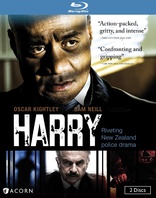

Movie rating
6.5 | / 10 |
Blu-ray rating
| Users |  | 0.0 |
| Reviewer |  | 4.0 |
| Overall | | 4.0 |
Overview
Harry (2013)
A six-part crime drama series set in Auckland that follows the intense psychological journey of Detective Sergeant Harry Anglesea. Harry returns from bereavement leave to investigate a brutal homicide committed by a young Samoan high on crystal meth. At the same time, he must manage his own grief over his wife's death and deal with his grieving teenage daughter, Mele.
Starring: Oscar Kightley, Sam Neill, Hunter Kamuhemu, Michael Koloi, Erroll ShandDirector: Christopher Dudman, Peter Burger
| Drama | 100% |
| Crime | Insignificant |
Specifications
Video
Video codec: MPEG-4 AVC
Video resolution: 1080p
Aspect ratio: 1.78:1
Original aspect ratio: 1.78:1
Audio
English: DTS-HD Master Audio 2.0 (48kHz, 16-bit)
Subtitles
English SDH
Discs
50GB Blu-ray Disc
Two-disc set (2 BDs)
Packaging
Slipcover in original pressing
Playback
Region A (locked)
Review
Rating summary
| Movie | | 4.0 |
| Video | | 4.0 |
| Audio | | 4.0 |
| Extras |  | 0.5 |
| Overall | | 4.0 |
Harry Blu-ray Movie Review
Way Down (Under) in the Hole
Reviewed by Michael Reuben August 21, 2015The six-part mini-series Harry is a cop drama consciously modeled on an American classic, The Wire, and two British gems, Prime Suspect and Cracker. The difference is that Harry is set in New Zealand, where the budgets for original TV programming are a fraction of what is available for content transmitted by broadcast, cable and streaming in the U.S. and U.K. It took producer Steven O'Meagher several years to sell anyone on the idea of a police procedural about the efforts of local law enforcement in Auckland. He was able to do it by assembling a complete, if unlikely, package. Star Oscar Kightley was primarily known for his work in comedy but eager to expand into drama. Series director Christopher Dudman had never directed a feature-length drama but had a solid reputation for his short films and commercials. Authenticity was provided by former Det. Sr. Sgt. Neil "Grim" Grimstone, who drew on his 28 years of policing experience for stories and characters, much as former Baltimore Det. Ed Burns supplied David Simon with essential material for The Wire. With scripts jointly written by Dudman, Grimstone and Kightley, Harry premiered on New Zealand's TV3 on Wednesday, May 8, 2013, in a time slot just vacated by the gritty American import, Sons of Anarchy. The show was an instant success, despite its unrelentingly bleak depiction of many aspects of Kiwi society, including the police bureaucracy itself. Never underestimate the power of showing an audience their own backyard. With a story "inspired by true events", in the language of the opening title, Dudman turned poverty into a virtue (as he would later say). Lacking the budget for set construction, he shot Harry like a documentary, traveling back and forth across Auckland to recognizable locations, shooting as much as possible in the real places where the action was set. Careful casting and Kightley's slow-boil performance combined to give Harry a sense of authenticity that no imported show could hope to match. Without it, who knows whether a show as distinctively local as The Brokenwood Mysteries would have been made?
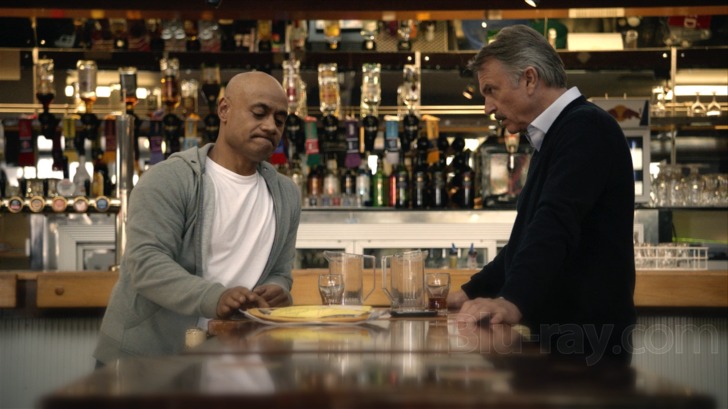
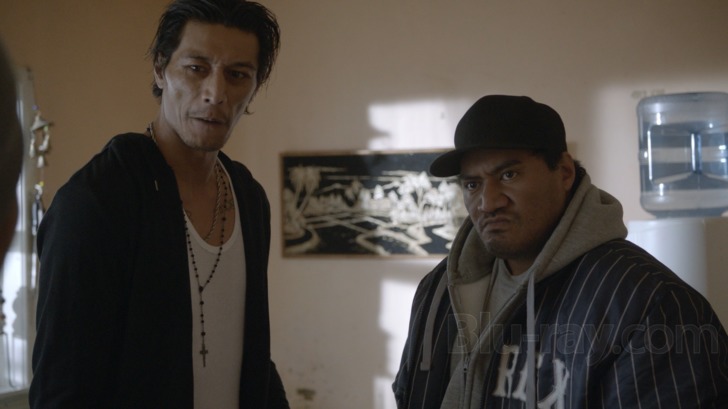
Borrowing a technique from The Wire, the writers of Harry have named each episode with a quotation from the dialogue. Episode 1, "This Is Personal", opens as Det. Sgt. Harry Anglesea (Kightley) returns to Auckland from bereavement leave in his native Samoa. His wife has died under circumstances that are only gradually revealed as the series unfolds and that Harry cannot bring himself to discuss, even in sessions with the police psychologist, Dr. Boucher (Theresa Healey), whom the department requires him to see. Equally serious is the distance between Harry and his teenage daughter, Mele (Hunter Kamuhemu), who cannot fathom why her father left her behind with her grandmother, Grace Anglesea (Ana Tuigamala), Harry's mother, who is concerned for both her son and granddaughter. Mele has eagerly awaited her father's arrival, because she wants nothing more than to return with him to the house in which she grew up. To Mele, that is home, but it no longer is to Harry. He prefers to remain with Mele at his mother's place, sleeping on the couch, where he is routinely awakened by nightmares. Harry's immediate superior, the gruff Det. Sr. Sgt. Jim "Stocks" Stockton (Sam Neill), doesn't care about the details. ("It's a very sad day indeed", he tells Harry, "when my best detective can't even bullshit a shrink.") Stocks's only concern is whether Harry is able to work. His unit has been tracking a rash of violent robberies, all by the same perpetrators. The most recent claimed the life of a bank teller, who was blasted with a sawed-off shotgun, even though he'd already surrendered the cash in his drawer. There are strong indications that the gunman was high on a powerful variety of crystal meth. Shortly after Harry and his team get a solid lead on the shooter and his confederates, they begin hearing rumors of a high-level deal that will flood the streets with millions of dollars worth of the drug, potentially detonating an explosion of violent crime. Over the course of six hour-long episodes (about 46 minutes without commercial breaks), Harry's team attempts to identify the players, track their suppliers and halt their deal before they can import, produce and distribute what turns out to be $20 million worth of crystal meth. As the investigation expands beyond the initial series of robberies, it first leads to a motorcycle gang called the Auckland Vipers headed by a cold-blooded killer named Chocka (Erroll Shand), then to an obscure triad that speaks a dialect intelligible only to natives of a single province in China (and for which there is only one translator in the entire New Zealand police department—who is backlogged), and finally to an import-export operation with offices and ships throughout the world. The police employ all of the familiar tactics in their arsenal: surveillance, snitches, phone taps, pressuring known associates to wear a wire under threat of prosecution, logical deduction and gut instinct. As is so often the case, though, law enforcement is stymied by its adversary's lack of inhibition when it comes to the use of violence as a defense. Still, one of the most intriguing elements in Harry's portrayal of the underworld is how easily extreme and casual violence can backfire on its perpetrators. In one notable series of developments, the criminals' vicious reprisals intended to keep people in line leave them with a critical void in their drug- manufacturing operation that they have to scramble to fill. It's a mistake that is both costly and possibly fatal to the enterprise as a whole (events are moving at such a fast pace that one cannot be sure). Even while the increasing urgency of the situation keeps Harry at work, he feels the nagging pull of his responsibilities as a parent. His mother keeps insisting that he spend more time with Mele, who has become increasingly sullen and withdrawn in reaction to her father's apparent indifference. A suspension from school for fighting does not improve the atmosphere, and Harry quickly reaches the point where he avoids going home, preferring to brood on a bar stool. Refusing to talk about his wife death in therapy sessions, he finds his grief and anger erupting unexpectedly at work. A suspect so vile that he deserves whatever happens to him files charges against Harry for excessive force, and Harry's friend and loyal subordinate, DC Mosese "Moss" Tuitonga (Michael Koloi), has to admit that his boss went beyond what was necessary to make the arrest. The complaint prompts an internal investigation by DI Kevin Gray (Stephen Lovatt), who seems to relish the opportunity to end the career of a cop under the command of "Stocks", against whom he holds a grudge from a former assignment. Like The Wire before it, Harry is effective in showing how law enforcement is just like any other institution; it has its quirks, its bureaucracy, it loyalties and feuds, and above all it depends on the capabilities of ordinary human beings whose personal lives frequently do not allow them to devote one hundred percent of their energy and attention to their jobs without exacting a heavy toll somewhere else.
Harry Blu-ray Movie, Video Quality
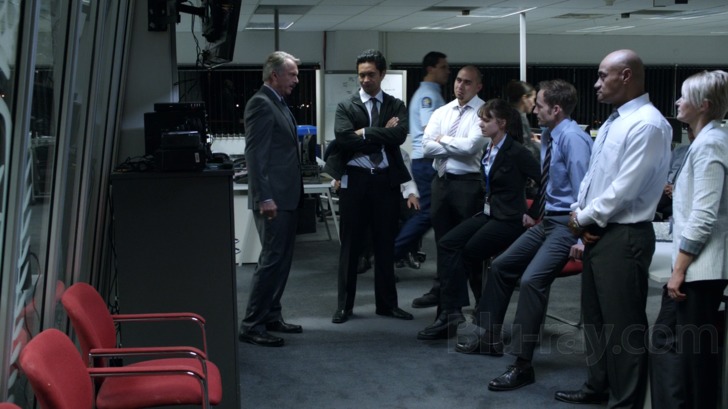
Specific information about the shooting format of Harry was unavailable, but the photography is obviously digital, and post-production was completed digitally. The cinematographer was D.J. Stipsen (What We Do in the Shadows), whose handheld camerawork effectively conveys the you-are-there sense of documentary footage without the excessive wobbling that has come to be known as "shaky cam". Judging from comments made in interviews by supervising director Dudman, much of the series was photographed with available light, which would account for the variation in texture between the sharp clarity of daytime exteriors and well-lit interiors, as compared to outdoors at night and darkened rooms, where the image acquires the slight roughness of a good digital image that doesn't have quite enough light. Detail ranges from good to excellent, and colors have the subdued, under-saturated quality familiar from run-and-gun news photography. (A few flashback and dream sequences have been tinted differently so that they stand out.) Acorn has spread the six episodes of Harry over two BD-50s, allowing them to be mastered at an average bitrate of just over 27 Mbps per episode. Despite the digital origination, the fast cutting, constant motion and sometimes grainy quality of the video makes for a challenging job of compression, and Acorn's presentation has allowed the compressionist ample room to work, assuring a fine encode.
Harry Blu-ray Movie, Audio Quality
Harry's stereo soundtrack has been provided in lossless DTS-HD MA. Consistent with the documentary aesthetic, it's a fairly basic track with a focus that's front-facing and centered, although the mix can be layered and subtle, especially when Harry gets lost in memory or the narrative shifts rapidly among different story lines. The sound effects are realistic, and the dialogue is clear, although the many variations of New Zealand accents will no doubt prove challenging to American ears. Use the English subtitles as needed. The low-key but intense score was provided by Karl Steven, a contributor to the soundtrack of Housebound. An advisory note: I do not know what standard governs broadcast television in New Zealand, but the language of Harry is of the R-rated variety that would not be heard on network or basic cable in the U.S.
Harry Blu-ray Movie, Special Features and Extras
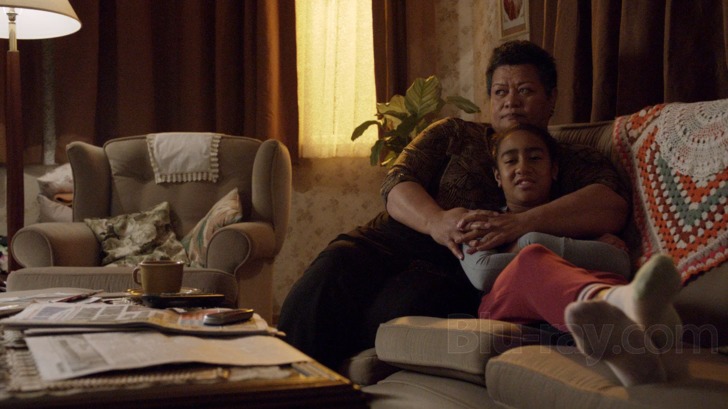
The only extra is a small photo gallery that appears on disc 2. At startup, disc 1 plays trailers for Acorn Media, Jack Irish and Falcón, which can be skipped with the chapter forward button and are not otherwise available once the disc loads.
Harry Blu-ray Movie, Overall Score and Recommendation
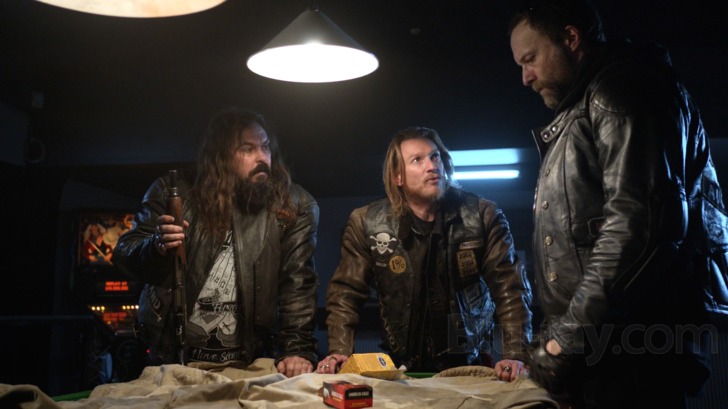
My only criticism of Harry is its uniform bleakness, both in the criminal investigation and in its lead character's personal life. The shows from which its creators drew inspiration, especially The Wire, were often equally bleak in both their outcomes and their prognosis for society's future, but they leavened the dramatic experience with moments of comedy, eccentricity or sheer absurdity. However dark, these provided respite from the dreary parade of broken lives on both sides of the law. Harry could have used something similar. Should the same creative team attempt a followup, they might want to consider spending more time with the members of Harry's squad, many of whom had the potential to become interesting characters in their own right but didn't have individual subplots. Even in its currently astringent form, Harry is a compelling police story with a distinctive setting and a memorable central character. Highly recommended.