Hannah Arendt Blu-ray Movie
HomeHannah Arendt Blu-ray Movie 
Zeitgeist Films | 2012 | 113 min | Not rated | Nov 19, 2013
Price
List price:Listed on Amazon marketplace

Movie rating
7.3 | / 10 |
Blu-ray rating
| Users |  | 0.0 |
| Reviewer |  | 4.0 |
| Overall | | 4.0 |
Overview
Hannah Arendt (2012)
A look at the life of political theorist Hannah Arendt, who reported for The New Yorker on the war crimes trial of the Nazi Adolf Eichmann.
Starring: Barbara Sukowa, Janet McTeer, Axel Milberg, Julia Jentsch, Ulrich NoethenDirector: Margarethe von Trotta
| Biography | 100% |
| Drama | Insignificant |
Specifications
Video
Video codec: MPEG-4 AVC
Video resolution: 1080p
Aspect ratio: 2.39:1
Original aspect ratio: 2.39:1
Audio
German: DTS-HD Master Audio 5.1 (48kHz, 16-bit)
English: LPCM 2.0 (48kHz, 16-bit)
Subtitles
English, English SDH
Discs
25GB Blu-ray Disc
Single disc (1 BD)
Playback
Region A, B (C untested)
Review
Rating summary
| Movie |  | 4.5 |
| Video | | 4.0 |
| Audio | | 4.0 |
| Extras |  | 3.5 |
| Overall | | 4.0 |
Hannah Arendt Blu-ray Movie Review
The Thinker
Reviewed by Michael Reuben November 20, 2013One's ability to enjoy Hannah Arendt may depend on how much one already knows about the remarkable woman who is the subject of the film. Arendt was a German-Jewish political theorist who fled the Nazis in 1933, eventually arriving in the U.S., where she became a citizen in 1950. Her reputation might have remained confined to academic circles, had she not written a widely read—and even more widely denounced—series of articles for The New Yorker on the 1961 trial of Nazi war criminal Adolf Eichmann, a principal architect of the Holocaust. The articles were published in book form under the title Eichmann in Jerusalem: A Report on the Banality of Evil, and her analysis of the dynamics by which seemingly ordinary people engaged in monstrous acts remains influential to this day. Director Margarethe von Trotta (The Lost Honor of Katharina Blum) initially resisted the idea of making a film about Arendt, because she couldn't imagine how to do it. Arendt was a thinker, and thinking is a private, interior activity that is inherently uncinematic. It was only in consultation with her producing partner, Bettina Brokemper (Melancholia), and the American author Pam Katz, who co-wrote the screenplay, that von Trotta began to conceive of Arendt's intellectual life as a battle, both personal and public, to understand both Eichmann and many others whose participation was essential to perpetrating an evil of the magnitude of the Holocaust. Arendt's adversaries included, at various points, her intellectual colleagues, the American Jewish community, even her own adopted family in Israel. They accused her of being proud, stubborn and unfeeling; Arendt responded that she simply wanted to understand evil, rather than just condemn it. In life as in the film, her most receptive audiences were often the students she taught at colleges like Princeton, Berkeley, Northwestern, Yale, the University of Chicago and the New School in Manhattan. Young and as yet uncommitted to a point of view, they were the ones most open to Arendt's efforts to think passionately but objectively. Hannah Arendt premiered at the Toronto Film Festival in September 2012 and was released in Germany the following January. It received a limited release in the U.S. in May 2013 to respectful but not overwhelming reviews. Specialty label Zeitgeist Films is releasing it on Blu-ray.
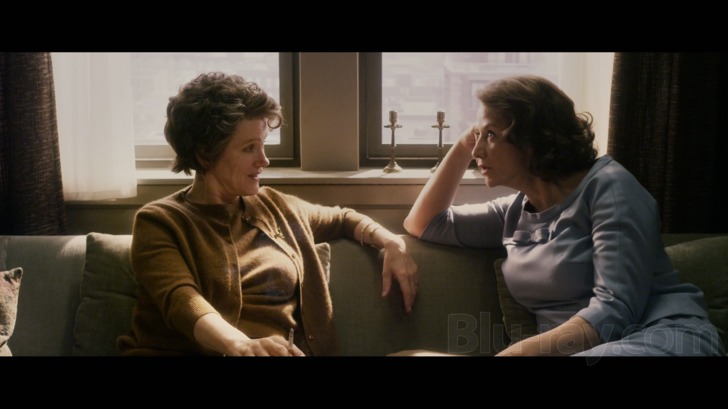
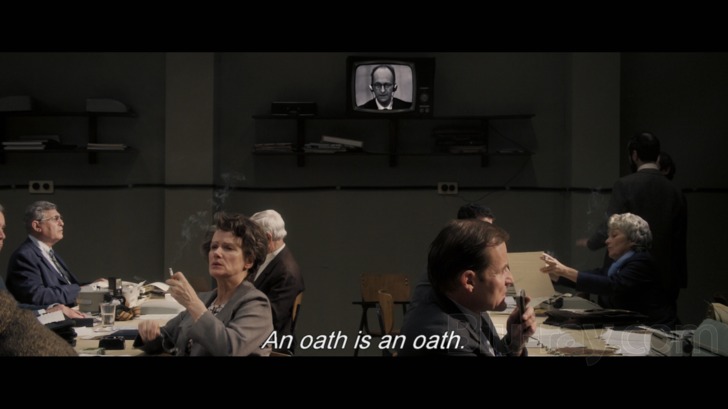
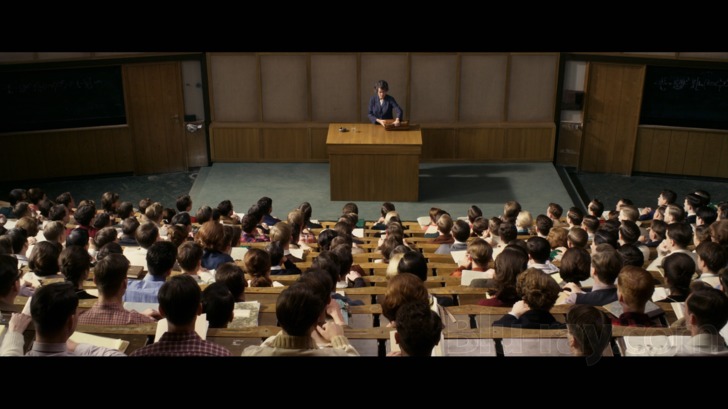
A number of key events from Hannah Arendt's early life are significant and dramatic, but von Trotta relegates them to flashbacks and recollections by the adult Arendt, who is played by the extraordinary Barbara Sukowa, famed for her early collaborations with Rainer Werner Fassbinder in such works as Berlin Alexanderplatz, as well as for her previous work with von Trotta (Rosa Luxembourg). The young Hannah (Friederike Becht) was a prize student of the noted German philosopher, Martin Heidegger (Klaus Pohl), with whom she had a reportedly stormy love affair. But Heidegger later shocked his admirers by joining the Nazi Party, prompting many of his former students to reconsider Heidegger's notion of philosophy as a pursuit disconnected from the world. The film opens in 1960, with the capture of Eichmann in Argentina by agents of the Israeli secret service, the Mossad. In her New York City apartment, Arendt reads the news and discusses its significance with her long-time friend, the novelist Mary McCarthy (Janet McTeer), her loyal assistant, Lotte Köhler (Jenna Jentsch), and her husband, Heinrich Blücher (Axel Milberg). Heinrich, who teaches at Bard College, is troubled by the legalities of kidnapping Eichmann abroad and trying him in a country that didn't even exist at the time of his crimes. Arendt understands the practicalities involved and the need for a public reckoning. When Arendt offers to write about the Eichmann trial, William Shawn (Nicholas Woodeson), editor-in-chief of The New Yorker, is thrilled, but Arendt herself is conflicted. The memory of her time in a French deportation camp called Gurs, from which she narrowly escaped, is still deeply painful. Both she and Heinrich fear that the Eichmann assignment will be more than she can bear. But she cannot resist the opportunity to confront the greatest evil of her age—or the intellectual challenge. In Israel, Arendt is reunited with her surrogate father, Kurt Blumenfeld (Michael Degen), with whom she has an affectionately contentious relationship, and his extended family. Von Trotta wisely does not try to recreate the Eichmann trial but relies primarily on archival footage of the real event. It's especially appropriate, because Arendt, who was a chain smoker, rarely sits in the courtroom, preferring to view the proceedings on TV monitors from the press room, where everyone is typing and puffing away. She does not stay for the whole trial (which lasted four months), but leaves with thousands of pages of transcript, with many more to follow. Even as she is sitting at the trial, Arendt is already fascinated with Eichmann's ordinariness, his dullness, his insistence that he was merely carrying out a routine according to a system. "He's a bureaucrat", she tells Blumenfeld. "Isn't it interesting that a man who did everything a murderous system asked of him, who even seems eager to give precise details of his fine work, that this man insists that he personally has nothing against Jews? [Y]ou can't deny the huge difference between the unspeakable horror of the deeds and the mediocrity of the man." As Arendt sifts through pages of testimony back in New York, she hears fragments of testimony in her memory and ponders what for her becomes the essential riddle not just of Eichmann, but of all the soldiers and SS men who were "just following orders": How does an individual's sense of right and wrong disappear so completely that he or she can go about the daily work of systematically murdering millions of people in response to "instructions"? How does evil become routine, dull, rote? How was genocide industrialized? At The New Yorker, Shawn and his staff are growing impatient, but Arendt will not be rushed. When she finally delivers her manuscript, the editors are impressed but concerned. Among other things, Arendt describes how some Jewish leaders worked with Eichmann's department as liaisons, a fact that emerged in testimony during his trial and was controversial even before Arendt drew attention to it. (An excerpt is included in the film, during which an accusatory spectator is ejected from the court.) This portion of her article was viciously attacked, usually by critics who hadn't read it, as "blaming the victim", and the entire publication was condemned for Arendt's efforts to understand Eichmann in human terms. Arendt's reply, as delivered in the film, is simple: "Trying to understand is not the same as forgiveness." Even in pre-internet 1963, when Arendt published in The New Yorker, a rabid press could elevate a previously obscure intellectual into the latest PR piñata for everyone to attack, and Hannah Arendt depicts the process in detail as writers, friends, fellow academics and even family members turn on Arendt and accuse her of all manner of sins. (Mary McCarthy remains a staunch supporter.) In the film's climax, her New School superiors recommend that she cease teaching, lest students object to her presence, to which Arendt replies that her classes are oversubscribed. Then she delivers a lecture to an overflowing hall that plays like a courtroom summation, defending not only her conclusions but the very project of thinking, with an impassioned eloquence. "Everyone is trying to prove me wrong", she later tells her husband. "But no one noticed my one real mistake"—and immediately she begins challenging her own conclusions about evil, probing for a better understanding. She never stopped.
Hannah Arendt Blu-ray Movie, Video Quality
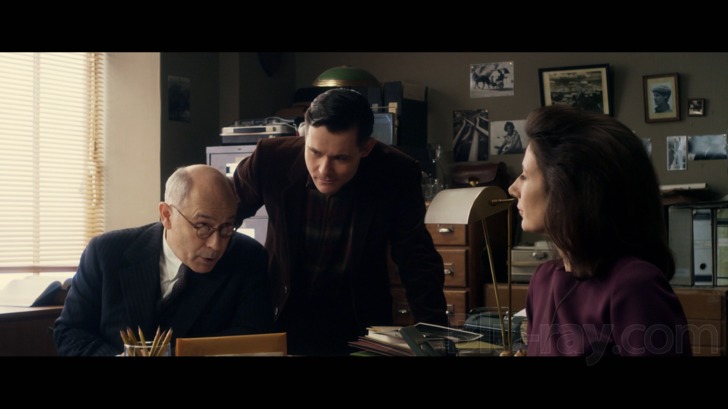
Hannah Arendt was shot on Red by French cinematographer Caroline Champetier (most recently, Leos Carax' Holy Motors). Zeitgeist's 1080p, AVC- encoded Blu-ray, which was presumably sourced from digital files, shows the usual virtues of digital capture, with some minor issues that I'll address below. The image is generally sharp, clear and detailed, with solid blacks (essential for the black-and-white archival footage) and a subdued color palette for the U.S. scenes that complements the academic lifestyle of Hannah Arendt and her husband. In the non-courtroom scenes in Israel, the colors are brighter and a golden glow suggests the sunnier climate and also, perhaps, the warmer family life from which Arendt has chosen to distance herself. The major criticism of the image is minor but recurring aliasing on horizontal edges. These issues may be source-based, especially if the original capture and/or the digital grading was performed at only 2K resolution, which doesn't offer quite enough resolution to avoid such problems unless care is taken in the set design and lighting. Since I did not see Hannah Arendt theatrically, I cannot say whether or not these artifacts are inherent to the source. The average bitrate of 17.76 Mbps is on the low side, but Red footage compresses well, and this is not a film with significant motion, because it is largely about people talking to each other. Except for the aliasing issues noted above, no artifacts were observed.
Hannah Arendt Blu-ray Movie, Audio Quality
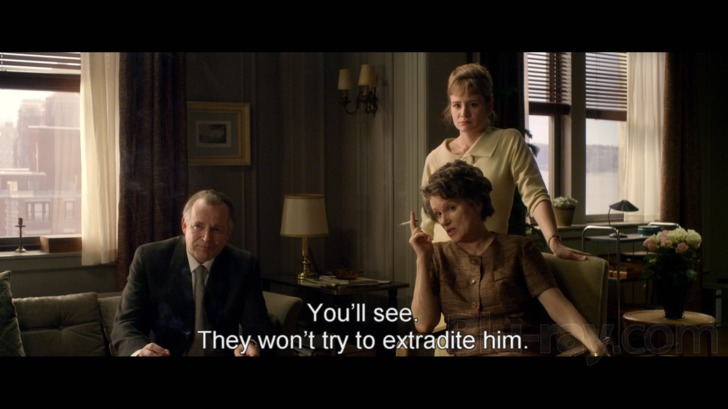
Hannah Arendt's original soundtrack is primarily in German, with a significant portion in English. The original 5.1 mix is presented in lossless DTS-HD MA, with optional English subtitles. An English-dubbed PCM 2.0 mix is also available. The film's soundtrack is functional but effective. Dialogue is the key element, and it remains clear and intelligible in English, even allowing for the heavy accent that actress Barbara Sukowa adopts for Arendt's English speech. To my ear (which is admittedly out of practice), the German dialogue was also perfectly clear. Sound effects in the front and rear channels are generally functional and appropriate to the specific environments. The exception is when Arendt recalls overlapping fragments of trial testimony, which tend to come from the front left and right, with faint echoes into the surrounds. The score by Luxembourger cellist André Mergenthaler provides a restrained and elegant counterpoint to the film's cerebral protagonist, while also underlining the deep sorrow evoked by the subjects she is discussing.
Hannah Arendt Blu-ray Movie, Special Features and Extras
- Making Of (1080p; 2.35:1; 30:21): This is an informative documentary on the genesis and production of the film, featuring extensive interviews with von Trotta, Brokemper and Katz (who is the only one interviewed in English). Unfortunately, Sukowa does not participate.
- Deleted Scenes (1080p; 2.35:1; 5:49): These scenes involve a subplot in which Arendt is injured in a traffic accident.
- U.S. Theatrical Trailer (1080p; 2.35:1; 2:06).
- Booklet: The Blu-ray is accompanied by an informative insert featuring credits; an essay on the film by its director; a biography of Arendt by Roger Berkowitz, director of the Hannah Arendt Center at Bard College; brief biographical sketches of the key characters; and a valuable set of parallel timelines for the lives of both Arendt and Eichmann.
Hannah Arendt Blu-ray Movie, Overall Score and Recommendation
Hannah Arendt wasn't the only social figure to be inspired by the Eichmann trial to investigate the capacity of modern individuals to commit horrific acts at the direction of authority. The famous "Milgram experiments" conducted by Yale University psychologist Stanley Milgram in 1961 were also inspired by Eichmann's testimony and (you'll pardon the expression) shocked the world with the willingness of test subjects to deliver dangerous and potentially life-threatening jolts of electricity to other participants (who were acting), when instructed by supervisory medical personnel that they were required to do so. (In reality, no electric shocks were given, but the test subjects heard recorded cries of pain from the next room—and many of them still continued to "follow orders".) Milgram pursued a typically American, experimental approach to the issue, while Arendt's was that of a classical German philosopher, but both provided valuable insights that remain influential. To the extent that Hannah Arendt provokes thought on the subject, or even sends its viewers back to the original work, it will have achieved a more productive result than most popular entertainment on the subject of good and evil. Highly recommended.
Similar titles
Similar titles you might also like
(Still not reliable for this title)

Things to Come
L'avenir
2016

Taxi
2015

Jimmy's Hall
2014

The Last of the Unjust
Le dernier des injustes
2013

Never Look Away
Werk ohne Autor
2018

Le Petit Soldat
The Little Soldier
1963

Genius
2016

On the Basis of Sex
2018

Mr. Jones
2019

The Grandmaster
一代宗師 / Yi dai zong shi
2013

The Insult
L'insulte
2017

Out 1
Out 1, noli me tangere
1971

Confucius
孔子 / Kong zi
2010

Sarah's Key
Elle s'appelait Sarah
2010

A Separation
Jodaeiye Nader az Simin
2011

The Club
El Club
2015

The Debt
2010

Persepolis
2007

Transit
2018

Welcome to New York
2014