Handel: Acis and Galatea Blu-ray Movie
HomeHandel: Acis and Galatea Blu-ray Movie 
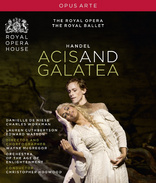
Featuring De Niese/ Workman/ AgnewOpus Arte | 2010 | 110 min | Rated G | Apr 27, 2010

Movie rating
Movie has not been rated yetBlu-ray rating
| Users |  | 0.0 |
| Reviewer |  | 3.5 |
| Overall | | 3.5 |
Overview
Handel: Acis and Galatea (2010)
Christopher Hogwood conducts the Orchestra of the Age of Enlightenment in Wayne McGregor's new production of Handel's opera. The cast includes Danielle de Niese and Charles Workman, and The Royal Opera and The Royal Ballet appear in a rare and beautifully crafted collaboration.
| Music | 100% |
Specifications
Video
Video codec: MPEG-4 AVC
Video resolution: 1080i
Aspect ratio: 1.78:1
Original aspect ratio: 1.78:1
Audio
English: DTS-HD Master Audio 5.0
English: LPCM 2.0
Subtitles
English, French, Spanish, German
Discs
25GB Blu-ray Disc
Single disc (1 BD)
Playback
Region A (B, C untested)
Review
Rating summary
| Movie | | 3.5 |
| Video |  | 4.5 |
| Audio |  | 5.0 |
| Extras |  | 2.0 |
| Overall | | 3.5 |
Handel: Acis and Galatea Blu-ray Movie Review
When is an opera not an opera? When is a water feature not a water feature? These and other questions may pique your interest in 'Acis and Galatea'.
Reviewed by Jeffrey Kauffman May 6, 2010In his excellent insert booklet liner notes for this production of Handel’s Acis and Galatea, Cambridge’s Andrew V. Jones wisely asks, “What’s in a name?” For Acis and Galatea was never really thought of as a traditional opera in Handel’s own time. Variously labeled a masque, serenata, or (incorrectly) an oratorio, the piece, according to Grove, really should be thought of a strange hybrid very popular in the early 18th century, the “pastoral opera.” This response to the often overblown if giddy charms of Italian opera usually placed fairly static characters down in a sylvan setting and let the scenic design transport audiences to a world of mythic nymphs, satyrs and other furry creatures. Jones makes the case that Acis and Galatea is more correctly thought of as a serenata, a piece written for a special occasion and presented outside at night, as indeed this piece originally was. Handel himself evidently preferred the serenata appellation, though his publisher printed various versions alternately calling it an opera, a serenade and a masque. This debate over what to call a piece really shouldn’t be a major issue when you get right down to it, except that it is a window into problems this whatever-it-is presents should someone choose to stage it. There’s not a traditional libretto indicating staging directions, and even usually basic questions like “what role does the chorus play” present intriguing quandaries to anyone approaching Acis and Galatea as a more or less traditional opera. There’s also the lack of bridging recitatives that must be addressed, as the emotional tone abruptly changes from dour mourning to rejoicing at the drop of a key change. Director/choreographer Wayne McGregor seeks to skirt some of these issues by melding dance with the sung moments, much as he did with his version of Purcell’s Dido and Aeneas, which in fact shared a double bill with this Acis and Galatea at a combined performance by the Royal Opera and Royal Ballet in March, 2009, subsequently filmed for home video release.
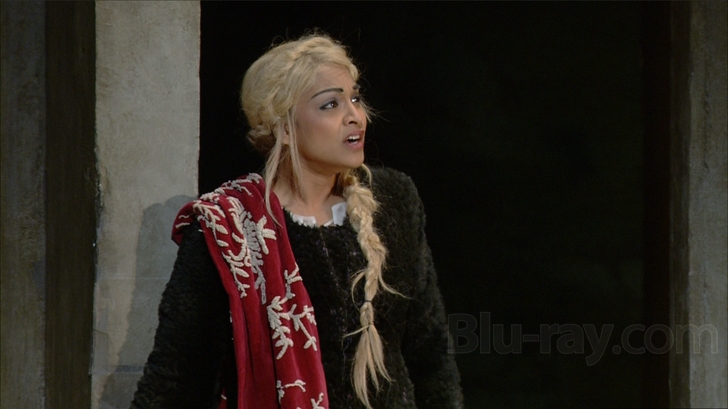
Danielle de Niese
Perhaps the most overriding problem with any version of Acis and Galatea, whether or not it’s fully staged or whatever its presenters may choose to call it, is the rather flimsy plot upon which Handel hangs some of his most scintillating music. There’s simply not much “there” there to begin with: Galatea (Danielle de Niese) is a sea-nymph who falls in love with Acis (Charles Workman). Happily ever after is put on hold by the evil giant Polyphemus (Matthew Rose), a personification of Mount Aetna, who “erupts” and crushes Acis. We’re appropriately sad for a moment until Galatea is reminded of her semi-Divine status, which allows her to transform Acis into perhaps the loveliest water feature even seen on an operatic stage. (It's thought that in the original production, a real fountain was used to illustrate Acis' transformation; here it's hinted at with a quick rear projection and lots of watery moves by blue-lit dancers). Obviously this doesn’t scream hyperbole and histrionics (with the possible exception of Polyphemus, who is in fact almost a humorous character here), those twin staples of most operatic libretti. The complete stasis of the dramatic content here, albeit stasis at least somewhat ameliorated by one of Handel’s most effortlessly tuneful scores, can never be completely overcome, despite McGregor’s either valiant or misguided (depending on your point of view) attempts to distract the viewer with an onstage battery of dancers supposedly revealing the deepest emotions of the characters.
What we’re left with is two parallel universes which never quite meet, despite a final resolution which sees de Niese briefly dancing with the balletic Acis (Edward Watson). Anyone who’s attended a more contemporary musical comedy which has dance interludes interpolated inartfully knows the disjunctive result of suddenly being pulled out of something even as patently unreal as the typical book of a musical. That same situation is perhaps magnified here in this Acis and Galatea as the dancers share the stage with the singers from the first moment. It’s as if we’re seeing two simultaneous interpretations of the same source material, instead of one cohesive unit elucidating two different aspects.
What can’t be denied here is the marvelous athleticism of the dancers, including the aforementioned Watson and the lovely Lauren Cuthbertson as our terpsichorean Galatea. This is unusually gymnastic dancing at times and in and of itself is almost always a delight to watch, even if it’s never well integrated into the dramatic flow of the piece as a whole. Despite some patently silly costumes for both the dancers (asexual body stockings) and the singers (especially de Niese, who looks like she wandered in from a bus and truck version of Wyss’ Heidi), and a minimalist production design which doesn’t exactly help achieve the mythic status of these characters, there’s an appealing juxtaposition between the semi-contemporary outfits of the singers and the more timeless look of the dancers, something that helps with the very elucidation of the two elements which the singing and dancing themselves never completely achieve.
The music itself, divorced from the dramatic presentation, is simply wonderful, well sung by de Niese, Workman and Rose. It’s also exceptionally well played by the always superb Christopher Hogwood and his period instrument Orchestra of the Age of Enlightenment. This was Handel’s first dramatic piece in his adopted language of English, but his settings here are inerrantly musical and often incredibly lilting, if sometimes rather angular, full of large intervallic leaps that tax all but the most technically assured singers.
It’s somewhat ironic that Acis and Galatea was Handel’s most popular work in his lifetime. The intervening centuries have not always been kind to the “whatever-it-is,” perhaps because of that very uncertainty about what exactly is being dealt with, and how exactly to stage (or not stage) it. I’m not entirely sure McGregor’s choices with this production are coherent and cohesive, but they at least allow Acis and Galatea to be seen and enjoyed by a new generation of audiences. The music itself is wonderfully inventive and certainly deserves to be in the top tier of Handel’s rather incredible output. Perhaps for that reason alone you should consider checking out this version.
Handel: Acis and Galatea Blu-ray Movie, Video Quality
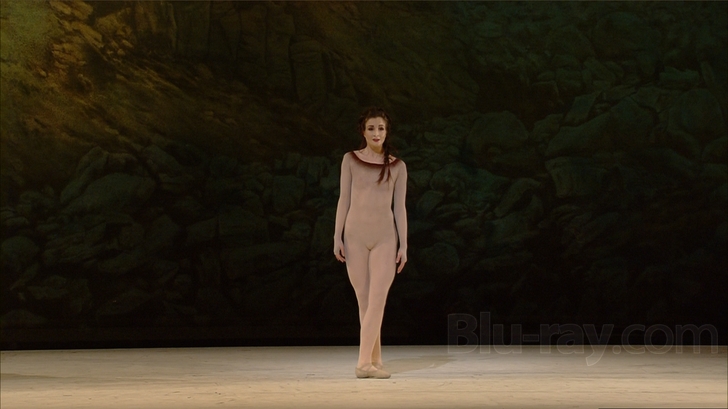
Opus Arte continues its winning ways with Blu-ray opera (and ballet) releases with this practically perfect AVC encoded 1080i live recording offered in a 1.78:1 aspect ratio. The first act plays out largely in neutral tones like ecru and beige, with a hint of brown thrown in. That's alleviated somewhat by the beautifully painted backdrops, which glow in this Blu-ray presentation with a suitably rich and saturated palette of greens, reds, and purples. The second act gives way to a bluer color scheme, especially in the watery finale. Through it all we're given excellent fine detail and lifelike, if sometimes strangely lit, flesh tones. Contrast and black levels are both consistent and excellent. About the only issue keeping this from a full five stars is with Acis' green sweater, which in mid-range shots simply doesn't quite resolve properly, leading to just the hint of shimmer. In close-ups and even far shots, it's just fine, but the mid-range shots show this artifacting quite clearly. Other than that minor issue, this is a winning presentation with a top notch image quality.
Handel: Acis and Galatea Blu-ray Movie, Audio Quality
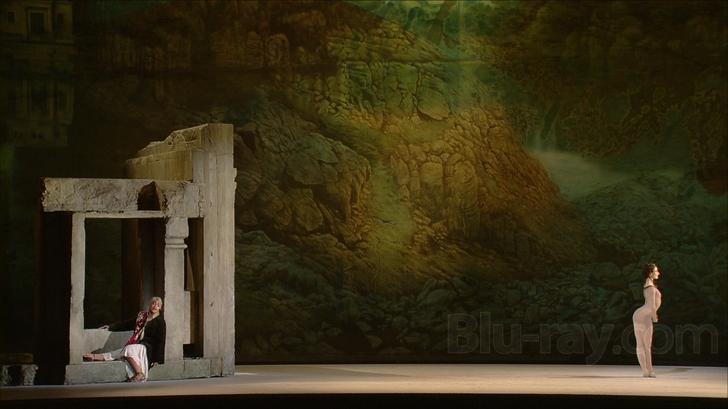
When it comes to accurate period music instrument performances, you simply can't do better than Christopher Hogwood and the Orchestra of the Age of Enlightenment. Luckily, both the lossless offerings on this Blu-ray reproduce this interpretation of one of Handel's crowning achievements with brilliant fidelity. Both the DTS-HD MA 5.0 and LPCM 2.0 offerings are clear as a bell, with excellent register reproduction and a really surprising amount of dynamic range. As early as the Prelude, Hogwood whips up the forces to some surprisingly robust crescendi, at least in the relatively reserved world (some of it borne of technical limitations) of period instrumentation. While the 5.0 offers spaciousness galore and a fair degree of surround activity with regard to the "pit band," it's gorgeous antiphonal choral moments like "These Wretched Souls" where the surround experience really kicks in and immerses the listener in the glories of Handel's effortless contrapuntal genius. Balance between singers, ensemble and orchestra is top notch. This is a wonderful recording of some really stellar Handel music.
Handel: Acis and Galatea Blu-ray Movie, Special Features and Extras
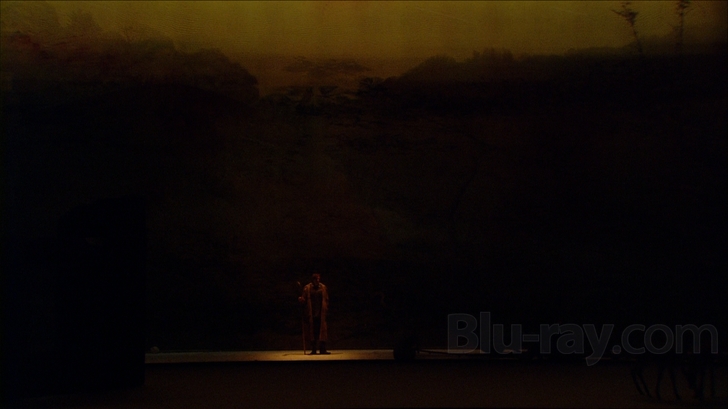
Opus Arte comes through with its "usual suspects," though perhaps a bit on the light side. The insert booklet essay by Jones is quite excellent. The disc itself contains the expected cast gallery and illustrated synopsis, as well as a pretty slight making of featurette (running only 9:35) called Staging Acis and Galatea.
Handel: Acis and Galatea Blu-ray Movie, Overall Score and Recommendation
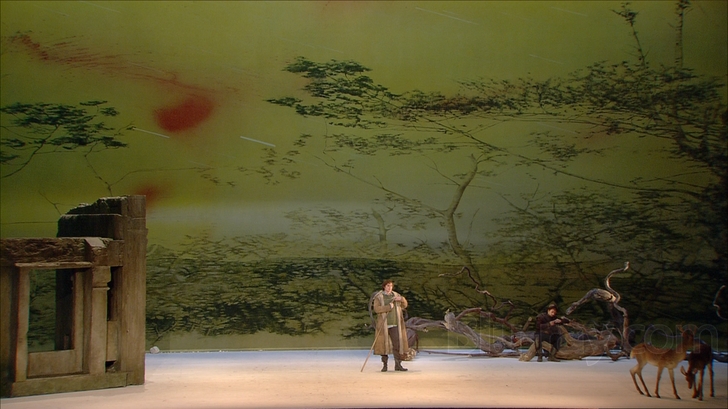
This may not be a completely successful solution to the manifold problems of this "whatever-it-is." Nonetheless, we're presented with a beautifully sung and played performance of some of Handel's loveliest music, so some of the idiosyncratic staging decisions can probably be tolerated. Acis and Galatea may not be an opera, and it certainly isn't a ballet despite McGregor's perhaps misguided attempts to inject dance into the drama, but it most certainly is a prime example of Handel's glorious way with setting a text. For that reason alone, this is a recommended Blu-ray.