Hamnet Blu-ray Movie
HomeHamnet Blu-ray Movie 
Collector's Edition / Blu-ray + Digital CopyUniversal Studios | 2025 | 125 min | Rated PG-13 | Mar 03, 2026


Movie rating
7.7 | / 10 |
Blu-ray rating
| Users |  | 0.0 |
| Reviewer |  | 5.0 |
| Overall | | 5.0 |
Overview
Hamnet (2025)
The story of Agnes - the wife of William Shakespeare - as she struggles to come to terms with the loss of her only son, Hamnet. A human and heart-stopping story as the backdrop to the creation of Shakespeare's most famous play, Hamlet.
Starring: Jessie Buckley, Paul Mescal, Emily Watson, Joe Alwyn, Faith DelaneyDirector: Chloé Zhao
| Biography | Uncertain |
| History | Uncertain |
| Period | Uncertain |
| Drama | Uncertain |
Specifications
Video
Video codec: MPEG-4 AVC
Video resolution: 1080p
Aspect ratio: 1.78:1
Original aspect ratio: 1.78:1
Audio
English: Dolby Atmos
English: Dolby TrueHD 7.1 (48kHz, 24-bit)
Spanish: Dolby Digital 5.1
French: Dolby Digital 5.1
Subtitles
English SDH, French, Spanish
Discs
Blu-ray Disc
Single disc (1 BD)
Digital copy
Packaging
Slipcover in original pressing
Playback
Region A (B, C untested)
Review
Rating summary
| Movie | | 5.0 |
| Video | | 5.0 |
| Audio | | 5.0 |
| Extras |  | 3.0 |
| Overall | | 5.0 |
Hamnet Blu-ray Movie Review
Reviewed by Justin Dekker March 10, 2026From two-time Academy Award winner Chloé Zhao ('Nomadland') comes 'Hamnet', which makes its Blu-ray debut courtesy of Universal. Based on
the New York Times bestselling novel from Maggie O'Farrell, the film shares the story of the events behind the creation of the play Hamlet,
one of William Shakespeare's most famous works. The emotionally intense and lavishly produced film stars Jessie Buckley (Agnes, 'Wild Rose', The
Bride'), Paul Mescal (William, 'Aftersun', 'Gladiator II'), and Emily Watson (Mary, 'Gosford Park', 'Breaking the Waves'). Featuring excellent technical
merits, the disc also includes a modest amount of on-disc supplemental material including some "making-of" segments and a director's commentary.
A slipcover, and a Digital Code redeemable via Movies Anywhere are also included.
Working as a Latin tutor, a young William Shakespeare meets Agnes, a woman with whom he is immediately taken. Despite parental objections, the
pair begin a life together, with Will struggling to write as their family expands. Eventually, to advance his career, Will moves to London, leaving his
family behind. The ensuing triumphs and tragedies would come to shape his most famous work, Hamlet.
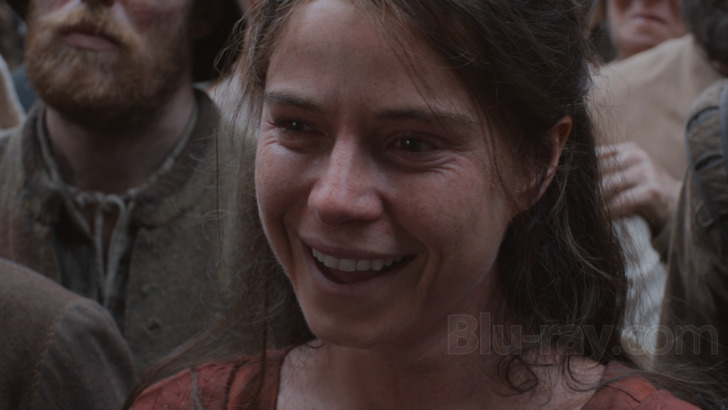
For all of Shakespeare's clever turns of phrase that have insinuated themselves into our everyday speech, sometimes without people even knowing their origins, and the riotous and bawdy comedy that inhabits his plays, many of Hamnet's most powerful and impactful scenes occur in relative or absolute silence. Confusion abounds in the opening moments of the film as an ethereal score seeps out of the speakers and deposits the viewer in the green world, tracing the gnarled trunk of a tree down to an unnamed woman, clad in a deep red dress, and lying in the fetal position as her body curls perfectly into the arc defined by one of the tree's massive exposed roots. Even with her dirty skin, she is beautiful. Who is she? Wordlessly, she opens her eyes, looking lazily about, before she wanders in search of her hawk. When she finally speaks, her voice is low, measured, earthy, and sultry.
The action cuts to a man in a darkened building. He's pacing in an agitated fashion as young voices blandly recite a Latin lesson. When, through the window, he spies the young woman walking toward the structure, her bird on her gloved arm, and his eyes show the attraction he feels. He offers his students a brusque "Repeat!", before stalking out of the building to find the woman he finds so beguiling.
With only the slightest handful of words in the film's first four minutes, already so much has been revealed about these characters as a result of Chloé Zhao's careful direction and her demonstrated tendency to have her actors reveal things to their audience with rich performances in scenes that flow organically rather than merely telling them things. The woman, while clearly civilized, is more a creature of nature and the green world than she is of society. She feels safe there, absent the need of any artificial structure to protect her or shield her from her surroundings. Her relationship with her hawk demonstrates that she has skills and knowledge of the natural world that most do not possess or understand. Dressing her in a deep and rich almost blood red optically positions her as the emotional heart of the film. Next to the massive tree in whose roots she rests, she is small, almost insignificant, but in her crimson dress, she is unmissable. Regarding the man, he is very much of society. He's smartly dressed with an earring and grey bishop's collared vest over a charcoal shirt. His skin is flawlessly clean, a small cut on his forehead notwithstanding. His beard, while not robust, is neatly trimmed, and he's obviously well-educated. In the darkened building he is constrained; restricted. He looks overly large for the building's small rooms. Wearing grey, he's not fully emotionally awake yet. These two (Agnes and Will, we later learn) could not be more different, yet they are most assuredly drawn to each other.
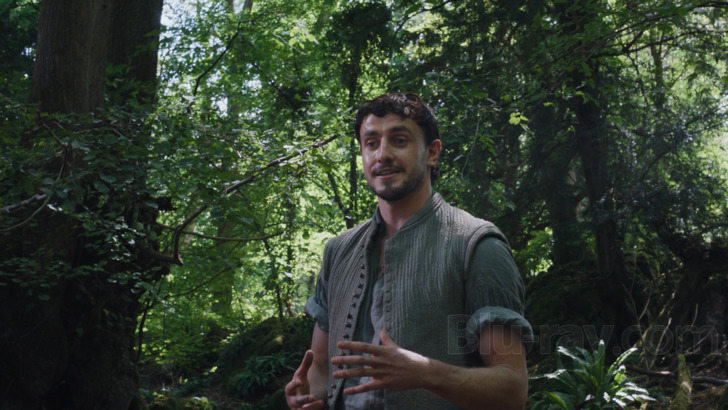
Despite the scale of the world, the film is defined by small spaces that concentrate the emotional and psychological energy in its scenes. For Agnes, this translates mostly to the green world, while for Will, it's London. While Agnes has the whole of the countryside that surrounds her family home at her disposal, she never strays far form familiar haunts nearby. Even in the clearing when William awakens emotionally and professes his love for Agnes, the space is neatly and somewhat claustrophobically defined by trees and bushes, forcing Will to walk through a compost heap as he somewhat nervously paces about. In London, Will, for his part, is mostly confined to a small attic flat that he calls home when he's not on or backstage at The Globe. While not quite a full-scale replica of the structure where Shakespeare worked (the set is three-fourths the size), the structure, though large, still feels cramped, with a small stage, tiny wings, and a cluttered backstage. What little else we see of London is either unwelcoming (the banks of the Thames), or frighting (as the victims of the pestilence are dealt with). The exclusive use of dark woods in the buildings only serve to shrink the world further. That sense of endlessly confined spaces and the resultant emotional oppression and psychological pressure created by it is also found in the country home the pair and their family inhabit for much of the film. Heavy wooden beams define walls and doors. Their weight brings the already low ceilings down even further into the room. Emotions are compressed, never much allowed to escape, with every setting, indoors or out, increasingly functioning like a pressure cooker.
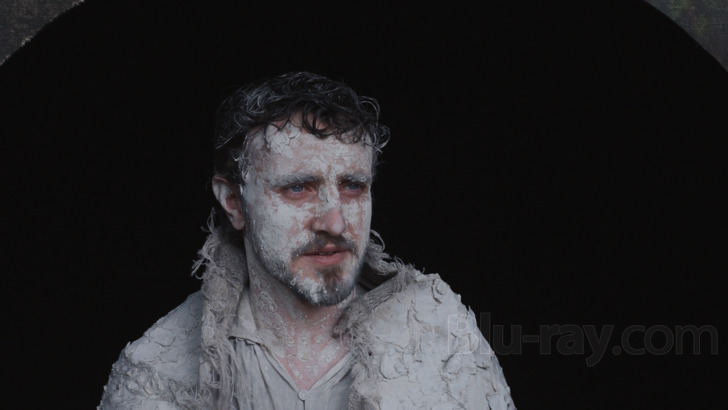
Even when Agnes makes her way to London to see Hamlet on stage, the film's audience is not given much of an opportunity to appreciate the scale and spectacle of the thriving metropolis. Instead, Agnes and her brother hurry into The Globe Theatre, eventually pressed tightly to the front of the stage by the throng of lower-class ticket buyers, and walled-in by the layers of high and dark balconies inhabited by the those of better means. Even here, when Shakespeare is playing the ghost of Hamlet's father, the space seems to confine and constrain him though at this point he is at his most vulnerable and emotionally honest. The cracking nature of his makeup adds visual proof that his hardened exterior is fractured and his true self and feelings are finally emerging. The theater's structure serves as funnel, concentrating his powerful and long-simmering emotions and directing them down on Agnes who stands essentially front and center. For a relationship that has floundered, where the actions of both have caused emotional wounds to grow and fester, it's the ghost's speech (albeit carefully edited) from Act I Scene V that finally allows Shakespeare to grieve the loss of his son, and for his Agnes to understand the scope and nature of the impact the boy's death had on him. By the end, Agnes, too, has a moment of catharsis that enables her to process her emotions over the loss of her son, reaching out for the actor as he plays young Hamlet's tragic death, and, by extension, reaching out for Will.
Hamnet Blu-ray Movie, Video Quality
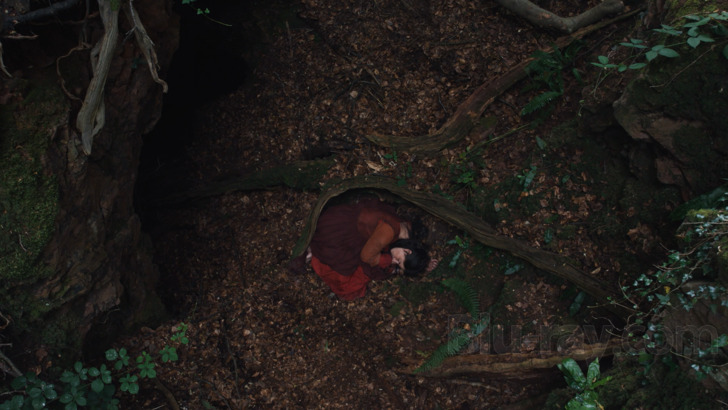
Hamnet's MPEG-4 AVC-encoded 1080p presentation is quite enjoyable. Skin tones are universally healthy across the board, whether they be paler such as Shakespeare's and the students he tutors or the more sun-kissed like Agnes'. Robust and vibrant colors are in short supply by modern film standards, but the varying green hues of the forest and Agnes' garden offer considerable visual interest, as does her well-saturated red dress. Fine detail levels are high, with every pore and freckle visible on Agnes' face, every whisker in Shakespeare's, and every flyaway hair in the hairstyles of the young girls. Environmental details are also open for inspection, such as the weather-worn and mossy shingles on the Shakespeare family's home, the leaves on the forest floor, and the rocks and pebbles that litter the banks of the Thames. Interior spaces allow viewers to appreciate woodgrain in tables, doors, and door frames, cracks and imperfections in the walls, and the few decorations that adorn the rooms. Age and wear are likewise discernable in the tools Agnes uses to grind the items she picks for her medicines, the tools in the glove shop, and the backstage spaces at The Globe. Blacks can be impressively deep, and image depth is pleasing. It's a lovely transfer.
Hamnet Blu-ray Movie, Audio Quality
The Dolby Atmos track that accompanies Hamnet is largely an exercise in understatement. Much of what it needs to handle is dialogue, which it does very well. Dialogue is typically front and center focused, and is clean and free from defect. It's properly prioritized and sit neatly atop the score and sound effects. Directionality is accurate and precise with objects and actors moving fluidly through the stage. Sound effects such as footsteps on gravel, galloping horses, the buzz of bees, and rainstorms present with solid realism, supported by a healthy bass presence. The film's score is handled extremely well, with the delicate instrumentation being precise and allowed to gradually spread through surrounds to envelop the viewer. It is often haunting and otherworldly. Surrounds are also leveraged as Shakespeare wanders through dirty London streets and alleyways, during rainstorms, and in the crowded Globe near the film's end. Probably one of the most sonically memorable scenes occurs when Agnes labors valiantly to aid a family member who has fallen ill, as music pulses through the sound stage, and hushed, intense voices swirl to demonstrate the business and panic of those in attendance. Impressively, the track eschews bombast and the sensational. Such things would be horribly out of place in the film. Instead, the track demonstrates considerable restraint, with no element, either sound effect or music, being allowed to dominate for long. Instead, the track and the film seem to revel either in the quiet or the soft persistence of sounds and the underscore. This allows the focus to remain with the actors, their words, and their actions, with track adeptly serving to gently and continuously amplify the mood and the slowly building tension. It's an emotionally powerful companion for the film.
Hamnet Blu-ray Movie, Special Features and Extras
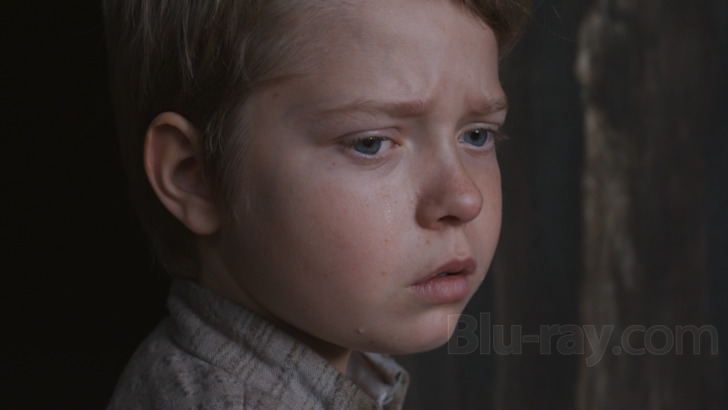
Hamnet comes equipped with a modest assortment of on-disc extras as below.
- Family is Forever (7.27) - Buckley, Mescal, and Zhao discussing the casting process, the film, and their working relationship. Emily Watson discusses her history with Shakespeare, and David Wilmont turns up as well before comments are shared on the child actors and Joe Alwyn.
- Cultivating Creativity (4.35) - Author/co-screenwriter/co-producer Maggie O'Farrell and Director Chloé Zhao talk about crafting the screenplay and the film. Buckley, Mescal, and others share their overwhelmingly positive impression of working with Zhao and the environment she created.
- Recreating the Tudor Period (10.10) - Chloé Zhao, Paul Mescal, Jessie Buckley, and others cover a variety of topics about the creation of the Globe Theatre, which was constructed at approximately three-quarters of the size of the real structure. Costuming is also addressed, with their unusual fabric choices, and their symbolic colors. Cinematography holds the focus for a time, before moving on to the film's sets.
- Director's Commentary with Chloé Zhao - Co-Screenwriter/Director/Co-Editor Chloé Zhao begins by discussing the music used to open the film, before moving on to the commenting on the forest location and Jessie Buckley working with the hawk. As the track progresses, Zhang's comments run the gamut between broad concepts and philosophies and pinpoint specifics and details, demonstrating and sharing a massive amount of information regarding the film and the filmmaking process. She also shares in several stories of allowing actors ample time to explore their characters and discover where they are in a given scene rather than allowing thing to be defined by rigid notions of predetermined character arc. She also shares differences between the book and what appears on screen. Its a very fluid and conversational commentary, and she is occasionally quiet, but usually only briefly, until the next thing that triggers a comment comes along. It's a great listen.
Hamnet Blu-ray Movie, Overall Score and Recommendation
Running counter to expectations, the film, for the most part, keeps its focus on Agnes and the children, letting Shakespeare flit in and out of their lives until the final act. As such, the film's success mostly depends on the performance of Jessie Buckley, and it's a weight she carries easily. Her earthy Agnes keeps every emotion just under the surface of her skin, allowing joy, fear, love, contentedness, anger, and grief erupt in manner both raw and believable at a moment's notice. But for all of the (brief) sound and fury that can occasionally inhabit the performances of her and the rest of the cast, it's the quieter moments that drive the film's emotional core. Every time Will returns to London, every time Agnes feels abandoned, every instance where she is forced to deal with something difficult on her own, it adds bucket after bucket of water behind an already distressed dam, until it ultimately bursts under the accumulated weight of everything that has transpired during the film. Elegantly and patiently shot, the film has the most emotionally powerful climax I've seen in quite some time. This is a film that belongs in the collection of every serious film fan. Chloé Zhao's Hamnet receives my highest recommendation.
