Hammer Horror Classics, Volume One Blu-ray Movie
HomeHammer Horror Classics, Volume One Blu-ray Movie 
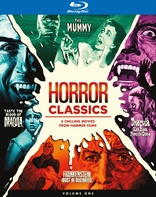
The Mummy / Dracula Has Risen from the Grave / Taste the Blood of Dracula - 95 Minute Uncut Version / Frankenstein Must Be Destroyed!Warner Bros. | 1959-1970 | 4 Movies | 376 min | Oct 06, 2015

Movie rating
Movie has not been rated yetBlu-ray rating
| Users |  | 0.0 |
| Reviewer |  | 3.5 |
| Overall | | 3.5 |
Overview
Hammer Horror Classics, Volume One (1959-1970)
See individual titles for their synopses.
| Horror | 100% |
| Thriller | Insignificant |
| Sci-Fi | Insignificant |
| Drama | Insignificant |
| Fantasy | Insignificant |
| Romance | Insignificant |
Specifications
Video
Video codec: MPEG-4 AVC
Video resolution: 1080p
Aspect ratio: 1.66:1, 1.78:1
Original aspect ratio: 1.66:1
Audio
See individual releases
Subtitles
None
Discs
25GB Blu-ray Disc
Four-disc set (4 BDs)
Playback
Region free
Review
Rating summary
| Movie |  | 3.0 |
| Video |  | 4.0 |
| Audio | | 3.5 |
| Extras |  | 0.5 |
| Overall | | 3.5 |
Hammer Horror Classics, Volume One Blu-ray Movie Review
Horror Begins
Reviewed by Michael Reuben October 12, 2015Beginning in 1955 with The Quatermass Xperiment, the British studio known as Hammer Films created a style of horror that remains influential to this day. An inspiration to creative forces as diverse as Tim Burton, Tobe Hooper and Sherlock co-creator Mark Gatiss, Hammer horror played a major role in the careers of actors Christopher Lee and Peter Cushing, providing both stars with iconic roles and expanding their audiences. As Dracula and Baron Victor Frankenstein, respectively, Lee and Cushing anchored popular and long-running franchises. Warner Brothers was one of several American distributors for Hammer Films, and the studio has now begun to restore some of the Hammer classics in its library. The first four have been issued in a single volume that contains exemplars from Hammer's three major horror franchises. Each title is also available individually.
For discussion of The Mummy, please The Mummy Blu-ray review. For discussion of Dracula Has Risen from the Grave, please see Dracula Has Risen from the Grave Blu-ray review. For discussion of Taste the Blood of Dracula, please see Taste the Blood of Dracula Blu-ray review. For discussion of Frankenstein Must Be Destroyed, please see Frankenstein Must Be Destroyed Blu-ray review.
Hammer Horror Classics, Volume One Blu-ray Movie, Video Quality
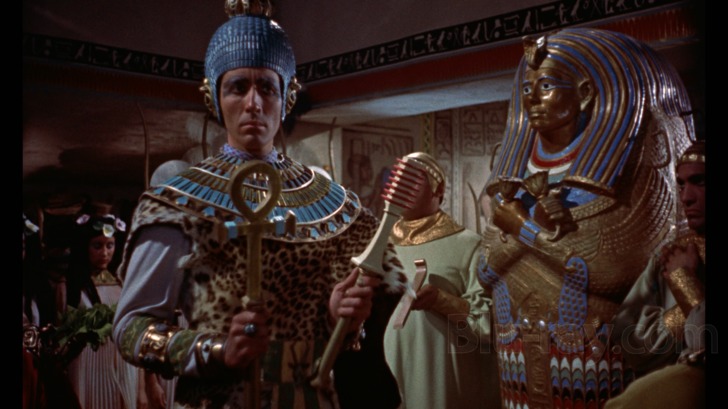
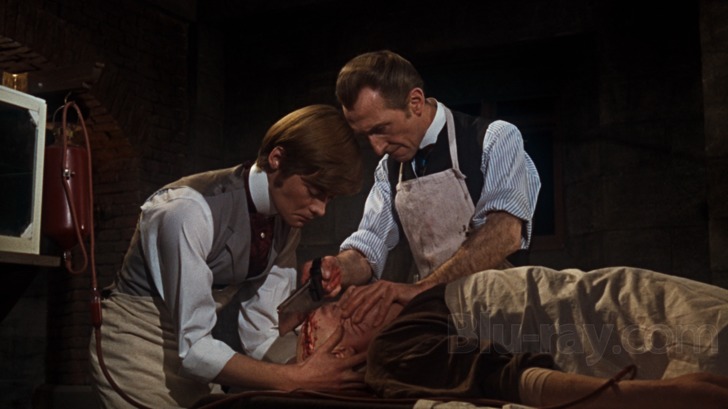
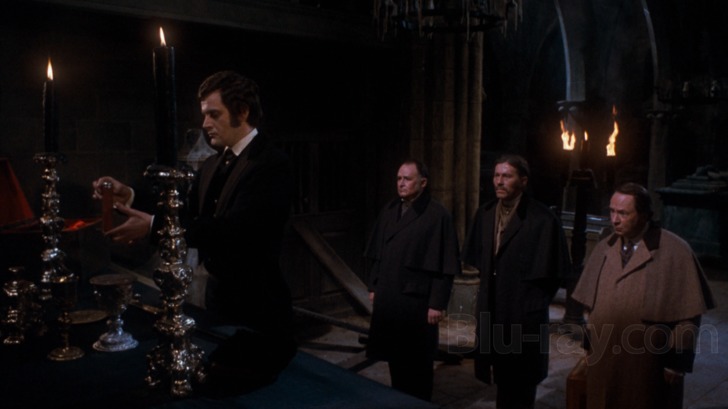
The Mummy (for additional screenshots, go here): While the other three titles in Warner Home Video's first volume of Hammer Horror Films were shot by Arthur Grant, and share the same darkly lit style, The Mummy was photographed by cinematographer Jack Asher, who was also responsible for such early Hammer hits as The Curse of Frankenstein and Horror of Dracula. Except for nighttime exteriors, Asher preferred brighter lighting, and his use of vivid, often fluorescent washes of color (typically greens or reds), without any concern for the light's source, are a classic element of the style associated with Hammer horror. A good example can be seen when Stephen Banning and Joseph Whemple first enter the chamber containing Princess Ananka's sarcophagus. The cavern, which has just been opened for the first time in centuries, is thoroughly illuminated with a green glow that seems to emanate from nowhere. Scanned at 2k from an IP for this 1080p, AVC-encoded Blu-ray, The Mummy has a noticeably softer and less detailed image than the three other Hammer films in this first volume from Warner, although it is hard to say whether that is a function of the original photography, the source material, the transfer or a combination of factors. (I suspect the source material is the limiting factor here.) Also, The Mummy is framed at 1.67:1, which would have been the aspect ratio used on European screens, rather than the 1.78:1 that is Warner's standard treatment for films released in the U.S. at 1.85:1. Despite the softer image, however, a significant amount of detail is still present, enough to allow appreciation of the fine points (and limitations) of the costumes, makeup and set design. The colors are excellent, both in the present-day sequences in England and Egypt and in the flashbacks to ancient times, which are more exaggerated and cartoonish. Blacks are solid and deep, and contrast is appropriate. A fine grain pattern is visible throughout. As is the case with all of the films in its first Hammer collection, Warner has mastered The Mummy with a higher bitrate than it has typically achieved in previous catalog releases, in this case an average of 29.84 Mbps. At the very least, there does not appear to have been any filtering of detail to facilitate compression, and the compression has been carefully performed. Dracula Has Risen from the Grave (for additional screenshots, go here): For its Blu-ray debut, Dracula Has Risen from the Grave has been newly scanned at 2k by Warner's MPI facility from a recently made IP. The results on this 1080p, AVC-encoded Blu-ray are so impressive that one can enjoy the full theatrical artificiality for which Hammer Films is so justly famous. The blood of Dracula's victims has a thickness and color unknown in nature; the wounds on their necks look like stage makeup; and the various sets resemble scenes from a play (which they might as well be). It's the stylized photography, with filters around the frame in key shots, that transforms these stage-bound conventions into cinema. This Blu-ray presentation conveys the cinematic quality more effectively than any prior version. Detail, depth, black levels and color density are all superior. A fine grain pattern is observable throughout. The only shots that are inferior are the stock establishing shots of several villages, and those are not the fault of the transfer. In yet a further sign that a new regime is settling in at Warner Home Video, DHRftG has been mastered with an average bitrate of 29.94 Mbps, which far exceeds the historical WHV approach. The compression has been skillfully performed. Taste the Blood of Dracula (for additional screenshots, go here): Although Hammer staple Arthur Grant shot both Taste the Blood of Dracula and Dracula Has Risen from the Grave, the two films look very different, because DHRftG was directed by cinematographer Freddie Francis, who had Grant use colored filters for key portions of the film. TtBoD has no such effects, and its photography is more consistent with the typical Hammer style. Warner's MPI facility has newly scanned TtBoD at 2k from a recently created IP, and the results on this 1080p, AVC-encoded Blu-ray are very good indeed. The sedate Victorian (or, technically, if we go by the date of DHRftG, Edwardian) houses and the dark ruins where Dracula is reborn provide a suitable contrast with the painted ladies of the East End brothel and the bloody deeds of Dracula's various "servants". The transfer has picked up copious fine detail in closeups and medium shots, while long shots tend to soften, depending on either lighting conditions or depth of field. Colors are excellent, especially the deliberately overstated reds of blood that bubbles and swirls in the goblets prepared by Lord Hartley for Dracula's resurrection (and later spurts from several victims). Blacks are deep and solid, which is essential for a film with so many night scenes and decrepit interiors. A fine grain pattern is readily observable throughout. Like its accompanying sequel in the first volume of Hammer Horror Films, TtBoD has been mastered with an average bitrate of 29.94 Mbps, which far exceeds the historical WHV approach, and the compression has been skillfully performed. Frankenstein Must Be Destroyed (for additional screenshots, go here): Cinematographer Arthur Grant brought his customary dark lighting to Frankenstein Must Be Destroyed, and it was well suited to Baron Frankenstein's various laboratories. The aboveground floors of Anna's boarding house and the wards at the asylum are more brightly lit, as are the town streets and yards. The film's finale, which involves extensive pyrotechnics, features sharp contrast between light and dark. Warner's MPI facility has newly scanned FMBD at 2k from a recently created IP, and the results on this 1080p, AVC-encoded Blu-ray are very good indeed. Detail is superior for a film of this style and vintage, and colors are rich and vibrant. Except for the lab in the prologue, which is quickly abandoned, the lighting avoids the exaggerated washes of bright light from an unspecified source, but Veronica Carlson's wardrobe and various items of Victorian-era decor provide ample opportunity to display bright colors, almost as a reminder of the hopeful life that is quickly receding from Anna and Karl as they sink further into Frankenstein's grasp. Of course, the red of blood is always intense. A fine grain pattern is visible throughout. Warner has mastered FMBD with an average bitrate of 31.93 Mbps, which is remarkable for a catalog title from WHV. The compression has been carefully done, and the results speak for themselves.
Hammer Horror Classics, Volume One Blu-ray Movie, Audio Quality
The Mummy: The Mummy's original mono track has been encoded in lossless DTS-HD MA 1.0, and the source material is in fine shape, with no pops, distortions or distracting background hiss. Dialogue is always clear, as are the sound effects. German-born composer Franz Reizenstein (Circus of Horrors) provided the classical score. Dracula Has Risen from the Grave: DHRftG's original mono track is encoded in lossless DTS-HD MA 1.0 and sounds just fine within the limits of its source material. Dialogue is always clear, as are the sound effects, even when they don't quite match the action. (Is the cross that Monsignor Ernst uses to seal Dracula's castle made of wood or metal? The sound effects suggest metal, but other indications say wood.) Some of the dialogue is unsynchronized, but this is due to post-dubbing and (probably) script changes. The melodramatic score by Hammer regular James Bernard sounds somewhat tinny and shrill, but again this appears to be a source issue. Taste the Blood of Dracula: TtBoD's original mono track is encoded in lossless DTS-HD MA 1.0, and to my ear the source material is somewhat superior to that of DHRftG. Dialogue is always clear, as are the sound effects. The melodramatic score by Hammer regular James Bernard has a somewhat fuller and less brittle quality than on some of the earlier films, though it by no means sounds like a modern recording. Frankenstein Must Be Destroyed: FMBD's original mono track has been encoded as lossless DTS-HD MA 1.0, with somewhat mixed results. Dialogue and effects are certainly clear, and the dynamic range is quite good. Hammer composer James Bernard has turned in another workmanlike horror score that is particularly effective in the film's grand finale. However, portions of the soundtrack have noticeable background hiss. This appears to be source-based, and it's likely that this cannot be removed without risking even more serious damage to other components of the recording. The rapid spread of Dolby noise reduction technology in the Seventies would soon eliminate these kinds of artifacts from original recordings, but apparently too late for FMBD.
Hammer Horror Classics, Volume One Blu-ray Movie, Special Features and Extras
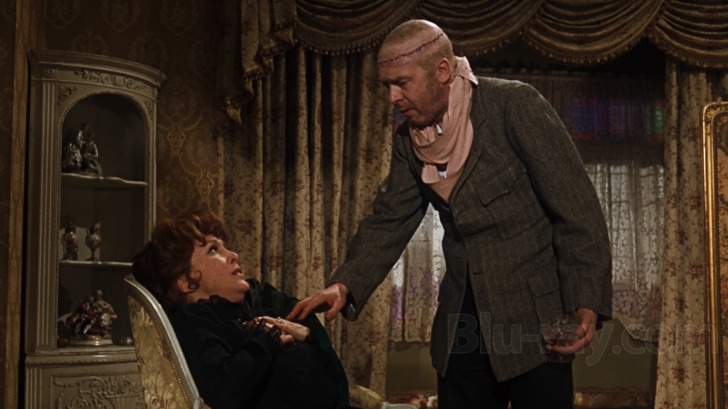
Each film is accompanied by a trailer. No other extras are included.
Hammer Horror Classics, Volume One Blu-ray Movie, Overall Score and Recommendation
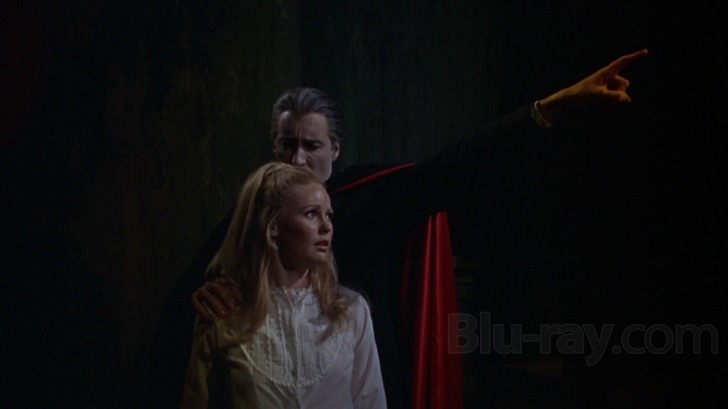
Warner has yet to announce a Volume Two of Hammer Horror, but rumors suggest that further restoration work is in progress. Fans of the studio and the genre can vote with their wallets to demonstrate that the market exists for further releases from Warner's Hammer collection. Even if the lack of extras is disappointing, the presentations are certainly good enough to earn Volume One a solid recommendation.