Hail, Caesar! 4K Blu-ray Movie
HomeHail, Caesar! 4K Blu-ray Movie 
4K Ultra HD + Blu-rayShout Factory | 2016 | 106 min | Rated PG-13 | Mar 24, 2026
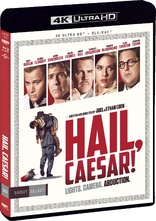

Movie rating
6.7 | / 10 |
Blu-ray rating
| Users |  | 0.0 |
| Reviewer |  | 4.0 |
| Overall | | 4.0 |
Overview
Hail, Caesar! 4K (2016)
A Hollywood fixer in the 1950s works to keep the studio's stars in line.
Starring: Josh Brolin, George Clooney, Scarlett Johansson, Tilda Swinton, Jonah HillNarrator: Michael Gambon
Director: Ethan Coen, Joel Coen
| Period | Uncertain |
| Crime | Uncertain |
| Comedy | Uncertain |
Specifications
Video
Video codec: HEVC / H.265
Video resolution: 4K (2160p)
Aspect ratio: 1.33:1, 1.85:1
Original aspect ratio: 1.85:1
Audio
English: DTS-HD Master Audio 5.1
English: DTS-HD Master Audio 2.0
Subtitles
English SDH
Discs
Blu-ray Disc
Two-disc set (2 BDs)
4K Ultra HD
Playback
Region A (B, C untested)
Review
Rating summary
| Movie | | 4.0 |
| Video |  | 4.5 |
| Audio |  | 3.5 |
| Extras |  | 2.0 |
| Overall | | 4.0 |
Hail, Caesar! 4K Blu-ray Movie Review
Reviewed by Dr. Stephen Larson April 2, 2026Joel Coen and Ethan Coen's seventeenth joint feature Hail, Caesar! (2016) was reviewed by my colleagues Brian Orndorf and Marty Liebman a decade ago. Brian published a theatrical review while Marty wrote about Universal Studios' BD-50. To read their impressions of the film, please consult the linked reviews.
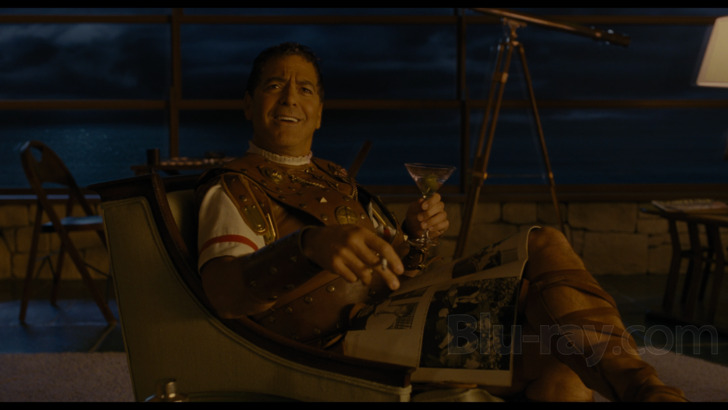
Baird Whitlock.
Hail, Caesar! 4K Blu-ray Movie, Video Quality
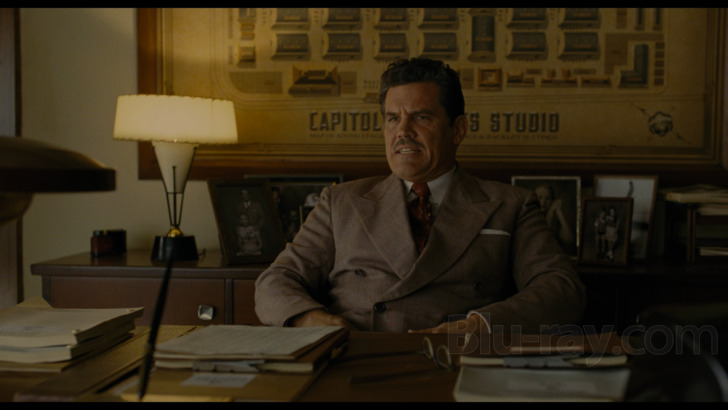
Shout Select's two-disc set comprises a 4K Ultra HD Blu-ray and standard Blu-ray. Since the Shout doesn't come with a slipcover but the Universal release does, I've swapped the slip to go over the UHD case. The 4K appears with Dolby Vision (HDR10 compatible). The picture is presented with two different aspect ratios. The main setting of Hail, Caesar! appears in 1.85:1. There are some films within the film, such as the fictional sword-and-sandals epic Hail, Caesar!: A Tale of the Christ and the Esther Williams-inspired aquatic musical Jonah's Daughter, that are shown in 1.33:1. This was a deliberate framing choice of cinematographer Roger Deakins. The DP considered shooting the whole movie digitally with an ARRI camera but since the Coens were making a feature about Hollywood set in ca. 1952, he opted to shoot it all on film. According to ICG Magazine (official publication of the International Cinematographers Guild), Deakins filmed on Kodak Vision3 emulsions. He specifically utilized the 50D, 200T, and 500T stocks. Deakins specified to Ron Prince of British Cinematographer Magazine that he shot on Kodak 50D for the Western scenes featuring Capitol Pictures star Hobie Doyle (Alden Ehrenreich) as well as for the Roman epic exteriors. For the latter Deakins employed 21 mm, 27 mm, and 32 mm lenses. Both Kodak 200T and 500T were used the remainder of the shoot primarily because Deakins prefers Tungsten-balanced stock. Deakins rented the ARRI 535-B from Otto Nemenz. The DP chose the Arricam LT as the B-camera. Deakins told Bill Desowitz of IndieWire that for Hobie's singing Western Lazy Ol' Moon, which is shown in a classic cinema palace, the DP sought to duplicate the two-strip (red and green) Trucolor process used at Republic Pictures. When shooting of Hail, Caesar! wrapped, Fotokem handled development of the negatives. Deakins worked with EFILM supervising digital colorist Mitch Paulson on the digital intermediate (DI). Paulson worked with Autodesk Lustre as his primary toolset. The colorist recounted to ICG Magazine that he enhanced the look of headlights on some day-for-night driving scenes on the DI. Brighter headlights are more apparent when viewing Hail, Caesar! in 4K with HDR or D.V. enabled.
Prince reported in his magazine that filming officially began in Los Angeles on November 10, 2014 and continued till February 2015. (Deakins stated that the full shoot was 54 days.) The crew shot in and around Warner Bros.' vintage buildings, Union Station in downtown LA, the Big Sky Movie Ranch in Simi Valley, and Vasquez Rocks Natural Area Park. Additional locations included Bronson Canyon, the Hollywood Palladium, the Fonda Theatre, and private homes in the Los Feliz area of the city. For the Jonah's Daughter scenes, ICG Magazine chronicled that a Hydroflex rig captured underwater shots on Sony's Stage 30. The big set piece contained a 15-foot-deep tank measuring 90 feet by 90 feet with a 45-foot ceiling. This is the same tank where Esther Williams performed in for her MGM films.
Costume designer Mary Zophres divulged to ICG Magazine that the Capitol Pictures interiors were desaturated in mostly earth tones. The movies within the movie retain earthly tones but they are further amplified by what she describes as "garish Technicolor intensities." Deakins's photography echoes the contrasts between "the reality" of daily life in a movie studio with the fantasy worlds of the filmed productions. So the costumes, production design, and cinematography each complement each other.
I upscaled Universal's Blu-ray (from ten years ago) to 4K and compared it directly to Shout's UHD. I immediately noticed superior clarity, sharpness, and detail in the most recent presentation. There are upticks in all three areas. For example, these improvements are instantly apparent in the opening shot of a crucifix in the apse of the church. In addition, black levels are deeper on the 4K. For instance, check out the solid blacks on the eksorasson (or outer cassock) worn by the Eastern Orthodox Patriarch (played by Aramazd Stepanian) (see Screenshot #19). Granted, the Universal BD features a brighter transfer so black levels don't appear as deep but they're still not as crisp as they look on the 4K. While the Dolby Vision/HDR10 grade don't offer a whole lot of depth compared to the SDR transfers, depth is noticeable in group shots and deep space compositions. Moreover, you will notice greater color saturation on the 4K. Deakins told Prince that he added a 1/8th coral color filter to the sets and costumes. The Roman epic scenes were given extra filtration to elevate their warmth and texture. Additionally, colors were boosted when Deakins and Paulson collaborated on the DI.
Shout's UHD boasts a mean video bitrate of 79.0 Mbps for the feature and an overall bitrate of 85.3 Mbps for the whole disc. Shout's second disc is just a BD-25 that carries an average bitrate of 22000 kbps. Universal's Blu-ray employs the same MPEG-4 AVC codec and delivers a standard bitrate of 34585 kbps. While the Universal disc definitely has better encoding and compression, I still prefer the remastered picture on Shout's regular Blu-ray.
Screenshot #s 1-15, 17, 19, 21, 23, 25, 27, 29, 31, 33, & 35 = Shout Select 2026 4K Ultra HD BD-66 (downscaled to 1080p)
Screenshot #s 16, 18, 20, 22, 24, 26, 28, 30, 32, & 34 = Universal Studios 2016 BD-50
Screenshot #s 36-40 = Shout Select 2026 BD-25
There are eleven chapter breaks for the 106-minute feature. (Universal's disc has twenty scene selections.)
Hail, Caesar! 4K Blu-ray Movie, Audio Quality
Shout has supplied a DTS-HD Master Audio 5.1 Surround mix (1803 kbps, 16-bit) and an optional DTS-HD Master Audio 2.0 Stereo track (1559 kbps, 16-bit), a fold-down of the 5.1. I would largely affirm Marty's comments about the 5.1 on all fronts. Dialogue sounds softer for some scenes such as the confession booth encounter between Eddie Mannix (Josh Brolin) and the priest listening. The Universal disc also offers a DTS-HD MA 5.1 mix but at a much higher rough average audio bitrate: 3604 kbps, 24-bit. While Shout's Surround track is based on the Universal mix, I feel that the latter does a better job of delivering sounds on the low end. For example, I could really hear low-end f/x while sitting on my couch near the SR channel.
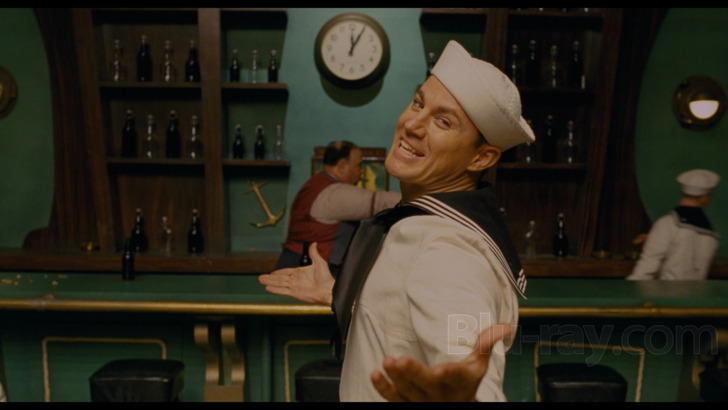
Carter Burwell's original score for the Hail, Caesar!: A Tale of the Christ scenes deliver a fine simulacrum of music for Hollywood epics scored by Miklós Rózsa and Dimitri Tiomkin. Burwell also incorporates choristers for Jonah's Daughter. I enjoyed Channing Tatum and other actors portraying sailors in a song-and-dance number performed in a bar when I saw Hail, Caesar in the theater. The music for "No Dames!" is composed by Henry Krieger with lyrics by Willie Reale. (Both are of Dreamgirls fame.)
I also listened to the downmix on Shout's Blu-ray. It is almost entirely a front-oriented track. My audio score for the Shout is 3.75/5.00.
Shout's optional English SDH deliver an accurate transcription of the film's dialogue.
Hail, Caesar! 4K Blu-ray Movie, Special Features and Extras
Shout has brought over all of Universal's EPK materials from the studio's Blu-ray on to Disc Two. No new supplements have been produced.
- Directing Hollywood (4:11, 1080p) - an all-too-brief featurette about the directing prowess of the Coen brothers. We hear from actors George Clooney, Channing Tatum, Tilda Swinton, Alden Ehrenreich, Ralph Fiennes, Josh Brolin, and Scarlett Johansson as well as executive producer Robert Graf. All interviewees speak in English, not subtitled.
- The Stars Align (11:34, 1080p) - the actors from the first featurette reappear in this longer piece to discuss their characters in Hail, Caesar!. They also talk about how the Coens write dialogue and how it's easy to interpret when delivering their lines. There's quite a bit of behind-the-scenes footage. In English, not subtitled.
- An Era of Glamour (6:22, 1080p) - Graf, production designer Jess Gonchor, and costume designer Mary Zophres describe the sets and costumes of Hail, Caesar!. Johansson, Tatum, Clooney, Brolin, and Fiennes all return to give remarks on the periods that are recreated in the picture. In English, not subtitled.
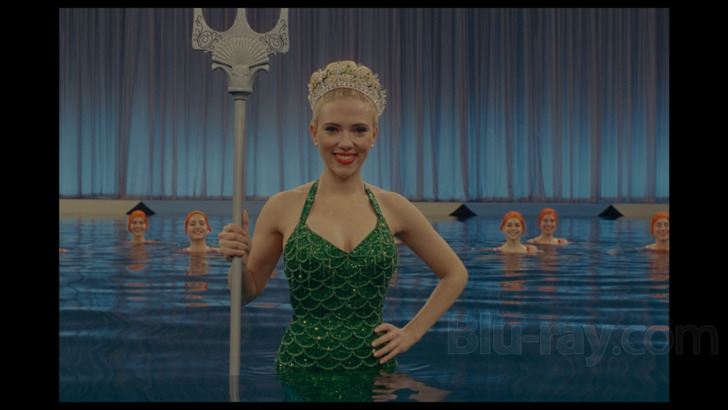
- Magic of a Bygone Era (6:01, 1080p) - this program focuses in part on the "No Dames!" sequence. We hear from Tatum and song-and-dance choreographer Chris Gattelli to see how the tap-dancing number was executed. In addition, Johansson and swimming choreographer Mesha Kussman are on hand to unpack how the synchronized swimming sequence was pulled off. Graf also contributes comments. In English, not subtitled.
Hail, Caesar! 4K Blu-ray Movie, Overall Score and Recommendation
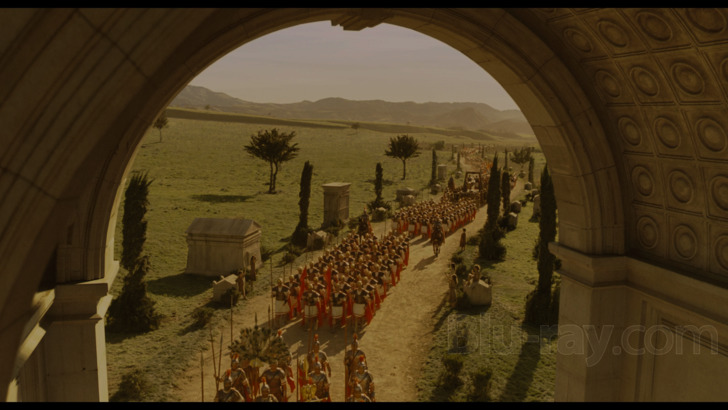
Hail, Caesar! is the Coens' valentine to the movies of yesteryear. (It's a project that they worked on for fifteen years.) The young cowboy they wrote for Alden Ehrenreich is meant to show that while some actors are not that bright or gifted at their craft, a handsome screen persona and talent for stunts can make genuine movie stars out of them. Upon re-watching the fictional sword-and-sandals epic that Deakins recreates within the film, I truly hope that we can get proper 4K presentations of El Cid (1961), The Fall of the Roman Empire (1964), Quo Vadis (1951), and The Robe (1953) in the not-too-distant future. Shout's UHD looks flawless. I wish that it could have given the DTS-HD MA 5.1 mix a high bitrate like Universal did a decade ago. All of the original extras have been ported over. A SOLID RECOMMENDATION.

