Guns: The Evolution of Firearms Blu-ray Movie
HomeGuns: The Evolution of Firearms Blu-ray Movie 
Mill Creek Entertainment | 2012 | 280 min | Rated PG | Jan 22, 2013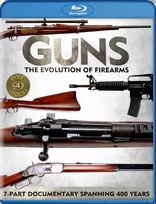
Price
List price:Listed on Amazon marketplace

Movie rating
6.5 | / 10 |
Blu-ray rating
| Users |  | 0.0 |
| Reviewer |  | 2.5 |
| Overall | | 2.5 |
Overview
Guns: The Evolution of Firearms (2012)
A seven-part history of the firearm.
Narrator: Coby BattySpecifications
Video
Video codec: MPEG-4 AVC
Video resolution: 1080p
Aspect ratio: 1.78:1
Original aspect ratio: 1.78:1
Audio
English: Dolby Digital 2.0 (192 kbps)
Subtitles
None
Discs
50GB Blu-ray Disc
Single disc (1 BD)
Playback
Region A (B, C untested)
Review
Rating summary
| Movie |  | 3.5 |
| Video |  | 2.0 |
| Audio | | 2.0 |
| Extras | | 0.0 |
| Overall | | 2.5 |
Guns: The Evolution of Firearms Blu-ray Movie Review
A history of things that go "bang."
Reviewed by Martin Liebman January 27, 2013God created man, Sam Colt made them equal.
American history will be forever linked to the firearm. Sometimes for the better, sometimes for the worst, but it's an integral part of American life and
freedom, so integral it was recognized as one of the founding principles, a natural and inalienable right on which the nation was conceived, one that
"shall not be infringed." Mill Creek Hone Entertainment has released Guns - The Evolution of Firearms at a time when news casts, radio
waves,
Internet blogs, dinner table banter, and water cooler chatter is dominated by talk of the gun and its place in society. This documentary takes no sides
on any modern debate and instead offers a
straight-down-the-middle look at the history of firearms, albeit with a very heavy tilt towards American military small arms firepower through the
years, from the Brown Bess Musket to the M4 carbine. It's the history of the tools that operators carried in rebellion, civil war, and
worldwide battles against Nazism, Fascism, Communism, and terrorism. Muskets, rifles, machine guns, battle rifles, grenade launchers, revolvers, and
semi-automatic pistols are all represented in the seven-part Guns - The Evolution of Firearms.
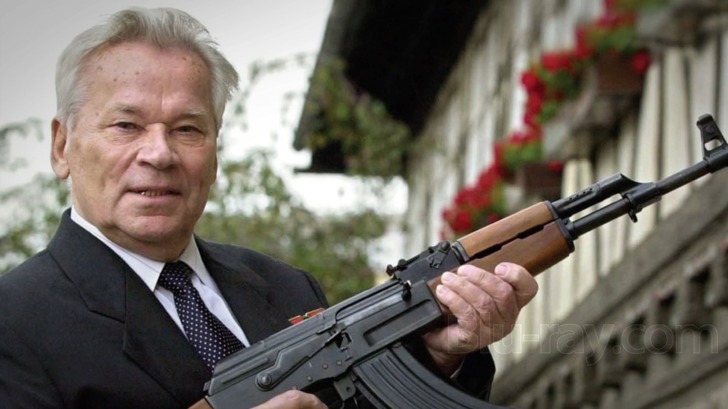
Mikhail says, "my gun is best of all time" (be that as it may, finger off the trigger, please, even with the safety on).
Guns - The Evolution of Firearms is an interesting but imperfect Documentary release that does a fine job of quickly recalling the history of long guns -- their design, evolution, function, and usage -- without being too vague or leaving out too much in the way of crucial information. But the breakneck pace does mean that the program glosses over, or almost completely foregoes, many important historical and modern arms. For instance, there's no mention of the modern revolution in polymer pistols. Handguns in general are largely ignored in comparison to the focus on long guns; old flintlock pistols, black powder revolvers, the Colt Peacemaker, the 1911, and the Beretta 92 are introduced but hardly studied in much detail. In fact, the program spends much of its segment on the 1911 retelling the story of "Sergeant York" in World War I, recycling the same footage used in Mill Creek's Medal of Honor Documentary (this program does recycle footage from various Mill Creek releases, including the aforementioned Medal of Honor as well as Ultimate Civil War and Up From Slavery). Nevertheless, it's a fascinating journey through history, using sketches, paintings, historical recreations, and firearm museum curators and archivists to paint a vivid portrait of some of history's most important firearms. The program is as much historical document as it is Documentary, no surprise given the tight connection between weapons and the shaping of the present through the prism of the past.
The following episodes comprise Guns - The Evolution of Firearms
- Episode One: From the Invention of Gunpowder to the American Rifle (36:26): Episode one begins with the development of gunpowder by a Chinese alchemist, used for fireworks displays and later military applications, including gunpowder-packed arrows, cannons, and grenades. The episode examines the "fire lance," beleived to be the first firearm. It was a bamboo tube with gunpowder and a projectile packed into it, highly effective but only at short ranges. Gunpowder remained a Chinese secret until the 13th century when Roger Bacon, a Franciscan monk, learned of it, saying, "the sound of thunder may be artificially produced in the air with greater resulting horror than if it had been produced by natural causes." As the episode jumps ahead to more modern times, it examines the development of hand cannons made of bronze metal tubes and the development of the Matchlock, the Wheellock, and the Snaplock. In the American colonies, the formation of militias and the necessity of firearms in homes for village defense and hunting game are examined. Also featured is Benjamin Church's formation of the first Rangers and the birth of gunsmiths and guns as works of art. The piece examines the development of the blunderbuss, the .75 caliber smoothbore Brown Bess Musket and other early weapons of a similar type, and the development of rifling and the positives and drawbacks of early weapons with rifled barrels. This episode ends with the lead-up to the place of arms in pre-revolution America and British General Gage's explicit orders to remove weapons from the colonists, resulting in the famed "shot heard 'round the world."
- Episode Two: From the Flintlock to the Percussion Cap (40:07): The strain between the colonists and the British Parliament, the threat of conflict, and the colonists' stockpiling of arms and ammunition for use in the coming war for independence begins episode two. The segment examines the arms of both the colonists and the English, most of which were covered in the previous episode. Also featured are the weapons acquired form the French and those produced in the colonies. Episode two also looks at the flintlock handguns carried at the time of the revolution and General Washington's "buck and ball" loading system. Examined in detail is the battle of Lexington, the burning of supplies at Concord, and the Battle of Saratoga and the critical role of "Morgan's riflemen." Episode two also studies the Springfield, Massachusetts and Harper's Ferry armories. Amongst the weapons introduced at the time are the 1795 Army musket and the models 1812 and 1816. There's an examination of the 1822 development of the percussion cap, the Mississippi rifle, and the model 1842 which would see extensive service in the Civil War. Episode two also sees the development of the Minié ball, which facilitated firing accurately from a rifled barrel, and the development of Sharp's rifle and its place in the pre-Civil War era. Also: the innovations of Samuel Colt in the development of handguns.
- Episode Three: Weapons of the Civil War (41:37): Episode three focuses in on the guns of the North and South, notably the smoothbore muskets on both sides, some converted to percussion guns, some not, and some coming straight from the armories as percussion tools. The episode looks at the evolution of arms in the Civil War, beginning with the model 1855, a smaller caliber but more accurate "tape primer" firearm invented by a dentist named Edward Maynard that ultimately proved unreliable in practice. The model 1861 was developed in response, a classic percussion fired weapon that added in a rear sight and that would become the most widely used arm in the war. Episode three also examines the Confederate raid on the Harper's Ferry armory and the Confederacy's dire need for arms and their purchase and trading of cotton for arms with Europe, notably acquiring the British Enfield and Austrian Lorenz. Also introduced are the Henry repeater and Spencer rimfire rifles that allowed for multiple cartridges to be loaded into the weapon, increasing the rate of fire over single-shot muskets. Also: the 1860 Colt .44 revolver, the most common handgun in the war and its advantages over single-shot muskets.
- Episode Four: Post Civil War Weapons and the Winning of the West (38:08): The 1873 "trapdoor" Springfield is the first focus of episode four. Also noted early is the Gatling gun that, by 1893, was capable of firing some 800 rounds per minute, spurring an advance in ammunition towards the development of the centerfire cartridge and the push towards the modern wave of firearms. Episode four examines the pioneering work of Smith & Wesson in the development of revolvers with rear loading cylinders, including the famed Models One and Three, the latter of which saw large sales to the Russian army. Meanwhile, Colt produced its Single Action Army 1873, or "Peacemaker," revolver. It was dubbed "the gun that won the West" along with the Winchester 1873 repeating rifle, both chambered in .44 caliber ammunition that was interchangeable between the weapons. Also highlighted is the emergence of other manufacturers such as Remington and Marlin and the introduction of smaller Derringers. Shotguns; the guns of the gunfighters of the old West; and the invention of European and American bolt action rifles, including the Mauser 1871, the Krag, the Lee 1895, and '03 Springfield, are covered.
- Episode Five: The Weapons of World War 1 (40:45): Episode five focuses largely on the U.S. weapons of World War I, a war in which American soldiers would first face the devastating Maxim machine gun, a weapon that used recoil to eject the spent casing and load the next round. Other machine guns highlighted are the crew-served German MG08, the .303 British Vickers gun, the Lewis gun with a 47-round drum magazine, the gas-operated Hotchkiss machine gun, and the Chauchat. Episode five also looks at the machine guns produced by John Moses Browning, including the M1917 and the Browning Automatic Rifle (BAR). Infiantry weapons highlighted include the American 1903 Springfield and P-14 (or American Enfield), the M1897 Winchester shotgun, the German G98, the British Lee-Enfield, and the French Lebel 1886 and Berthier models. On the handgun front, this episode highlights the development of the 1911 semiautomatic handgun, which would remain in military service for nearly 80 years (and is making a comeback with a recent Marine Corps purchase of railed Colt 1911 pistols), and .45 caliber revolvers from Smith & Wesson and Colt.
- Episode Six: The Weapons of World War 2 (35:12): Episode six begins with the development of the Thompson .45 caliber submachine gun and its wide usage in prohibition and depression era America in the lead-up to World War II. The evolution of the BAR into a fully automatic-only weapon, the development of the M1919, and the introduction of the venerable .50 caliber M2 or "ma deuce" machine gun, which even served as a sniper rifle in Vietnam by Carlos Hatchcock, are examined. The development and wartime usage of the classic M1 Garand, the first semi-automatic rifle to serve as standard issue for any army in the world, swallows much of this episode's runtime. Also featured are a plethora of small arms used in the European and Pacific theaters, including lighter automatic rifles such as the .30 caliber M1 carbine; the updated M1A1 carbine with a folding stock designed for use by paratroopers; and the stamped M3 submachine gun, better known as the "grease gun." Also featured are the Japanese Type 99 rifles, the German K98s, the Soviet Mosin-Nagant rifles (which are still popular and available in large surplus quantities), and the PPSH 41 made from stamped steel and mass produced in Russian factories during the war.
- Episode Seven: Post World War 2 to Today...From the M-14 to the M4 Carbine (41:04): Two decades after World War II, American forces entered into the Vietnam Conflict and required a new weapon to face a new enemy on a new battlefield. The heavy hitting (and flat-out heavy) M14 was developed and deployed but short-lived as a main battle rifle as its limitations were exposed in the conflict. It was replaced by the lightweight M16, a smaller-caliber .223 rifle described as a "Mattel toy" upon its initial deployment. It, too, was limited in battle, at first, lacking a chrome-lined barrel and chamber and cleaning instructions and equipment for operators. But with the introduction of the A1 model, the weapon began to prove its worth. Examined later in episode seven is the development of the A2 version and on through to today's M4 carbine. Also highlighted are the M60 machine gun, the M249 machine gun, the M79 "thumper" grenade launcher, and the M203 weapons-mounted grenade launcher. Of course, the piece also explores the origins and the proliferation of the AK-47. It highlights the AK's innovations and rugged reliability, as well as the development of the weapon's cousin, the SKS. On the handgun front, episode seven examines the military handgun trials of the 1980s and the adoption of the 9mm M9 Beretta as the standard-issue sidearm of the U.S. military, replacing the venerable 1911. The program ends with a single shot of a Glock pistol, a weapon one would think would have garnered more attention in the film's final chapter as a quantum-leap forward in polymer and striker-fired handguns (with all due respect to the HK VP70).
Guns: The Evolution of Firearms Blu-ray Movie, Video Quality
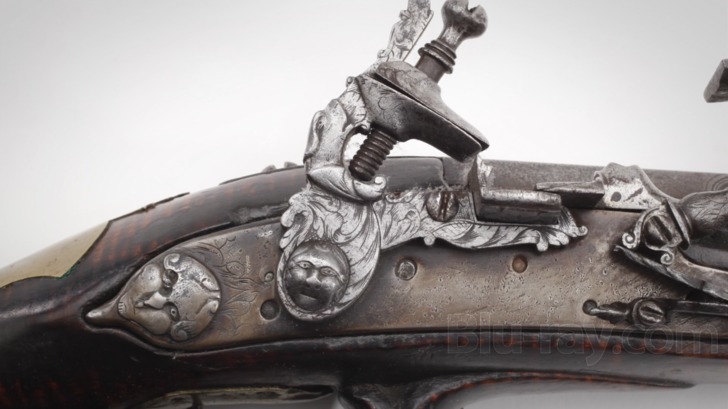
Guns - The Evolution of Firearms features a lackluster high definition image. While Mill Creek's video presentation ofttimes offers some exceptionally detailed close-up shots of firearms in a controlled environment, most any live action footage looks downright awful. Interviews with National Firearms Museum Curator Philip Schreier take on a heavy red push and feature crushed blacks, muddy details, heavy blocking, and zero vibrancy. Interviews with Christopher Ruff show false colors and heavy aliasing. Recreated historical footage suffers from jagged edges, banding, severe blocking, crush, mediocre details, and unstable colors. Of course, not every problem is evident in every frame, but just about every shot is home to at least one, if not more, of these issues. It's just good enough to watch, but videophiles will likely be repelled by this offering.
Guns: The Evolution of Firearms Blu-ray Movie, Audio Quality
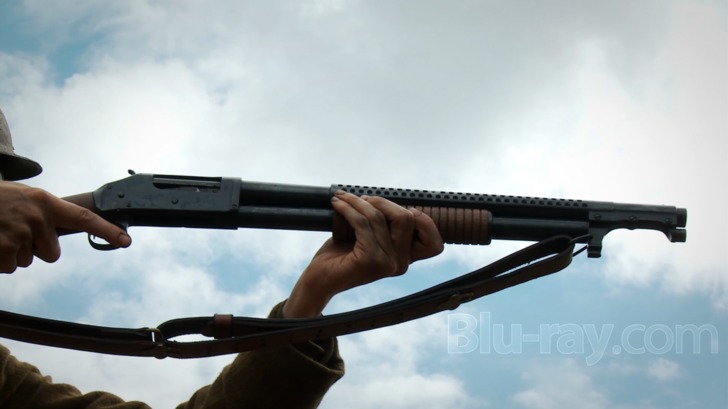
Guns - The Evolution of Firearms features a lackluster Dolby Digital 2.0 soundtrack. Music is shallow and lacking in clarity but is fairly spaced across the front. Narration is fairly clear but a bit on the scratchy side. Battles often run underneath narration and sound tiny -- more so than one might even expect for a secondary sonic element -- and tossed into the soundtrack with little thought. Gunfire proves weak even when it's the focal point, and even cannon fire cannot muster up much energy. Like the video, this track is good enough to get listeners through the program, but forget an engaging, exciting sound presentation.
Guns: The Evolution of Firearms Blu-ray Movie, Special Features and Extras
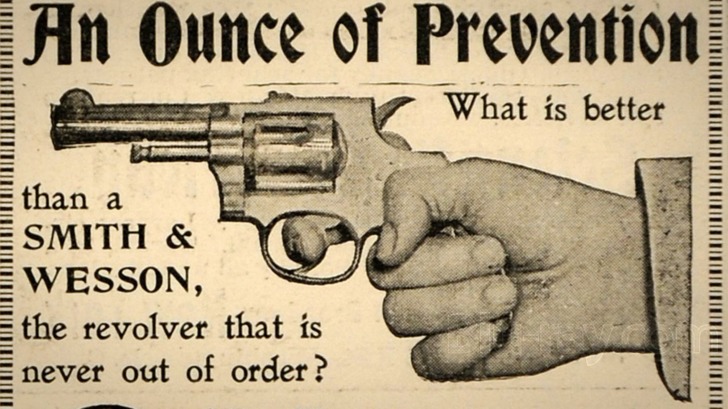
Guns - The Evolution of Firearms contains no supplemental content.
Guns: The Evolution of Firearms Blu-ray Movie, Overall Score and Recommendation
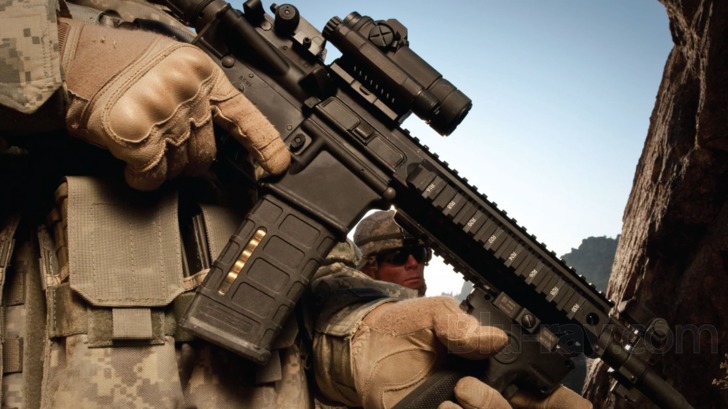
Guns - The Evolution of Firearms is a fun, informative, and absorbing Documentary, albeit an imperfect Documentary. It lacks the funds for superior storytelling and recreations, but it does what all of the Mill Creek documentaries do so well: shape history through quick and easy-to-follow segments. Firearms enthusiasts are the target audience here -- some may even learn a thing or two -- but the program is also suited for armchair historians, novice shooters, or anyone interested in the history behind today's most controversial subject. Given the price, length, and quality of information, this release should appeal to a wide audience. Unfortunately, the technical presentations are below par and there are no supplements. Nevertheless, the release comes with a solid recommendation based on its content.
Similar titles
Similar titles you might also like
(Still not reliable for this title)

Shark Week: Fins of Fury
2013

The Dream is Alive
Double feature with Blue Planet
1985

Decoding Die Hard
2013

Hickok 4K
2017

The Scorpion King 4: Quest for Power
2015

Redline
MVD Marquee Collection
2007

Dragon Crusaders
2011

Mine
2016

Reach Me
2014

Freerunner
2011
Outrage Born in Terror
Outrage
2009

Burning Daylight
2010

The Last Kumite 4K
2024

The Enforcer
2022

Rogue
2020

All the Devil's Men
2018

Final Score
2018

Silencer
2018

Mile 22
2018

Security
2017