Gung Ho Blu-ray Movie
HomeGung Ho Blu-ray Movie 
Kino Lorber | 1986 | 112 min | Rated PG-13 | Aug 19, 2025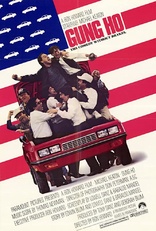

Movie rating
6.6 | / 10 |
Blu-ray rating
| Users |  | 3.0 |
| Reviewer |  | 2.5 |
| Overall | | 3.0 |
Overview
Gung Ho (1986)
When a Japanese car company buys an American plant, the American liason must mediate the clash of work attitudes between the foreign management and native labor.
Starring: Michael Keaton, Gedde Watanabe, George Wendt, Mimi Rogers, John TurturroDirector: Ron Howard
| Comedy | Uncertain |
| Drama | Uncertain |
Specifications
Video
Video codec: MPEG-4 AVC
Video resolution: 1080p
Aspect ratio: 2.39:1
Original aspect ratio: 2.39:1
Audio
English: DTS-HD Master Audio 2.0
English: DTS-HD Master Audio 5.1
Subtitles
English SDH
Discs
Blu-ray Disc
Single disc (1 BD)
Packaging
Slipcover in original pressing
Playback
Region A (locked)
Review
Rating summary
| Movie |  | 2.0 |
| Video |  | 4.0 |
| Audio |  | 5.0 |
| Extras | | 2.5 |
| Overall | | 2.5 |
Gung Ho Blu-ray Movie Review
Reviewed by Dr. Svet Atanasov September 5, 2025Ron Howard's "Gung Ho" (1986) arrives on Blu-ray courtesy of Kino Lorber. The supplemental features on the release include new program with actor Gedde Watanabe; new program with actor George Wendt; and new audio commentary by author and critic Dwayne Epstein. In English, with optional English SDH subtitles for the main feature. Region-A "locked".
Built to impress
If Gung Ho turned out exactly as its creators wanted, then it is very easy to declare that these people had a terrible sense of humor. If Gung Ho did not turn out as its creators wanted, then it is just as easy to declare that it is precisely why it does not work. Needless to say, being a fly on the wall while Gung Ho was conceived and different people shared different ideas about what type of film it should be would have been a very interesting experience.
Virtually all of Gung Ho is set in a small town in Pennsylvania, but this town could have been anywhere in the Midwest. When hundreds like it began dying during the late 1970s and 1980s because local factories were either gradually downsized or closed, effectively collapsing local economies and forcing many people to relocate, the areas that suffered the most became known as the Rust Belt. All of these towns employed different strategies to adapt to the sweeping changes, but they all ultimately failed to revive their economies and restore them to their former productivity. The most successful among them simply kept their economies on life support for as long as possible. Until a decade or so ago, political leaders in America agreed that the transformation of the Midwest from an economic powerhouse into the Rust Belt was a sad but ultimately unavoidable process. It was a lie, but it was repeated so many times, usually by people who did not live in the Rust Belt states, that eventually it became an unpopular truth.
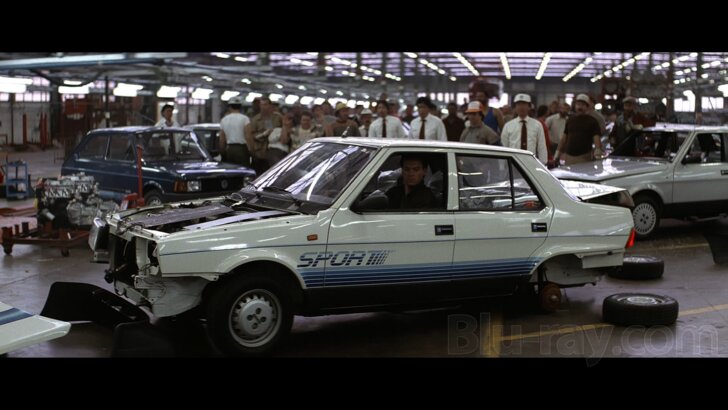
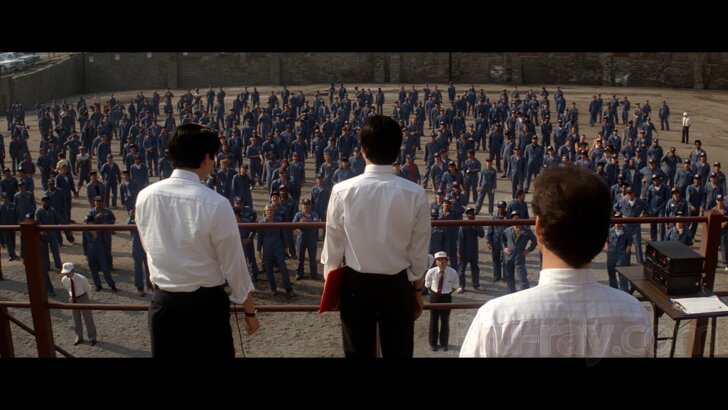
At the center of Gung Ho is a massive campaign to save a once-thriving auto factory. Leading the campaign is foreman Hunt Stevenson (Michael Keaton), who arrives in Japan determined to convince a group of local industrialists that the auto factory, which is the economic engine of his town, is worth saving. Despite his best efforts, however, he fails. Or, so he concludes. A week after returning home, Stevenson meets Japanese manager Oishi Kazihiro (Gedde Watanabe), who informs him that his bosses are willing to give the auto factory a chance to prove that it can be profitable again. The sensational news spreads like fire, but immediately after that, so do the new work requirements of the auto factory’s new owners. Faced with the possibility of a massive revolt that could collapse the arrangement to save the auto factory, Stevenson and Kazihiro begin improvising, each realizing that the side they represent must give up something big and important.
The efforts to save the auto factory channel a great deal of satire, virtually all of which is supposed to produce hilarious content. Unfortunately, even by the notoriously flexible standards of the 1980s, this hilarious content looks and feels seriously dull. There are two key reasons for this. First, the satire is fueled by a culture clash that is defined by poor stereotypes, not a proper grasp of the economic crisis in the Rust Belt states and Japanese culture. (For example, Midwestern male factory workers are all rowdy boozers, while Japanese male workers are all submissive workaholics who would endure various types of abuse in the name of success). Second, a substantial portion of the satire is used to deliver supposedly serious messages about the difficult socio-economic environment in middle America during the 1980s. Unsurprisingly, not only do these messages miss their targets, but the overwhelming majority of them come off as seriously smug.
There is one other unmissable development that sabotages everything Gung Ho tries to get right. All major characters are given a mindset that would be perfect for a college student. Many silly comedies from the 1980s have such characters, so what is the problem? Gung Ho makes it quite clear that it does not want to be seen as such a film.
Gung Ho Blu-ray Movie, Video Quality
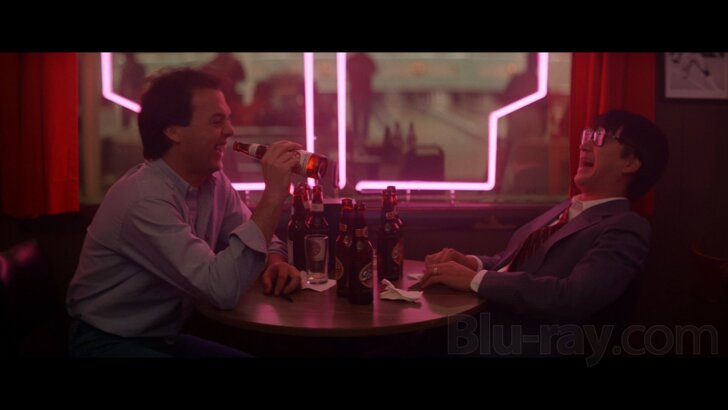
Presented in its original aspect ratio of 2.39:1, encoded with MPEG-4 AVC and granted a 1080p transfer, Gung Ho arrives on Blu-ray courtesy of Kino Lorber.
The release is sourced from a recent 4K master struck from the original camera negative, on behalf of Paramount. This master produces good and stable but occasionally rather odd visuals. In several areas, select visuals exhibit effects similar to those that appear after sharpening corrections are applied. You can see very obvious examples here. However, elsewhere, well-lit and darker visuals look perfectly fine. Occasionally, some darker nuances appear slightly less convincing, but I still think that there is nothing to be concerned about. I do not know why these fluctuations are present. Color reproduction and balance are excellent. All primaries and supporting nuances are nicely set, and both look very healthy. Image stability is great. The entire film looks immaculate as well. My score is 3.75/5.00. (Note: This is a Region-A "locked" Blu-ray release. Therefore, you must have a native Region-A or Region-Free player in order to access its content).
Gung Ho Blu-ray Movie, Audio Quality
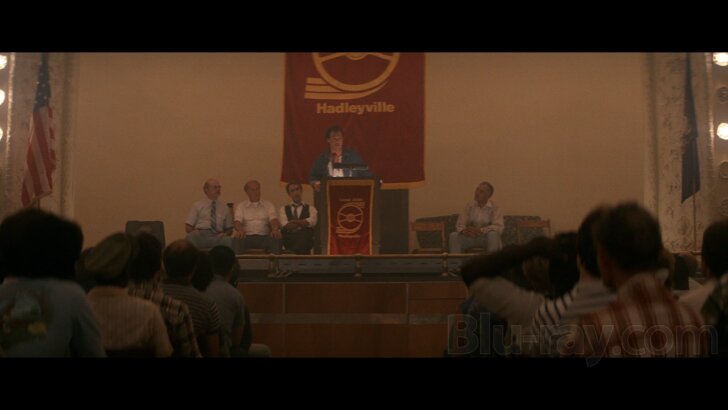
There are two standard audio tracks on this Blu-ray release: English DTS-HD Master Audio 2.0 and English DTS-HD Master Audio 5.1. Optional English SDH subtitles are provided for the main feature. When turned on, they appear inside the image frame.
Gung Ho does not have any impressive action material. However, it has a terrific soundtrack with several outstanding 1980s rock hits, so turning up the volume slightly more than usual is definitely warranted. I thought that the music sounded great. All exchanges were clear, stable, and easy to follow, too. I also tested the 5.1 track. I think that only a few of the mass sequences benefit a bit, but the 2.0 track performed very well on my system.
Gung Ho Blu-ray Movie, Special Features and Extras
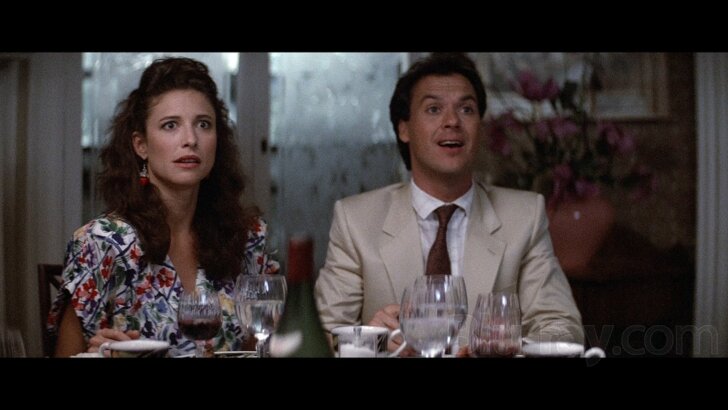
- Finding Common Ground - in this new program, actor Gedde Watanabe recalls his involvement with Gung Ho and discusses the character he plays, Oishi Kazihiro. Watanabe also comments on his interactions with Michael Keaton and Ron Howard. In English, not subtitled. (13 min).
- A Big Old Movie - in this new program, actor George Wendt discusses his transition from the South Side of Chicago to the film industry and recalls his contribution to Gung Ho. In English, not subtitled. (10 min).
- Commentary - this exclusive new audio commentary was recorded by author and critic Dwayne Epstein.
Gung Ho Blu-ray Movie, Overall Score and Recommendation
It is unfortunate Gung Ho did not turn out to be a great film because it unites several great actors. It looks seriously dated, but this is not why it fails. Its satire is quite poor, relying on dull stereotypes that cannot produce the thought-provoking laughs it was meant to deliver. Kino Lorber's Blu-ray release is sourced from a recent, somewhat inconsistent, but still decent 4K master, prepared on behalf of Paramount.
Similar titles
Similar titles you might also like

The Good Lie
2014

Fighting with My Family
Director's Cut
2019

Stand and Deliver
Warner Archive Collection
1988

Aspen Extreme
1993

Pride
2014

The Scout
1994

The Principal
1987

Twins
1988

Summer School
1987

The Paper
1994

The Sum of Us
1994

Roommates
1995

The Hoax
2006

Memories of Me
1988

The Details
2012

Family Ties: The Complete Series
1982-1989

Rocky III
1982

Rocky IV
1985

Stay Hungry
1976

Ping Pong Playa
2007