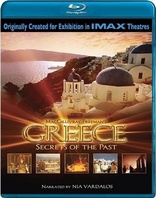
Greece: Secrets of the Past Blu-ray Movie
HomeGreece: Secrets of the Past Blu-ray Movie 
IMAXImage Entertainment | 2006 | 45 min | Not rated | Jan 10, 2012
Price
List price:Listed on Amazon marketplace

Movie rating
Movie has not been rated yetBlu-ray rating
| Users |  | 0.0 |
| Reviewer |  | 4.0 |
| Overall | | 4.0 |
Overview
Greece: Secrets of the Past (2006)
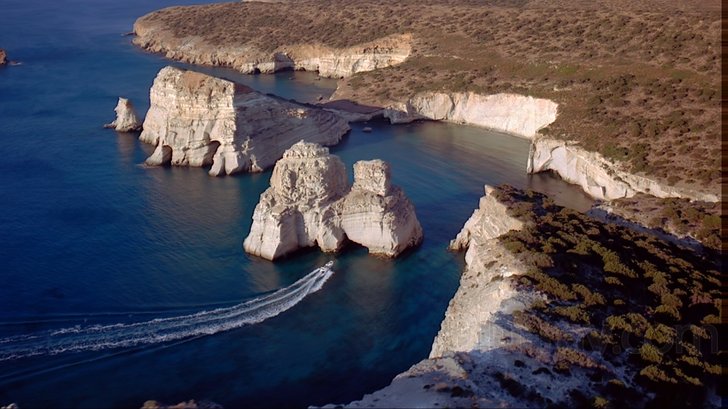
Directed by Greg MacGillivray and from the Academy Award-nominated producers of Everest, comes a dynamic tale of science, archeological adventure and discovery. Greece: Secrets of the Past takes you to the dawn of democracy and the birthplace of Western Civilization on a quest to uncover the buried secrets of one of the world's most enlightened societies. With stunning aerial photography that captures the breathtaking, azure vistas of the Greek Isles, the film is at once a modern detective story and a sweeping archeological journey back in time.
Starring: Christos DoumasNarrator: Nia Vardalos
Director: Greg MacGillivray
| Documentary | Uncertain |
| Nature | Uncertain |
| History | Uncertain |
| Other | Uncertain |
Specifications
Video
Video codec: MPEG-4 AVC
Video resolution: 1080p
Aspect ratio: 1.78:1
Original aspect ratio: 1.43:1
Audio
English: DTS-HD Master Audio 5.1 (48kHz, 16-bit)
French: DTS-HD Master Audio 5.1 (48kHz, 16-bit)
Subtitles
None
Discs
25GB Blu-ray Disc
Single disc (1 BD)
BD-Live
Playback
Region A (B, C untested)
Review
Rating summary
| Movie |  | 3.5 |
| Video |  | 5.0 |
| Audio | | 4.0 |
| Extras | | 4.0 |
| Overall | | 4.0 |
Greece: Secrets of the Past Blu-ray Movie Review
Western Civilization for Dummies, An Introduction
Reviewed by Michael Reuben December 27, 2011The small specialty production house of MacGillivray Freeman Films (hereafter "MFF") has been making IMAX films long before the format became a cash cow for studios and theater chains with feature releases like The Dark Knight, Avatar, Tron: Legacy and, most recently, Mission Impossible: Ghost Protocol. MFF released its first IMAX film in 1976, long before most of today's IMAX theaters existed even as blueprints. The film was To Fly!, and it wasn't made for theaters but for the Smithsonian's National Air and Space Museum. To Fly! was later included in the National Film Registry by the Library of Congress. MFF has produced more than thirty IMAX films since then, including Everest (1998), which is the highest-grossing IMAX film to date (if you don't count films that have incorporated some IMAX footage, like The Dark Knight). When the very first commercial IMAX theaters were built and tickets had to be sold primarily on the novelty of the giant screen and the breathtaking images that a large negative was capable of capturing, for many years MFF was one of the lead firms supplying content. In pursuit of cinematic sights unlike anything else in the multiplex, MFF went to extreme lengths, and as titles like To Fly! and Everest suggest, the efforts were often dangerous. Shortly before To Fly! was released, co-founder Jim Freeman was killed in a helicopter crash. His partner, Greg MacGillivray, has dedicated the company's name and subsequent productions to the memory of his late partner. In 2004, MacGillivray and his wife founded an educational foundation devoted to using large-screen films as a teaching tool, with specific emphasis on preserving the world's natural and cultural heritage. His 2006 IMAX film on ancient Greece was a direct outgrowth of that effort. The film's release on Blu-ray is especially timely now, when the nation of Greece has become so firmly linked in the popular mind with debt and economic lassitude that other aspects of the nation's rich heritage may be overshadowed. Though a 45-minute documentary can barely scratch the surface of the many centuries of history and volumes of philosophy, poetry and drama that the ancient Greeks bequeathed to future generations—as noted repeatedly in this documentary, they are the founders of Western civilization as we know it—MacGillivray's rapid overview serves as timely reminder that the term "Greece" stands for much more than a pretty vacation spot, a debt-ridden country and the setting for Mamma Mia!
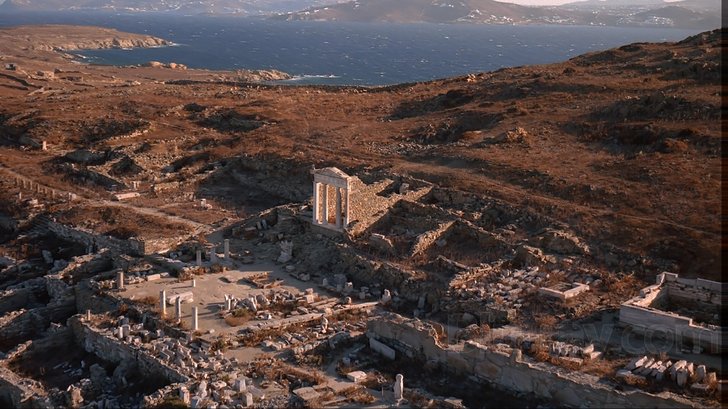
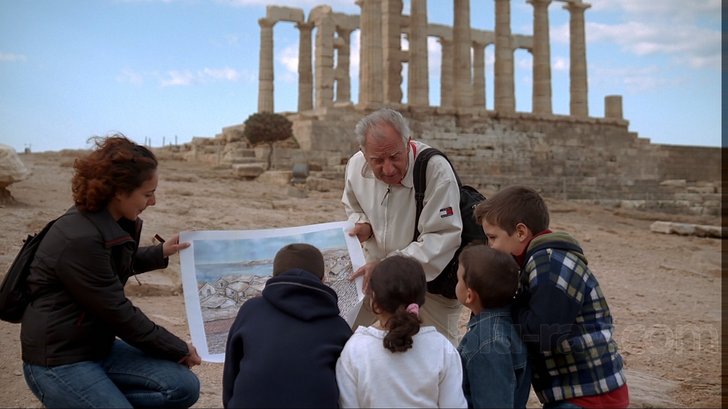
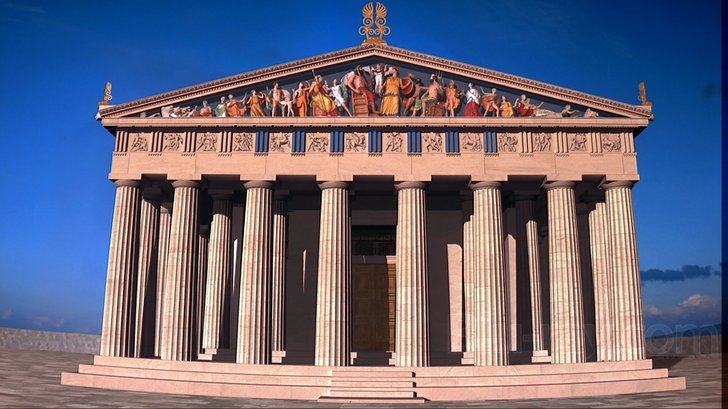
Searching for an organizing principle to structure the film's "quick peak" at a subject so vast, writer Steve Judson decided to use Greek archaeologist Dr. Christian Doumas, a lively and charming character whose voiceover alternates with the narration by actress and writer Nia Vardalos, creator of My Big Fat Greek Wedding. (Thankfully, no Windex jokes are included.) We get a kind of flashback to Dr. Doumas' early years (the young Dr. Doumas is played by actor Christos Sourmelis), when his early discovery of an artifact first confirmed for him that committing his life to the pursuit of archaeology was the right choice. The remainder of the film focuses on two areas of special interest to Dr. Doumas. The first is the destruction of the island community known as Santorini sometime in the second millennium B.C. by a volcanic eruption that is the largest and most destructive ever recorded in known history; the event forms the basis for the legend of Atlantis, and many unanswered questions remain about what happened to ancient Santorini. The second area of special interest to Dr. Doumas is less speculative, because the ruins are one of the most famous tourist destinations in the world: the Parthenon in Athens, which represents the peak of Greek social and cultural achievement. Santorini lies on an island now known officially as "Thera" in the southern Aegean Sea to the east of the Greek mainland. Its extensive and inviting contemporary structures, which look gorgeous in IMAX aerial photography, betray no hint of the natural catastrophe that overtook the island and its residents several thousand years ago. But Dr. Doumas and his various teams continue to unearth and reconstruct artifacts of that ancient civilization from the Bronze Age of which so much is still unknown. This being an IMAX film that attempts to educate by entertaining, the set piece of the Santorini segment is the remarkable CGI reconstruction, using all available data, of how the volcanic event most likely occurred. The effects have been rendered at high resolution and are so remarkably detailed that they look like footage recorded by cameramen who did not survive the experience. The greatest mystery of Santorini is what became of the inhabitants when the volcano erupted. Analysis of the rock layers indicates that the eruption came with no warning and proceeded so rapidly that residents would not have had time to flee. Yet there are no indications of human remains, as there are, for example, at Pompeii. Where did the people go? Dr. Doumas considers several theories, none of them satisfactory, and also examines the difficulty of dating the eruption with precision. The mysteries of Santorini are an ongoing project—a paradigm, in many respects, for the task of archaeology. From Santorini, the film jumps forward over a thousand years to Athens at the height of its power and glory, when it built the Parthenon atop the Athenian Acropolis. The structure was intended as a temple to the goddess Athena, considered by the city to be its principal protector and guardian. It was one of many projects championed by Pericles, an influential statesman and solider often referred to as the "first citizen" of Athens during its Golden Age. As the narration stresses, it was in Athens that many of the most basic elements of our culture were created, including democracy, voting and the performing arts. The centerpiece of this section of the film is one of the most expensive CG shots ever created for an IMAX feature. It begins as a live-action plate: a sweeping aerial shot of the Parthenon ruins just after dawn photographed by MacGillivray from a helicopter. Then, as the craft slowly circles the structure, the shot morphs seamlessly into an artist's line drawing on an architect's table, and from there the complete reconstruction begins. Using high-resolution scans of the actual ruins, plus information gleaned from hundreds of photographs and drawings from all over the world, as well as textual descriptions from numerous ages, the CG artisans proceed to rebuild the Parthenon to its original specifications and decor, right before your eyes. But the shot doesn't stop there. The virtual "camera" enters the building to view the huge, imposing statue of Athena originally housed in the temple. (To provide a sense of scale, Dr. Doumas and his family have been included in the shot.) Watching this icon of the ancient world being restored to its former glory by the latest technology of today may not be anyone's idea of a classical education, but it's eye candy of the highest order. In an observation that has become unintentionally ironic in the years since Greece was released, the film notes that the glory of Athens declined rapidly after the city spent beyond its means and became burdened by debt. The difference from present day, however, is that ancient Athens overspent on war (primarily with Sparta), which, according to many economic historians, is usually the fatal stumbling block for major powers (a recent example being the British Empire in the 20th Century). Ultimately, though, Greece: Secrets of the Past isn't much of a history lesson. It's little more than an invitation to study ancient Greece. Still, it's a far more tempting invitation than the usual list of great books and odd-sounding names. MFF uses all the tools of cinematic entertainment to inspire interest, and if the result is that a few viewers are moved to go out and buy a book (or, more likely, download it to a Kindle or Nook) about Athens or the Bronze Age, that's no small accomplishment for a documentary.
Greece: Secrets of the Past Blu-ray Movie, Video Quality
Blu-ray is an ideal format for showcasing Greg MacGillivray's superb large-format photography, much of it shot with specially modified 70mm cameras. The 1080p, AVC-encoded transfer captures as much detail as the format as capable of holding in MacGillivray's brilliantly colored perspectives on modern-day Santorini, Athens and neighboring environs. Ground-level and underwater views, as archaeological teams dig and analyze, are equally detailed. There is barely any visible film grain, but also no evidence of any post-processing clean-up to remove grain. Why would any clean-up be needed, when the resolution of the source itself is greater than Blu-ray? The transfer has been performed impeccably from an excellent source, and the result needs nothing except accuracy. Where they appear, blacks appear deep and solid; contrast levels are properly balanced; and, as noted, colors are bright and strong without oversaturation. Worthy of special mention is the CGI "Parthenon restoration" sequence, where the temptation must have been strong to overemphasize the colors of the original Parthenon. Certainly, in contrast to the ruins of today, the colors of the reconstruction are unusually intense, but they don't pulse with psychedelic shades. People often look for demo material on Blu-ray, and while the subject matter may not suit your taste, Greece: Secrets of the Past contains one visual after another that shows off a Blu-ray system's capabilities. Highest marks.
Greece: Secrets of the Past Blu-ray Movie, Audio Quality
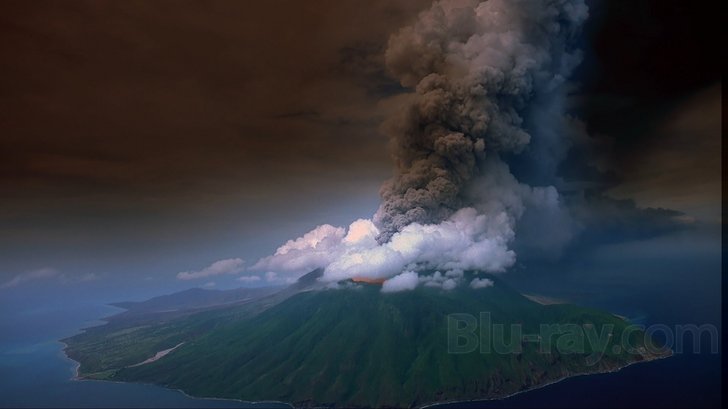
While not as bombastic as a contemporary action film, the 5.1 soundtrack for Greece: Secrets of the Past, presented on Blu-ray in DTS lossless, makes effective use of the discrete format with various panning and rear channel effects. An obvious example occurs in a sort of reenactment where an actress representing Athena appears in a doorway meant to represent the Parthenon's entrance, sweeping aside anyone opposed to her; a roar of sound follows her gesture from left to right. Similar (but even louder) roars accompany the volcanic destruction of Santorini. Sounds of wind and water can be heard at appropriate times, but at other times these drop away to focus on the voices narrating the events and conveying information. There is also a finely calibrated score by Steve Wood, who discusses his musical strategies in the extras.
Greece: Secrets of the Past Blu-ray Movie, Special Features and Extras
- Making Of (SD; 1.78:1, non-enhanced; 22:25): This featurette explores the history of the film, its rationale and some of its challenges through interviews with director MacGillivray, writer (and editor) Judson, producer Alex G. Spanos and members of his family, score composer Steve Wood and others. The film was clearly a passion project for many participants, especially producer Spanos and his family, who are Greek-American.
- History of MacGillivray Freeman Films (HD, 1080p; 1.78:1; 7:37): Though styled as a "history", this short documentary more resembles a "demo reel" for MFF as one of the world's foremost producers of original material in large-negative format.
- Trailershow: Except where indicated, these trailers are HD, 1080p. Each runs about two minutes or less, and a "play all" feature is included.
- Alps
- Grand Canyon Adventure
- Journey into Amazing Caves
- Ride Around the World (SD)
- Super Speedway
- Amazon
- Dolphins
- Magic of Flight
- Dinosaurs Alive
- Hurricane on the Bayou
- Mummies
- Volcanoes of the Deep Sea
- Fighter Pilot
- The Living Sea
- Coral Reef Adventure (HD, 1080i)
- Van Gogh
- BD-Live
Greece: Secrets of the Past Blu-ray Movie, Overall Score and Recommendation
If Blu-ray didn't exist, MFF might have to invent it. IMAX theaters aren't likely to be showing its films on a regular basis to the public at large, because theater owners are too busy trying to extract premium tickets prices for IMAX and IMAX 3D showings of—well, just about anything they can get away with. Very few of the films advertised for IMAX screens were actually created from scratch for those venues, unlike MFF's work. However, thanks to affordable Blu-ray releases like Greece: Secrets of the Past, MFF's films can be seen in the home with a degree of clarity and detail that comes reasonably close to the experience their creators intended. Even if you're only casually interested in the subject matter, Greece: Secrets of the Past is recommended.
Similar titles
Similar titles you might also like
(Still not reliable for this title)

Cave of Forgotten Dreams 3D
2010

Mummies: Secret of the Pharaohs
IMAX
2007

In the Shadow of the Moon
2007

Best of Europe: London & Beyond

Yellowstone: Battle for Life
2009

Best of Europe: Italy

The Universe: The Complete Series Megaset
2007-2009

Best of Europe: France

Scenic Walks Around the World: Our Dramatic Planet

Sports Illustrated Swimsuit 2011: The 3D Experience
2011

The National Parks: America's Best Idea
A Film by Ken Burns
2009

Last Chance to See
2009

Hurricane on the Bayou
IMAX
2007

Planet Ocean
2012

The Alps
IMAX
2007

Wild Africa
2015

Asia
2024

Discovery Atlas: Complete Collection

Wings 3D
2014

Over Ireland
1998