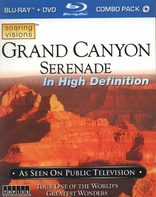
Grand Canyon Serenade Blu-ray Movie
HomeGrand Canyon Serenade Blu-ray Movie 
Blu-ray + DVDTopics Entertainment | 2010 | 52 min | Unrated | Jul 05, 2011

Movie rating
6.4 | / 10 |
Blu-ray rating
| Users |  | 0.0 |
| Reviewer |  | 4.0 |
| Overall | | 4.0 |
Overview
Grand Canyon Serenade (2010)
Sights of the Grand Canyon are set to a variety of classical music pieces.
Director: John Howe| Music | Uncertain |
| Other | Uncertain |
Specifications
Video
Video codec: MPEG-4 AVC
Video resolution: 1080i
Aspect ratio: 1.78:1
Original aspect ratio: 1.78:1
Audio
English: DTS-HD Master Audio 5.1
English: DTS-HD Master Audio 2.0
Subtitles
None
Discs
25GB Blu-ray Disc
Two-disc set (1 BD, 1 DVD)
DVD copy
Packaging
Slipcover in original pressing
Playback
Region A (B, C untested)
Review
Rating summary
| Movie | | 4.0 |
| Video |  | 4.5 |
| Audio | | 4.5 |
| Extras |  | 2.5 |
| Overall | | 4.0 |
Grand Canyon Serenade Blu-ray Movie Review
Amazing views and gorgeous music.
Reviewed by Jeffrey Kauffman August 24, 2011When is ambient television not ambient television? When it’s a piece that is supposedly meant to be virtual wallpaper but is so entrancing you actually want to pay attention to it. Topics Entertainment has really been stretching the boundaries of this once pretty forgettable genre, releasing several excellent titles that might be lumped into this category but which are decidedly better and more involving than many “environmental” releases. Grand Canyon Serenade is a lovely compilation of footage taken in and around one of the wonders of the United States, set to an appealing variety of classical pieces, both orchestral and small scale. There’s no narration at all, which means this Blu-ray can play as a background screensaver when you have parties and simply want something on your flatscreen, or indeed it can actually be watched, and, more importantly, enjoyed. The Grand Canyon is such an awesome sight that it provides a wealth of opportunities for grand vistas and more claustrophobic canyons and waterways, and director-cinematographer John Howe does an admirable job of covering the immense territory of the region, offering an abundance of aerial footage interspersed with ground level views of a variety of odd geologic forms and raging rivers. It may strike some as odd that in a piece dedicated to the Grand Canyon and classical music that Ferde Grofe’s Grand Canyon Suite isn’t utilized even one whit, but the choices of music here make for an often elegant marriage of image to sound, one that makes this release another very commendable ambient television offering that helps to subtly elevate exactly what titles like this can really do with the idiom.
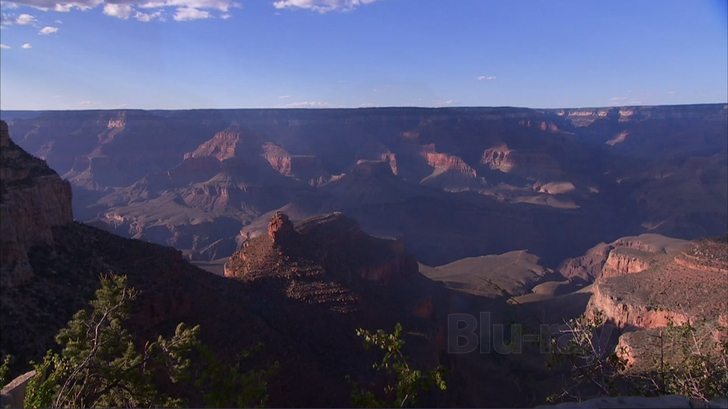
The Grand Canyon is usually thought of as such a monolithic “structure” (or anti-structure as the case may be), that it’s perhaps surprising to realize that the region is made up of vastly different looks and ecosystems, and is in fact filled with a number of intriguing nooks and crannies, several of which Grand Canyon Serenade peeks into with some glorious imagery. However, the piece starts out with some languid aerial shots of the vast vistas that greet visitors to the Canyon, set to Dvorak’s gorgeous Serenade for Strings in E Major, Op. 23, Movement IV, Larghetto (another movement of this fabulous piece shows up later in the Serenade). One of the most amazing sights in this opening sequence is an absolutely vertical rainbow seemingly shooting either straight down from or straight up to the heavens, with incredibly deep colors.
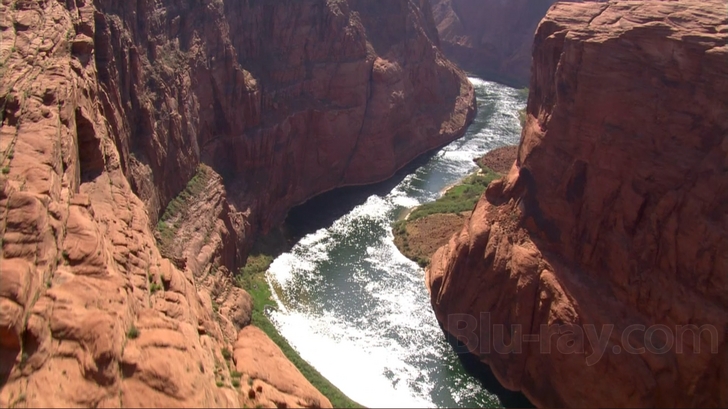
There was huge controversy when Glen Canyon Dam was built decades ago, but the huge expanse of the Dam and the lake (Powell) it created are covered in the next sequence, set to Erik Satie’s quietly mournful piece for solo piano Gymnopedie No. 1 (made famous in the late 1960’s as a flute piece on Blood, Sweat and Tears’ second album). Some of the astoundingly different colors available for view in the Grand Canyon are on display here, from the Vermillion Cliffs to the deep brown muddy water of some raging rapids. The Act I Valse Lente from Delibes’ Coppelia provides the next underscore as we get some more water scenes, as well some nice cloud time lapse photography (something Grand Canyon Serenade utilizes fairly liberally throughout its brief running time).
Dvorak’s Serenade is back, this time the opening movement (Moderato), which provides a perhaps anachronistic underscore to both the President Harding Rapids as well as the incredible Anasazi Cliff Dwellings which can be seen high up on several sheer vertical drops. Several of these cliff dwellings throughout the Four Corners region can be visited and I highly recommend them. I still have wonderful memories of my father taking me to them on a special father-son vacation we did when I was a kid, and I still remember making poor old Dad repeatedly climb up the rope ladders to get to several of these incredible “homes” carved out of ledges and the like, as I wanted to go back to them over and over, so unusual and striking did they seem to my young eyes.
Some of the most frankly unbelievable looking color is featured in the next sequence, which takes us to the Little Colorado River, set to the Grand Adage a la Rose from Act I of Tchaikovsky’s The Sleeping Beauty. While a lot of the water running through the Canyon is either frothy or downright dirty and mucky looking, this particular section of the Little Colorado sports the most amazing baby blue hue imaginable, something that looks like some telecine colorist went a little mad with color timing. It’s an almost unreal looking color that pops impressively on this Blu-ray.
The haunting Sicilienne from Faure’s gorgeous Pelleas and Melisande is up next, in one of the most beautiful sequences of Grand Canyon Serenade, one which offers shadows growing over various landscapes, as well as drifting shadows of clouds, as day slowly turns to night. We get some beautiful shots of mists floating through glints of sunlight, and this entire segment features some really sumptuous looking dappled light which dances gloriously on the impressive topography of the Canyon. More time lapse photography of clouds and shadows also accompanies Vivaldi’s Concerto for Two Oboes, Op. 42, Movement I (Allegro).
The wonderfully named Elves Chasm, probably something very few visitors to the Grand Canyon know exists or have ever visited, is up next, set to Grieg’s Rigaudon from the Holberg Suite, Op. 40. This sequence offers some up close and personal shots of a waterfall enclosed in the rusty arms of a mini-canyon. We then get some really lovely shots of various brightly colored wildflowers. Several more disparate pieces, including works by von Weber, Respighi and Smetana, follow in quick succession as Grand Canyon Serenade gives us shots of everything from imposing cliffs to birds foraging to several creeks and water features, including some fiercely raging rapids.
The autumnal sounds of Brahms and Dvorak start to bring Grand Canyon Serenade to a close. Brahms’ Ever Softer Grows My Slumber from Five Songs, Op. 10 accompanies beautiful shots of Havasu Falls with its cascading green waters and brightly colored butterflies. The first movement of Dvorak’s iconic Ninth Symphony in E Minor (From the New World) accompanies more shots of boats fording some incredibly muddy and vicious looking water.
Perhaps the most distinctive sight of all is saved for almost last, set to another small scale lyrical piece by Erik Satie, in this case the Gnossienne No. 1. This is a quieter interlude, which starts with point of view shots of muddy brown water taken from the bow of a boat. After some aerial shots of a huge algae field encroaching on a lagoon, we get one of the most unusual features in the entire Grand Canyon, the really incredible looking Pumpkin Springs. If you’ve never seen this amazing and somewhat whimsical sight, prepare yourself for a little chuckle as you visit a place that might be a perfect campsite for Halloween.
Grand Canyon Serenade comes to a conclusion as the plaintive tones of the Satie piece wind down and we get a few parting shots of sunsets with no music. This may not in fact replace actually visiting and spending time in the vast expanses of the Canyon, an experience everyone really should try to have at least once in their lifetime, but this Serenade is a unique and appealing way for armchair travelers (and classical music enthusiasts) to spend an hour or so soaking up some incredible sights while listening to some glorious music.
Grand Canyon Serenade Blu-ray Movie, Video Quality
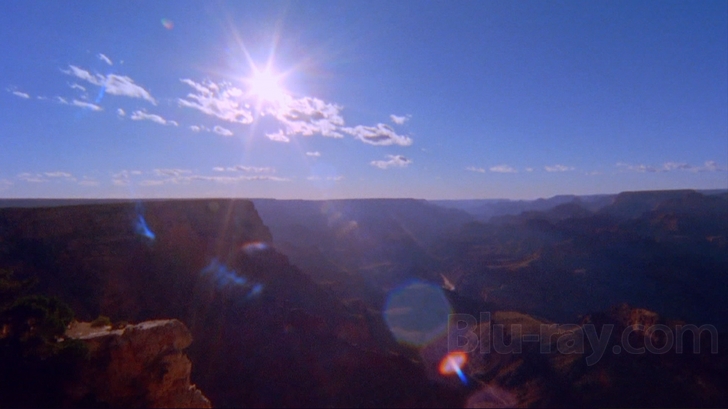
Topics Entertainment continues to impress with another AVC encoded 1080i transfer in 1.78:1. Despite its interlaced source material, Grand Canyon Serenade exhibits few if any artifacting issues and in fact looks razor sharp almost all of the time. Depth of field is awesome in this piece, especially in the many aerial shots which are liberally sprinkled throughout the piece's 52 minute running time. Colors are beautifully natural and gorgeously saturated. Some of the deep purples of the Canyon are beyond majestic and that baby blue water of the Little Colorado River mentioned above in the main body of the review simply has to be seen to be believed. There are evidently some stock shots utilized (if one is to believe the credits) and that may account for the relative softness of a few interstitials, but overall everything here is clear, precise and well defined.
Grand Canyon Serenade Blu-ray Movie, Audio Quality
Two lossless audio options are offered on Grand Canyon Serenade, a DTS-HD Master Audio 5.1 surround mix and a DTS-HD Master Audio 2.0 stereo fold down. This Topics release features a little bit less of ambient environmental effects mixed in with the music, probably because the music is such an integral part of this offering. The classical performances were licensed from a music production house called Uniquetracks (can you say "royalty free"?), and so no performer information is listed in the credits, and while I wouldn't accuse any of these performances of being standard bearers, they're all perfectly competent and rousing when they need to be. Both DTS tracks sound great, with the 5.1 track offering decent surround activity, albeit activity without a lot of discrete channel effects. Fidelity is excellent throughout, and dynamic range is also superb as evidenced by the change from orchestral sequences to solo piano ones.
Grand Canyon Serenade Blu-ray Movie, Special Features and Extras
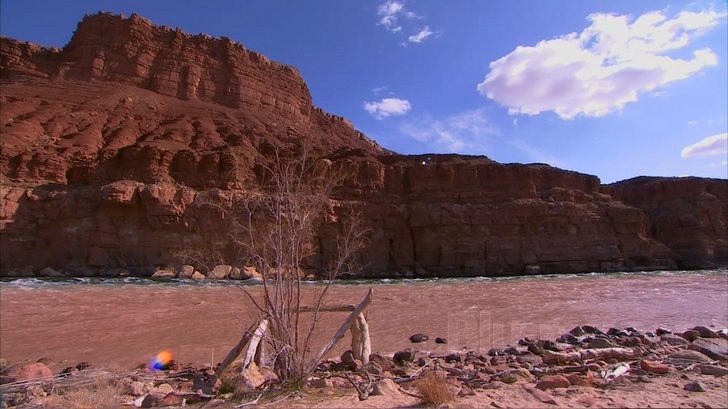
- Beginnings (1080i; 5:49). Perhaps called Beginnings due to its peek at the headwaters of the Colorado River, this featurette also visits Dead Horse Point, Canyonlands National Park and Glen Canyon, set to The Dove from Resphighi's The Birds Suite for Orchestra.
- The Journey Continues (1080i; 5:14). Chopin's Berceuse Op. 57 accompanies shots of Lake Mead.
Grand Canyon Serenade Blu-ray Movie, Overall Score and Recommendation
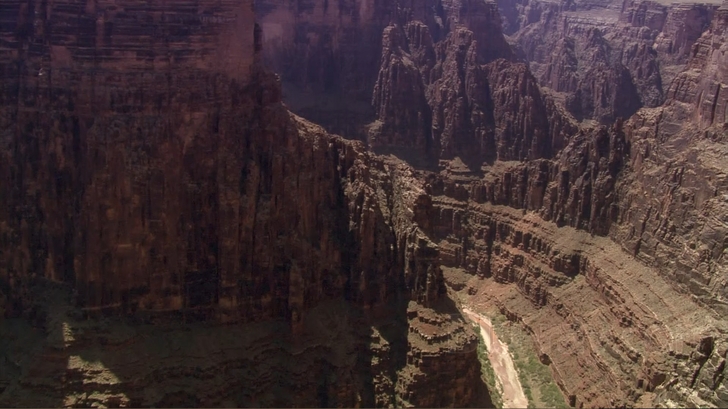
Grand Canyon Serenade is yet another largely sterling release from Topics Entertainment, a boutique label which continues to present ambient television offerings which actually raise the bar rather significantly from the typical fish or train items (though truth be told Topics has a few of those titles as well). Filled with glorious imagery and some nice classical music, this is a piece which can play in the background if needed but which actually warrants paying attention to if you're so inclined. Recommended.