Gounod: Mireille Blu-ray Movie
HomeGounod: Mireille Blu-ray Movie 
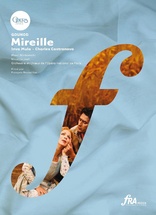
Inva Mula/Minkowski / Opéra national de ParisHarmonia Mundi | 152 min | Not rated | Jan 11, 2011

Movie rating
Movie has not been rated yetBlu-ray rating
| Users |  | 0.0 |
| Reviewer |  | 4.0 |
| Overall | | 4.0 |
Overview
Gounod: Mireille ()
| Music | 100% |
Specifications
Video
Video codec: MPEG-4 AVC
Video resolution: 1080i
Aspect ratio: 1.78:1
Original aspect ratio: 1.78:1
Audio
French: DTS-HD Master Audio 5.1
French: LPCM 2.0
Subtitles
English, French, Spanish, German, Italian
Discs
50GB Blu-ray Disc
Single disc (1 BD)
Playback
Region A (B, C untested)
Review
Rating summary
| Movie | | 4.0 |
| Video |  | 4.5 |
| Audio | | 4.5 |
| Extras |  | 3.0 |
| Overall | | 4.0 |
Gounod: Mireille Blu-ray Movie Review
Mistral's daughter.
Reviewed by Jeffrey Kauffman January 18, 2011Lovers of classical music and opera on Blu-ray have had to make do mostly with releases from Naxos distributed labels like Opus Arte and ArthausMusik. “Making do” is a relative term in this case, as Naxos’ releases are often stellar, hugely disparate in approach and well modulated between hoary classics and lesser known fare. Sprinkled into this Naxos lion’s share are passing releases from a handful of other labels. We’ve had a few great releases from Decca on Blu in both the classical and pop music categories, and Harmonia Mundi has also seen fit to release at least a couple of their titles on Blu. Harmonia Mundi is of course one of the iconic imprints in the classical music world, and one hopes that we’ll see more hi-def releases from them, as their few releases thus far have been really exceptional. The sadly infrequently performed Gounod opus Mireille follows that tradition, with an elegant and visually arresting physical production and some lovely singing from soprano Inva Mula.
Is Gounod the Rodney Dangerfield of French opera? While his Faust and Romeo et Juliette receive high marks and frequent productions, even the French themselves have never really cottoned to Mireille. This quiet and intimate piece is based on Mireio, a poem by Provençal poet Frédéric Mistral, a writer who wanted his native language to be as recognized and lauded as French. The poem was published in a dual-language version (Provençal and French), where it became something of a sensation and soon attracted the attention of Gounod, who recognized its inherent dramatic possibilities. The poem was adapted by librettist Michel Carré, who took a few dramatic liberties but hewed fairly closely to Mistral’s original conception, one rooted deeply in the traditions and culture of Provence as it told the story of starcrossed lovers Mireille (Mula) and Vincent (Charles Castronovo).
One of the problems Mireille has encountered through the years is its admittedly smaller scale and lack of, well, operatic drama. Mireille and Vincent come from different classes, though neither is a member of the opulent rich, frequently the world of Grand Opera, especially in the 19th century. And, really, not very much happens in the piece. Even the one truly operatic moment, when bull tender Ourrias (Franck Ferrari), who has amorous intentions toward Mireille, viciously attacks Vincent, Gounod seems to struggle musically to provide the menace and violence that are needed to make the moment truly horrifying. Instead Gounod works on a tamer canvass, evoking the folksongs of the region in music that is frequently lilting and set in triple meters. This is most certainly not the hyperbolic world of the Italian composers of the same era, and it’s perhaps easy to dismiss Mireille as a second string work from a composer some critics have themselves relegated to the second string.
And yet there’s much to love in this piece, including some wonderfully evocative melodies which manage to reveal nuances of character while remaining unassuming and unpretentious. This is most certainly the case with the character of Mireille, despite the often repeated critique that a simple girl could never rise to the operatic heights of such arias as “En marche.” But under the skillful direction of Nicolas Joel, newly appointed leader of the National Opera of Paris, and with the expressive talents of Mula, these criticisms seem less apt, at least with regard to this particular outing.
Incredibly, Mireille had never before received a production at France’s national opera house, and in fact the National Opera’s former director was on record as thinking that Gounod was indeed a second string composer. Perhaps Joel’s intention here was not just to mount an important piece of France’s own operatic history, but to make a point that the National Opera was under his figurative baton now, and things were going to be different. This production is under the literal baton of conductor Marc Minkowski, who conducts here with a fine ear for shaping Gounod’s dance like phrases, maintaining an excellent balance between the inherent simplicity of Gounod’s musical lines while achieving a fair amount of drama in the interpretation.
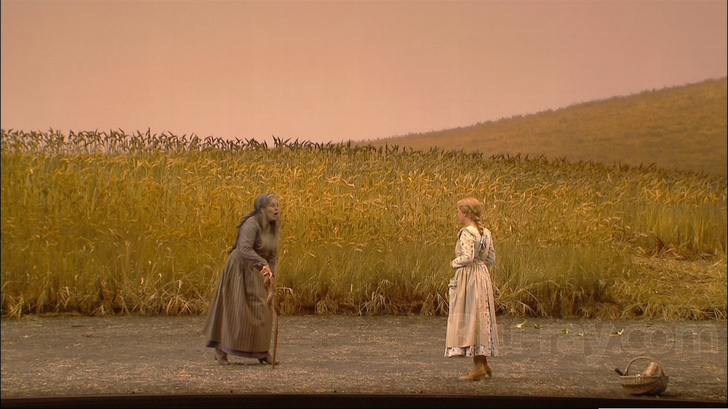
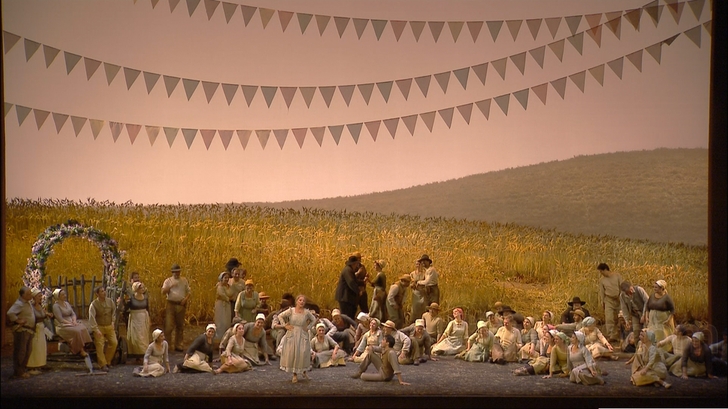
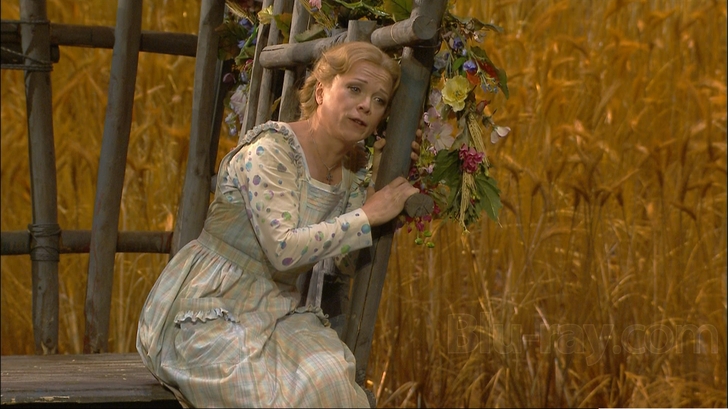
This is a physically resplendent production, one filled with the amber light and waving wheat of southern France. In fact this is one of the most elegantly lit opera productions in recent memory, with wonderfully subtle sections of the stage lit with slight gradations of hue that are most pleasing to the eye. Notice for example in the opening scene how the face of the “good witch” Taven (Sylvie Brunet) is kept darker than the faces of the young girls who are excitedly singing about the joys of an agrarian life. It’s really remarkable and just one moment that shows that though this might not be a bombastic piece, it has nonetheless been approached with an impressive eye for detail.
The world of 19th century opera is more often than not one of huge emotions, grandiose music and opulent settings. Occasionally it’s nice to have a piece which celebrates the glories of the “common man.” Though it’s ultimately a semi-tragic piece (depending on your own personal view of salvation), Mireille is like a breath of fresh air in a frequently stagnant opera house. Quiet, unassuming, almost intentionally non-dramatic at times, though removed stylistically from the bel canto world of Donizetti, this piece reminds me of that Italian’s penchant for unpretentious, relatively simple fare. Maybe it’s finally time for this underappreciated gem in Gounod’s oeuvre to get the respect it really deserves.
Gounod: Mireille Blu-ray Movie, Video Quality
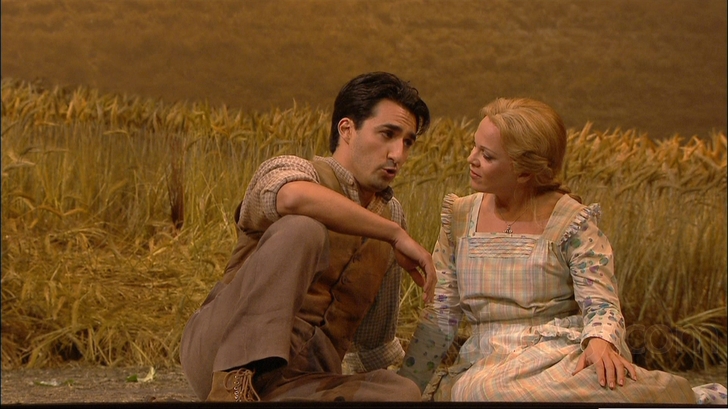
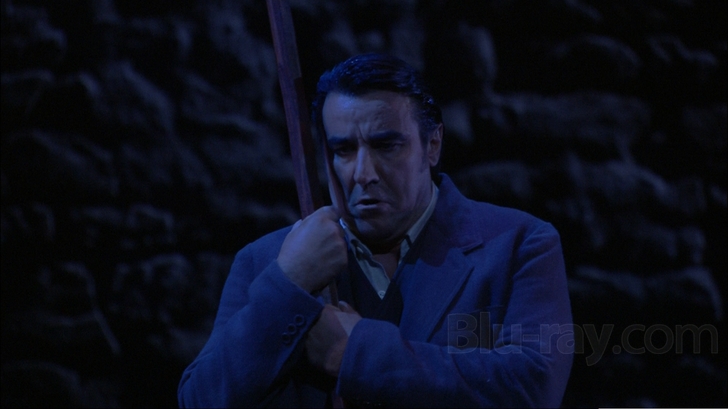
The production design and lighting of Mireille are extremely impressive and they are delivered very well to this Blu-ray via an AVC encode, in 1080i and 1.78:1. The first two acts are lit with a beautiful golden-amber hue, which perfectly evokes late summer-early fall afternoons and harvest time. Discrete lighting effects, as mentioned above in the main body of the review, are fantastic. The last three acts are by contrast lit in a cool, dark cobalt blue hue, icy cold and menacing. The production design, especially in the "haunted" riverscape, is wonderful, and the Blu-ray offers excellent saturation and solid and stable black levels. Some of the diffuse lighting adds just a touch of softness to the image, but it's completely in keeping with the general tenor of Mireille. Close-ups reveal a wealth of fine detail and overall this Blu-ray has a strong, sharp and clear image.
Gounod: Mireille Blu-ray Movie, Audio Quality
Mireille is presented with two wonderful lossless soundtracks, a DTS-HD Master Audio 5.1 and an LPCM 2.0 stereo mix. Anyone expecting the bombast and emotional hyperbole of the Italian composers or even Berlioz, or in fact Gounod himself in such works as Faust, may initially be disappointed in this score, which works a resolutely smaller scale (no pun intended), with an emphasis on gentle string motifs and wind accents. This is a lilting, dance-like score built around a wealth of triple meters, and it floats like a leaf in the late summer breeze, wafting gently from theme to theme with only very rare and passing storms to upset the overall placid ambience. That in fact may be why Mireille is not generally seen as the top tier of Gounod's achievement, as there are dramatic moments in the libretto that are set in this same languid manner. But even given these caveats, the recording itself is splendid, with excellent work from the ensemble and orchestra, and outstanding work from Mula, whose full tone never wavers in one of the more demanding soprano roles of this era. Surround channels are utilized effectively, especially in some moments when the ensemble sings offstage. Balance between the orchestra and the vocalists is also excellent. There's not a whole lot of dynamic range in this piece, by Gounod's own design, but fidelity here is brilliant and precise, with excellent clarity.
Gounod: Mireille Blu-ray Movie, Special Features and Extras
From Mistral to Mireille (1080i; 26:54) is an interesting featurette giving a lot of background information on the opera, including in depth interviews with Joel and Minkowski.
Gounod: Mireille Blu-ray Movie, Overall Score and Recommendation
Take a chance on something a little off the beaten operatic track with Mireille. There's no denying there are some dramatic inadequacies in Gounod's setting, but the overall story is so charming, albeit slight, and filled with such a feeling of time and place that it's easy to put these qualms aside and just enjoy this piece for what it is. Aided by a really beautiful physical production and some outstanding singing, this Blu-ray will hopefully put Mireille back on a path toward critical reevaluation. Recommended.