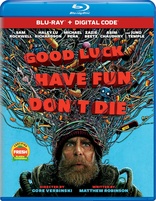
Good Luck, Have Fun, Don't Die Blu-ray Movie
HomeGood Luck, Have Fun, Don't Die Blu-ray Movie 
Blu-ray + Digital CopyUniversal Studios | 2025 | 134 min | Rated R | Apr 21, 2026

Movie rating
7.3 | / 10 |
Blu-ray rating
| Users |  | 0.0 |
| Reviewer |  | 4.0 |
| Overall | | 4.0 |
Overview
Good Luck, Have Fun, Don't Die (2025)
A "Man From the Future" arrives at a diner in Los Angeles where he must recruit the precise combination of disgruntled patrons to join him on a one-night quest to save the world from the terminal threat of a rogue artificial intelligence.
Starring: Sam Rockwell, Juno Temple, Haley Lu Richardson, Michael Peña, Zazie BeetzDirector: Gore Verbinski
| Dark humor | Uncertain |
| Sci-Fi | Uncertain |
| Comedy | Uncertain |
| Adventure | Uncertain |
| Action | Uncertain |
Specifications
Video
Video codec: MPEG-4 AVC
Video resolution: 1080p
Aspect ratio: 2.39:1
Original aspect ratio: 2.39:1
Audio
English: Dolby Atmos
English: Dolby TrueHD 7.1 (48kHz, 24-bit)
Subtitles
English SDH, French, Spanish
Discs
Blu-ray Disc
Single disc (1 BD)
Digital copy
Packaging
Slipcover in original pressing
Playback
Region free
Review
Rating summary
| Movie | | 4.0 |
| Video | | 4.0 |
| Audio |  | 5.0 |
| Extras |  | 0.5 |
| Overall | | 4.0 |
Good Luck, Have Fun, Don't Die Blu-ray Movie Review
Reviewed by Justin Dekker April 24, 2026Briarcliff's science-fiction adventure thriller 'Good Luck, Have Fun, Don't Die' arrives on Blu-ray disc courtesy of Universal. Directed by Oscar
winner Gore Verbinski ('Pirates of the Caribbean'), the films stars Sam Rockwell ('Three Billboards Outside Ebbing, Missouri'), Juno Temple ('Ted
Lasso'), Zazie Beetz ('Joker'), and Haley Lu Richardson ('The White Lotus') in a story that casts a critical by darkly funny gaze at our present and
postulates a future that is far from Utopian. The South African production features impressive practical sets, and an engaging and energetic Dolby
Atmos audio track. A Digital Code redeemable via Movies Anywhere is also included.
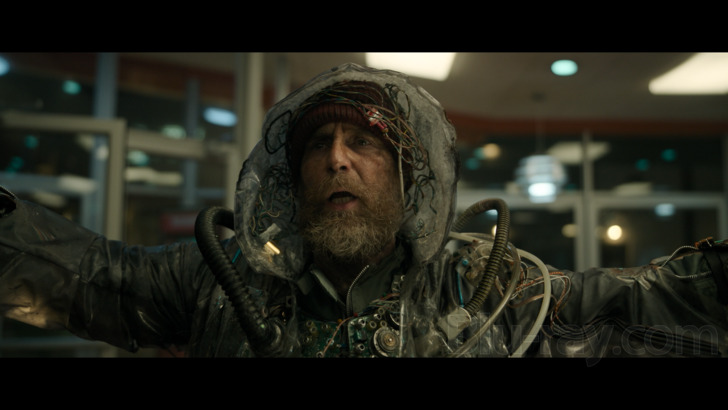
Late one night, a strangely dressed man (Sam Rockwell) claiming to be from the future bursts into a diner, and after critiquing our modern cellphone-
obsessed society, recruits an eclectic assortment of its patrons to assist him in preventing an effectively world-ending AI generated apocalypse. The
rag-tag group including a pair of teachers (Zazie Beetz and Michael Peña), a grieving mother (Juno Temple), and birthday party entertainer with an
unusual medical condition (Haley Lu Richardson) has mere hours to overcome numerous obstacles, from the mundane to the bizarre, to reach their
objective and avert disaster.
One of the most interesting elements of science fiction has always been the genre's tendency to employ exotic locations and unusual or "alien" characters to examine or comment on the world in which we live, or the world we fear is coming. By setting these events on distant worlds or in the future, it allows the very real and contemporary issues to feel less threatening; they're disconnected from our world and therefore safe to critique and explore. For example, set in our future, Robert Heinlein’s novel Starship Troopers addresses some of the issues tackled in this film as he comments on civic responsibility, societal and moral decay, and the need for miliary muscle to protect the futuristic society's safety from the "bugs" that threaten it. Philip K. Dick's novel Ubik does as well, as his story tackles consumer culture, grapples with questions regarding the nature reality, and plumbs the meaning of life and death, all while demonstrating the destructive nature of time. Both of these novels are set in worlds not terribly unlike our own, but they are conveniently tucked away in the far-future of Heinlein's novel some 700 years distant, and Dick's dystopian then near-future of 1992 as envisioned from 1969, now our parallel Earth's past. In any regard, the questions asked and the answers readers arrived at are somewhat sanitized for our protection by virtue of their setting. The science-fiction-fueled satire of Good Luck, Have Fun, Don't Die offers a similar shield as some of the elements and institutions present in that world are foreign to our current reality, but the majority of what is displayed and examined is directly analogous to our own.
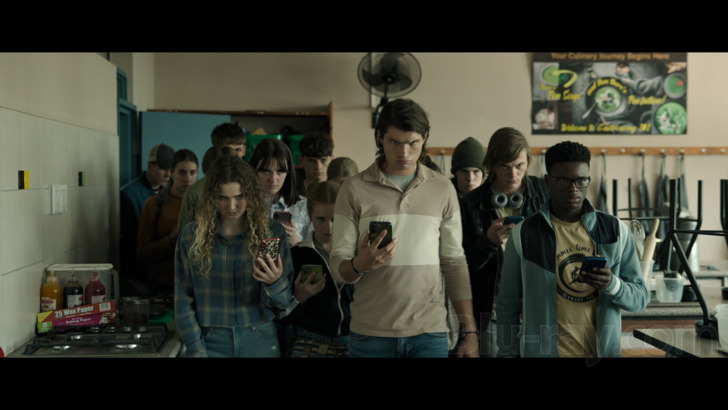
Without spoiling much of the film, it is safe to say that cell phone "addiction" is blatantly on display in the early goings of Good Luck, Have Fun, Don't Die. Phones are being used by many of the patrons at Norm's before The Man From the Future (Rockwell) removes the ubiquitous devices from their hands in dramatic fashion. As substitute teacher James (Peña) surveys the school room at the start of class, he's irritated and amazed to see every student with their nose buried in their phone as they complain about actually having to read a real book in a literature class in a generationally stereotypical low-key and entitled manner. Why should they have to read if there is a movie version (with Kiera Knightly!) or an audio book to consume instead? The students are perturbed and resistant when he asks them to put the devices away, and that certainly rings true. So, too, is the frustration and resignation over the matter displayed by the other teachers. Banishing phones simply isn't worth the work.
As The Man From the Future is keen to point out, modern technology in general, and phones and social medial specifically, aren't helping people get better. Or smarter. While it's described and depicted in the film in a much more extreme way, boiling his comments down underscores that those early morning phone checks lead to extended doom scrolling, bed rotting, and brain rot, with all of the implications thereof. Science bears this out to some degree, with neuroscientist Jared Cooney Horvath recognizing alarming trends in the data from standardized testing of school-aged children and comparing it to that of other age groups. The data paints a picture of falling scores relating to attention, memory, literacy, mathematics, executive function, and IQ. These declines seem to be linked to the introduction and proliferation of technology in the classroom and in the students' personal lives. The ultimate conclusion and take-home message is that Gen Z will be the first generation to be "dumber" than the one that came before. Hardly a ringing endorsement for technology. Striking a bit closer to a passion all who frequent this site share and also in line with those findings, "The Atlantic" published a piece earlier this year where, after conversations with a varied group of film studies professors, it was revealed that modern college students lack the attention span necessary to watch a film in one sitting. Further, to counter the tendency and propensity of people using their phones while watching their films, Netflix has explicitly described their current filmmaking strategy of routinely repeating plot points, and recapping what has happened and what should come next as well. They also drop in big action set-pieces every five minutes or so to entice these "viewers" to look up from their phones to witness a crash, an explosion, a fight, or a chase, even if it's only briefly. Not unique to that streamer, it's something I've noticed in other films and series, and it only serves to slow momentum at best and insult attentive viewers and hamstring storytelling at worst. More anecdotally, at a recent performance of Florence and the Machine that I had occasion to attend, Florence herself took a moment near the end of the set and before bursting into "Dog Days are Over" to emphatically and enthusiastically implore the audience to put away their phones and simply experience the song with their friends, the band, and the thousands in attendance. While many complied with the very reasonable request, there were a number I could see in my immediate vicinity who steadfastly continued to experience the concert through the small glowing screens their phones. Rockwell's The Man From the Future would likely have something to say about that, too.
Throughout all of the on-screen mayhem, Rockwell is never less than engaging. With boundless manic energy, he manages to portray a character who may be from the future, but could just as easily simply be insane. Like those in the diner and even among his recruits, his actions result in crafting an audience reaction that is a precarious mix of belief and incredulousness. We often want to trust in what he's saying more than we think we should. Temple's grief is palpable, and her shellshocked presence highlights the dangers of their modern world, with the reactions of some her peers demonstrating the overall callousness and perversity of her society, the diminished value placed on human life, and the blurred line between life and death. Their performances, and those of the rest of the cast are significantly aided by the massive and elaborately dressed sets in which the film's action transpires, with Norm's being especially authentic and dazzling. And, while significantly more simple by comparison, the location of the final battle similarly delights. It may be a world gone wrong, but it's wonderfully crafted.
Good Luck, Have Fun, Don't Die Blu-ray Movie, Video Quality
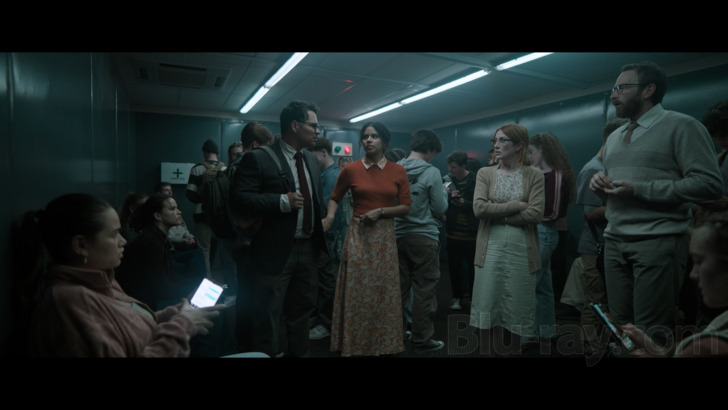
Good Luck, Have Fun, Don't Die has been given a good-looking AVC-encoded 1080p transfer. The film was captured by James Whitaker, ASC who used an Alexa LE and modified Panaspeed lenses which give the image a sharp and crisp center but allow the the edges to darken slightly and fall out out of focus, creating an intentional general softness at the periphery, and giving the film an almost dream-like quality. The film largely features a slightly desaturated palette and environments with mindfully crafted practical lighting solutions that create the impression that the sets are shot with ambient lighting. As a result, interiors are slightly drab and slightly to moderately darkened spaces are the norm, adding to the overall creepiness of the opening diner scenes, and the scene in and around the high school. They also work to depict our technologically obsessed culture as less than ideal. There are some relatively bright moments of the film, such as the time we spend in the front of the house in the diner, with Ingrid at some birthday parties, and with Susan outside the school and at her acquaintance's posh home. Fine detail levels here are quite pleasing, with facial, and, more importantly, costuming particulars open for inspection. However, the bulk of the film takes place in darkened hallways, nocturnal streets and neighborhoods, and dimly lit homes. In these moments character and environmental details can be somewhat more difficult to observe. Skin tones are generally healthy, though there are scenes where they are negatively impacted by lighting choices, such as when Susan goes to the store, when they can appear more pasty and washed out.
Good Luck, Have Fun, Don't Die Blu-ray Movie, Audio Quality
The film's Dolby Atmos track provides a near-constantly immersive experience. Sometimes it opts for greater subtly, adding ambient sounds at the diner, on the darkened city streets, and at the high school where Michael Peña's Mark and Zazie Beetz' Janet are working when we first meet them. At other times, the immersive elements are much more aggressive and room-filling, such as when the stage is filled with the deep throaty rumble of an engine belonging to the car used by a pair of masked gunmen. Another impactfully immersive moment occurs when Susan's (Juno Temple) panicked and emotional breathing as she sits in her car at the high school surrounds the viewer, adding to the emotional quotient of the scene. It's a simple thing, but clever. Music is handled very well, with thick bass lines punctuated and accompanying various moments, and sound separation is impressive. Directionality is accurate, with objects and voices being well-placed and moving smoothly and realistically through the stage. Heights are leveraged to add realism to circling helicopters, explosions, and the like. Bass is hefty, adding excellent depth to gunshots from shotguns and automatic weapons, the previously mentioned explosions, crumbling walls, crashing cars, and the film's score, which is sometimes allowed to dominate. Dialogue is typically kept front and center, and echo realistically in the cavernous spaces used for some of the scenes. In all moments, they're properly prioritized and sit neatly on top of the frequent bursts of mayhem. It's a lovely track.
Good Luck, Have Fun, Don't Die Blu-ray Movie, Special Features and Extras
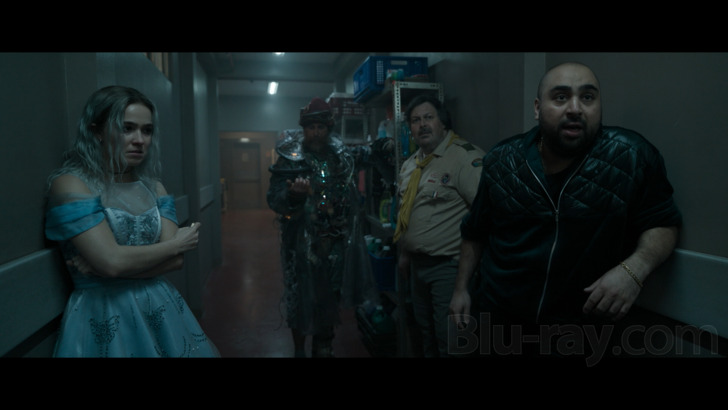
Good Luck, Have Fun, Don't Die is outfitted with one light on-disc supplemental feature as below.
- The Making of 'Good Luck, Have Fun, Don't Die' (5.07) - Sam Rockwell, Juno Temple, Zazzi Beetz, and Michael Peña quickly comment on a host of subjects including their characters, costumes, sets, and the film's director.
Good Luck, Have Fun, Don't Die Blu-ray Movie, Overall Score and Recommendation
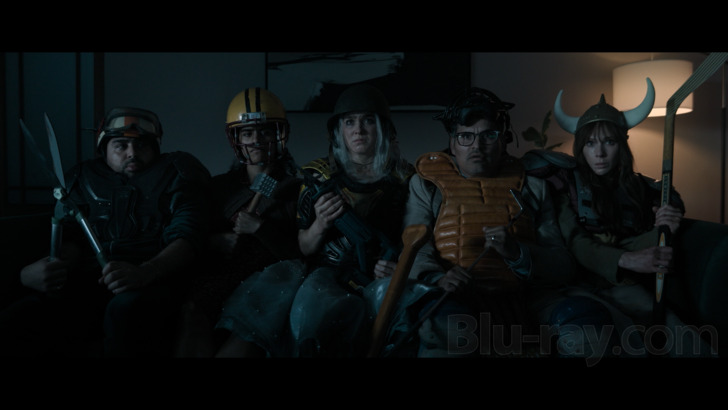
The world of Good Luck, Have Fun, Don't Die is eerily akin to contemporary America. It's a place where cell phones are everywhere and the implementation of AI without first having established and implemented guardrails or safety parameters is the greatest threat to Ingrid, Janet, and James' survival, and is the chief architect of the apocalyptic future Rockwell's character is attempting to rewrite. Frenetic, darkly funny, and tense, the film dabbles in a number of meaty themes as The Man From the Future struggles to keep his team alive long enough to complete his mission. With a solid video presentation and an energetic Dolby Atmos track Good Luck, Have Fun, Don't Die comes strongly recommended.

Similar titles
Similar titles you might also like

The Brothers Grimsby
2016

The Running Man 4K
2025

This Is the End
with bonus disc
2013

Mars Attacks!
1996

AVGN X Collection
Angry Video Game Nerd Episodes 1-100
2004-2011

Four Rooms
1995

Death at a Funeral
2007

Operation: Endgame
2010

Fleabag: The Complete Series
2016-2019

Dirty Work 4K
1998

The Hangover Part III
2013

Team America: World Police 4K
20th Anniversary Limited Edition
2004

It's Always Sunny in Philadelphia: The Complete Season 6
2010

Edge of Tomorrow 4K
Live. Die. Repeat.
2014

Curb Your Enthusiasm: The Complete Series
2000-2024

Tropic Thunder
Director's Cut
2008

The Man from U.N.C.L.E. 4K
Special Edition
2015

Monty Python and the Holy Grail 4K
50th Anniversary Edition
1975

Zombieland
2009

Mystery Team
Vestron Collector’s Series
2009