Going Clear: Scientology and the Prison of Belief Blu-ray Movie
HomeGoing Clear: Scientology and the Prison of Belief Blu-ray Movie 
FilmRise | 2015 | 120 min | Not rated | Oct 06, 2015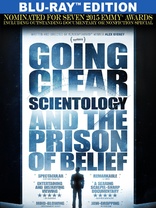

Movie rating
7.8 | / 10 |
Blu-ray rating
| Users |  | 4.0 |
| Reviewer | | 4.0 |
| Overall | | 4.0 |
Overview
Going Clear: Scientology and the Prison of Belief (2015)
An in-depth look at the inner-workings of the Church of Scientology.
Starring: Paul Haggis, Jason Beghe, Sylvia Taylor (III), Lawrence Wright, Mike RinderDirector: Alex Gibney
| Documentary | 100% |
Specifications
Video
Video codec: MPEG-4 AVC
Video resolution: 1080p
Aspect ratio: 1.78:1
Original aspect ratio: 1.78:1
Audio
English: Dolby Digital 5.1
English: Dolby Digital 2.0
Subtitles
English SDH
Discs
Blu-ray Disc
Single disc (1 BD)
Playback
Region A (B, C untested)
Review
Rating summary
| Movie | | 4.0 |
| Video | | 4.0 |
| Audio |  | 3.5 |
| Extras |  | 0.0 |
| Overall | | 4.0 |
Going Clear: Scientology and the Prison of Belief Blu-ray Movie Review
Reviewed by Jeffrey Kauffman July 22, 2017If there’s one thing relatively recent scandals involving two institutions which at least call themselves churches make clear, it’s that
tyranny and denial simply aren’t able to hold water in today’s ultra-connected world with its relentless news cycle. The Catholic church is still
coming to terms with its longstanding sex abuse issues, but the fact that the church has entered into repeated financial settlements with victims,
with the Pope himself apologizing for the crimes, indicates that old strategies of sweeping everything under the rug have been largely abandoned.
Scientology’s troubles are somewhat more circumspect (as is its standing as a “church”, at least for many outside observers), with years of
allegedly nefarious conduct on the part of various officials slowly coming to light only when former members have left the organization and come
forward with various claims about mistreatment and harassing techniques. Those harassing techniques include Scientology’s by now well known
tendency to sue whenever it feels threatened, something that evidently played into the pre-production woes of this documentary adaptation of
Lawrence Wright’s muckraking investigatory book, Going Clear: Scientology, Hollywood and the Prison of Belief, leading potential
investors or licensors of the documentary to shy away from the project, despite the fact that Wright’s tome was a finalist for the National Book
Award for nonfiction. Interestingly, the documentary’s subtitle drops the “Hollywood” attribution, one indication that it’s striving for a perhaps
more universal understanding of why otherwise well informed and highly intelligent people are willing to hand over their hard earned cash, not to
mention their belief systems, to a group with at least arguably fascist tendencies.
I’ve personally experienced some of Scientology’s attempts to
silence their critics, and while my personal interactions with Scientologists don’t rise to the threat levels related in both Going Clear and
also by such former members as Leah Remini, I’ve had some bizarre and discomfiting emails through the years from various Scientologists who
have
taken issue with my research on the late actress Frances Farmer, research which documented what I feel is at least a tangential Scientology
connection to some misinformation promulgated about her after her death (those interested can do a little Googling and easily find my research,
which has been online for over two decades now). Scientology was repeatedly on my radar throughout the seventies and eighties due to a high
profile lawsuit that erupted in my hometown of Portland concerning the institution (briefly alluded to in the documentary itself), one that resulted
in Scientologists
fanning out across parks in downtown Portland to hand out leaflets on sunny summer days, and later when I was involved in a recording project
where the engineer turned out to be a former Scientologist who had broken away from the group and relayed several horror stories to me about
the
lengths this person’s former supposed “congregants” had gone to in order to make his life a living hell. But the very fact that this individual, as
well as
several interview subjects in Going Clear, are still standing is another example that those who have tilted quixotically at this particular
windmill have been able to withstand at times unimaginable pressure to “recant”.

Dianetics, L. Ron Hubbard’s perennial bestseller, was still something of an “it” book for “seekers” when I was still in college, and some friend gave me a dogeared old paperback copy, which I frankly only leafed through, finding its odd combination of psychobabble and self-help techniques too odd for my personal tastes. Hubbard kind of unexpectedly entered my life again a few years later, when I was working on a proposed Masters thesis discussing various elements of the fractious relationship between William Butler Yeats and infamous occultist Aleister Crowley. I briefly lived with some Crowley followers in San Francisco and was kind of fascinated to hear anecdotes they told about Crowley acolytes and Hubbard (also briefly documented in Going Clear), including Hubbard’s second wife Sara Northrup Hollister. While this occult connection may make some even more trepidacious than they might already be about Scientology, as Going Clear points out, there are undeniably commendable aspects to at least some of Hubbard’s formulations in Dianetics and, later, Scientology (which the documentary argues was founded at least in part to help supplant diminishing income from book sales). That said, as with many “religions” (I use quotes only to indicate Scientology’s status is still hotly debated), dogma ultimately replaced ostensible inspiration, leading to some pretty frightening results.
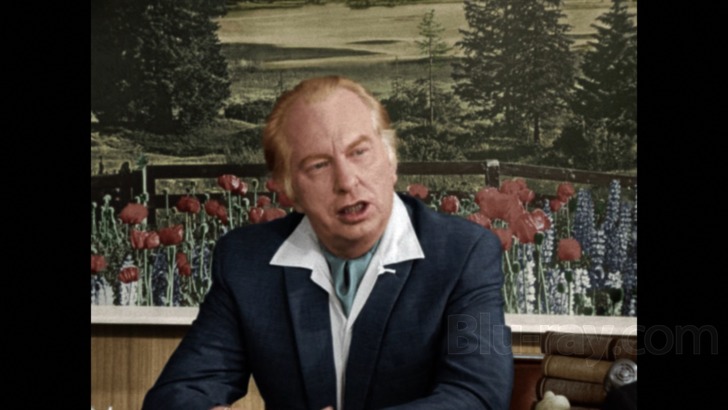
Going Clear introduces a number of former Scientologists, including at least relatively well known folks like Jason Beghe and Paul Haggis, all of whom talk about their unbridled excitement at joining Scientology, which they hoped would help them overcome a variety of personal issues. And in fact at least some of these people relay undeniable successes in their early Scientology lives, something that reinforced their belief that they had made the correct decision in joining. Director Alex Gibney cuts away from these introductions to delve into Hubbard’s remarkably fascinating history, one which involves an early career writing science fiction (where many of his ultimate Scientology doctrines were originally introduced), as well as his psychological unease, as documented by letters to the Veterans Administration where Hubbard basically was begging for help with his mental instability. In a couple of quite rare on camera interviews with Hubbard included in the documentary, Hubbard actually comes off as rather charming and even self deprecating, though anecdotes related by former members who interacted with him regularly paint a much darker and more troubled picture of the entrepreneur.
Those darker aspects tend to take up more and more of the second half of Going Clear, with Scientology’s use of celebrities like John Travolta and Tom Cruise offered up as examples of the institution’s PR abilities. There’s an obviously intentional focus on David Miscavige, the erstwhile Hubbard acolyte who took over Scientology after Hubbard’s death and managed to get an official IRS determination that Scientology was indeed a religion, leading to its tax exempt status (exactly how Miscavige arranged for this is another potent example of Scientology’s well documented sue-happy techniques). Miscavige comes off as a somewhat unhinged character in the documentary, and some of the anecdotes relayed by former members paint him as actually physically dangerous at times.
Hubbard’s now well known “creation” story involving an alien named Xenu and “Thetans” consigned to volcanos is addressed (with a particularly funny reaction from Beghe), and it’s here that some of Scientology’s supposedly foundational documents tend to sound so outlandish that they make other religions’ vignettes involving seas magically parting or messiahs magically resurrecting sound almost quaint by comparison. The subtext here is of course “how could anyone believe this drivel?”, but Going Clear does in fact make it clear that the allure of reaching some higher level of consciousness is often enough to make people ignore that those promoting this supposed “bridge” to the beyond may well be out of their (rational) minds themselves.
Going Clear: Scientology and the Prison of Belief Blu-ray Movie, Video Quality
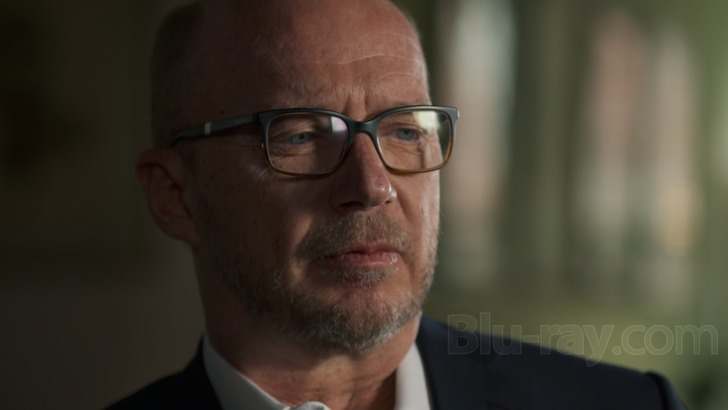
Going Clear: Scientology and the Prison of Belief is presented on Blu-ray courtesy of FilmRise with an AVC encoded 1080p transfer (mostly) in 1.78:1 (some archival video hovers around Academy ratio, as can be seen in some of the screenshots accompanying this review). This is the second FilmRise release I've reviewed which comes on a BD-R (the first was Mail Order Wife), and while that may not be some fans' preferred disc format, in terms of quality I found little to complain about here, other than shoddy looking archival footage. The contemporary interview segments all have excellent sharpness and clarity, as well as some good levels of fine detail when extreme close-ups are employed. A bit stronger contrast might be hoped for, especially in a number of interviews where a range of brown tones predominate, but there are no issues with compression artifacts. A lot of the older video elements are pretty fuzzy looking, some obviously sourced from smaller formats.
Going Clear: Scientology and the Prison of Belief Blu-ray Movie, Audio Quality
While there's nothing in this documentary that cries out for lossless audio, some prospective consumers may be disappointed by the fact that FilmRise has only offered two Dolby Digital tracks, one in 5.1 and the other in 2.0. The 5.1 track opens up the mid and lower ranges rather effectively, as well as providing at least the semblance of surround activity in a couple of extraneous scenes offering outdoor environments or crowds, but since this is comprised largely of talking head sequences, there truly isn't a huge difference between the 5.1 and 2.0 versions. Fidelity is fine on both, though amplitude on the 2.0 track is a little anemic, at least when compared to the 5.1.
Going Clear: Scientology and the Prison of Belief Blu-ray Movie, Special Features and Extras

There are no supplements offered on this release.
Going Clear: Scientology and the Prison of Belief Blu-ray Movie, Overall Score and Recommendation

While not germane to a discussion of this particular documentary, I have to share what I consider to be a hilarious anecdote involving Portland's old Scientology "Celebrity Centre", which was a little south of the main downtown area back in the day. On a relatively busy corner, a devoted Scientologist would always be outside, rain or shine, accosting passersby with a regular "Can I ask you a question?" introduction, which, if the passerby responded affirmatively, would lead to a "are you happy?" or "is there something about your life you want to change?", which in turn would lead to this Scientologist inviting the passerby into the Celebrity Centre to take an initial "auditing" test. Back in my early twenties I was working for a company whose owner had the bright idea to dress me up in a giant pumpkin outfit for Halloween one year (replete with a big orange globe circling my midsection, green leggings and a little leaf pinned in my hair), sending me out into the streets of Portland to hand out marketing information on the company. I found myself up in the Celebrity Centre neck of the woods, and indeed there was a guy standing on the corner with his back to me. I walked up behind him and said "Can I ask you a question?", which caused him to turn around. I continued, "I keep having a delusion that I'm a giant pumpkin — can Scientology help me?" The guy, without missing beat (and evidently not understanding I was obviously joking), said, "Yes, I think so, come inside with me." I swear I am not making up this (to me, anyway) absolutely drop dead funny story, but it's perhaps indicative of how seriously some Scientologists take their supposed "mission". That mission, to improve Mankind, is completely commendable, and is in fact the goal of many major religions. But the devil is in the details (so to speak), and it's those details, as documented by Going Clear, that make Scientology so problematic for many in the general public and of course for its former members. While unavoidably disturbing, Going Clear is an object lesson in the dangers of unexamined "belief", something that is not confined to only believers in Scientology, which is admittedly a pretty extreme example. This may not be the sort of Blu-ray consumers will want in their permanent collection, but it's a riveting piece, a deserved multi Emmy winner, and comes Highly recommended.
Similar titles
Similar titles you might also like

Waiting for "Superman"
2010

Corman's World: Exploits of a Hollywood Rebel
2011

Prohibition
2011

Skidoo
1968

Room 237
2012

The Look of Silence
2014

RBG
2018

An Inconvenient Sequel: Truth to Power
2017

Where to Invade Next
2015

The Wolfpack
2015

Bowling for Columbine
2002

Enron: The Smartest Guys in the Room
2005

Hearts and Minds
1974

Earth: One Amazing Day 4K
2017

Blue Planet II 4K
2017

Dawson City: Frozen Time
2016

Class: Season One
2016

An Inconvenient Truth
2006

Ulee's Gold
1997

Jodorowsky's Dune
2013