Going All the Way Blu-ray Movie
HomeGoing All the Way Blu-ray Movie 
The Director's EditOscilloscope Pictures | 1997 | 127 min | Not rated | Aug 01, 2023

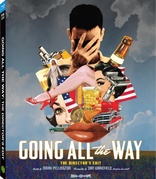
Price
List price:Amazon: $27.79 (Save 40%)
Third party: $27.79 (Save 40%)
Only 6 left in stock (more on the way).

Movie rating
7 | / 10 |
Blu-ray rating
| Users |  | 0.0 |
| Reviewer |  | 4.5 |
| Overall | | 4.5 |
Overview
Going All the Way (1997)
After returning home from the Korean War, two young men search for love and fulfillment in middle America.
Starring: Jeremy Davies, Ben Affleck, Amy Locane, Rachel Weisz, Rose McGowanNarrator: Leo Trombetta
Director: Mark Pellington
| Romance | Uncertain |
| Comedy | Uncertain |
| Drama | Uncertain |
Specifications
Video
Video codec: MPEG-4 AVC
Video resolution: 1080p
Aspect ratio: 1.90:1
Original aspect ratio: 1.85:1
Audio
English: LPCM 2.0 (48kHz, 24-bit)
English: DTS-HD Master Audio 5.1 (48kHz, 24-bit)
Subtitles
English SDH
Discs
Blu-ray Disc
Two-disc set (2 BDs)
Playback
Region free
Review
Rating summary
| Movie | | 4.5 |
| Video |  | 4.0 |
| Audio | | 4.5 |
| Extras |  | 5.0 |
| Overall | | 4.5 |
Going All the Way Blu-ray Movie Review
Reviewed by Dr. Stephen Larson March 1, 2024Beginning in the LaserDisc era, the "director's cut" became a more common form for filmmakers to present an alternate version (and vision) of the film that they had. Less common is the "redux," a process that may involve re-cutting a film by rearranging the order of scenes, inserting scenes that were initially left on the cutting room floor, and/or removing them altogether. Not all cinematic reduxes perform these three tasks. Some may integrate previously excised scenes into the theatrical cut's narrative. Coppola's Apocalypse Now: Redux (1979/2001) is a famous example.
First-time feature director Mark Pellington was never completely comfortable with the 103-minute version of Going All the Way that played in US theaters in the autumn of 1997. Pellington had screened a 112-minute cut at Sundance early that year and, as he explained in a 2000 DVD commentary, the six screenings did not produce the reaction from the indie-friendly crowd that he had hoped so he removed a few scenes prior to the film's wide release. A few years later, Pellington began having second thoughts about doing a new cut of the film as he expressed in the commentary and in press interviews. He remained busy over the next two decades directing other features, doing TV work, and making music videos (which launched his career). It wasn't until the pandemic that Pellington decided it would be a "fun project" to revisit Going All the Way so he contacted editor Leo Trombetta and his original crew members about producing a reconstructed version. Pellington had saved reels, dailies, opticals, and other original materials that filled thirty boxes! When he later assembled "The Director's Edit," Pellington sent it over for post work to FotoKem, the same company that processed the original film's color for the release prints. Oscilloscope Laboratories finalized the 4K re-edit.
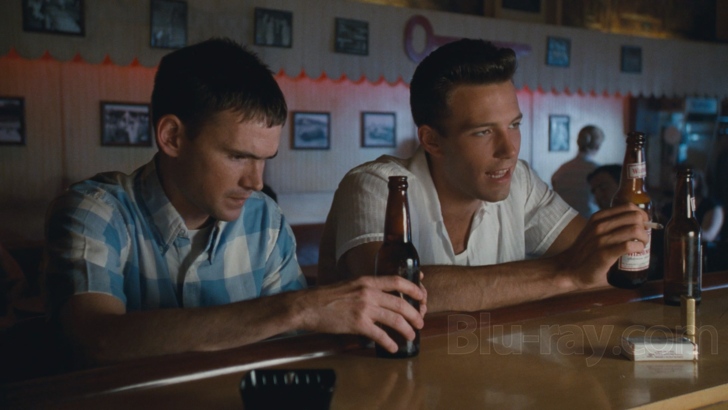
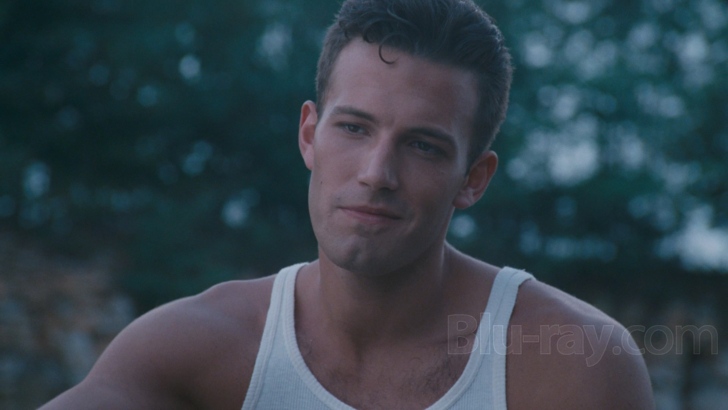
Gunner and Sonny enjoy a cold one.
Going All the Way is based on Dan Wakefield's critically heralded novel from 1970. It is widely regarded as a Midwestern version of The Catcher in the Rye. (Wakefield was very influenced by Salinger's style when he wrote it.) Wakefield received the rare opportunity of adapting his own book in close collaboration with Pellington. To say that Going All the Way was a passion project for Pellington would be an understatement. In newspaper clippings I found, Wakefield said that Pellington, who first read the novel while in high school, read it a total of 25 times before filming began!
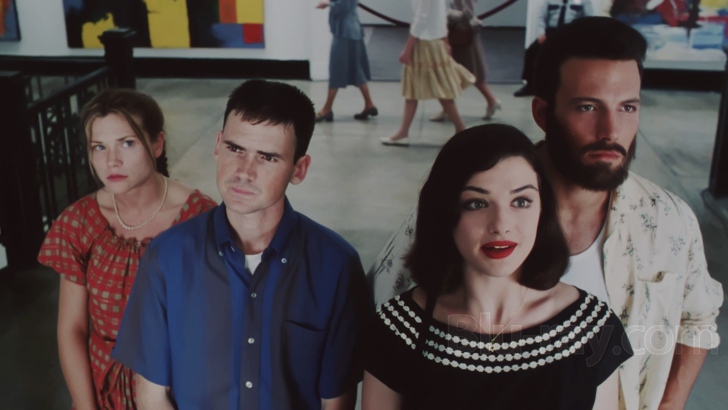
In a train headed back to their hometown of Indianapolis, Army servicemen Gunner Casselman (Ben Affleck) and Sonny Burns (Jeremy Davies) strike up a chat. Gunner and Sonny were high school classmates but really didn't know each other. The Affleck character is an extrovert and Big Man on Campus type. Sonny is much more reserved and tends to keep to himself. This begins an unlikely friendship. Sonny is trying to find his outer self as much as his inner one. He wants to break out of the ultra-conservative household that his religious parents, Alma (Jill Clayburgh) and Elwood (John Lordan), have ensconced him in. He has libidinous urges that he has to keep inside because of a repressed sexuality that goes back to his formative years. Sonny's parents have this idyllic vision of mom, dad, apple pie, and the pretty girl next door that they want their son to continue to embrace. Sonny's sweet girlfriend Buddy (Amy Locane) appears to love him but he seems to want a different lady and change of scene. Gunner is becoming something of an intellectual who recites Zen sayings from the time he studied Buddhism while stationed in Japan. Gunner admires Sonny's skills as a photographer. Gunner is also a burgeoning artist who takes Sonny to the local art museum where they examine abstract works. Gunner meets a smart and sophisticated Jewish woman named Marty Pilcher (Rachel Weisz). Sonny's sexpot mother Nina Casselman (Lesley Ann Warren) doesn't want him involved with either Marty or Sonny. Like Alma and Elwood have for their son, Nina has her own ideas for Gunner and his future. (In the theatrical version, Nina is a borderline antisemite. That's been toned down in The Director's Edit.) Both Sonny and Gunner have dreams of leaving Indiana to head for the northeast.
The theatrical cut of Going All the Way has a markedly different tone and focus than Pellington's new version. The former is like a Fifties comedy with folk rock ballads. The Director's Edit explores darker material in Gunner and Sonny's lives. Gunner is ostracized by peers in his town for appearing "different." The recut also delves further into the homespun life that the Burns have wrapped around Sonny. Jeremy Davies captures Sonny's tenderness, sensitivities, and conflicted feelings for his mother, and women that attracts him, to perfection. Ben Affleck is so natural as Gunner Casselman that it's as if Wakefield wrote the part with him in mind. (He was Pellington's first choice.) The new edit, which features 50 additional minutes, significantly deepens Sonny and Gunner's relationship. The tone has also been altered from a Happy Days feel to a more solemn and contemplative atmosphere, which is anchored by a new score from Pete Adams that's affective and graceful.
Going All the Way Blu-ray Movie, Video Quality
Oscilloscope Pictures' two-disc set of Going All the Way comes with a standard plastic case. (If you order through Oscilloscope's website, you can get a limited edition DigiPak.) Pellington's maiden feature was first released on home video in 1997 by Polygram Video, who issued a "Widescreen Edition" LaserDisc distributed by Image Entertainment. I haven't seen the LD but it's highly likely that the USA Home Entertainment 2000 DVD is sourced from the same master. Both are presented in non-anamorphic 1.85:1 and contain the 103-minute theatrical cut. The DVD looks as if it was struck from a theatrical print and sports dirt along with various anomalies associated with SD video in the early years of DVD. It still remains watchable if your display has a good scaler and can resize the letterboxed picture.
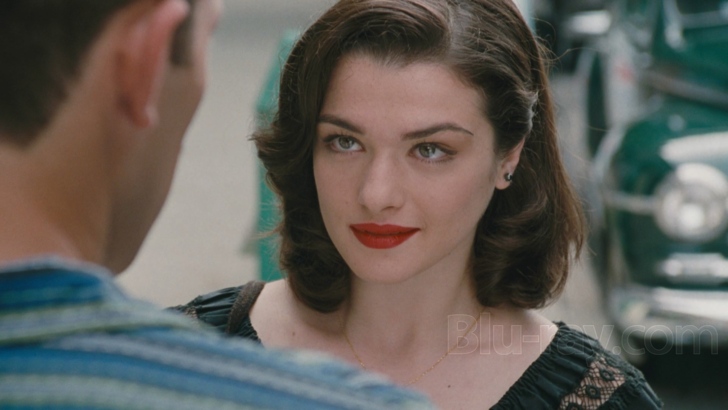
It's important to keep in mind while watching this Blu-ray that the original camera negative, an internegative, or interpositives probably couldn't be located and were not part of this restoration. Pellington comments in the making-of doc that a "drive" was nowhere to be found at Village Roadshow Pictures (formerly Lakeshore Entertainment). Fortunately, Pellington had an amalgamation of recorded footage from the film's shoot that he gave editor Leo Trombetta to sift through and cobble together over an 18-month span. The result is quite a revelation. Contrast is vastly improved over the DVD. The new edit displays film-related artifacts but the higher resolution offers frame details that were missing on the DVD. You will notice that the image boasts a milky look. It isn't this way all throughout the presentation, although it's frequently bright. Colors are sometimes more saturated on the USA HE transfer (see the prairie land in #39.) There is one shot that has a conspicuous compression-related issue on the 1080p transfer. Look at the ringing halo around Sonny in Screenshot #11. The aspect ratio on the Oscilloscope is more like 1.90:1 because it shows added picture info at the top and bottom of the frame. There is one goof in screen capture #12: a small microphone is visible at the top right of the ceiling. Oscilloscope's MPEG-4 AVC-encoded BD-50 (disc size: 37.37 GB) carries a rough average video bitrate of 30913 kbps. My video score for "The Director's Edit" is 4.25/5.00.
The technical credits for the new edit are as follows:
Produced by Mark Pellington & Prolific ContentScreenshot #s 1-12, 14, 16, 18, 20, 22, 24, 26, 28, 30, 32, 34, 36, 38, & 40 = Oscilloscope Pictures 2023 Blu-ray of The Director's Edit (anamorphic 1.90:1)
Color Correction by MTO
Colorist: Mark Todd Osborne, CSI
Color Studio: MTO Color Inc.
Post Production Services by FotoKem
Negative Assembler: Karen Sulzer
Restoration Supervisor: Scott Thompson
Lead Scanner: Alex Hernandez
Post Finishing Services Provided by Fancy Film
New title sequence created by Sergio Pinheiro.
Screenshot #s 13, 15, 17, 19, 21, 23, 25, 27, 29, 31, 33, 35, 37, & 39 = USA Home Entertainment 2000 DVD of the Theatrical Cut (letterboxed 1.85:1)
The 127-minute reconstructed version has eighteen chapters.
Going All the Way Blu-ray Movie, Audio Quality
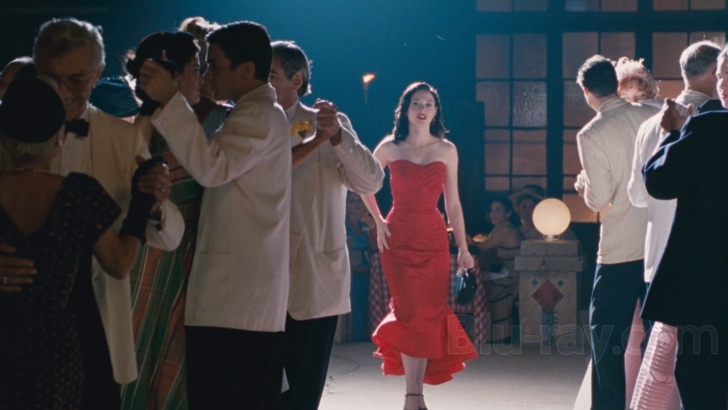
On the Blu-ray, Oscilloscope has supplied an LPCM Audio 2.0 Stereo mix (2304 kbps, 24-bit), which is the default, and a DTS-HD Master Audio 5.1 Surround track (3663 kbps, 24-bit). USA Home Entertainment's DVD includes a Dolby Digital 5.0 Surround mix (448 kbps) and a Dolby Digital 2.0 Stereo track (192 kbps). I don't know if theaters presented the film in Dolby Digital 5.1 or 2.0 (perhaps both mixes were used in '97). I listened to both USA's 5.0 track and the lossless 5.1 mix. The former employs the surround speakers most prominently at the opening train station scene and also when Sonny dances to mambo music with Gail Ann Thayer (Rose McGowan). Oscilloscope's 5.1 mix is unsurprisingly much more active with outstanding bass and use of .LFE. Delivery of the dialogue is generally clear and doesn't present any audibility issues. The new original music by Pete Adams, which in effect supplants most of the period songs, sounds warm and enveloping. There was one replacement I initially had some reservations about but Adams's score is pretty comparable to it. In the theatrical cut, Pelllington incorporated preexisting music by tomandandy, which was excerpted from PBS' documentary miniseries, The United States of Poetry (1995), which Pellington worked on. The cue features keyboards as well as some low strings and brass, which were possibly produced on synths or electronic instruments. It is a gorgeous piece and surely to bring tears to the lay viewer. I thought of Thomas Newman's work in general while listening to it. In the documentary featured on the second disc, Trombetta points out that he thought Newman's score for Revolutionary Road (2008) should be a guiding inspiration for the replacement score. Adams's music does sound like what was heard on the non-diegetic track in Sam Mendes's 1950s drama. It is a very moving score. The sound design and re-mix were done by Stanley Kastner.
Oscilloscope has included optional English SDH for The Director's Edit.
Going All the Way Blu-ray Movie, Special Features and Extras
The R1 DVD has a feature-length commentary track with director Mark Pellington, 50 minutes of excised scenes (with optional commentary by Pellington), an original 1997 theatrical trailer (2:16, 1.33:1), and an insert with production notes. The titles of the deleted material are "The Beard Sequence," "The Quarry," and "Sonny's Confession." (There's another scene that's misleading labeled and contains a spoiler I won't list.) The scenes appear in letterboxed 1.85:1 and are interlaced. They look tape-sourced since I could see tracking on the bottom. Much of this material was later inserted into The Director's Edit. Two scenes were initially included in the cut screened at Sundance but later taken out for wide theatrical release. Because this original version isn't part of Oscilloscope's set, the commentary hasn't been retained. And since Oscilloscope's compilation of deleted scenes differs from the omitted ones on the DVD, Pellington's optional commentary hasn't been carried over.
DISC ONE: GOING ALL THE WAY: THE DIRECTOR'S EDIT (2:06:41; 1080p; LPCM 2.0 Stereo, DTS-HD Master Audio 5.1 Surround)
DISC TWO: SPECIAL FEATURES
- NEW The Making of Going All the Way (3:05:46; 1080p; Dolby Digital 2.0) - this is a comprehensive documentary produced and directed by Richard Schenkman on the film that's delivered in three parts: "Part One: Book to Film," "Part Two: The Shoot," and "Part Three: The Restoration." Interviewed (in order of appearance) are director Mark Pellington, costume designer Arianne Phillips, cinematographer Bobby Bukowski, casting director Ellen Chenoweth, author/screenwriter Dan Wakefield, producer Tom Gorai, first assistant director William Clark, editor Leo Trombetta, line producer Mark Lipson, assistant to director Lee Harmon, original re-recording mixer/new sound designer Stanley Kastner, new music composer Peter Adams, Fotokem's Christian Straub, video editor Joe D'Augustine, and digital intermediate colorist Mark Todd Osborne. Lesley Ann Warren and Amy Locane are the only two actors interviewed. (Archival interviews with other cast members are excerpted from press junkets.) Oscilloscope has divided the full doc into thirty chapters, which can only be accessed by remote. All interviewees speak in English; not subtitled.
- NEW An Interview with Dan Wakefield (20:21, 1080p) - Mark Pellington interviews Wakefield about the inspiration behind his novel Going All the Way, his early career as a journalist writing for magazines, writing a review of a fellow writer friend, the process of writing the novel, the influence The Catcher in the Rye had on his writing, the friendship between Gunner and Sonny, and his reaction to the movie he scripted (both versions). Portions of this interview appear in the documentary. In English, not subtitled.
- Press Reel (40:32, 480i) - this is a compilation of clips about Going All the Way that aired in 1997 on local and national TV stations, including some syndicated shows. There are reviews of the movie by local and national film critics, including an excerpted episode of Siskel & Ebert. In addition, there's some behind-the-scenes footage. Interviews with the actors from the press junket are also shown. Finally, sit-down interviews with Bruce Jay Friedman, Kurt Vonnegut, and Tim Wakefield discussing adapting literary works and writing for the screen on an episode of Charlie Rose is played to wrap up the reel. All archival footage is in English, not subtitled.
- NEW Nick Offerman Callback (18:40, 480i) - this is actor Nick Offerman's audition tape for Going All the Way. Offerman reads his lines for Wilks (a role he later won) along with other actors auditioning to play Wilks's friends. Mark Pellington reads the lines of Gunner Casselman opposite the other actors. All of the actors appear like they're having a great time. The footage probably was recorded on a Betacam SP Camcorder. In English, not subtitled.
- NEW Deleted Scenes (38:00, 1080p) - A collection of fifteen excised/alternate scenes not part of The Director's Edit. There are about eight scenes here that were included in the original theatrical version. They're presented in 1.78:1 anamorphic widescreen with picture that's at least partially restored. They look pretty good but are struck from an interlaced source. (They are not taken from the 2000 DVD because that was a progressive-sourced transfer and had more print artifacts.) Most of the remaining seven scenes were not included in either version. They appear in non-anamorphic 1.85:1. Each of these scenes has a burnt-in timecode at the bottom border of the screen. They're also interlaced. They were likely included either on the first assembled cut or on a workprint (perhaps both). The deleted scenes have a Dolby Digital 2.0 Stereo mix (192 kbps). In English, not subtitled.
- NEW Theatrical Trailer (2:26, 1080p) - this is Oscilloscope's 2022 theatrical re-release trailer for the "never-before-seen version" (aka The Director's Edit) of Going All the Way. It's presented in 1.90:1 anamorphic widescreen with a Dolby Digital 2.0 Stereo mix (192 kbps).
Going All the Way Blu-ray Movie, Overall Score and Recommendation
I think that Going All the Way had a hard time initially reaching the right niche audience and also fitting into the indie scene because it was quite different from low-budget productions in the 1990s. This Director's Edit represents a yeoman's effort on the part of Pellington, Trombetta, and Oscilloscope. The longer cut is thematically richer and develops the bond between Gunner and Sonny substantially more. This was the first of three films Ben Affleck acted in back in 1997. (Chasing Amy and Good Will Hunting followed it.) A legitimate case can be made that this reconstructed version at the very least equals, if not surpasses, the two Miramax pictures. This is also a wonderful opportunity to see a young Rachel Weisz in one of her earliest features. This is massive package from Oscilloscope. The 3+ hour retrospective doc is an exhausting chronicle of the film's making and the work that went into the restoration. I am hoping that there are 35 mm prints of the theatrical cut still in existence for a future restoration. I am very glad to have gotten the OOP DVD with Pellington's commentary. Going All the Way is unmissable. VERY HIGHLY RECOMMENDED.
Other editions
Going All the Way: Other Editions
Similar titles
Similar titles you might also like

Before We Go
2014

Magic Town
1947

Mistress America
2015

Class
1983

Midnight Sun
2018

That Awkward Moment
2014

The Art of Getting By
2011

Racing with the Moon
1984

The Great Impostor
1961

Coup de Chance
Wasp 22
2023

Thanks for Sharing
2012

Foxes
1980

The World to Come
2020

The Out-of-Towners
1970

Fatso
1980

The Sessions
2012

The Major and the Minor
Arrow Academy
1942

The Forbidden Room
2015

Manhattan
The Woody Allen Collection
1979

Planes, Trains & Automobiles 4K
1987