Godard Mon Amour Blu-ray Movie
HomeGodard Mon Amour Blu-ray Movie 
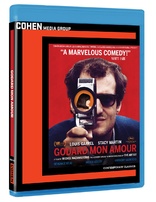
Le RedoutableCohen Media Group | 2017 | 108 min | Rated R | Sep 04, 2018
Price
List price:Listed on Amazon marketplace

Movie rating
6.7 | / 10 |
Blu-ray rating
| Users |  | 0.0 |
| Reviewer |  | 3.5 |
| Overall | | 3.5 |
Overview
Godard Mon Amour (2017)
Paris, 1967. Legendary director Jean-Luc Godard is shooting "La Chinoise", which is more a political tract than an actual movie. His female star is Anne Wiazemsky, sixteen years his junior, whom he has been dating since 1966. They marry, but the uprising of May 1968 puts their marriage to the test, as Godard's political involvement pulls him away from his new wife.
Starring: Louis Garrel, Stacy Martin, Bérénice Bejo, Micha Lescot, Grégory GadeboisDirector: Michel Hazanavicius
| Foreign | Uncertain |
| Drama | Uncertain |
| Comedy | Uncertain |
| Biography | Uncertain |
Specifications
Video
Video codec: MPEG-4 AVC
Video resolution: 1080p
Aspect ratio: 1.85:1
Original aspect ratio: 1.85:1
Audio
French: DTS-HD Master Audio 5.1
French: Dolby Digital 5.1
Subtitles
English SDH
Discs
Blu-ray Disc
Single disc (1 BD)
Playback
Region A (B, C untested)
Review
Rating summary
| Movie | | 3.5 |
| Video |  | 4.5 |
| Audio |  | 4.0 |
| Extras |  | 1.0 |
| Overall | | 3.5 |
Godard Mon Amour Blu-ray Movie Review
The out of breath artist?
Reviewed by Jeffrey Kauffman September 1, 2018Quick: name a French film director. Chances are only one of two names occurred to many folks, either François Truffaut or Jean-Luc Godard, though there are of course innumerable others that could be added to the list (e.g., Renoir, Resnais, Malle, Demy, Chabrol, Rohmer, Varda, et al). It’s perhaps simply an inescapable fact of modern, or at least post-World War II, film culture that the names of Truffaut and Godard are almost like twin monoliths beckoning cineastes to lands that had heretofore been unexplored in the annals of moviedom. A follow up question that may be kind of revelatory would be to ask those who chose Godard to name only one film by the iconic auteur, and here once again I suspect that the vast majority of folks would almost instinctively identify Breathless, a film which has entered the annals of all time classics and which is considered rightly or wrongly as having kickstarted (or at least is one of the prime examples of) the Nouvelle Vague movement. But as any fan of Godard will probably be foaming at the mouth to discuss, Breathless is just one of a rather interesting and at times fairly thorny filmography, one which tipped over into what some might perceive as “screed” territory as the sixties wore on, and youthful insouciance was replaced with an increased political awareness, and, perhaps inevitably, a certain jaded quality. In that regard, it might be instructive for those who are not overly familiar with the Godard outings that Arrow relatively recently collected in their Jean-Luc Godard + Jean-Pierre Gorin: Five Films, 1968-1971 set to spend some time watching those films in conjunction with Godard Mon Amour, a film which perhaps saliently was released in its native country under the title Le Redoubtable.
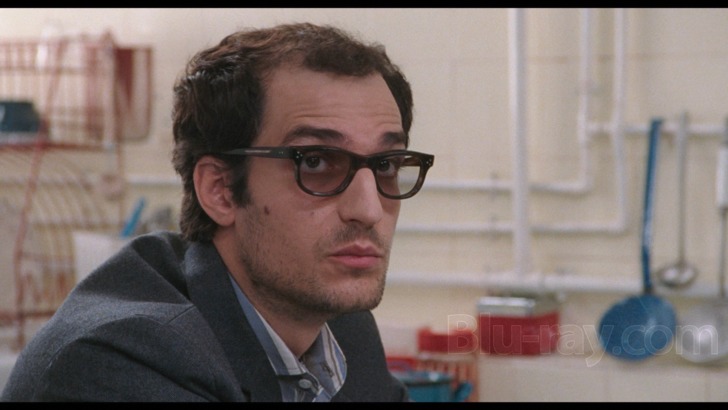
If watching the five films collected in the Arrow Godard-Gorin films can provide a little “meta” context for Godard Mon Amour, watching La Chinoise (note that the link points to my review of a Region B release from Arrow) will actually provide an interesting “double feature” with this film, since at least the first part of Godard Mon Amour is concerned with the less than enthusiastic response the film received from virtually everyone, something that might have put the kibosh on what was then a relatively new relationship between Godard (portrayed by Louis Garrell) and his leading lady in the film, Anne Wiazemsky (played by Stacy Martin). In fact a lot of the first half or so of Godard Mon Amour details not just Godard’s romantic adventures with his soon to be wife, but also the pair’s reaction to the fractious political climate that was sweeping across France at the time, and which resulted in the still infamous 1968 student (and other) riots.
Godard Mon Amour is in fact culled from some writing by Wiazemsky (who passed away in October of 2017), and there may be some Godard fans whose interest might be piqued simply because Wiazemsky might be able to peel back the facade of one of the more inscrutable filmmakers of his (or perhaps any) generation. And in fact writer-director Michel Hazanvicius (The Artist) does manage to humanize Godard “the character”, revealing a rather humorous imp who just also happens to be a towering intellectual. But the film is perhaps overly precious at times, deliberately skewing “narrative” passages with more “meta” aspects that are no doubt meant to echo some techniques used by the real life Godard at this very point in his career. But Godard was really not all that concerned with narrative at this point in his career, as can easily be seen not just in La Chinoise, but perhaps even more so with regard to his collaborations with Gorin. Here, in a film that kinda sorta wants to be a more traditional biographical picture, the mismatch is arguably debilitating, if occasionally effective.
It can be instructive to survey various Godard fans to find out when they think he tipped over to “the dark side”, by which I mean when he started forsaking the undeniable ebullience that informed his earlier work, even if the subject matter was at times deadly serious in those very films. A lot of people I’ve personally spoken to tend to place that dividing line squarely at or around the time of La Chinoise, but Godard Mon Amour seems to suggest that Godard himself had already been feeling like “an actor playing Godard”, as the “character” of Godard states in this film, and therefore might have seemed like he couldn’t have cared less if audiences didn’t respond to his pieces with the same joy they had earlier. Except — Godard Mon Amour actually details Godard being upset about the way La Chinoise affected audiences (one salient sequence shows a supposed Godard booster sleeping through the film). It’s a frankly weird disconnect that I’m not sure Godard Mon Amour is ever successfully able to bridge.
If Godard Mon Amour is never able to fully elucidate the conflicting emotions of an artist of Godard’s calibre, it does a rather good job of detailing the epochal sociopolitical changes France was experiencing during these years, even if it understandably filters everything through the personal experiences of Godard and Wiamzenksy. There’s actually some kind of wry humor even in these moments, as when Godard slips during a riot and breaks his glasses, rendering him virtually blind, which in turn leads to him being kind of a boor with an elderly couple at a restaurant. Later, when he and Anne have to get through a police cordon to get back to their apartment, he berates her for thanking the cop that has recognized Godard and praised his work. “Never thank a cop!” the distraught would be “revolutionary” instructs his main squeeze.
This is a rather interesting if arguably not completely successful attempt by Hazanavicius, who has had a bit of a struggle maintaining the momentum generated by the multi-Academy Award winning The Artist. Godard may simply be too complex of a "character" to adequately address in a film like this, even with the kind of cheeky "meta" elements that are added to the basic tale of Godard and Wiazemsky falling in love. Kind of ironically, then, I can give the same basic advice in terms of the "accessibility" of this material that I gave in my reviews of both the Godard-Gorin set and La Chinoise itself: this is a film that will probably appeal to Godard fans, but may leave the "uninitiated" scratching their heads.
Godard Mon Amour Blu-ray Movie, Video Quality
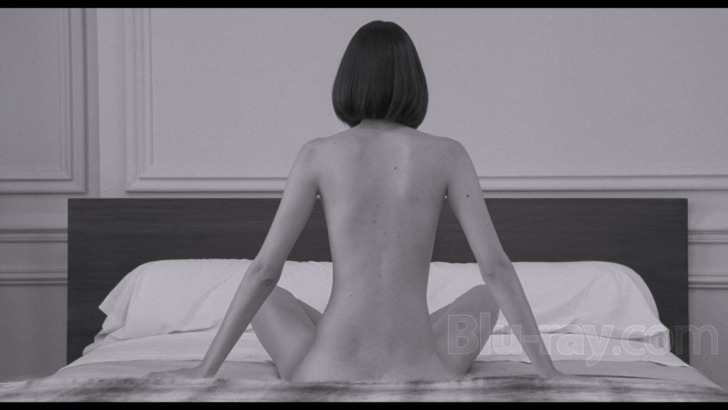
Godard Mon Amour is presented on Blu-ray courtesy of Cohen Media Group with an AVC encoded 1080p transfer in 1.85:1. This was shot on film and finished at a 2K DI (according to the IMDb), and as is almost always the case with Cohen releases, the transfer preserves a very natural, organic looking presentation that offers a nicely resolved grain field. Hazanavicius and cinematographer Guillaume Schiffman mimic some of Godard's "tri color" sensibilities from his so-called revolutionary period, with an emphasis on reds and blues, all of which look rather vivid throughout the film (some of the reds looked a bit ruddy-brown to my eyes at times). Detail levels are routinely excellent, and fine detail is often abundant (look at the precise fabric structure on the blue couch in screenshot 12). There are a couple of "arty" black and white moments (see screenshots 2 and 18) that feature solid contrast. Things do look slightly soft at times throughout the presentation, but this seems to be a stylistic choice, one that perhaps is meant to emphasize the "gauzier" aspects of falling in love rather than the down and dirty "sharpness" of student revolutionaries.
Godard Mon Amour Blu-ray Movie, Audio Quality
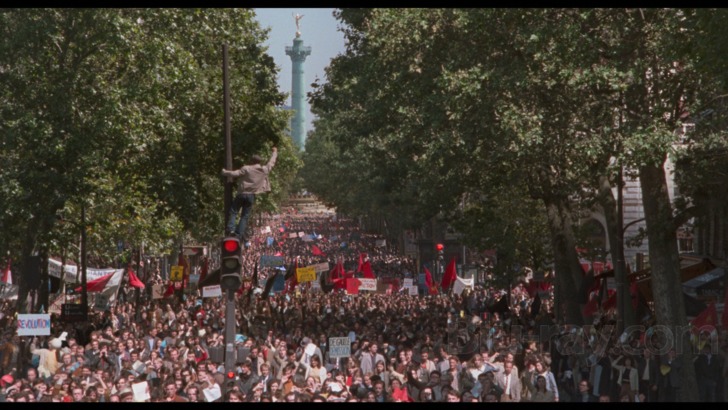
Godard Mon Amour features a DTS-HD Master Audio 5.1 track that achieves some intermittent raucousness in sequences like the huge student protest relatively early in the film (one that seems to have been staged with thousands of extras), but which tends to be a bit more tamped down in the many "two hander" scenes between Godard and Wiazemsky. There are also occasional intrusions from voiceover (often inserted to deliberately cheeky effect, giving an "answer" to dialogue within the film). All elements are rendered cleanly and clearly without any problems whatsoever.
Godard Mon Amour Blu-ray Movie, Special Features and Extras
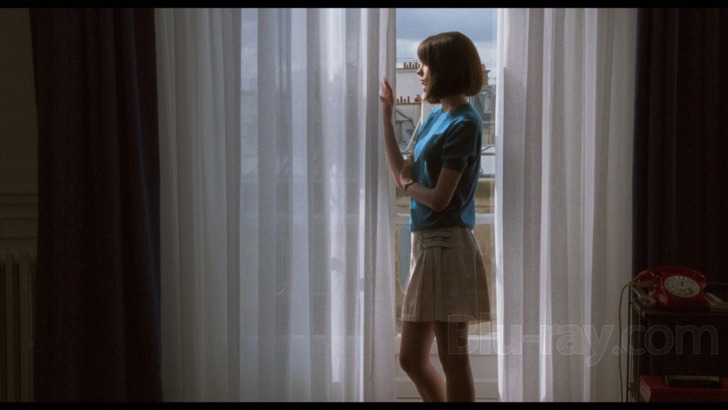
- Conversations from the Quad with Michel Hazanavicius and Stacy Martin (1080p; 28:48) is an appealing dual interview hosted by Richard Pena of Columbia University.
- Theatrical Trailer (1080p; 1:58)
Godard Mon Amour Blu-ray Movie, Overall Score and Recommendation
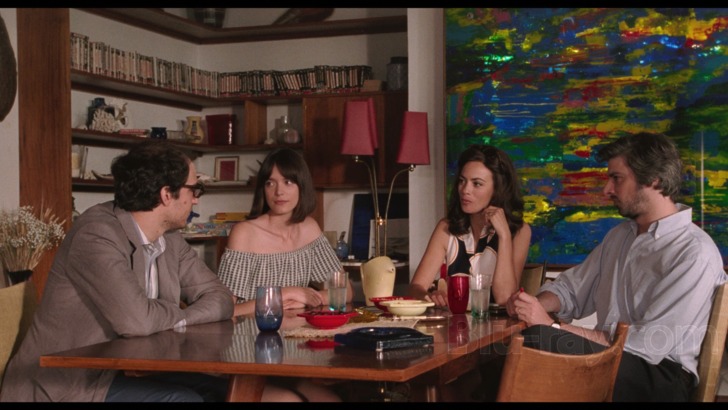
I actually enjoyed Godard Mon Amour quite a bit, and it provoked a chuckle or two at regular intervals, even if I might not call it hilarious in any real way. That said, I think my appreciation of the film stemmed at least in part due to the fact that I've spent so much time fairly recently wading through films like the Godard-Gorin collaborations and La Chinoise itself, so I'm frankly not sure how the "public at large" might respond to this "insider" tale. Cohen has provided a release with solid technical merits, and as I've said with regard to both the Godard-Gorin films and La Chinoise, for Godard fans if for no one else, Godard Mon Amour comes Recommended.
Similar titles
Similar titles you might also like
(Still not reliable for this title)

The Image Book
Le livre d'image
2018

Goodbye to Language 3D
Adieu au langage
2014

Things to Come
L'avenir
2016

Transit
2018

La Chinoise
1967

The Salt of the Earth
Le Sel de la Terre
2014

Masculin Féminin
1966

The Insult
L'insulte
2017

Heroic Purgatory
煉獄エロイカ
1970

Out 1
Out 1, noli me tangere
1971

Life of Riley
Aimer, boire et chanter
2014
The Fire Within
Le feu follet
1963

Babette's Feast
Babettes gæstebud
1987

Lost in Paris
2016

The Measure of a Man
La Loi du Marché
2015

Capital
Le capital
2012

Mon Oncle
My Uncle / French and English Versions
1958

Le Chef
Comme un chef / The Chef
2012

The Mad Adventures of Rabbi Jacob
Les aventures de Rabbi Jacob
1973

Americano
2011